Contents
- What an indoor trainer really gives you compared with the road
- Types of indoor trainers and how they compare on price
- Cooling: the cheapest way to a better workout
- Ergonomics: why it hurts differently on the trainer
- Indoor cycling apps: what to choose
- How to build an indoor cycling training plan
- How to combine the trainer with the road
- The trainer through the year
- A power test on the indoor trainer
- The most common mistakes on the indoor trainer
- Frequently asked questions
What an indoor trainer really gives you compared with the road
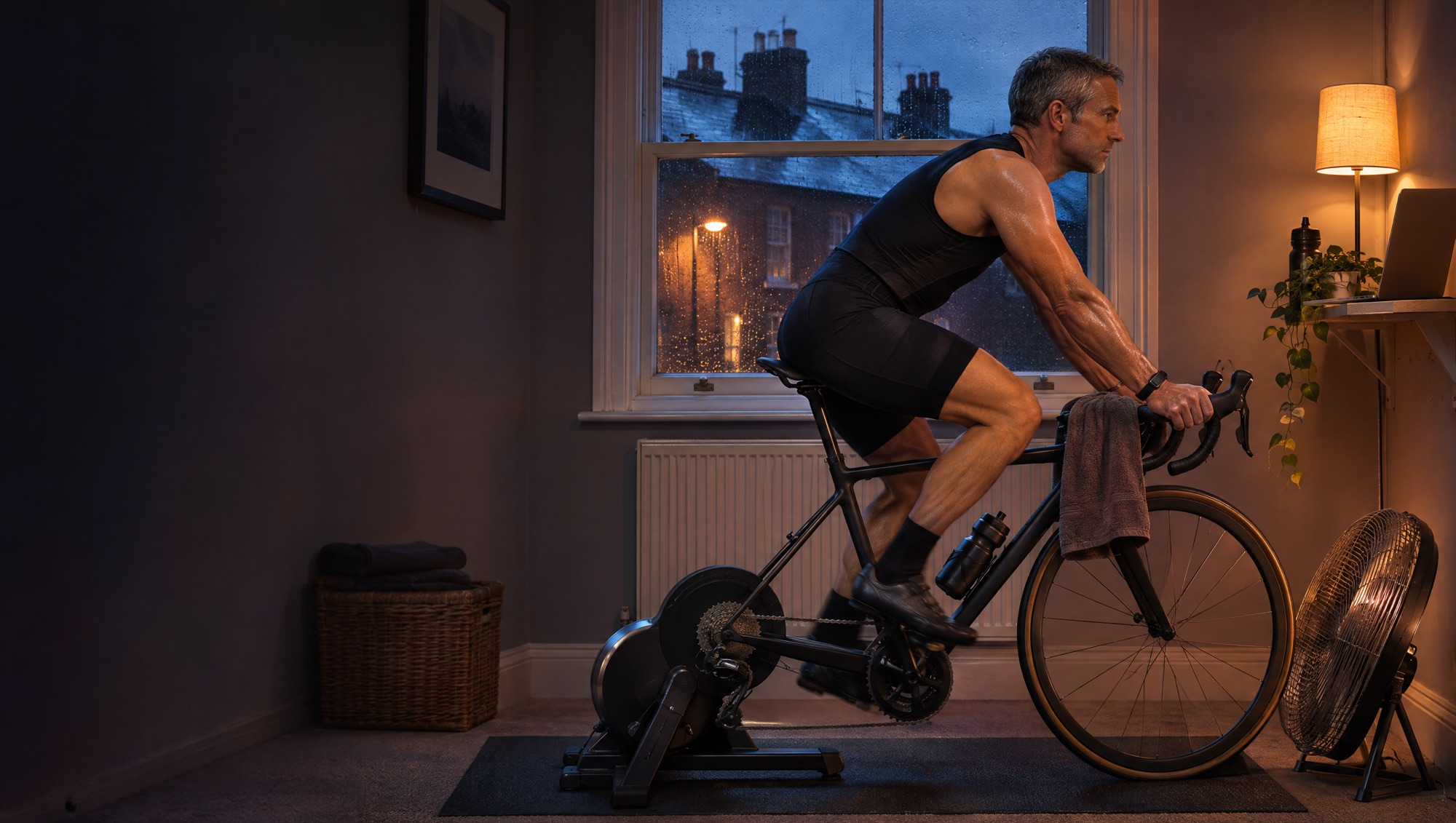
On the trainer there are no traffic lights, no wind, no potholes and no change of plan because of rain. The price is a few things only the road provides.
| Indoor trainer | Road | |
|---|---|---|
| Working time | Practically every minute is riding | Intersections, descents, stops, getting out of town |
| Precision of intervals | Very high | Depends on the road and the traffic |
| Cooling | You have to organize it | The airflow does it for you |
| Weather and traffic | Irrelevant | In winter they often decide whether you train at all |
| Bike handling | Hardly develops | Cornering, braking, group riding, descending |
| Variability of effort | Low, especially in ERG mode | High |
| Boredom | An hour can drag | Three hours pass more easily |
Is power indoors the same as power on the road?
Two studies give results that seem to contradict each other. The difference lies in how they measured.
| Study | How it was measured | Result |
|---|---|---|
| 20 cyclists | A maximal 20-minute effort, the same bike and power meter, a fan in the laboratory | 280 W indoors and 284 W outdoors, a difference of about 1% |
| 12 amateur cyclists (2014) | 40 km at the same perceived effort, in a laboratory with no air movement | 208 W outdoors and 163 W indoors: outdoor power about 28% higher |
In the first study the riders went all out and had a fan. In the second the air in the laboratory stood still (0 m/s against 2.5 m/s outside) and the task was to hold the same perceived effort. Skin temperature was higher indoors, 33.0°C against 31.4°C (91.4°F against 88.5°F), and heart rate lower, 143 against 152 beats per minute. Core temperature and perceived effort stayed similar. The authors conclude that indoors you have to ride at a higher perceived effort to get the same stimulus. If the same watts feel harder on the trainer, that does not have to mean you are less fit.
The first study showed one more thing. Average power was almost identical, but the variability of the effort was more than twice as high outdoors: 69 W against 33 W. So the average hides different muscle work. If you are preparing for a race, training at home should reproduce the variability of the course.
The myth that an hour on the trainer equals an hour and a half on the road
This conversion circulates on forums, but research does not support it, and long-term studies comparing indoor and outdoor training are rare. Work it out in kilojoules, the work done on the pedals. An hour on the trainer at 200 W is 720 kJ. An hour and a half on the road at 180 W, when you are not pedaling for 20% of the time, is about 780 kJ. With 10% of the time coasting or stopped it comes to 875 kJ. The work of an hour at home is done on the road in about 75–85 minutes.
In this example, 90 minutes on the road gives more work than an hour at home, so the 1 to 1.5 conversion is inflated. The route makes the difference. A flat road without intersections is close to the trainer. A city ride with ten sets of lights is not. It is simpler to compare the time and power of a specific session than to look for a single conversion factor.
Can you prepare mostly indoors?
The best-known example is Jay Vine. The Australian won the Zwift Academy in 2020, which earned him a contract with Alpecin-Fenix, and at the 2022 Vuelta he won two stages, the 6th and the 8th, both with summit finishes. The story shows that a trainer can reveal talent. It does not prove that a trainer can replace the road for everyone.
The trainer can take over a large part of your training, especially in winter and on working days. Group riding and descending can only be learned outside.
Types of indoor trainers and how they compare on price
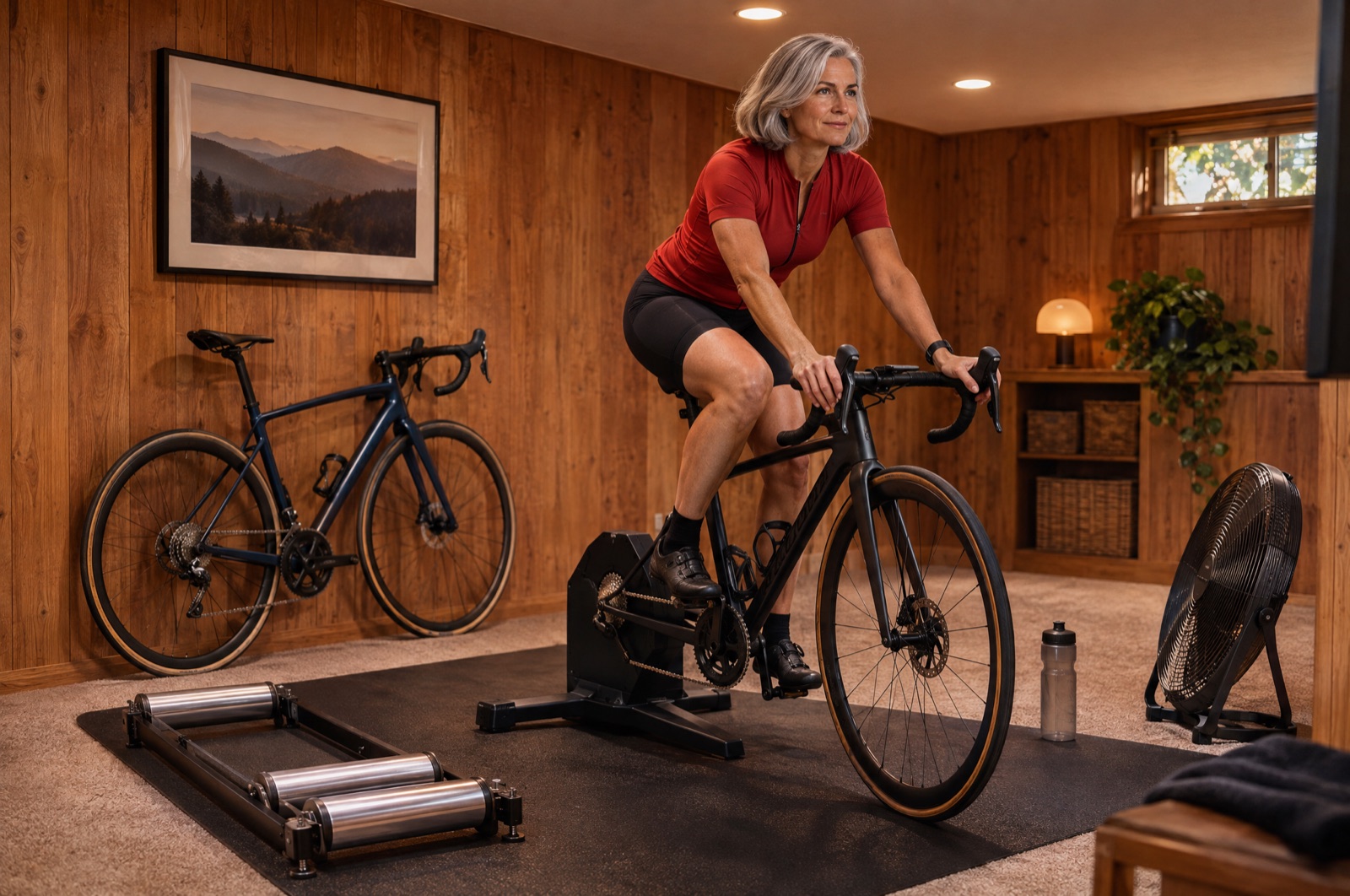
The names can mislead. In the UK and Ireland any indoor trainer is usually called a turbo trainer. "Roller" in a shop listing can mean a trainer whose roller presses against the rear tire, or classic rollers on which the bike stands free. Check before you buy. Prices depend on the country, the currency and the sale season, so the table gives the price level in relation to the other types.
| Type | How it works | Price level | Advantages | Drawbacks |
|---|---|---|---|---|
| Wheel-on magnetic | A roller with resistance pressed against the rear tire | Lowest | Cheap, simple | Noise, tire wear, low maximum resistance |
| Fluid | The roller drives an impeller in a chamber of fluid | Low | A smoother feel | Resistance changes as the unit heats up |
| Rollers | The bike stands free on rotating drums | Low to middle | Teach balance and smooth pedaling | Hard to start on, limited strength work |
| Wheel-on smart | A control unit adjusts the resistance | Low to middle | Works with an app | Accuracy depends on the model |
| Direct drive | You remove the rear wheel and the chain drives the trainer through a cassette | Middle to high | Stable, quiet, accurate | Price, weight, cassette compatibility |
| Smart bike | A separate stationary machine | Highest | No bike needed, always ready | Very expensive, takes up space |
How to read the prices
The categories overlap. The spread inside direct drive is wider than the gap between neighboring categories, and smart bikes sit in a price class of their own. Prices also move with the season, and the same model can cost noticeably more in one shop than in another. Compare the offer on the day you buy, and look at the used market too.
What to look at when you buy
- Accuracy. Manufacturers usually claim between ±1 and ±2.5%: about ±1% for top direct-drive models and up to ±2.5% for cheaper ones. Do not expect the trainer to agree to the watt with the power meter on your bike.
- Maximum resistance. Cheaper wheel-on models offer clearly less maximum resistance, while top direct-drive models claim more than 2,000 W. For amateur training, smoothness usually matters more than record power.
- Inertia. A heavier flywheel usually imitates riding better. But it is a guide, not a rule: well-reviewed models have flywheels of very different weights.
- Noise. Important in an apartment. Wheel-on models and rollers can be loud, and ratings of the same model can differ.
- Compatibility. Check the hub width, the axle type, the cassette and, on a disc brake bike, the axle setup. What is permitted is set by the makers of the trainer and of the bike, so read both manuals.
Compatibility with your bike
| What you have | What to check |
|---|---|
| A bike with a quick release, 130 or 135 mm | Most trainers include adapters, but confirm it in the description of the model |
| A disc brake bike with a thru-axle, usually 142 × 12 mm | Whether the adapter is in the box or has to be bought separately |
| An 11-speed or 12-speed drivetrain | Whether the trainer comes with a cassette and whether it fits your drivetrain |
| A gravel or mountain bike frame with a 148 × 12 mm axle | Whether the model supports wider hubs, often with an extra adapter |
| A used trainer | Play in the bearings, noise, calibration, app support for that model |
What to buy, depending on your situation
| Situation | A sensible choice |
|---|---|
| You want to find out whether indoor riding suits you | A simple wheel-on model, used or cheap |
| You live in an apartment | Direct drive plus a mat |
| You train with power all winter | Direct drive controlled by an app |
| You want to improve your pedaling technique | Rollers as an addition, not as your only equipment |
| Several people at home use the trainer | A smart bike, if the budget allows |
What one session costs
Divide the price by the number of rides. An off-season of 20 weeks with 2 sessions a week gives you 40 workouts. A trainer that costs 400 in your currency therefore works out at 10 per ride in the first year, and a model at 800 at 20 per ride. In later years the cost per ride keeps falling. Add the app: MyWhoosh is free, and five months of Zwift cost about EUR 100. Whether the purchase pays off depends mostly on whether the trainer gets used.
A trainer in an apartment
The biggest problem is vibration passing into the floor. Choose a model without a roller on the tire, put down a thick mat and talk to your neighbors before they come to you. A hard standing sprint transmits more vibration than steady riding, so keep the loudest sessions for the daytime. Quiet hours are set by your building's rules, your lease or local regulations. Check yours before you plan evening intervals.
Cooling: the cheapest way to a better workout
On the road, the moving air does what a fan has to do at home.
A cyclist's gross efficiency is about 19–20%. For every 100 W on the pedals the body therefore produces about 400 W of heat. Our calculation:
| Power on the pedals | Heat at 20% efficiency | Heat at 25% efficiency |
|---|---|---|
| 150 W | about 600 W | about 450 W |
| 200 W | about 800 W | about 600 W |
| 250 W | about 1,000 W | about 750 W |
That is like a small electric heater switched on in a small room, which is why it gets hot so quickly indoors.
How much air you need
In a 2005 study, cyclists rode for 2 hours at about 33°C (91°F) and 59% humidity, at different air speeds:
- At about 0 and 10 km/h (0 and 6 mph), heat storage, body temperature and perceived effort were higher than at 33 and 50 km/h (21 and 31 mph).
- Between 33 and 50 km/h there was no further difference.
- At 33 km/h, raising fluid intake from about 59% to 80% of losses changed nothing. In those conditions the air did the cooling, not the bottle.
That was a study in the heat. In the study of 20 cyclists the fan produced only 10.4 km/h (6.5 mph), but the room was at about 17°C (63°F) and power stayed close to that on the road. The warmer the room, the stronger the airflow you need.
Temperature also affects how long you last. In a 1997 study, riding to exhaustion at about 70% of VO2max lasted 93.5 minutes on average at 10.5°C (51°F) and only 51.6 minutes at 30.5°C (87°F). Those are extreme conditions, but they show what longer work in a warm room costs. If you live in a hot or humid climate and ride indoors to escape the heat outside, this matters twice over: cool the room first, then add the fan.
How to set up the room
- Open the window before the warm-up, not after 20 minutes.
- The fan in front, aimed at your face and chest, at an angle of about 45°.
- More airflow than you think. A small desk fan is usually not enough for a hard workout.
- A second fan from the side or behind is useful in long sessions.
- Don't ignore symptoms. If you feel dizzy or nauseous, stop riding.
Sweat and hydration
Indoors, more sweat drips off instead of evaporating, so it cools you less, and fluid losses can be higher. A simple test: weigh yourself before and after the ride, add the weight you lost to the fluid you drank and divide by the riding time. That tells you roughly how much sweat you lose per hour. For harder sessions keep two bottles within reach, but don't force yourself to drink, because too much fluid is harmful as well.
Ergonomics: why it hurts differently on the trainer
On the road you keep standing up, shifting position, turning and braking. On the trainer the bike is fixed, so the body repeats the same movement for an hour and the muscles tire sooner.
- Saddle. Less movement means higher, constant pressure. Wear good shorts, on short rides too.
- Changes of position. Every 10–15 minutes, stand up for ten seconds or so. Treat it as part of the session.
- Leveling. A trainer can raise the back of the bike. A riser block under the front wheel helps.
- Position. Use the same settings as on the road. A bike leveled differently from usual can change the load on the knees and wrists.
- Towel and cover. Sweat is salty and corrosive. A towel on the handlebars or a frame cover keeps it off the bike.
- Mat. It damps vibration, protects the floor and spares the neighbors.
- Screen. Place it so that your neck is not turned to one side the whole time.
The muscles may also work slightly differently, but few studies have compared muscle activity indoors and on the road. Trainers that let the bike rock a little may reduce stiffness and chafing.
Saddle soreness, genital numbness or knee pain that appear only on the trainer often come from the lack of movement. If they appear on the road as well, check your setup, which we describe in the bike fit section for beginners. If the pain persists, see a physiotherapist or a doctor.
Indoor cycling apps: what to choose
An app is not compulsory. A trainer works with a bike computer alone, and for a model without resistance control a power meter or a speed sensor is enough. Only a smart trainer gives you the full range of features. Prices can depend on the country and the payment method.
| App | Price | Strength | What to watch |
|---|---|---|---|
| Zwift | EUR 19.99 a month or EUR 199.99 a year (price list of December 2025), a 14-day trial with the monthly plan | Community, races, many workouts, a Racing Score from 0 to 1,000 | The price in your currency may differ |
| MyWhoosh | Free | Workouts, races with prizes, workout import, ERG mode | The pricing model may change in the future |
| ROUVY | EUR 19.99 a month or EUR 179.99 a year (price list in force since July 2025) | Real routes on video | A 7-day trial. Check the terms when you buy |
| Apps with an adaptive plan | A monthly or yearly subscription, depending on the app | Structure, detection of FTP and fatigue | Check the trial period and the refund rules |
Racing in virtual worlds is now an official part of the sport: the fourth UCI Cycling Esports World Championships were held in 2024 on the MyWhoosh platform.
The annual Zwift plan costs as much as ten months of the monthly subscription, so it pays off only if you also ride indoors outside the winter. Choose whatever helps you get on the trainer. For one rider that is a race on Tuesday evening, for another a quiet film. The training plan does not have to come from the same app, because many programs let you import workouts.
How to build an indoor cycling training plan
Shorter and with a specific purpose
The trainer works best in sessions of 45–90 minutes in which every minute has a purpose: warm-up, main part, cool-down. That is our guideline, not a rule. Threshold intervals, VO2max intervals and cadence work go well at home, because nothing interrupts them.
Short repeats of 30 s of work and 15 s of rest fit well here. In a 2015 study they gave trained cyclists an advantage over 5-minute intervals (VO2max up by 8.7% against 2.6%), but the groups were small. In a real plan, what counts is how such a session fits the rest of the week.
ERG mode: convenience with a catch
In ERG mode the trainer holds the set power by itself, whatever your cadence. For intervals it is an excellent tool, but it has two drawbacks. When you tire and your cadence drops, the resistance rises and the repeat can fall apart. Over time you also lose the feel for regulating the effort yourself. Every so often do intervals without ERG, controlling the effort with your gears as you would on the road.
First setup: connection and calibration
A smart trainer connects to an app through ANT+ or Bluetooth. Check before you buy what your phone, tablet or computer supports. Bluetooth can be limited in the number of simultaneous connections, so if you want to connect an app and a watch at once, look in the manual.
Many models are calibrated with a spindown: after about 10 minutes of riding you bring the wheel up to a set speed and stop pedaling. With a wheel-on model, also keep the same tire pressure and roller tension, or two rides will not be comparable. Record each ride in one place. Two recordings of the same workout, from the app and from the watch, can double the load in your calendar.
The first three weeks
The biggest mistake after buying a trainer is an all-out hour in the first week. Start with 30–45 minutes of easy riding to check the saddle, the fan, the bike setup and the noise. Add a hard workout only when sitting stops hurting. Do the first test after 2–3 weeks, once you are used to the conditions at home. Without that, the result may mostly tell you about overheating and discomfort.
Steady at home, variable in a race
The trainer encourages steady riding. Before a race, don't rely on an even pace alone: weave in changes of power, short surges and simulated climbs. For a long, even time trial or the bike leg of a triathlon, work at home suits very well.
Motivation
- Decide what the session is for before you get on. In one study, 13 people riding at constant power gave up sooner indoors than outdoors, where their attention drifted more often to the surroundings. Something to occupy your mind is part of the workout.
- Divide a long session into blocks, with small changes every 10–15 minutes.
- Keep the trainer set up. Having to drag the equipment out of a closet is a common reason for skipping a session.
- Train with others. Virtual group rides work well on dark evenings.
- Shorter is better than nothing. 40 minutes on a Wednesday makes sense when an hour is impossible.
How to combine the trainer with the road
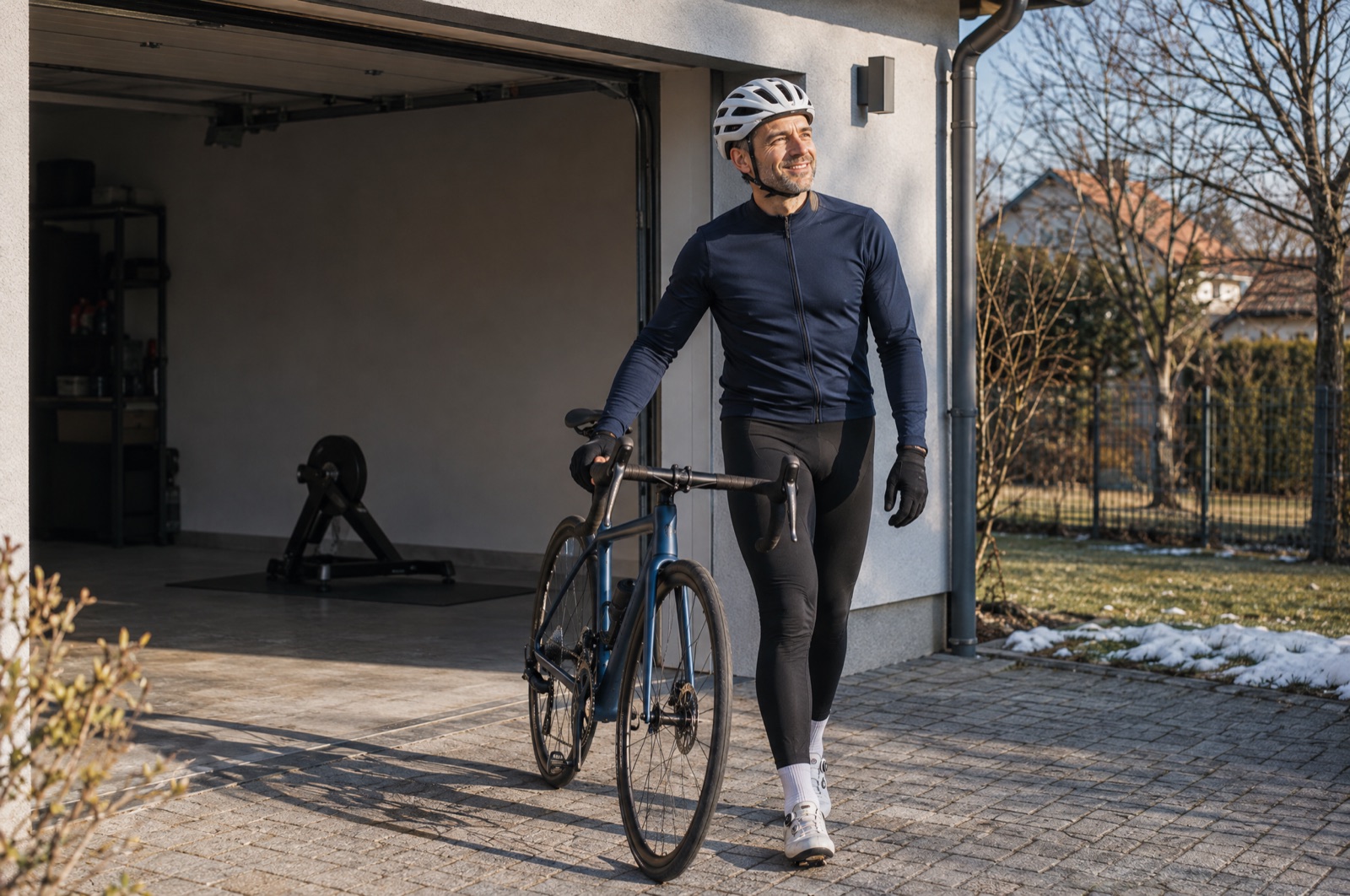
The trainer is a tool, not a punishment for bad weather. Where you ride depends on the purpose of the session.
| Purpose of the session | Better indoors | Better outdoors |
|---|---|---|
| Threshold and VO2max intervals | Yes, especially in winter | When you have a safe stretch of road |
| Long easy ride | Only when the weather does not allow it outside | Yes |
| Cornering technique, descents | No | Yes |
| Group riding | Only a substitute | Yes |
| FTP test | Yes, for repeatability | When the route is fixed and safe |
| Recovery during the week | Yes, when you are short of time | Yes, if you have a quiet route |
Power ranges at home and on the road
Measure instead of assuming. Do a test at home and note what effort you feel. If it is harder at home, a coach can set separate zones for the trainer and the road. Compare the trainer with the power meter on your bike too, because even good devices differ from one another.
All year round
The trainer matters most in the darkest and coldest months, December to March in the northern hemisphere and June to September in the southern, but it is useful in season as well, in the evening or before work for example. How to divide your time between home and the road is described in the article on winter cycling training, and the phases of the season in road cycling training plans.
At IMI a coach builds the plan so that the trainer and the rides outside complement each other, and updates it every week when the weather or your schedule changes.
The trainer through the year
The share of indoor riding changes with the months. The table is our reference point for someone who works in a city, lives in a temperate climate and has a main goal in summer.
| Northern hemisphere | Southern hemisphere | Share of the trainer | Role |
|---|---|---|---|
| November | May | Small | Easy spins, setting up the space, testing the fan |
| December and January | June and July | Large, often most rides in the week | Easy sessions, cadence, short harder efforts |
| February and March | August and September | Large | Intervals, climbing work, a power test |
| April and May | October and November | Medium | Rainy days, precise sessions |
| June to September | December to March | Small | A short evening interval session, a ride after work in the rain |
| October | April | Growing | Shorter days, the first easy sessions at home |
Where the hard season is the hot one, in the tropics or in a desert summer, the pattern turns around: the trainer in an air-conditioned room takes the midday and after-work sessions in the hottest or wettest months, and the road gets the early mornings.
How to compare the trainer with a power meter
If you have a power meter on the bike, ride for 20 minutes at constant power and note the averages from both devices. An example: the trainer shows 200 W, the pedals 208 W, a difference of 4%. An FTP of 260 W from the pedals then corresponds to 250 W on the trainer. Write the difference down and check it every few months, because it can change. One shared reference point saves a lot of confusion about zones. Why two devices rarely agree, and why a change of device breaks the comparison, is covered in the section on judging progress.
A power test on the indoor trainer
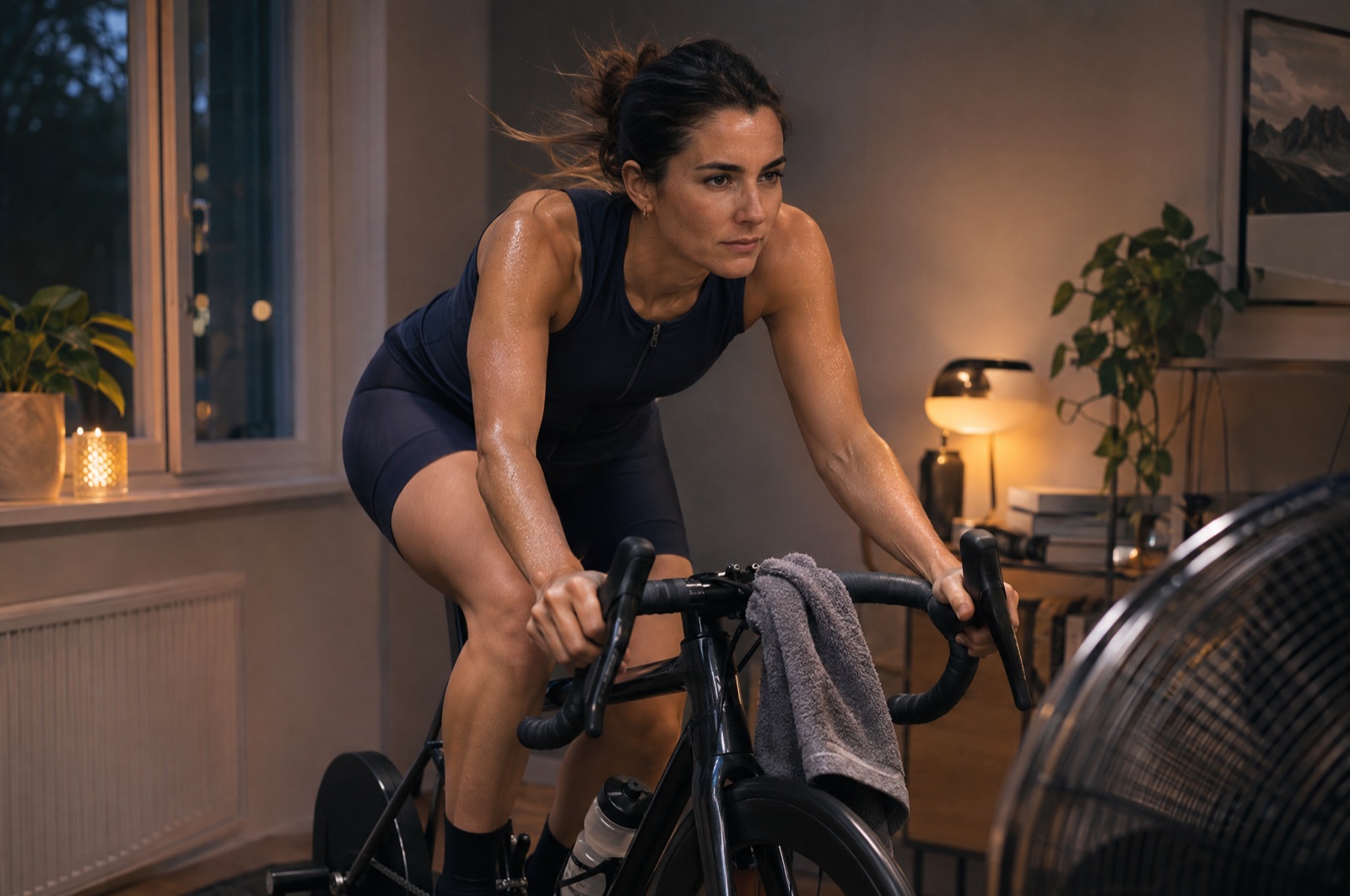
Conditions at home are repeatable, so it is a good place for a test. Make sure the conditions are the same every time:
- the same room temperature and the same fan,
- the same mode, preferably without ERG, so that you regulate the effort yourself,
- the same measuring device, calibrated before the ride,
- a similar time of day and comparable rest before the test.
Convert the 20-minute result with the multiplier for your level: from 0.95 if you are well trained to 0.88 if you ride recreationally. A change in room temperature can affect the result by itself, so don't judge your fitness from a test done in different conditions from the previous one.
The most common mistakes on the indoor trainer
- No fan. The cheapest improvement you can make.
- Only hard sessions. Thinking "it's short, so it has to hurt" ends in fatigue by the middle of winter.
- Racing every day. A race in an app is a hard workout, not an easy spin.
- Comparing results online. Different trainers, different calibration, and a body weight that anyone can type into the app.
- Long rides without a purpose. Three hours in a warm room cost more than they return.
- No riding outside before the season. Technique and confidence do not come back by themselves.
- Skipping the warm-up. At home it is easy to jump straight into an interval.
Frequently asked questions
How many times a week should I ride the indoor trainer?
In winter many people do 2–3 sessions at home and as many rides outside as the weather allows. The number depends on the rest of the plan and on recovery.
Is an hour on the indoor trainer worth more than an hour on the road?
Slightly, because you never coast. In our example the work of one hour indoors takes about 75–85 minutes on the road, not the 90 minutes of the popular rule.
Does an indoor trainer damage a carbon frame?
It depends on the model, so check the recommendations of the bike maker and the trainer maker. Avoid rocking the bike hard and check regularly that the axle is tight. Sweat speeds up corrosion, so wipe the bike down after riding.
Is 30 minutes on an indoor trainer enough?
For an easy spin or a short interval session, yes. A focused 30–45 minutes is far better than skipping the ride, but it does not replace the long ride. Keep those for outside, or for a day with more time.
Do I need a smart trainer?
No. A simple trainer with a sensor and a plan is enough, but a smart trainer makes intervals easier and gives you ERG mode.
How long should an indoor trainer workout be?
Usually 45–90 minutes. Leave longer easy rides for outside, unless the weather does not allow it.
Do I need a separate rear wheel or cassette for the trainer?
It depends on the type of trainer. Direct drive needs a cassette compatible with your drivetrain, and for some models you have to buy it separately. A wheel-on model wears an ordinary road tire quickly, so a trainer tire is useful, ideally on a separate wheel.
Can I use an indoor trainer without an app?
Yes. A plan, a clock and heart rate or a power meter are enough. An app adds convenience and motivation, but it is not a condition of training.
Is an indoor trainer too loud for an apartment?
It can be. Direct drive on a mat is usually the quietest setup, but vibration still passes through the floor. Keep standing sprints for the daytime and ride steadily in the evening.
Is an indoor trainer good for beginners?
Yes, as a safe place for first rides, but it will not replace learning to ride on the road. The first season is described in the beginner cycling training plan.