Contents
- Ironman, 140.6, full distance: what the names mean
- Who finishes an Ironman and how fast
- Race day: six stages, not three sports
- The marathon after 180 km: where the bill arrives
- Bike power: why a slower rider has to ride easier
- Fueling for 12 hours
- Heat: what Frankfurt 2026 taught
- DNF: where and why people leave the course
- An Ironman training plan in numbers
- Work, family, recovery
- Heart and health checks
- How much an Ironman costs
- Gear that matters after hour six
- Where to race: the full-distance calendar by continent
- What a ready-made Ironman training plan cannot do
- Frequently asked questions
Choose your goal
Triathlon time calculator
- Start0:00
- Swim:/100 m
- T1swim to bike:
- Bikekm/h
- T2bike to run:
- Run:/km
- Finish
Cut-offs depend on the race. Check the rules of your event.
Where you gain the most
Time arithmetic only. A harder bike leg can cost you more on the run.
Ironman, 140.6, full distance: what the names mean
The distance is a 3.8 km (2.4 mile) swim, a 180 km (112 mile) bike and a 42.2 km (26.2 mile) run, 226 km in total, which is 140.6 miles. That is where the shorthand 140.6 comes from. In everyday speech people say Ironman. Organizers outside the brand say full distance, long distance or iron-distance. The other names and formats are set out on the triathlon distances page.
IRONMAN is a trademark of The IRONMAN Group. A race run by another organizer over the same course lengths is not an IRONMAN in the brand sense, but the effort is identical. This has a practical consequence. If the brand matters to you, because you want the name on the medal or a chance to qualify for the IRONMAN World Championship, you need a race from that series, and depending on where you live that can mean a flight. If only the distance matters, your choice is wider and often cheaper: the Challenge Family series, extreme point-to-point events and independent club races all offer the same 226 km.
Who finishes an Ironman and how fast
A peer-reviewed analysis published in Scientific Reports in 2024 covered 677,702 age-group results from 444 IRONMAN races held between 2002 and 2022. The mean finish time was 12:38 for men and 13:32 for women. The data covers only people who reached the finish line.
| Age group | Men, mean | Women, mean |
|---|---|---|
| 18–24 | 12:36 | 13:16 |
| 25–29 | 12:20 | 13:08 |
| 30–34 | 12:16 | 13:12 |
| 35–39 | 12:20 | 13:20 |
| 40–44 | 12:32 | 13:31 |
| 45–49 | 12:44 | 13:44 |
| 50–54 | 13:04 | 14:02 |
| 55–59 | 13:28 | 14:19 |
| 60–64 | 13:54 | 14:46 |
The study gives the means in decimal hours, converted here to hours and minutes. The fastest men were aged 30–34 and the fastest women 25–29. Between 25–29 and 50–54 the mean rises by only 44 minutes for men and 54 for women, despite a quarter of a century of difference. The margin is wide too: the men's mean is 4:22 inside the usual 17-hour limit.
The course matters a great deal. Among the venues with the most finishers in the study, the mean was 11:41 in Copenhagen and 13:32 in Wales. Almost two hours of difference over the same distance, so compare your result with others from the same race. You can work out your own splits in the triathlon time calculator.
Who is on the start line
Ironman is a sport for people over forty. In the same study, 56% of results belong to athletes aged 40 and over, and almost the same share falls in the 35–49 bracket. 19% belong to people aged 50 and over. The largest single group is men aged 40–44, with 114,260 results.
Women account for 19.6% of the results, fewer than the 24% at the half distance. In interviews with 13 women who had raced an Ironman, the same barriers kept coming up, and they are typical of a sport that takes this much time: time, money and gender stereotypes.
Race day: six stages, not three sports
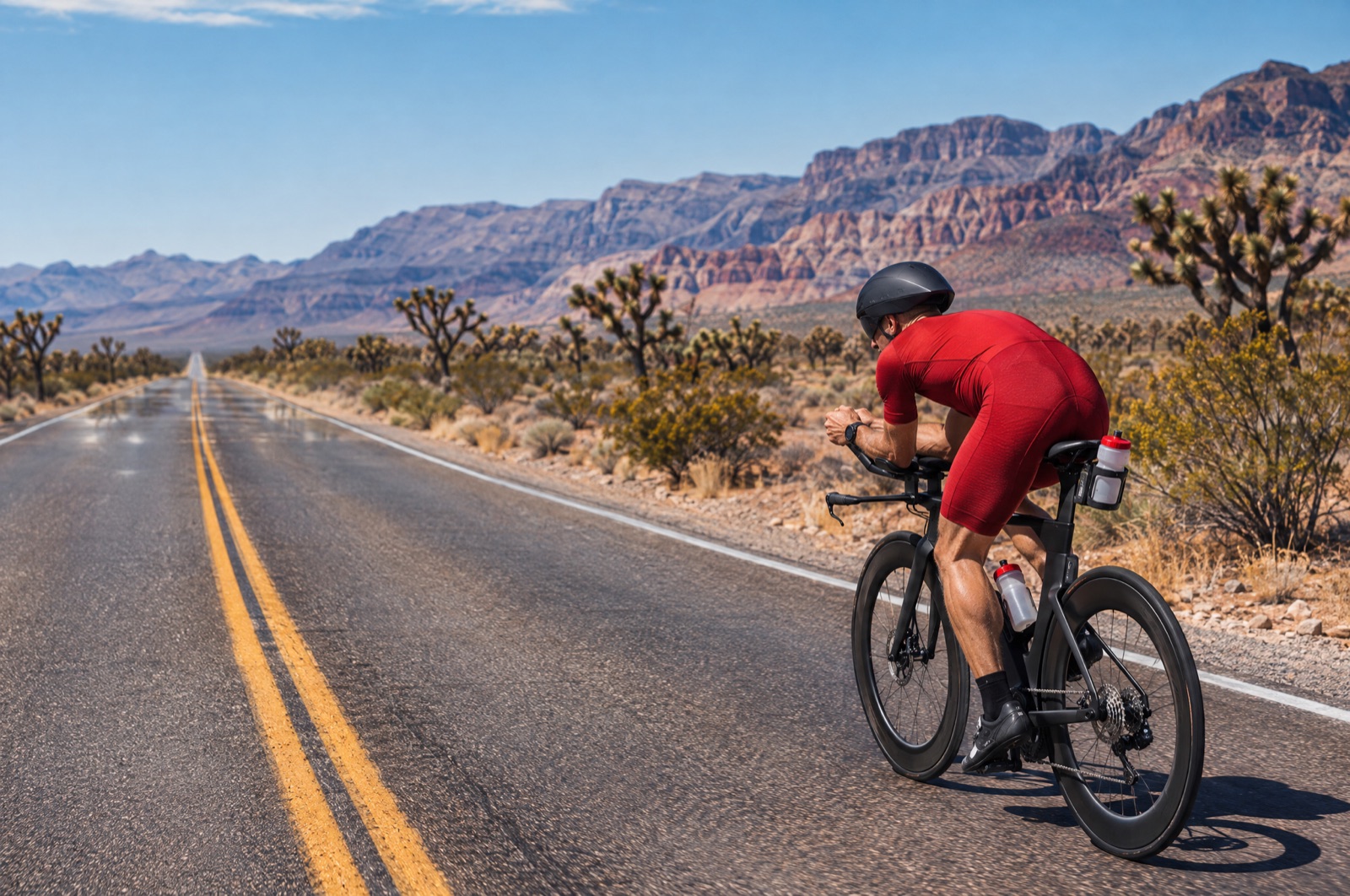
Three sports is how the rulebook divides the day. Your body divides it differently. This is the day of someone finishing in about 12:45 (2:15/100 m in the water, 28 km/h (17.4 mph) on the bike, 6:30/km (10:28/mile) on the run and 20 minutes in transitions), with hours counted from the start.
- Hours 0–1:25, control. The swim is only 11% of your time. Nobody wins the day here, but pace and crowding can lose it. In a US registry covering all triathlon distances it is the most dangerous leg: 90 sudden deaths and cardiac arrests, compared with 15 on the run and 7 on the bike, not counting 15 trauma deaths on the bike.
- Hours 1:35–4:50, illusion. The first half of the bike. Power feels low and food goes down easily. Every watt above the plan is a loan you repay in the afternoon.
- Hours 4:50–8:00, work. The second half of the bike. Neck, back and saddle pain arrive, and sweet flavors start to get in the way. Food you skip in this phase you pay back later on the run.
- Hours 8:10–10:30, the first half of the marathon. The legs run and the pace looks good, but heart rate is already high. In one study, trained triathletes finishing in about 10:11 averaged 83% of maximum heart rate across the whole race.
- Hours 10:30–12:00, the slide. Kilometers 21–35 (miles 13–22). Muscles hurt, reserves are low and the stomach has had enough. Many people mix running and walking here.
- Hours 12:00–12:45, the head. The last kilometers. The only thing left to decide the result is whether you keep moving forward.
The energy arithmetic is brutal. At Ironman New Zealand men spent about 10,036 kcal and ate 3,940 kcal. Another study estimated 11,009 kcal spent and 3,643 kcal eaten for a finish time of about 12.5 hours. Both rely on estimates from heart rate, but the conclusion is the same: the deficit is 60–67% of what you burn. You cannot close it. The goal is to eat as much as your gut will accept.
The marathon after 180 km: where the bill arrives
An Ironman marathon is nothing like a marathon on fresh legs. It starts after seven or eight hours of effort, with an energy deficit you could not close and 180 km in your legs. Almost nobody runs it at their marathon pace, and it is in those last hours that the day is saved or lost.
The comfort is that you do not have to be a fast runner. You have to keep the ability to run after 180 km. That is built with volume, eating and discipline on the bike, not with intervals on the track.
- There is no time bank. Minutes gained by riding harder usually come back on the run. Over a marathon, 30 seconds per kilometer (48 seconds per mile) is already 21 minutes.
- A walk plan is not a defeat. Short walk breaks at aid stations make eating and cooling easier. They are hard to plan in the middle of a crisis and easy to plan from the first kilometers. At 6:30/km, half a minute of walking at 6 km/h (3.7 mph) costs about 10 seconds, so across 15–20 aid stations the total is about 3 minutes.
- The long run has a limit of usefulness. The longest run usually lasts 2:00–2:30. A marathon in training would cost more recovery than it returns in fitness.
- Train the run after a long ride. A run of 45–90 minutes after 5–7 hours on the bike teaches more than another hour added to the long run.
Bike power: why a slower rider has to ride easier
FTP is the power you can hold for about an hour. A typical IF (normalized power divided by FTP) for age-group athletes is about 0.60–0.75. Values of 0.68–0.72 fit a ride of about 5:00–5:30. The range is wide because age-group athletes ride for anything from five to eight hours.
More important than IF is the total cost, TSS (Training Stress Score), calculated as IF² times hours times 100. A good range with solid preparation is 250–285 TSS. Run the numbers and you get a table you rarely see:
| Bike time | IF for 250 TSS | IF for 270 TSS | IF for 285 TSS | With an FTP of 240 W |
|---|---|---|---|---|
| 5:00 | 0.71 | 0.73 | 0.75 | 170–180 W |
| 5:30 | 0.67 | 0.70 | 0.72 | 161–173 W |
| 6:00 | 0.65 | 0.67 | 0.69 | 156–166 W |
| 6:30 | 0.62 | 0.64 | 0.66 | 149–158 W |
| 7:00 | 0.60 | 0.62 | 0.64 | 144–154 W |
| 7:30 | 0.58 | 0.60 | 0.62 | 139–149 W |
The table is a reference point calculated from the formula. The conclusion is counterintuitive: for a 7-hour ride the sensible range is about 0.60–0.64, not the 0.70 of popular advice. That 0.70 would give 343 TSS, more than 20% above the upper limit. At 7:30 the IF is already at the bottom of the typical range, and riding like that feels too easy early in the day. A longer ride always costs more, which leaves even less room for surplus.
Even riding matters more here than at shorter distances. Keep VI (normalized power divided by average power) at or below 1.05, and on a flat course ride the second half 1–2% harder than the first. On climbs this takes a deliberate decision to back off, because a few minutes at 110% of FTP cost more than the average suggests.
How to train for an effort like this
Nine triathletes were followed for 18 weeks before the same Ironman. In training, 68% of their time was spent in zone 1 (below the aerobic threshold), while in the race 59% was spent in zone 2. More time in zone 1 went with a better result (r = −0.92), and a lot of riding in the middle zone went with a worse one. It is only nine people and a correlation, but the direction fits experience: the zone you race in does not have to be the zone you spend most of the week in.
Fueling for 12 hours
The reference point is 80–100 g of carbohydrate per hour on the bike and 60–90 g on the run. For someone finishing in about 12:45 that means about 790–1,050 g over the whole day, or 32–42 gels of 25 g each, or the equivalent in drinks and bars. That is about 3,150–4,200 kcal, roughly what the athletes in New Zealand actually ate, and 94% of their energy came from carbohydrate.
What the research says
- For ultra-endurance efforts the recommendation is about 90 g/h from a mix of glucose and fructose. At lower intensity oxidation falls, so reduce the dose. This matters for people riding 6:30 and longer. The top of the range, 100 g/h, makes sense mainly for faster times.
- Long-distance triathletes in one study ate 62–71 g/h on average. Higher intake went with a faster Ironman time, but also with more nausea and bloating. Both things are true at once.
- In trained cyclists, 120 g/h did not spare glycogen compared with 90 g/h. In 20 elite runners in a mountain marathon, 120 g/h brought possible benefits for fatigue and recovery. There is no evidence for age-group athletes over the full distance.
- The upper limit of 90 g/h on the run is ambitious. Averages across a whole race were lower, so a reasonable base target is 60 g/h.
The gut over the full distance
About 31% of Ironman starters reported serious symptoms, more than twice as many as at the half distance, despite a similar hourly intake. So the difference is explained by time rather than by the dose itself. The best predictor was a previous history of gut problems. If you have one, start nutrition training earlier and discuss persistent symptoms with a doctor.
Gut training works over weeks. Two weeks of regular intake reduced symptoms by about 60% in a study of runners, and a 28-day high-carbohydrate diet raised the oxidation of ingested carbohydrate. In a 30-week block you have time for this, which is why from the middle of your preparation every long ride should be a rehearsal of race-day eating.
Fluids, sodium and hyponatremia
At this distance the danger is not only dehydration but also overhydration. At Ironman New Zealand in 1997, 58 of 330 finishers (18%) had hyponatremia, a blood sodium concentration that is too low, and 73% of the severe cases were caused by excess fluid. It is a single edition, but it shows the scale. Athlete education and less fluid available on the course later reduced the number of symptomatic cases there.
The 2015 consensus on hyponatremia recommends drinking to thirst. The consensus on exercise in the heat from the same year says that in severe dehydration thirst alone may not be enough, and gives Ironman as the example, but it also warns age-group athletes against drinking too much. The practical conclusion: drink regularly, but no more than you lose. Gaining weight during the race is a sign of overhydration. In a study of ten well-trained athletes, a loss of 2.3 kg (5 lb), or 3% of body mass, was well tolerated. That is not permission for any level of dehydration.
Sodium is disputed. The New Zealand studies suggest that supplementation is not needed to prevent hyponatremia in people who lose weight during the race. A study of 26 athletes at the half distance found the opposite: a faster time and higher blood sodium with salt capsules. A model from Monash University suggests that replacing less than half of the losses is usually enough. The consensus on exercise in the heat recommends a drink with 0.5–0.7 g of sodium per liter for efforts longer than an hour. In a study of 11 men at 34°C (93°F), those who replaced all of their sweat loss maintained sodium and plasma volume with a 60 mmol/l drink, while with a typical 21 mmol/l both fell. That result cannot be transferred to people who drink less. For 12 hours you therefore need your own plan, tested on long hot training days.
Heat: what Frankfurt 2026 taught
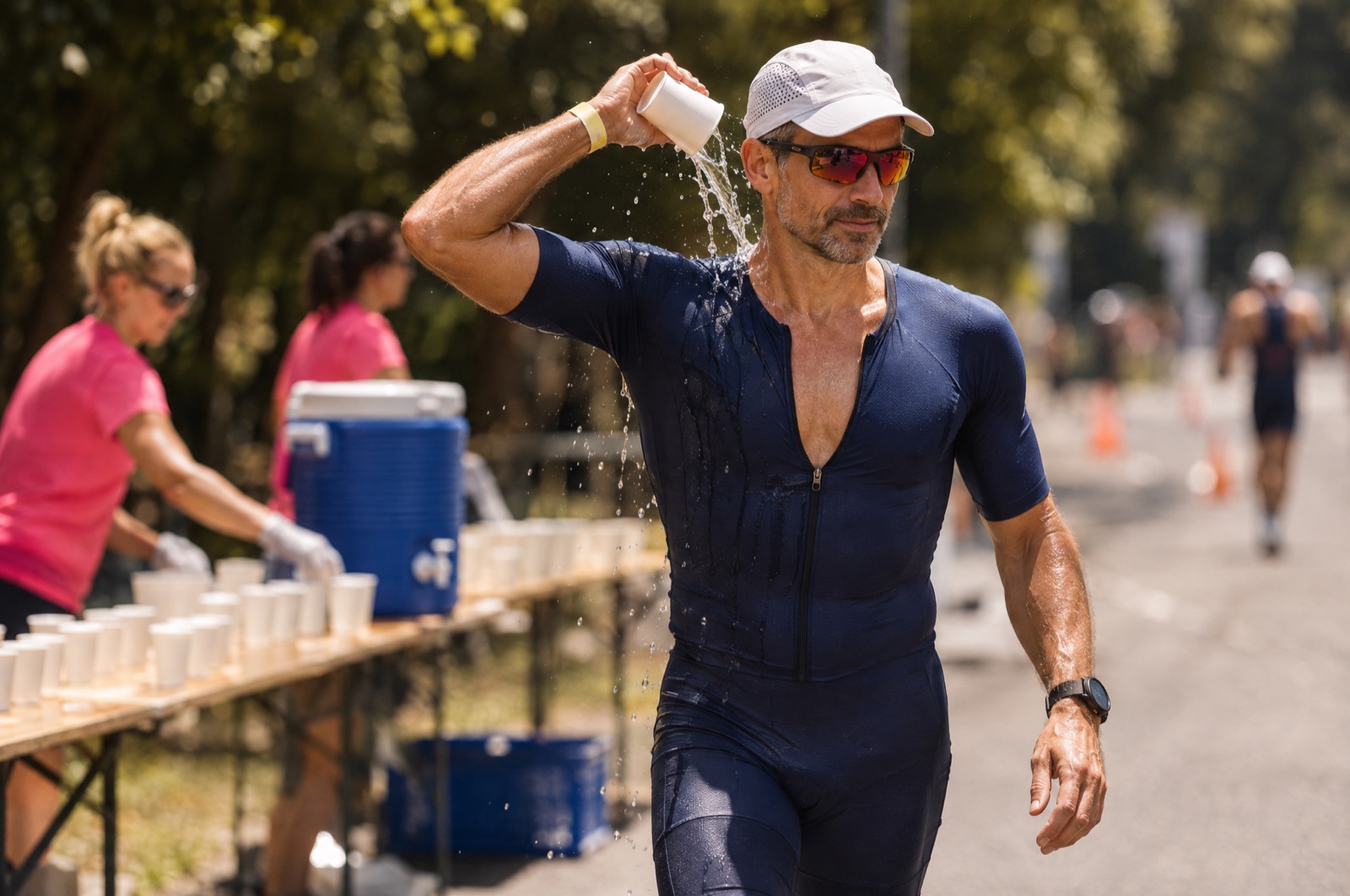
At the end of June 2026, IRONMAN Frankfurt, the men's European championship, was shortened in the days before the race, with forecasts of 36–40°C (97–104°F) over the weekend. The bike went from 180 to 125 km and the marathon was replaced by a half marathon. On the same weekend the Alpes-Maritimes prefecture canceled the full-distance and 70.3 races in Nice, and about 4,500 entered athletes were left without a start. Athletes who had trained and paid for the full distance found themselves in a different race, or in none. So read the refund rules before you enter.
Heat hits hardest when it comes early. In two triathlons in Melbourne with a similar level of heat stress, the first, held on an unusually hot day at the start of summer, had 15 cases of heat illness, including 3 of heat stroke. The second, two months later, had none. And over the full distance almost everyone runs the marathon in the hottest hours of the afternoon.
What to do if your race is in a hot season
- Prepare for a swim without a wetsuit. At IRONMAN races age-group athletes may wear a wetsuit and stay in the rankings when the water is at or below 24.5°C (76.1°F). Between 24.5 and 28.8°C (76.1 and 83.8°F) a wetsuit takes you out of the age-group rankings and world championship slots, and above that it is banned. The temperature is measured on race morning.
- Heat acclimation. Sessions in the heat of at least 60 minutes, for a week and preferably two, with a minimum of 6–7 exposures. The benefits last up to 2–4 weeks, although some studies describe a faster loss, so finish the acclimation close to the race. A sauna or hot bath after training is an option if you are in good health. With cardiovascular disease, ask a doctor first.
- One number on the course. If heart rate climbs clearly at constant power, lower the power. The athlete in a case report from Ironman Western Australia slowed down only after reaching a core temperature of 39.4°C (102.9°F). It is better to do it earlier and on purpose.
- Cooling from the first kilometer of the run. Ice, water and a wet cap work better before the crisis than after it.
Heat is not only a European summer problem. Races in the tropics, in the southern United States and in the Australian summer are warm every year, and humidity makes the same temperature harder because sweat evaporates less. If you live somewhere cool and race somewhere hot, the acclimation block above belongs in your plan, not in your hopes for the forecast.
DNF: where and why people leave the course
DNF (Did Not Finish) means the race was not completed, DNS (Did Not Start) means the athlete never started, and DQ is a disqualification. Every organizer's results list shows these codes, but there is no official DNF statistic for the distance as a whole, and the results do not say why someone stopped. The share changes a lot from one day to the next: heat, wind, waves and the difficulty of the course move it more than anything else.
The mechanisms do fall into a logical order:
| Moment | Typical mechanism | What lowers the risk |
|---|---|---|
| Swim | Cut-off, waves, panic, cold | Open water in training, a 30-minute margin |
| Bike, first 90 km | Mechanical failures, crashes | A service before the race, knowing how to fix a flat |
| Bike, last 90 km | Cut-off, dehydration, stomach, pain | A position rehearsed for 6 hours, eating every 15–20 minutes |
| Run, to 25 km | Stomach, cramps, overheating | Lower power on the bike, cooling, a walk plan |
| Run, last 15 km | Cut-off, exhaustion, hyponatremia | Steady eating, drinking to thirst, a time margin |
Ironman cut-off times
Typical values are 2:20 for the swim, 10:30 for the swim plus the bike and 17:00 overall, as at IRONMAN Texas 2026. Not every race is that generous: some publish shorter limits or intermediate checkpoints within a leg, and independent organizers set their own rules. Limits can also change from year to year at the same venue. Always read the current athlete guide. The margins are worked out on the page about your first Ironman.
An Ironman training plan in numbers
Typical figures are 10–18 hours in the build phase, 14–22 at the peak and 6–9 in recovery weeks. Most age-group athletes average 12–15 hours. The whole block usually takes 24–36 weeks, often inside a project of 9–12 months.
| Phase | Length | Volume and focus |
|---|---|---|
| Base | 8–15 weeks | Volume in three sports, gym work, a stable 10–12 h by the end |
| Build | 9–12 weeks | Long rides up to 4–5 h, long runs up to 2:00–2:30, peak of 14–22 h |
| Specific | 4–6 weeks | Race pace with race food, a big training day 4–6 weeks before the race |
| Taper | 3 weeks | Volume at about 80%, 60% and 40% of the peak, intensity in short doses |
The longest sessions are 5–7 hours on the bike and 45–90 minutes of running, 4–6 weeks before the race. Some people do one full combined session of 6–8 hours, others prepare better with repeatable 5-hour rides.
What it adds up to
30 weeks at 13 hours is 390 hours. That is 16 full days, or almost 10 working weeks of 40 hours. On top come travel to the pool, changing, laundry, bike maintenance and the nap after long sessions. Do the sum on your own week: add the time around training to every hour of training.
Can you do it on less
A 1999 study of lower-level athletes showed that finishing takes less training than studies of elite athletes had suggested. The participants had about 6 years in triathlon behind them and prepared for 21.5 weeks on average. The best predictors of the result were their best time over the Olympic distance, weekly cycling distance and the longest ride. Distance mattered more than training pace. The data is old and retrospective, but the logic still holds: the foundation is the bike and the base from previous years.
What the body pays
174 athletes preparing for Norseman Xtreme Triathlon were followed for 26 weeks before the race. On average, at any given moment 56% of them reported overuse problems, and about 20% reported substantial problems that limited training. The knee, the lower leg and the lower back were affected most often. Illness affected 11% of athletes on average. Norseman is an extreme race, but the conclusion fits the full distance: overuse problems in a block like this are the norm, not the exception. A plan has to allow for that, and pain that persists is a reason to see a doctor or physiotherapist.
Work, family, recovery
This is where the full distance differs from everything else. At 15 hours a week, the long ride with a run and the long run can take 9–10 hours of the weekend. That leaves 5–6 hours for five working days, usually one session a day of about an hour. Three swims a week mean three mornings or evenings at the pool.
- The weekend disappears. A Saturday with a 6-hour ride and a run is in practice the whole day, including the nap and the eating. That day repeats for several months.
- Weeks have to differ. A business trip during the peak will not ruin the plan if it is known in advance that the week will be lighter.
- Sleep is part of the plan. At 18 hours a week, after a short night it is better to cut a session than to start it at five in the morning.
- You carry the fatigue into the office and home. A peak week lowers patience and concentration. Tell the people close to you in plain words.
Research gives a less obvious picture here. In interviews with 15 partners of endurance athletes the main stressor was frequent absence, but the partners also saw benefits for family life. Both effects occur together. Men who race Ironman report little role conflict and still stress the need for support at home and at work. In an older study of 342 partners of runners, the level of conflict depended on how much support the partner gave. The conclusion: the conversation before you enter is part of the preparation. It is not only about race day but about 30 Saturdays.
After the race
Blood markers were studied in 42 well-trained triathletes for up to 19 days after an Ironman. The strong inflammatory response faded quickly, but low-grade inflammation lasted at least 5 days, which is linked with incomplete muscle recovery. Feeling good after three days therefore does not mean you are ready for hard training. Plan at least two easy weeks, at work as well, and put them in the calendar before the race.
Heart and health checks
A US registry covers 135 deaths and cardiac arrests from 1985–2016 (average age 47, 85% men). In USA Triathlon races from 2006–2016 the rate was 1.74 per 100,000 participants, and as high as 18.6 in men over sixty. It was similar across distances, so the risk does not come from length itself, but the long preparation gives you time for a check-up. Autopsy showed relevant cardiovascular abnormalities in 27 of the 61 people examined (44%). A visit to a doctor, especially if you are over 40, have heart disease in the family or get symptoms during exercise, is a sensible part of the project. Chest pain, palpitations or fainting mean you stop training.
How much an Ironman costs
The entry fee is the most visible cost, and it depends on the brand, the region and how early you enter. IRONMAN-brand races sell entries in price tiers that rise as places sell, so the same race costs more the later you decide, and service fees and any federation license come on top. Some races also sell a paid add-on that refunds part of the fee if you withdraw, which looks more sensible after what happened in Nice.
| Item | What it depends on | What to watch |
|---|---|---|
| Entry fee and license | Brand, price tier, entry date, annual or one-day license | Read the refund and transfer terms before you pay |
| Bike | From your road bike with clip-on aerobars to a time-trial bike | A position you can hold for 6 hours beats a more expensive bike |
| Wetsuit, race kit, helmet | New or used, entry level or race level | Fit before price, and everything tested in training |
| Pool and club | Where you live, lane times, club fees | A club often has reserved lanes and open-water sessions |
| Coach | How much contact is included and how often the plan is adjusted | Ask who looks at your data and how often the plan changes |
| Travel and accommodation | Distance, number of nights, who comes with you | Rooms near the venue fill early and cost more on race weekend |
| Nutrition | Race day and, above all, the long sessions | Training costs far more than the race |
The table gives no amounts on purpose, because they change from year to year and from country to country. The item that varies most is travel. A race within driving distance means one or two nights away. A race on another continent means flights, a bike case or a bike transport fee, and most of a week off work. Independent races are often cheaper than IRONMAN-brand ones, though not always cheap: the 2027 entry for Norseman in Norway is EUR 550.
What almost nobody counts is nutrition in training. At 80 g/h a six-hour ride takes 480 g of carbohydrate, the equivalent of 19 gels, and at the peak you have several of those rides a month.
Gear that matters after hour six
- Position beats price. A bike on which you cannot hold the aerobars for 6 hours is slower than a cheaper one on which you can. Get a bike fit early and test it on long rides.
- Saddle and kit. After hour five, chafing can turn the run into suffering. Test your race kit on long rides.
- Only proven shoes. Damaged toenails and blisters are common after 180 km on the bike and 42 km of running. Feet swell.
- Spares. Two tubes or a repair kit, and the skill to use them in 10 minutes.
- Rules. Drafting, which means riding in another athlete's slipstream, is banned: for age-group athletes at IRONMAN races the draft zone is 12 m (39 ft) and you have 25 seconds to complete a pass. Other organizers generally run the full distance without drafting too, but check the zone length in their rules. Headphones are banned. Since March 2026, containers on the top tube may be up to 10 cm (4 in) high.
Where to race: the full-distance calendar by continent
There is a full-distance race on every inhabited continent. The table shows where the IRONMAN-brand races are and when their seasons run. The calendar changes every season: races move, new ones appear and some disappear. Use it as a map and confirm the date on the race page.
IRONMAN races by region
| Region | Races | When |
|---|---|---|
| United States and Canada | About ten races, among them Texas, Lake Placid, Wisconsin, Maryland, Chattanooga, California and Florida | April to November |
| Europe | Lanzarote, Hamburg, Klagenfurt, Frankfurt, Thun, Vitoria-Gasteiz, Tallinn, Kalmar, Copenhagen, Vichy, Leeds, Nice, Emilia-Romagna (Cervia), Wales, Calella-Barcelona and Cascais | From Lanzarote in May to Calella-Barcelona and Cascais in October, with most races from June to September |
| Africa | South Africa | The southern autumn, in March or April |
| Oceania | New Zealand (Taupō), Cairns, Australia (Port Macquarie), Western Australia (Busselton) | New Zealand in March, Cairns in June, Port Macquarie in October (since 2026), Busselton in December |
| Latin America | Brazil (Florianópolis), Mexico (Cozumel) | Florianópolis was held in June in 2026 |
| Asia | A smaller and changing list, with races in the Philippines, Malaysia, Taiwan, Japan, South Korea and Kazakhstan in recent seasons | Varies with the local climate |
Registration status moves faster than dates. The most popular European races can sell out many months before race day while others stay open into the season, so check the status of every race on your shortlist early.
- The date decides where your long rides fall. A race in June in the northern hemisphere puts much of the preparation in winter. A race from September to November lets you do the longest rides outdoors in summer. In the southern hemisphere the logic is mirrored: for New Zealand in March the peak weeks fall in January and February, in the middle of summer, and for Western Australia in December the base is built over the southern winter.
- Crossing hemispheres flips your season. If you live in Europe or North America and travel to a race in March or April in New Zealand or South Africa, your biggest weeks come in the darkest months and largely on an indoor trainer. The same is true in reverse for an Australian flying to a European summer race.
- Climate and water. Compare the typical air and water temperatures of the race with what you train in. A cold-water wetsuit swim, a hot and humid run and a windy bike course each call for different preparation.
- Travel. A race you can drive to keeps the bike in one piece and the costs down. A long-haul flight adds a bike case, jet lag and the question of how many days before the race you can arrive.
Kona and Nice: world championship basics
The IRONMAN World Championship is held in Kailua-Kona, Hawaii, in October. From 2023 to 2025 the men's and women's races were split and alternated between Kona and Nice in France. Since 2026 men and women race in Kona again on a single day.
Age-group athletes qualify at IRONMAN-brand races. Under the system introduced for the 2026 championship, the winner of each age group earns a slot, and the remaining slots go to the best age-graded performances, ranked against a benchmark built from past Kona results. The details have changed more than once, so read the current rules. The practical point for a first-timer: qualification is a goal for athletes near the front of their age group, and no independent race, however hard, leads to Kona.
Challenge and independent iron-distance races
Outside the IRONMAN brand the best-known goal is Challenge Roth in Germany, held in early July, with about 5,000 athletes, relay members included, and up to 300,000 spectators according to the organizer. The organizer describes it as selling out in seconds, so the entry has to be planned a year ahead. In the same series, Challenge Almere-Amsterdam in the Netherlands, held in September, bills itself as Europe's oldest long-distance triathlon.
Extreme point-to-point races are a category of their own. Norseman in Norway puts only about 250 athletes on the start line each August, and its ballot draws many times more entries than there are places. At the other end are small independent races put on by clubs and local organizers in many countries. They cost less and are easier to enter, but they have fewer athletes on the course, sometimes tighter cut-offs and fewer aid stations, so read the athlete guide with extra care.
Demand is high and information about registration goes out of date quickly. Start looking more than a year ahead. The steps are in the guide on how to register for an Ironman.
What a ready-made Ironman training plan cannot do
Over 30 weeks something will happen that no template can foresee: illness, an overuse injury, travel, the birth of a child. The Norseman data has already shown that health problems are the rule. At this distance the value of a plan lies mainly in how it changes after a week like that. That is why at IMI a real human coach runs your plan in the app and updates it every week, starting from the Cooper test (a 12-minute run) or a 5K, an FTP test and a 200 m swim. Without a power meter the plan is built on heart rate. Data from Garmin and Apple Watch reaches the coach without retyping.
If this is your first attempt, start with the page on your first Ironman. If the half distance is still ahead of you, see the half Ironman training plan, and for a view of every distance side by side go to triathlon training plans.
Frequently asked questions
How long does it take to train for an Ironman?
Usually 24–36 weeks of structured training, often inside a project of 9–12 months. From a low base, allow a year.
How many hours a week do you need to train for an Ironman?
10–18 hours in the build phase, 14–22 at the peak and 6–9 in recovery weeks. Most age-group athletes average 12–15 hours.
What is the average Ironman finish time?
In a peer-reviewed analysis of 677,702 results from 2002 to 2022, the mean was 12:38 for men and 13:32 for women. Venues differ by almost two hours, so compare yourself with your own race.
What are the Ironman cut-off times?
Typically 2:20 for the swim, 10:30 for the swim plus the bike and 17:00 overall. Some races publish shorter limits, so check the athlete guide of your race.
What power should I hold on the bike in an Ironman?
Usually an IF of 0.60–0.75, which is 60–75% of FTP. The longer you ride, the lower it goes. For a 7-hour ride the sensible range is about 0.60–0.64.
How many carbs per hour do I need in an Ironman?
The reference point is 80–100 g/h on the bike and 60–90 g/h on the run. The practical upper range is about 90 g/h, and age-group athletes in studies ate 62–71 g/h on average.
What percentage of people do not finish an Ironman?
There is no official figure for the distance as a whole. The share depends mostly on the day: heat, wind and the difficulty of the course move it a lot. The results list each organizer publishes shows who did not finish (DNF), and it is the best reference for your race.
What is the longest training session before an Ironman?
5–7 hours on the bike and 45–90 minutes of running, 4–6 weeks before the race. You do not need to run a marathon in training.
How do you qualify for Kona?
By racing an IRONMAN-brand full distance. Age-group winners get automatic slots and the rest go to the best age-graded performances. Challenge and independent races do not qualify you.
How long is the taper before an Ironman?
Three weeks of gradually falling volume, to roughly 80%, 60% and 40% of the peak. Intensity stays, but in short doses.