Contents
- Where to start with no experience at all
- Super sprint, sprint or Olympic for a first race
- Swimming: from the pool to open water
- Fear of open water
- Gear and costs
- The transition area
- How to read the race rules
- Race day step by step
- What can go wrong
- The stages of preparation in numbers
- How to choose your first race
- Frequently asked questions
Where to start with no experience at all
Your first month is decided by swimming. On the bike and the run you can, at worst, slow down. In the water there is no walking mode, and the swim cut-off is the first thing that can end your race. Find the row in the table that describes you best.
| What you can do today | What you do first | When to think about a race |
|---|---|---|
| You cannot swim or you are afraid of deep water | Adult swimming lessons. Breathing and calm in the water first, a plan later. | Once you swim calmly, not once you have bought a wetsuit |
| You swim 25–50 m and have to stop | Technique 2–3 times a week, short repeats | A race this season or next is realistic, depending on progress |
| You swim 200–400 m without stopping | A 12–16 week plan for a sprint or a shorter novice race | In 3–4 months |
| You run or ride regularly and swim poorly | Most of your attention goes to swimming. The fitness is already there. | In 3–4 months, if you can swim 200 m in one go |
| Out of shape, but healthy and keen | Walk-run, easy riding, the pool. Regularity before length. | In 4–6 months |
Before the plan proper, check three things: 30 minutes of easy movement without pain, an hour on the bike without fear of corners, and 200 m of continuous swimming. If you have heart disease, high blood pressure, diabetes, chest pain on exertion, or you have not exercised for a long time, start by talking to a doctor.
Super sprint, sprint or Olympic for a first race
Around the world the basic short race is the sprint, and it is the most common first triathlon. Below it sit the super sprint and a family of local novice formats. Above it is the Olympic distance, exactly twice as long. On paper the short options look alike, but in the water they are far apart.
| Super sprint | Sprint | Olympic | |
|---|---|---|---|
| Swim | 250–500 m | 750 m | 1.5 km |
| Bike | 6.5–13 km | 20 km (12.4 miles) | 40 km (24.9 miles) |
| Run | 1.7–3.5 km | 5 km (3.1 miles) | 10 km (6.2 miles) |
| Who it suits as a first race | Weak swimmers, anyone who wants to try the format | Most people | A strong base from running or cycling and a calm, confident swim |
The distances are those of World Triathlon, the international federation. The gap between a 400 m swim and a 750 m swim is 88% more swimming. At 3:00/100 m that is 22:30 instead of 12:00, over 10 minutes longer in the water, the part of a first race that causes the most stress. If swimming is your weakest sport, choose the shorter swim, even if it means a smaller event.
An Olympic distance debut makes sense only if you can swim 1,500 m without a break, run 10 km comfortably, ride 40 km without trouble and have 6–10 hours a week for 14–20 weeks. It is a race twice as long, and one badly judged bike leg can turn the run into a walk. For most people it is wiser to race a sprint early in the season and an Olympic distance later than to risk a bad first experience.
The trap: a label is not a distance
Only the federation distances are fixed. Organizers use the word "sprint" for whatever fits their venue, so a sprint in a race calendar is often not the 750 m, 20 km and 5 km of the rulebook. Examples from 2026 race listings:
| Race | Label | Swim | Bike | Run |
|---|---|---|---|---|
| World Triathlon rules | Sprint | 750 m | 20 km | 5 km |
| Race in a Canadian series | Sprint | 750 m | 28 km | 5 km |
| Another race in the same series | Sprint | 500 m | 25 km | 5 km |
Within one label the bike leg runs from 20 km to 28 km and the swim from 500 m to 750 m, so comparing your time with a friend's from a different race means little. All the names are in the table of triathlon distances, and the page on triathlon training plans compares the plans for each of them.
What finish time to expect
For a sprint you can work it out yourself, most easily in the triathlon time calculator. A pace of 3:00/100 m in the water, 26 km/h (16.2 mph) on the bike, 6:30/km (10:28/mile) on the run and 8 minutes of transitions gives 1:49:09. At 2:15/100 m, 32 km/h (19.9 mph), 5:10/km (8:19/mile) and 5 minutes of transitions the result is 1:25:13. This is a model on a standard course with no wind and no hills, not a norm for a first race.
In a first race the goal is the finish line. The real result depends on the course, the weather and how many minutes you leave in transition. A pace of 3:00/100 m means 22:30 in the water for 750 m, comfortably inside the usual limit.
Swimming: from the pool to open water
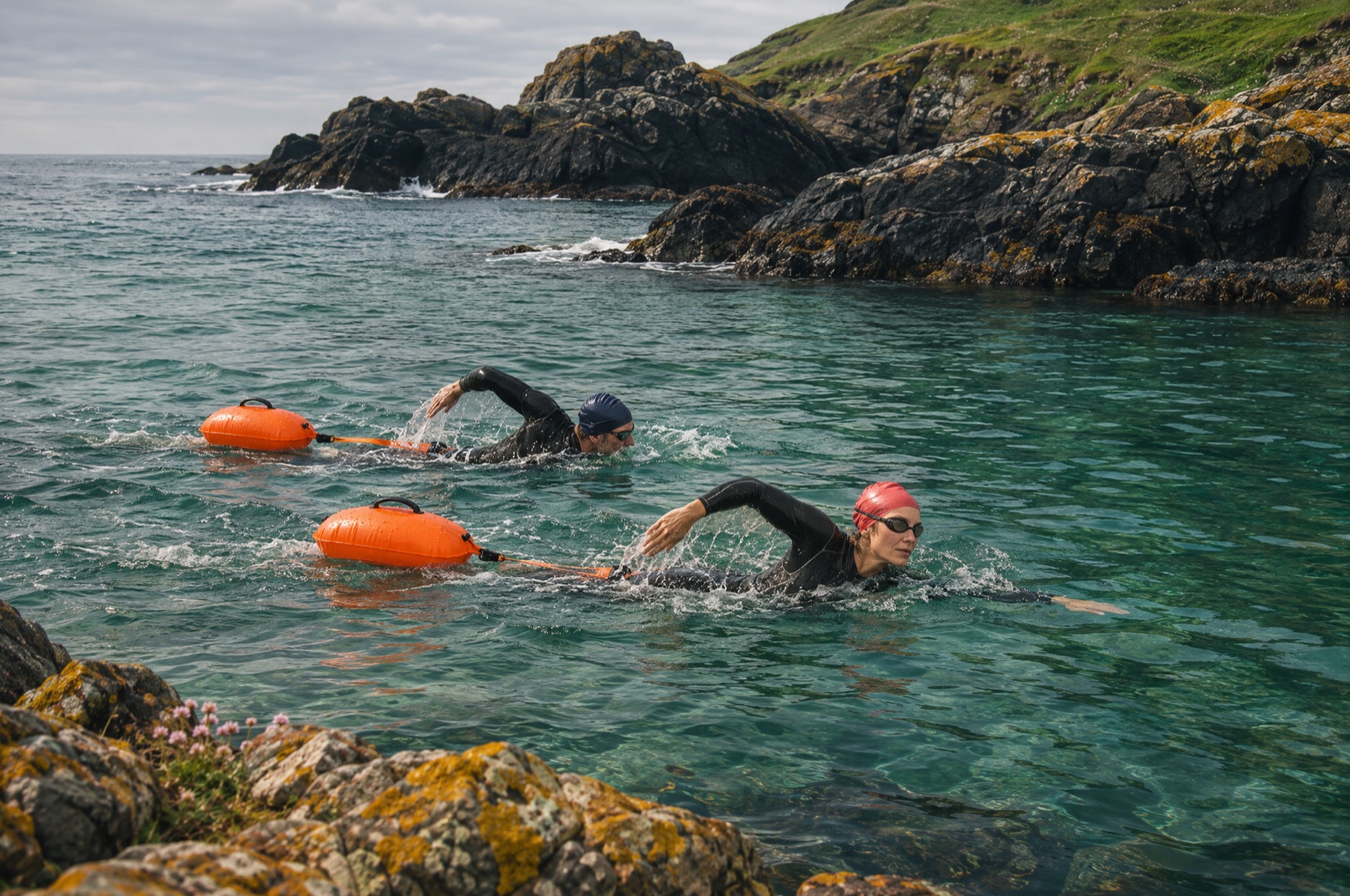
Most people come to triathlon from running or cycling. For them swimming is a new sport and the leg where it is easiest to take fright. In the first 6 weeks give most of your time in the water to technique: body position, breathing rhythm, relaxation.
What separates open water from the pool
| Difference | What it changes | How you train it |
|---|---|---|
| No line on the bottom | You drift sideways and swim extra meters | Sighting, which means lifting your eyes every few strokes |
| No wall | No break every 25 m | Continuous swims in the pool without pushing off the wall |
| Dark, cold water | A stronger gasp reflex and unease | First entries close to the shore, with someone beside you |
| Other people | Contact, waves, someone right on your feet | Swimming in twos and threes, breathing to the side |
| Wetsuit | More buoyancy, pressure on the chest | Several swims in it before the race, not the first time on race day |
| The sea | Waves, current and salt water | Entries and exits through small surf with someone experienced, more frequent sighting |
What the rules allow in the water
World Triathlon's rules give you more freedom than most people expect before a first race:
- You may swim any stroke, including breaststroke or backstroke.
- You may float and tread water.
- You may stand on the bottom or rest holding a buoy or a stationary boat, as long as you do not use it to move forward.
- In an emergency you raise an arm and call for help. Once you accept official assistance, your race is over.
A pause at a buoy to settle your breathing is neither a failure nor a breach of the rules. It is a normal part of a first race.
The swim cut-off: work out your margin
World Triathlon sets a maximum time in the water for age-group athletes, which is the federation's term for amateurs racing in age categories. Organizers may set a stricter limit, and some give none at all.
| Swim length | World Triathlon limit, age groups | Slowest pace that fits |
|---|---|---|
| 301–750 m, water below 31°C (87.8°F) | 30 min | 7:30/100 m over 400 m, 4:00/100 m over 750 m |
| 751–1,000 m | 50 min | 5:00/100 m over 1,000 m |
| 1,001–1,500 m | 1:10 | 4:40/100 m over 1,500 m |
In very warm water the limit is shorter. Limits also change between editions of the rules, so check the athlete guide of your own race. As a safe margin, aim for a pace at least a minute per 100 m faster than the slowest pace that fits, because in open water you swim more slowly and further than in the pool.
Fear of open water
Being afraid of swimming in a lake or the sea is normal. It also affects people who swim well in a pool, because it comes from something else: cold, crowding, poor visibility, breathing thrown off by stress.
What is known about the risk
The largest review is a case series from races in the United States between 1985 and 2016 (Annals of Internal Medicine, 2017). It covers 135 sudden deaths, cardiac arrests and trauma-related deaths. For USA Triathlon races from 2006 to 2016, close to 4.8 million participants, the rate of death or cardiac arrest was 1.74 per 100,000. It was 2.4 in men and 0.74 in women, and 18.6 in men aged 60 and over. Differences between short and long races were small. The swim accounted for 90 of the 135 events. An autopsy was performed in 61 cases, and 44% showed clinically relevant cardiovascular abnormalities, most often coronary artery disease or cardiomyopathy. The authors note that the list of cases may be incomplete. They also allow that the stress of a race start in the water plays a part, but that can be neither confirmed nor ruled out.
The risk is small but real, it is concentrated in the water and it rises with age. That is an argument for a medical check before the season, not for giving up. The authors recommend training in race conditions, a warm-up in the water before the start and bright swim caps, which make it easier to spot someone in trouble.
A symptom you must not wait out
Swimming-induced pulmonary edema (SIPE) is a rare condition in which fluid passes into the air sacs of the lungs during swimming. The symptoms are breathlessness out of proportion to the effort, a rattling chest, a cough, sometimes with frothy or blood-tinged sputum, and a feeling that the wetsuit is squeezing your chest too tightly. Risk factors include cold water, stress, high blood pressure, heart disease and drinking too much before the start. If it happens, get out of the water at once, call a lifeguard and seek medical help. The symptoms can return, so after such an episode you need to see a cardiologist.
A plan for getting used to it: small steps
- Calm breathing in the pool. Exhale into the water and hold a steady rhythm before you add speed.
- Lengths without the wall. In a side lane or a wide pool, over a gradually longer distance.
- The shallows of a lake or a sheltered bay. Go in with someone who knows the water, swim along the shore, stay where you can stand.
- The wetsuit. First in shallow water, then over short stretches. A well-fitting wetsuit is snug but lets you breathe normally.
- Buoy to buoy. No hurry, stopping to breathe and look around.
- Contact. One person swims close to you, then several. You learn that a touch in the water is usually an accident.
- A small trial race. A local event or a group open-water session before your main race.
Start tactics for an anxious swimmer
- Choose a rolling start. In this system athletes enter the water a few at a time or one by one, instead of all at once. It is now common at large events.
- Stand at the back and to the side. You lose a dozen or so seconds and gain calm.
- Warm up in the water if the rules and the organizer allow it. Putting your face in before the start clearly reduces the shock.
- Swim the first 100 m more easily than your head tells you to. Panic often comes from breathing too fast at the beginning.
- In trouble? Roll onto your back, breathe, swim to a buoy. If that does not help, raise an arm and call for help.
Gear and costs
For a first race you need less than the shops suggest. Buy safety first and speed later.
| Item | Needed? | Notes |
|---|---|---|
| Bike helmet | Mandatory | In good condition and fastened for the whole bike leg |
| Bike | Mandatory | Roadworthy, with working brakes. The permitted type depends on the race rules. |
| Swim cap | Usually in the race pack | Often you must wear the organizer's cap |
| Goggles | Yes, two pairs | The strap snaps at the worst moment |
| Race clothing | Something comfortable, a cheaper tri suit is fine | The torso must be covered, and nudity in transition is forbidden |
| Running shoes | Yes | The ones you train in |
| Race belt for the number | Very useful | Saves time and lets you turn the number to the front for the run |
| Wetsuit | Depends on the water | See below |
| Multisport watch | No | Useful but not required |
| Time trial bike, aero wheels | No | Unnecessary for a first race, and a time trial bike is banned in draft-legal races |
| Clipless pedals and cycling shoes | No | You can race in running shoes on flat pedals |
Which bike is allowed
The race rules decide, and the type of race matters more than the country:
| Type of race | What the rules usually say about the bike |
|---|---|
| Non-drafting age-group race, the usual format for amateurs | Road and time trial bikes, and often any roadworthy bike. Under World Triathlon rules you keep 12 m behind the rider ahead. |
| Draft-legal race, where riding in a group is allowed | Under World Triathlon rules only a road bike with traditional drop handlebars, with no clip-on aero bars |
| Novice and pool-based events | Typically any bike in safe condition, including a mountain bike or hybrid |
| Indoor triathlon | A stationary bike provided by the venue |
If you own a mountain bike or a hybrid, do not assume you cannot race. Ask the organizer and read the bike clause before you enter. If you are buying a bike with triathlon in mind, an ordinary road bike with drop bars is enough for a first race. Working brakes, pumped tires and a service a week before the race will give you more than any gadget. At check-in, officials can refuse a bike with a fault.
Do you have to buy a wetsuit
For a first race, often not. For age groups up to the 55–59 category and swims of up to 1,500 m, World Triathlon sets these thresholds:
- water at 15.9°C (60.6°F) and colder: wetsuit mandatory,
- water at 16–21.9°C: the choice is yours,
- water at 22°C (71.6°F) and warmer: wetsuit forbidden.
The temperature is measured an hour before the start, in three places, at a depth of 60 cm. So the purchase depends on where and when you race more than on the distance. In a northern lake in late spring the water can sit right at the mandatory threshold. In midsummer, and for most of the year in the tropics, a wetsuit bought for the race may stay in the bag on the day. It does give buoyancy and calm, so if you badly need one, choose an earlier race or cooler water. The rules allow a maximum thickness of 5 mm. A surfing wetsuit is not suitable, because it restricts the shoulders.
These thresholds are World Triathlon's. Other rulebooks differ: IRONMAN events typically allow age-group athletes a wetsuit up to 24.5°C (76.1°F), and ordinary races under USA Triathlon rules up to 78°F (25.6°C). National federations may add their own variations, so the athlete guide of your race decides. The page on triathlon organizations explains who is responsible for what.
What a first race costs
Prices differ so much between countries and events that a single figure would mislead. The structure of the bill is the same everywhere, though, and that is what you can plan around.
| Item | What to expect | How to keep it down |
|---|---|---|
| Entry fee | A small club or community race costs a fraction of a big branded event. Fees rise in steps as race day approaches. | Enter early, start local |
| License or membership | Many federations require one to race. Non-members usually buy a day license: USA Triathlon, for example, sells a one-day membership priced by race distance. | Check before entering whether it is included in the fee |
| Medical paperwork | Mostly a signed declaration. A few countries ask for more: race rules in Italy, for example, require a medical certificate for triathlon from entrants who are not members of a federation. | Read the entry requirements before you book travel |
| Wetsuit | Buying is the largest single cost after the bike | Borrow or rent for the first race |
| Small items | Goggles, a race belt, elastic laces | These are cheap. Buy them and train with them. |
| Travel | Fuel, sometimes a night nearby | Pick a race within 2 hours of home |
The biggest saving is entering early. Check the withdrawal terms as well: many races do not refund the fee, charge for transferring an entry to another person, or sell a separate cancellation option at registration.
A simple rule for equipment: if you do not know yet whether you will stay in triathlon, borrow a wetsuit or rent one for your first race. With a working bike and a helmet you can start for the price of the entry, the license and a pair of goggles. A time trial bike is an expense for later, usually after a few races over longer distances.
The transition area
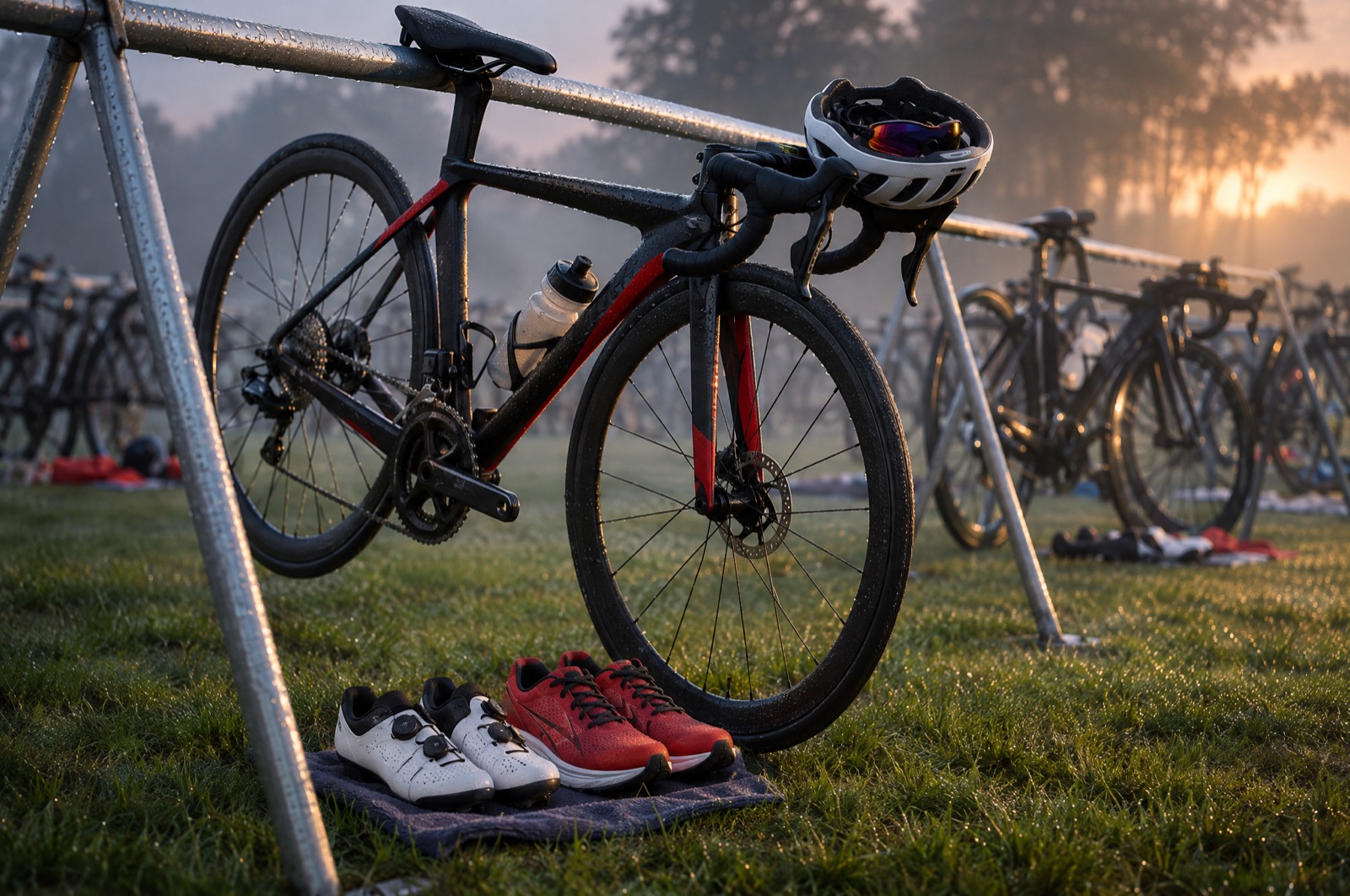
The transition area is where you leave your bike and change from one leg to the next. T1 is the change from swim to bike, T2 from bike to run. In a first race it is easy to lose minutes here and even to be disqualified, although a few rules are enough to avoid both.
Transition time depends largely on the layout of the area, which you cannot influence. Just the 300 m run up from the water takes 1:48 at 6:00/km, before you touch the bike. What you can influence is your routine: 2–3 sessions of transition practice in the last 4 weeks can save 2–4 minutes.
Setting out your spot
- The bike hangs on the rack, usually the way the organizer indicates.
- On the ground on the side of your bike: a small towel if the rules allow it, cycling or running shoes, the number on its belt.
- The helmet on the handlebars or the rack, upside down with the straps out and your glasses inside.
- Socks, if you use them, rolled so that you can pull them on in one movement.
- A bottle on the bike, a gel or bar taped to the frame or tucked in a pocket.
Memorize the route: in from the water, the way to your rack, out with the bike, back with the bike, the way out to the run. Walk it in the morning. Marking your position is forbidden, and marks, towels and objects used for marking are removed without notice. Instead, count the racks from the entrance and find a landmark such as a lamp post or a tree.
Mistakes that cost you the race
| What happens | Consequence under World Triathlon rules | How to avoid it |
|---|---|---|
| Taking the bike off the rack with the helmet unfastened | A penalty, and on the course even disqualification. The helmet must be fastened from the moment you take the bike until you rack it after the leg. | Helmet first, then bike. Always in that order. |
| Riding in transition before the mount line | Disqualification if you do not mount at the line and ride out of transition | Run with the bike to the line and mount after it, with a full foot on the ground |
| Not getting off before the dismount line | Disqualification if you make no attempt to dismount and ride into transition | Slow down early, get off before the line |
| Undressing in transition | Nudity is forbidden | Race clothing under the wetsuit |
| Stopping in the flow lane | Forbidden, because you block others | Stand at your own spot |
| Kit or bike outside your spot | A penalty for racking the bike or leaving equipment incorrectly | Bike on the rack, kit in its place |
| Giving another athlete your bike, a wheel or a helmet | Disqualification of both people | A pump or an inner tube is allowed, complete equipment is not |
Under World Triathlon rules, time penalties in a sprint are 10 seconds, and 30 seconds for drafting. In shorter events the penalties for other infringements are 5 seconds. National federations and IRONMAN events apply their own rules, so treat this as a reference point.
How to read the race rules
You read the athlete guide twice. Before you enter, you check whether you can race. A week before the event, you check exactly what you have to do. Give most attention to ten points:
- Distance and course. The real meters and kilometers of each leg, not the label.
- Cut-offs. How long for the swim, for the swim plus the bike, for the whole race.
- License. Whether you need an annual or one-day federation membership to collect your race pack, and whether you buy it online in advance.
- Medical requirements. A declaration, a questionnaire or a doctor's certificate. This varies by country, and visitors from abroad are not exempt.
- Drafting. Whether you may ride on someone's wheel. In non-drafting races under World Triathlon rules the draft zone is 12 m (39 feet) and you have 25 seconds to complete a pass. National rules and race series may give other values.
- Bike. Permitted types and handlebars.
- Transition timetable. When you check the bike in and when you can collect it. Large events often require check-in the day before.
- Traffic on the course. Whether the road is closed. On an open road you obey normal traffic law.
- Refunds and transfers. Deadlines and fees.
- Age. World Triathlon requires 15 years for a super sprint, 16 for a sprint and 18 for the standard distance. National federations and organizers can set their own conditions.
Headphones may not be used on any leg under World Triathlon rules, and most national rulebooks say the same. Outside help is limited to race staff, so your family cheers but does not ride alongside. Athletes in the same race may help each other with small things such as a pump or an inner tube, as long as it is not a bike, a frame, a wheel or a helmet.
A camera or a phone camera without the organizer's permission means disqualification under World Triathlon rules. A phone must not be used in a distracting way during the race either. A watch can stay on your wrist.
Race day step by step
Part of the nerves at a first race comes from not knowing what happens next. Take the times from the event schedule. The outline below is for a short race and shows the order, not fixed times.
| When | What you do | What to watch |
|---|---|---|
| The day before | Pack your bag, check brakes and tires | Dinner without experiments |
| About 3 hours before the start | A breakfast you know from training | Nothing new, in your drinks either |
| On arrival | Registration, race number, timing chip | ID and license to hand |
| While transition is open | Bike on the rack, kit in place, a walk through the routes | The time transition closes |
| 30–40 minutes before the start | Wetsuit, cap, goggles, race briefing | A warm-up in the water if it is allowed |
| Start | A place at the back and to the side, an easy first 100 m | Breathing, not pace |
| After the finish | Drink, eat, collect the bike | The hours when bikes are released from transition |
Pack your bag from a list, not from memory: helmet, two pairs of goggles, wetsuit if you use one, race clothing, shoes, race belt, towel, bottle, sunscreen, ID and license if needed. Take dry, warm clothes for after the finish as well, because once your heart rate drops you cool down fast. In hot weather add a hat and extra water for the wait before the start.
What can go wrong
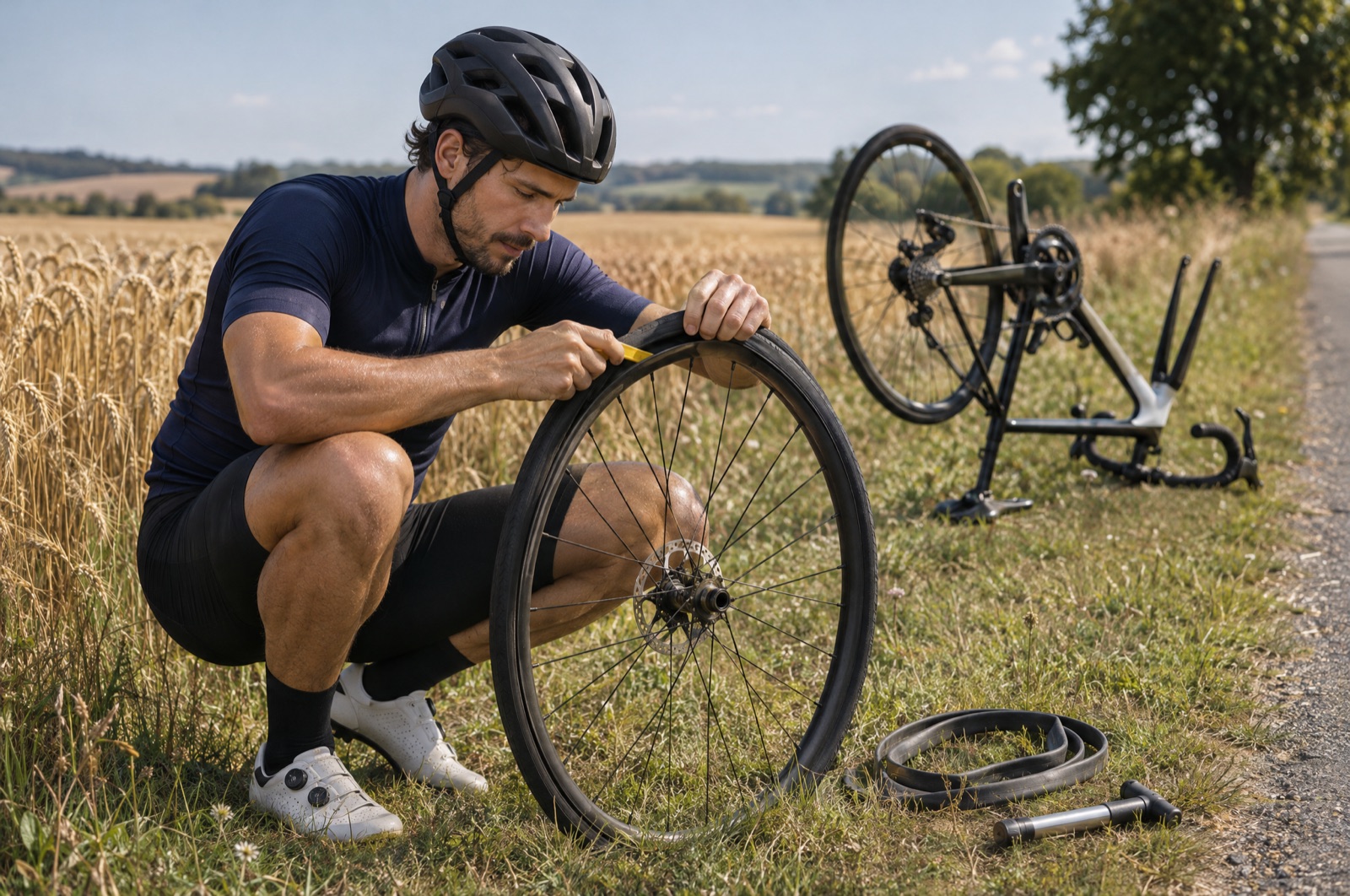
The list looks alarming, but most of these things call for a quick decision and do not end your race.
| Problem | What you do | How to prepare in advance |
|---|---|---|
| A goggle strap snaps just before the start | The second pair | Two pairs in the bag |
| A panic attack after 100 m | Onto your back, breathe, a buoy, if needed a kayak and help | Group practice, a place at the back |
| A calf cramp in the water | Relax the foot, stretch it out, swim with your arms | A warm-up, regular training in the wetsuit |
| You cannot find your bike | Stop for three seconds, check the row | A landmark, a walk through the route in the morning |
| A puncture | Pull over, change the tube or walk to technical support | A tube, tire levers, a pump or CO2 cartridge and a rehearsal at home |
| A dropped chain | Stop safely, put it back by hand | A check of the drivetrain after servicing |
| Legs like wood after the bike | An easy first kilometer. It passes by itself after a few minutes. | A short run off the bike once a week towards the end of the build-up |
| You miss a cut-off | Finish the leg as well as you can. An official will tell you the decision. | Checking your margin, choosing a race with a longer limit |
| Cold water, swim shortened | Listen to the briefing. At 12–12.9°C a 750 m swim stays and a 1.5 km swim is cut to 750 m. | Spare clothes, calm acceptance of the change |
| Swim canceled | Cold, very warm water or poor water quality can turn the race into a duathlon. World Triathlon rules then prefer a duathlon with a shorter first run. | Stay calm. Your legs will do the work anyway. |
| Heat | An easier pace, cooling with water or a sponge if the organizer provides them | Sessions in the heat before the race |
| Chest pain, dizziness, breathlessness | Stop at once and go to the medical team | A medical check before the season |
The most common mistakes in preparation
- Training only what you like. The runner runs and the swimming gets dropped. It is swimming that decides whether you reach T1 calm.
- No run off the bike. The first such run on race day is a poor idea.
- New equipment on race day. You test new clothing, shoes and gels in training.
- Constantly catching up. A missed session is simply gone. Squeezing it into the following days raises the risk of injury.
- Starting the bike too hard. In a sprint an even ride pays well, and riding too hard can take more from the run than it gave on the bike.
- Not eating before the start. For a sprint a normal breakfast eaten early enough and water are usually sufficient. Fueling during the race becomes a subject of its own only at longer distances.
The stages of preparation in numbers
A plan from zero has three stages and a short reduction in load before the race. These are principles and proportions, not a ready-made schedule. A specific week depends on your weakest sport and the time you have.
| Stage | Job | Per week | Sign that you are ready for the next stage |
|---|---|---|---|
| Introduction | Swim technique, easy riding, walk-run, strength | 4–5 sessions | You swim 200–400 m calmly and run without pain |
| Build | Continuous swimming, a longer ride, runs off the bike | 5–6 sessions, 5–8 hours | You swim the race distance in one go, and the run off the bike does not hurt |
| Race-specific part | Open water, transitions, race pace, food and equipment | 5–6 sessions | A dress rehearsal starts calmly and ends without a crisis |
| The last 7–10 days | Less volume, light efforts | Less than usual | You feel restless and your legs are fresh. That is normal. |
At IMI the plan starts with tests: the Cooper test (a 12-minute run) or a 5K for the run, FTP (threshold power) on the bike and a 200 m swim. Without a power meter the coach builds the bike plan on heart rate. A real human coach in the app updates the plan every week, and at the beginning that is exactly what counts: a plan that responds to the pace at which you are learning the water.
How to choose your first race
Wherever you live, the national federation's calendar and local clubs are the best place to look, and most countries with an active triathlon scene have short races suited to beginners. Start from the criteria below.
| Criterion | Better for a first race | Why |
|---|---|---|
| Water | A pool, a calm lake or a sheltered bay, a visible course, a rolling start | Fewer nerves at the beginning |
| Date | The middle of your local season rather than its first weekend | Warmer water than at the season opener, and more weeks to prepare. In the northern hemisphere that tends to mean July or August, in the southern January to March. |
| Climate | In hot, humid places, an early start time and the cooler months | Heat on the run is harder to manage than a slow swim |
| Bike course | Closed roads, flat, no rough surface or sharp corners | Safer |
| Cut-off | More than 20 minutes for a short swim and more than 2 hours overall | A margin for a bad day |
| Size | A medium-sized, well-organized event | Lifeguards on the water and other first-timers around you |
| Travel | Up to 2 hours, or a night on site | You do not need extra stress in the morning |
| Family | A spectator zone, a short run loop | They see you more than once |
Beginner formats around the world
Short races for first-timers exist wherever the sport is established, under different names. The distances vary from event to event, so treat the examples as illustrations.
| Where | What it is called | Typical format |
|---|---|---|
| World Triathlon rules | Super sprint | 250–500 m swim, 6.5–13 km bike, 1.7–3.5 km run |
| Canada | Try-a-Tri | For example 375 m, 10 km and 2.5 km |
| Australia | Enticer | An entry-level distance below the sprint, set by each event |
| United Kingdom | Novice and pool-based events | A short swim in a pool, then a bike and run of a few kilometers each |
| United States | Indoor triathlon in a fitness club | Timed legs, for example 10 minutes in the pool, 30 on a stationary bike and 20 on a treadmill |
A pool swim removes the two things beginners fear most, deep water and a mass start, because swimmers set off a few at a time in lanes. It is a good first step, as long as open water appears in your training before you enter a lake or sea race.
Other ways to get a first taste
- A relay. Many events have relay teams. You can swim and hand the rest to friends, or take the bike or the run and see transition from the inside.
- An aquathlon or aquabike. Swim and run, or swim and bike. Two sports instead of three, with the same open-water start.
- An indoor triathlon. No lake and no outdoor transition, but a low-pressure test of the format in the off-season.
- A duathlon. Run, bike, run. If only the water is holding you back, see what a duathlon training plan looks like.
Frequently asked questions
Can I do a triathlon if I cannot swim freestyle?
Yes. World Triathlon rules allow any stroke. You can finish with breaststroke too if you stay inside the cut-off, but freestyle is usually faster and more economical.
How long does it take to train for a first triathlon?
Usually 12–16 weeks at 5–8 hours a week, if you can already swim continuously and you run and ride for leisure. If you are learning to swim from scratch, add time for lessons.
What distance should I choose for my first triathlon?
Most often a sprint, or a super sprint or novice race if swimming is your weakest sport. Check the meters in the race information, because the labels can mislead.
Do I need a road bike for a triathlon?
Not always. Many non-drafting and novice races accept different kinds of bike, but rules vary, and draft-legal races require a road bike with drop handlebars. Check the bike clause and ask the organizer.
Is a wetsuit mandatory in a triathlon?
Only in cold water: under World Triathlon rules at 15.9°C (60.6°F) and below. At 22°C (71.6°F) and above a wetsuit is forbidden for age groups up to 55–59 in swims of up to 1,500 m. IRONMAN and USA Triathlon use higher upper limits, so check the rules of your race.
Do I need a license or a medical certificate to race?
It depends on the country. Many federations require an annual or one-day license, bought with the entry or separately. Most races ask only for a signed health declaration, while some countries, Italy among them, ask for a doctor's certificate. Have a medical check before the season in any case.
What should I wear for my first triathlon?
A tri suit worn from the swim to the finish is the simplest option, but a swimsuit with cycling or running shorts works too. Your torso must be covered and nudity in transition is forbidden, so put on everything you race in before the swim, under the wetsuit if you use one.
What if I cannot swim the whole distance without stopping?
You can rest holding a buoy or a boat, stand on the bottom, change stroke or lie on your back. The one thing you must not do is use an object to move forward.
How much does a first triathlon cost?
The fixed items are the entry fee, a license if one is required, and travel. Small local races cost a fraction of big branded events, and early entry is the cheapest. If you have a working bike and a helmet, equipment does not have to be a major expense, especially if you rent or borrow a wetsuit.
Is a pool-based triathlon a good first race?
Yes. The swim is short, the water is warm and clear, and swimmers start a few at a time, so the two hardest parts of a first race are removed. Before a later open-water race you still need several sessions in a lake or the sea.