Contents
- The long race between the 10K and the marathon
- What changes after the 10K
- Training phases: 12 to 16 weeks
- Fueling and hydration
- How to pace the race
- Common half marathon training mistakes
- Three different starting points
- How the block changes when life interferes
- Where it usually hurts
- Choosing a race: season, climate and course
- The half marathon as a test before a marathon
- World records and the history of the distance
- Safety
- When a coach makes sense
- Frequently asked questions
Choose your goal






Pace calculator
Splits
| Point | Split pace | Time |
|---|
Equivalent results
| Distance | Estimate |
|---|
Estimated with the Riegel formula. Most amateurs slow down more than this over longer distances.
The long race between the 10K and the marathon
The half marathon is long enough for a big goal and short enough to train for alongside work and family, which is why so many runners pick it as their first long race. Many city marathons put on a half marathon the same weekend, and standalone halves fill the spring and autumn calendars on every continent.
Big races fill early, some of them many months ahead, so choose your race first and then count the weeks back.
What recreational runners actually run
No official statistic covers every half marathon in the world. The best published picture of a big city field is a study of the Vienna half marathon: 133,268 finishers from 2006 to 2018, 91,145 men and 42,123 women, split by placing into four equal quarters.
| Quarter of the field | Men, average time | Women, average time |
|---|---|---|
| Fastest | about 1:37 | about 1:51 |
| Second | about 1:52 | about 2:06 |
| Third | about 2:03 | about 2:17 |
| Slowest | about 2:23 | about 2:36 |
The times are our conversion of the study's average speeds, so read them as approximate. The middle of the men's field sits between 1:52 and 2:03, and the middle of the women's field between 2:06 and 2:17. In Vienna, two hours is a mid-field time for a man and in the faster half for a woman.
Age matters less than most people expect. In a study of about 300,000 marathon and half marathon runners, average times were almost identical between the ages of 20 and 49 and slowed by only 2.6–4.4% per decade between 50 and 69.
What changes after the 10K
On paper the half marathon is a stretched 10K, and the pace drops only a little. What changes is what limits you. With a 2:00 goal you run at about 88% of your speed in the 12-minute Cooper test, on the border between our Tempo and Threshold zones. Your breathing stays under control, but your legs absorb about 20,000 steps.
| 10K | Half marathon | Marathon | |
|---|---|---|---|
| Time for a 50:00 10K runner (Riegel formula) | 50:00 | 1:50:19 | 3:50:01 |
| Pace relative to Cooper test speed | about 92% | about 88% | 85% at most |
| Main limiter | Threshold pace | Muscular endurance and tolerance for a monotonous pace | Fuel and tissues |
| Fueling during the race | Usually unnecessary | Useful beyond about 90 minutes | Essential |
| Preparation time | 8–12 weeks | 12–16 weeks | 16–20 weeks |
At this distance a prediction is still trustworthy. In a study of 2,303 recreational runners the Riegel formula was a good fit for the half marathon and broke down only at the marathon, so a forecast from a solid 10K is reasonable if you train the volume the distance demands.
How much volume buys
In the same study the link between weekly mileage and speed was similar at every distance from 5K to the marathon. The principle stays the same, and only the minimum rises: 25 km (16 miles) a week can be enough for a decent 10K, but your legs will rarely get through 21 km at race pace on that. Tempo runs were associated with a 4.4% faster half marathon and intervals with 3.7%, so tempo runs counted for less than at 10K.
Time goals in numbers
| Goal | Pace per km | Pace per mile | Cooper test, approx. | Aim |
|---|---|---|---|---|
| 2:15 | 6:24 | 10:18 | 2,150 m | finish |
| 2:00 | 5:41 | 9:09 | 2,400 m | improve |
| 1:50 | 5:13 | 8:23 | 2,610 m | race the clock |
| 1:40 | 4:44 | 7:38 | 2,850 m | race the clock |
| 1:30 | 4:16 | 6:52 | 3,150 m | race the clock |
A 2:00 half marathon and a 4:00 marathon are exactly the same pace, 5:41/km (9:09/mile), as are 1:30 and 3:00 at 4:16/km (6:52/mile). On race day the two efforts are far apart. To run a 4:00 marathon you need a half marathon of about 1:50 rather than 2:00, because the formula with an exponent of 1.12 turns 1:50 into roughly 3:59.
Training phases: 12 to 16 weeks
A full block usually takes 12–16 weeks. Twelve weeks fit if you comfortably run 25–40 km (16–25 miles) a week. Sixteen suit runners coming back to the sport or moving up from 5K or 10K. Without a running base, start with half marathon training from zero.
Count the block back from race day and look at the season it lands in. A race in early spring puts the base phase in midwinter, and a race in early autumn means long runs in summer heat, whichever hemisphere you live in. On ice or in heat, plan the long run by time, not pace, and move race-pace work to clear days, cooler hours or a treadmill.
| Phase | Timing in a 16-week block | What happens |
|---|---|---|
| Base | weeks 1–5 | Aerobic volume and the long run grow. Strides, hills, strength work is introduced |
| Build | weeks 6–12 | Threshold running and work at race pace. Progressive long runs |
| Peak and taper | weeks 13–16 | The longest run, then volume falls and the hard sessions get short and fast |
Weekly numbers
| Goal | Running days | Peak weekly volume | Longest run |
|---|---|---|---|
| First finish, 2:15 | 3–4 | 35–45 km (22–28 miles) | 18–22 km (11–14 miles) |
| 2:00 | 4 | 45–60 km (28–37 miles) | 20–22 km (12.5–13.5 miles) |
| 1:50 | 4–5 | 50–65 km (31–40 miles) | 20–22 km (12.5–13.5 miles) |
| 1:40 | 4–5 | 55–75 km (34–47 miles) | 20–23 km (12.5–14.5 miles) |
| 1:30 | 5–6 | 65–90 km (40–56 miles) | 22–24 km (13.5–15 miles) |
This is our reference point, not a promise. Three days is the realistic minimum and four is the optimum for a time goal. How to arrange the week on three is covered on the page about half marathon training on 3 runs a week. More than five days rarely helps someone who does not have many years of running behind them.
Three sessions that drive progress
- The long run. It grows gradually. Several runs of 16–20 km (10–12.5 miles) do more than a single record one. Late in the block, part of the long run can be at race pace if there is time to recover afterwards.
- The threshold run. With a time goal it usually gives the most: repeats of a few kilometers or a continuous stretch at a "comfortably hard" effort in the Threshold zone.
- Race-pace work. It teaches you to hold a rhythm and to eat on the move.
A week in numbers
With a 2:00 goal, 45 km (28 miles) and 4 runs a week, the proportions can look like this: a long run of 16–20 km (10–12.5 miles), about 8–10 km (5–6 miles) of work near Threshold or at race pace, and the rest at conversational pace. For a first finish on 35 km (22 miles) the long run can be as much as half the week, so keep the other runs short and easy. Treat this as proportions, not a plan.
How to extend the long run
In a study of 5,205 runners and 588,071 runs, a single run more than 10% longer than the longest of the previous 30 days was associated with about 1.5–1.6 times the risk of an overuse injury, and more than doubling it with about 2.3 times. Changes in weekly volume alone showed no such link. Going from 14 to 18 km (8.7 to 11.2 miles) in one week is therefore riskier than adding a kilometer at a time, even when the weekly total looks modest.
This is an observation, not an experiment, but lengthening the long run cautiously is a sound habit.
Intensity distribution
Most of the volume at conversational pace, a smaller part near Threshold and the least above it: that is a pyramidal distribution. A polarized distribution has almost nothing in the middle. A meta-analysis of 13 studies and 348 athletes found no overall difference between the two, and for recreational runners the pyramid may have given more. Half marathon pace sits right next to the Threshold zone, so threshold work stays in the plan.
Tapering for a half marathon
Tapering is the planned reduction of volume before a race. A meta-analysis pointed to 2 weeks and a 41–60% cut in volume, with intensity and frequency unchanged. For a half marathon a sensible range is 10–14 days. The longest run usually falls 2–3 weeks before race day. The final week is short, with one session at race pace.
Fueling and hydration
This is the first distance at which fueling on the course can make a difference, although it is not always necessary. Running costs about 1 kcal per kilogram per kilometer, so for a 70 kg (154 lb) runner roughly 1,500 kcal over the race. Typical carbohydrate stores in the liver and legs are around 1,600 kcal, and part of the energy comes from fat anyway.
That is why below about 90 minutes fuel rarely limits the result. In a longer race, start eating on the course: from about 30 g of carbohydrate per hour up to about 60 g for efforts of 2–3 hours. Allow for the risk of stomach trouble.
| Finish time | What makes sense |
|---|---|
| Under 1:30 | A small dose, for example one gel, or a mouth rinse |
| 1:30–2:00 | About 30–40 g over the whole race, one or two gels |
| Over 2:00 | 30–60 g per hour, taken regularly |
Test it on your long runs. A stomach that has never had a gel at race pace may react badly on the one day it matters.
Water is simpler: drink to thirst. Hyponatremia, a blood sodium level that is too low because of excess fluid, affected 13% of the runners studied at the Boston Marathon, and the strongest risk factors were weight gain during the race and a finish time over 4 hours. The risk is lower in a half marathon, but there is no reason to drink more than thirst asks for.
Caffeine can help. The dose supported by research is 3–6 mg per kilogram of body weight, most often 60 minutes before the effort. Try it in training first.
How to pace the race

World-class athletes run the half marathon in a U shape: fast at the start, slower in the middle and with a strong finish. That is a tactic for winning races. A recreational runner gains more from an even race: the first 3–4 km (about 2 miles) 3–5 seconds per km (5–8 seconds per mile) slower than goal pace, the middle exactly on pace, the end faster if there is anything left.
Results from 133,268 finishers of the Vienna half marathon between 2006 and 2018 show what happens otherwise. Every quarter of the field slowed down, but the fastest quarter of men lost under 5% of their speed between the first 5 km and the stretch from 15 to 20 km, and the slowest quarter lost 13%. Most collapses appear around km 16–18 (miles 10–11) and often come from a first 5 km that was too fast. Only if you feel good at 15 km (just past mile 9) have you earned the right to speed up.
If you are 15 seconds down at 10 km, do not win them back in one kilometer. You will recover them at the end if the strength is there.
Weather, course and start time
At large races you start in waves and your result is your net (chip) time, measured from the moment you cross the start line, so there is no need to rush after the gun.
An analysis of marathons put the best temperatures at 3.8–9.9°C (39–50°F), and marathon data from seven North American races show that slower runners lose more in the heat than fast ones. At the Gothenburg half marathon, over seven editions and 315,919 starters, every extra degree between 15 and 29°C (59–84°F) meant about 107 more runners who did not finish. In warm weather plan a slower start.
Shoes
Models with a carbon plate lowered the energy cost of running by about 4% in high-level runners at 14–18 km/h, which is 4:17–3:20/km (6:54–5:22/mile). At 5:41/km there is no evidence that strong. Keep that in mind before you buy, and do not race in shoes you have not run in.
Common half marathon training mistakes
- Training as for a longer 10K. The same volume with more intervals is rarely enough for the last part of 21 km.
- Only one long run. A single 20 km (12.5-mile) run before the race does not build endurance. You need several.
- A fast first 5 km. Starting a half marathon at 10K pace is the shortest route to walking at km 18.
- The first gel on race day. Test your fueling in training.
- New socks, new shoes, new kit. Over 2 hours a small rub turns into a serious problem.
- Making up missed sessions. A missed week is gone. Two hard sessions back to back after a break invite injury.
- A goal chosen for its round number. A finish under 2:00 needs fitness worth about 2,400 m in the Cooper test. At 2,200 m a more sensible goal is about 2:12.
Three different starting points
| Situation | Main problem | What comes first |
|---|---|---|
| First half marathon after 10K | Your legs have never worked this long | A gradual long run, easy pace, eating on the course |
| Another half marathon with a time goal | Threshold pace and rhythm | Threshold running, race pace, the quality of the last part of long runs |
| Half marathon after a marathon | Speed and recovery | Less volume, more speed, rest after the previous block |
How the block changes when life interferes
| Situation | What a coach does |
|---|---|
| Two long runs were missed | Goes back to the last distance you actually ran and extends it a kilometer at a time, instead of jumping to the distance on the schedule |
| A cold 3 weeks before the race | Shortens the longest run, starts the taper earlier, sometimes lowers the goal |
| A gel causes stomach problems | Tests another product and a smaller dose on the next long runs |
| The long run always falls apart after 15 km | Checks pace, fueling and fatigue from the previous days before judging your fitness |
| The forecast says 18°C (64°F) and sunshine | Plans slower opening kilometers and a less ambitious goal, and reminds you to drink to thirst |
Where it usually hurts
In a review of 36 studies and 10,688 injuries, 70% involved the knee or the leg below it: knee 28%, foot and ankle 26%, lower leg 16%. In studies that separated the sexes, the knee accounted for 40% of injuries in women and 31% in men. The most common diagnoses were patellofemoral pain (17%), Achilles tendinopathy (10%) and medial tibial stress syndrome (8%). If pain does not settle or changes your stride, drop the hard sessions and see a specialist.
Choosing a race: season, climate and course
Seasons are reversed across the equator, so "a spring half" means March to May in Europe or North America and September to November in Australia, South Africa or South America. In the tropics the hour matters more than the month, and races start before dawn.
| Race | Usual month | Worth knowing |
|---|---|---|
| Lisbon, Portugal | March | Jacob Kiplimo ran 57:20 here in 2026 |
| Berlin, Germany | late March or early April | Pacers from 1:25 to 2:30, time limit 3:15 |
| Buenos Aires, Argentina | August | A winter race in the Southern Hemisphere. Men's world record, 56:51 in 2026 |
| Copenhagen, Denmark | September | Start groups by goal time, pace teams from 1:25 to 2:30, time limit 3:00 |
| Valencia, Spain | October | Women's world record in a mixed race, 1:02:52 in 2021 |
| Singapore | December | 4:30 am start, time limit 3:45 |
Dates and limits are those of the most recent editions, checked in November 2026, so confirm them on the organizer's page. For a fast time, look for a cool month, pacers at your goal and a flat, record-eligible course: start and finish no more than half the race distance apart and a drop of no more than 1 m per km. For a first finish, look at the time limit and how it is measured, which we explain on the sub-2:15 page.
The half marathon as a test before a marathon
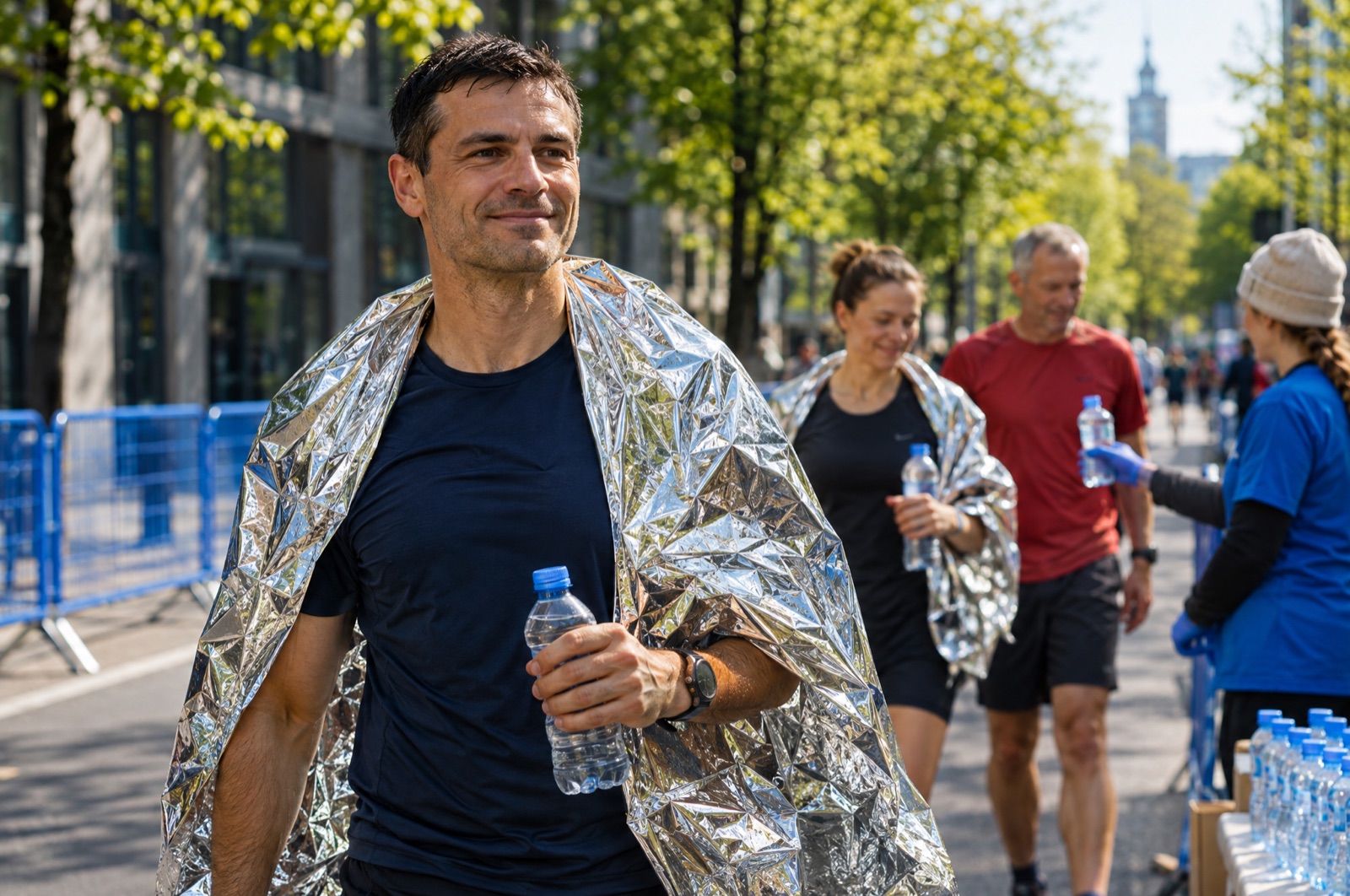
A well-run half marathon 4–6 weeks before a marathon is the best single test there is. Do not multiply the result by two, and do not trust the Riegel formula blindly. The table shows the prediction for three exponents of the formula: the higher the exponent, the more you slow down over the longer distance.
| Half marathon | Marathon at 1.06 | At 1.12 | At 1.15 |
|---|---|---|---|
| 1:30:00 | 3:07:39 | 3:15:37 | 3:19:43 |
| 1:40:00 | 3:28:30 | 3:37:21 | 3:41:55 |
| 1:50:00 | 3:49:21 | 3:59:05 | 4:04:06 |
| 2:00:00 | 4:10:12 | 4:20:49 | 4:26:18 |
| 2:15:00 | 4:41:28 | 4:53:25 | 4:59:35 |
Among 164,746 British runners the median individual exponent was 1.12, and the 5th and 95th percentiles were 1.10 and 1.15. The first column is therefore for the best-prepared runners. You can run your own numbers in the pace calculator.
World records and the history of the distance
The 21.0975 km distance has no history of its own. It is simply half a marathon. Races of about that length appeared early in the 20th century, and world championships began in 1992.
The men's world record has moved quickly. Jacob Kiplimo ran 57:20 in Lisbon on March 8, 2026, and Yomif Kejelcha took it to 56:51 in Buenos Aires on August 23, 2026, a mark World Athletics ratified in November 2026. Kiplimo's 56:42 from Barcelona in 2025 was never ratified. The women's record in a mixed race is 1:02:52, run by Letesenbet Gidey in Valencia on October 24, 2021.
A time of 56:51 averages 2:42/km (4:20/mile), or about 13:28 for every 5 km. Gidey's record is 2:59/km (4:48/mile).
Safety
Cardiac arrest at mass-participation races is very rare. A US registry covering 29.3 million finishes between 2010 and 2023 reports 0.47 cases per 100,000 participants in the half marathon and 1.04 in the marathon. The most common identified cause was coronary artery disease. If you have chest pain, palpitations, dizziness or shortness of breath, stop and ask for help. Before your first race of this kind, especially after 40 and with risk factors, have a check-up with your doctor.
When a coach makes sense
A block of 12–16 weeks leaves plenty of room for a cold, a trip and a bad week at work. At IMI a real coach builds your plan in the app after a test (the Cooper test or a 5K run) and updates it every week. If you prefer to guide yourself, stick to the principles on this page and watch your longest run.
Frequently asked questions
How long does it take to train for a half marathon?
12–16 weeks if you already run regularly. Without a running base, add a few months to build up to continuous running first.
What is a good half marathon time?
It depends on the field, your age and your sex. In the Vienna half marathon (133,268 finishers from 2006 to 2018) the middle of the men's field sat between 1:52 and 2:03 and the middle of the women's field between 2:06 and 2:17. Two hours there is an average time for a man and a good one for a woman.
Do I need to run 21 km (13.1 miles) in training before a half marathon?
With a time goal, usually yes: 20–22 km (12.5–13.5 miles) about 2–3 weeks before the race. If you simply want to finish your first half marathon, 18–20 km (11–12.5 miles) is enough.
How many miles a week should I run for a half marathon?
At the peak of the block, from 35–45 km (22–28 miles) for a first finish to 45–60 km (28–37 miles) for 2:00 and 65–90 km (40–56 miles) for 1:30. The weekly numbers table above gives every goal in between.
How many days a week should I run for a half marathon?
Three is the minimum and four is the optimum for a time goal. Five makes sense for more experienced runners.
Do I need a gel for a half marathon?
For a finish under 90 minutes, usually not. Around 2 hours, one or two gels help you hold the pace. Test them on long runs beforehand.
What should I eat before a half marathon?
A carbohydrate-rich meal that you have already tested before long runs. The ACSM position stand gives 1–4 g of carbohydrate per kilogram of body weight 1–4 hours before exercise, which for 70 kg (154 lb) is 70 to 280 g. Full carbohydrate loading as before a marathon is usually not needed.
How can I predict my half marathon time?
Take your latest 10K result and multiply it by about 2.2. That is the Riegel formula's prediction, which is fairly accurate at this distance. You can do more conversions in the pace calculator.
How long should I rest after a half marathon?
Usually a few days without running or with light movement, then about a week of easy, shorter runs. Hard sessions come back when your legs stop hurting on the stairs and an easy run feels free again.