Contents
- The short answer
- Couch to marathon: where 12–18 months comes from
- When it makes sense and when to wait
- How many hours a week it really takes
- Overuse risk: legs adapt more slowly than the heart
- The half marathon as a test before you decide
- The long run for slower runners
- What extra volume gives you
- The wall: what the data say
- Cut-offs and entries: what the big races require
- How long your marathon will take
- How to run your first marathon
- What to do today
- Frequently asked questions
The short answer
Marathon training from zero, for the full 42.195 km (26.2 miles), makes sense if your health allows it, if you will have time for 4–5 runs a week at the peak of preparation, and if no deadline is chasing you. It does not make sense if you want to run "this year" because someone at work signed up. The sensible order is a 10K, then a half marathon, and only then a marathon.
"From zero" here means no regular running. If you have a 10K behind you and run 30–45 km (19–28 miles) a week, go straight to the main marathon page.
Couch to marathon: where 12–18 months comes from
Before the marathon block, which lasts 16–20 weeks, you need a base of 10–14 weeks and a comfortable 30–45 km a week. On top of that comes the road to a 10K and a half marathon.
| Stage | Goal | Time |
|---|---|---|
| From zero to 10K | Continuous running, a first race | 4–6 months |
| Half marathon | Long run up to 20–22 km (12–14 miles), a fueling rehearsal | 3–4 months |
| Marathon base | A stable 30–45 km (19–28 miles) a week | 2.5–3 months |
| Marathon block | Peak of 50–65 km (31–40 miles), longest run of 30–35 km (19–22 miles) or a time cap | 4–5 months |
The total is 14–18 months. When the stages partly overlap it comes to about 12 months, but that is the lower limit for someone with a good general fitness background. Less than 12 weeks for the marathon block alone is a high injury risk, even for experienced runners.
When it makes sense and when to wait
| Your situation | Decision | Why |
|---|---|---|
| You do not run, your health is good, you have more than 12 months | Start, but with a 10K | You have time for every stage |
| You can run 10K and have 9 months | Realistic if a half marathon fits in on the way | Little margin, but doable |
| A half marathon behind you, 30–45 km a week | A good moment | You meet the condition for the marathon block |
| You have only 3 days a week | Consider what you lose | See marathon training on 3 runs a week |
| Recurring tendon or joint pain | Wait | Get a diagnosis first, because the marathon multiplies every problem |
| A date set by other people, less than 6 months away | Wait | Choose a half marathon |
| Two jobs, small children, no sleep | Postpone | At 5–7 hours a week recovery counts as much as running |
How many hours a week it really takes
The peak of preparation for a first marathon is 50–65 km (31–40 miles) a week. At an easy pace of 6:30–7:30/km (10:28–12:04/mile) that gives from about 5.5 to about 8 hours of running alone, without travel, a shower and strength exercises. The long run then takes most of a morning.
That is why "do I have the time" is the first question, not the last. If the week has only 4 free hours, even the best plan will fall apart. Choose a half marathon then, and run it well.
Overuse risk: legs adapt more slowly than the heart

The main obstacle in a first marathon is injury, not fitness. A meta-analysis by Videbæk and colleagues (13 studies) reports 17.8 injuries per 1,000 hours of running in novices against 7.7 in recreational runners. A marathon from zero is exactly a long passage from the first group to the second.
The trap is the long run. A study by Frandsen and colleagues (British Journal of Sports Medicine 2025, 5,205 runners) linked a higher injury risk to a single run more than 10% longer than the longest of the previous 30 days. When the distance more than doubled, the hazard ratio was 2.28 (95% confidence interval: 1.50–3.48), while a change in weekly distance showed no such link. It is an observation, but it gives a simple control rule: from 10 km to 35 km there are about 13 steps of 10%, which with rest weeks means about 3–4 months.
The Achilles tendon, shin, knee and foot suffer most often, because they adapt more slowly than the heart. Pain that changes your stride or grows with the kilometers is a signal to stop the session and see a specialist. It is better to lose a week than a season.
The half marathon as a test before you decide
| How it went | What it means for the marathon |
|---|---|
| Even pace, you felt good, legs recovered in 3–4 days | A good moment for a marathon block |
| A crisis over the last 5 km, but no injury | Improve fueling and the long run. Marathon half a year later |
| A painful recovery, tendons or knees | Diagnosis and strength first, marathon later |
| Your stomach would not take gels | Fueling practice before you enter. In the marathon the problem doubles |
The long run for slower runners
For most people the longest run is 32–35 km (20–22 miles), three weeks before the race. But 32 km at 7:30/km (12:04/mile) takes four hours, the whole race of a faster runner. Time on your feet counts for more than kilometers. A three-hour easy run teaches the body almost the same as a longer one and costs far less. At 7:00/km (11:16/mile) and slower it is often better to set a time cap, not a distance.
What extra volume gives you
A study by Vickers and Vertosick lets you put a number on weekly distance. The difference in marathon time between 80 and 48 km (50 and 30 miles) a week was 25:32 for men and 31:41 for women, while interval training went with a time better by 4:46 and 3:07. These are survey data, but the direction is clear: in the marathon volume counts for much more than clever sessions. Do not read this as encouragement to add distance quickly. Every change has to fit inside the progression of the long run.
The wall: what the data say
The wall is a sudden collapse of pace late in a marathon. The largest study of it (Smyth, PLOS One 2021) covered about 4.18 million results and defined it as slowing by at least 25% for at least 5 km after the 20 km mark.
- 28% of men and 17% of women hit the wall.
- The slowdown started on average at about 29.5 km (mile 18) and lasted about 10 km.
- It cost about 32 minutes against the runner's best recent result.
The most common causes are a start that is too fast and too little carbohydrate. The reference is 60–90 g of carbohydrate per hour, at a slow pace closer to 60 g or less, and every dose has to be practiced. Every long run over 90 minutes is a chance for such a rehearsal. A first gel at 20 km of the race is a test of your stomach at the worst possible moment.
Cut-offs and entries: what the big races require
First-timers often ask whether they will make the time limit. These are the rules published by several majors as of November 2026.
| Race | Time limit | Average pace needed |
|---|---|---|
| Berlin | 6:15 | 8:53/km (14:18/mile) |
| Chicago, Cape Town | 6:30 | 9:15/km (14:53/mile) |
| Tokyo, Sydney | 7:00 | 9:57/km (16:01/mile) |
| London | Full course support up to an 8-hour pace | 11:23/km (18:18/mile) |
A pace of about 9:15/km is very brisk walking mixed with jogging, so for a prepared runner the limit is not the main obstacle. Read the small print, though. Your result is usually a net time from the start line, but the limit can run from the starting gun, as in Tokyo, and races enforce cut-offs at points along the course. Smaller marathons can be stricter than the majors.
Getting a place takes planning too. The majors are oversubscribed and hand out most general entries by ballot, lottery or drawing months ahead, with charity places as the other common route, and Boston requires a qualifying time. The minimum age is usually 18. Check the rules of your edition before you build a block around a date.
How long your marathon will take
Online predictions are too optimistic for first-timers. The Riegel formula, which our pace calculator also uses, works well up to the half marathon, but in the marathon, in the study by Vickers and Vertosick, it gave half of the runners a time too fast by at least 10 minutes.
| Your half marathon | Riegel prediction | With 10 minutes added |
|---|---|---|
| 2:00 | 4:10 | about 4:20 |
| 2:15 | 4:41 | about 4:51 |
| 2:30 | 5:13 | about 5:23 |
For reference: in the Berlin Marathon from 1999 to 2025 the mean finish was about 4:02 for men and about 4:29 for women, in a study of 873,334 finishers. A debut in 4:45–5:30 puts you in the back part of the field, and there is nothing wrong with that. The goal is to reach the finish in good shape.
How to run your first marathon

The strategy is simple. Run the first 5–8 km (3–5 miles) 3–5 seconds per km slower than goal pace. A study of 78,912 finishers of the Boston Marathon from 2015 to 2017 showed that about 48% ran evenly, and that even pacing went with the fastest times. In the Oslo Marathon (8,828 runners) the second half was on average 12.7% slower for men and 9.9% slower for women, and in the 10K only about 3–4%. The marathon punishes an early mistake several times harder.
Eat from the beginning, not from the crisis. And before you stand on the start line, let your legs rest: over the last 3 weeks volume falls in turn by about 20%, 40% and 60%.
What to do today
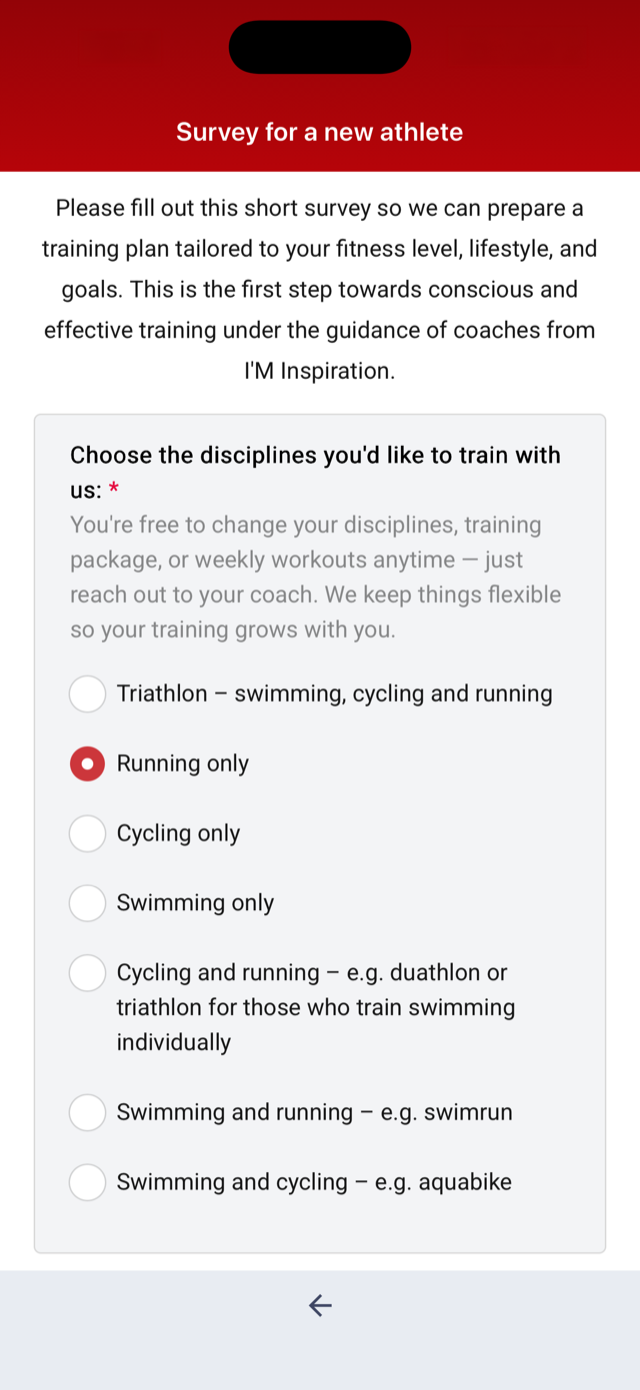
If you do not run, start with the beginner running plan and then move on to half marathon training from zero. Put the marathon in your calendar once the half marathon is behind you. At IMI you start with an athlete survey and a control test (the 12-minute Cooper test or a 5K), and a real coach updates your plan in the app every week.
With heart disease, high blood pressure or diabetes, talk your plan through with a doctor. This is general information, not medical advice.
Frequently asked questions
How long does it take to go from couch to marathon?
Realistically 12–18 months: a 10K first, then a half marathon, a base of 30–45 km a week and a marathon block of 16–20 weeks.
Can I run a marathon after a year of running?
Yes, if the year included regular training, a half marathon and a block of 16–20 weeks. For many people 12 months is the lower limit.
How many miles a week should I run before my first marathon?
At the peak of preparation usually 50–65 km (31–40 miles) a week. Before you start the marathon block you need a stable 30–45 km (19–28 miles) a week.
How many days a week do you need to run for a marathon?
Four runs is the minimum, five is the optimum at the peak of preparation. If you have only three days, first check what you lose.
What is the time limit for a marathon?
At the big races it is generous: 6:15 in Berlin, 6:30 in Chicago and 7 hours in Tokyo, as of November 2026. Smaller races are often stricter and enforce cut-offs along the course, so check the rules of your edition.
Is running a marathon dangerous?
For a healthy, prepared person the risk is low, but months of preparation put a heavy load on tendons and joints. With an illness or symptoms, see a doctor before you enter.
Can I walk during a marathon?
Yes, as long as you stay inside the time limits. Regular, planned walking sections are a sensible strategy for first-timers.