Contents
- What an ultramarathon is
- 50K, 50 miles, 100K and 100 miles: four different tasks
- Time on your feet, not distance
- Walking is part of the race
- Fueling on the course: how much to eat and drink
- Durability: the main quality in ultra
- What the preparation looks like
- Road or mountains, and what to do if you live on flat land
- Pacing, night and low points
- Aid stations, crew and mandatory kit
- The international scene: famous races and how to get in
- Who runs ultras
- When and how to choose your first ultra
- Season and recovery
- Health, safety and the most common mistakes
- Frequently asked questions
What an ultramarathon is
An ultramarathon, ultra for short, is any run longer than 42.195 km (26.2 miles). The distances you will meet most often are 50 km (50K, 31 miles), 50 miles (80 km), 100 km (100K, 62 miles) and 100 miles (161 km, the hundred-miler), plus timed events of 6, 12 and 24 hours. Europe, Asia and the southern hemisphere mostly count in kilometers; North America built its tradition on 50 and 100 miles. A mountain race of this length is called an ultra trail.
Ultra divides into two distinct worlds. Road and track ultras are run on asphalt or on a loop, at an even pace, on a certified course. The International Association of Ultrarunners (IAU), which works under the patronage of World Athletics, holds championships at 50 km, 100 km and 24 hours, and World Athletics ratifies world records at 100 km. Trail ultras mean mountains, paths, climbs and descents, where a kilometer can take 5 minutes or 25. Most of the famous races, and most first ultras, belong to the second world.
50K, 50 miles, 100K and 100 miles: four different tasks
The biggest mistake beginners make is treating an ultra as a longer marathon. The times in the table follow from an assumed average pace on a course with a moderate profile, stops included.
| 50K | 50 miles | 100K | 100 miles | |
|---|---|---|---|---|
| Time at 7:00/km (11:16/mile) | 5:50 | 9:23 | 11:40 | 18:47 |
| Time at 9:00/km (14:29/mile) | 7:30 | 12:04 | 15:00 | 24:08 |
| Time at 11:00/km (17:42/mile) | 9:10 | 14:45 | 18:20 | 29:30 |
| What decides the result | Endurance, pace on the climbs | Eating, descents, the race plan | Stomach, feet, night, head | All of that, plus sleep |
| Fueling | 150–300 kcal an hour | 150–300 kcal an hour, the first solid food | 200–400 kcal an hour, a full strategy | 200–400 kcal an hour for a day or more |
| Night | Rarely | Sometimes, depending on the start | Often, a headlamp is necessary | One full night, for many a second |
| Main mistake | Running it like a fast marathon | Undereating in the first 4 hours | Starting too hard, a bad patch after 60 km | Racing the first half |
| Sensible entry point | A marathon behind you, terrain you know | A finished 50K, long training days in the hills | Several races of 50K to 50 miles, night experience | A finished 100K and at least one night on the trail |
Every step up is bigger than it looks. From 50K to 50 miles you enter an effort where the limit is often fueling, not fitness. From 50 miles to 100K time is added: at 9:00/km that is three more hours on the course, often after dark. A hundred miles adds a whole night and a second sunrise, which is why this page treats it as a goal for later seasons and not as a first ultra.
Time on your feet, not distance
In a marathon, pace per kilometer or mile is a reliable measure. In a trail ultra it has to be replaced by time. A conversion used by ITRA, the International Trail Running Association, and by the UTMB World Series helps: 1 km of the course is 1 km of effort (km-effort), and every 100 m (330 ft) of climbing is another 1 km of effort.
| Course | Climbing | Km-effort | What it means in practice |
|---|---|---|---|
| 50 km, rolling hills | 1,000 m (3,300 ft) | 60 | A first ultra for most people |
| 50 km, mountains | 2,500 m (8,200 ft) | 75 | An effort like 75 km on the flat |
| 70 km, mountains | 3,500 m (11,500 ft) | 105 | An effort at the level of 100 km |
| 100 km, mountains | 5,000 m (16,400 ft) | 150 | For people with experience |
The conversion ignores how technical the trail is, the altitude and the weather, but it protects against a typical disappointment: someone with a 4:00 marathon enters a mountain 50K, counts on 6 hours and comes back after nine.
The choice of course changes the training. In the mountains the goal is endurance on a long climb, hiking and descending. On a flat 100K what counts is an even, monotonous pace for many hours.
Walking is part of the race
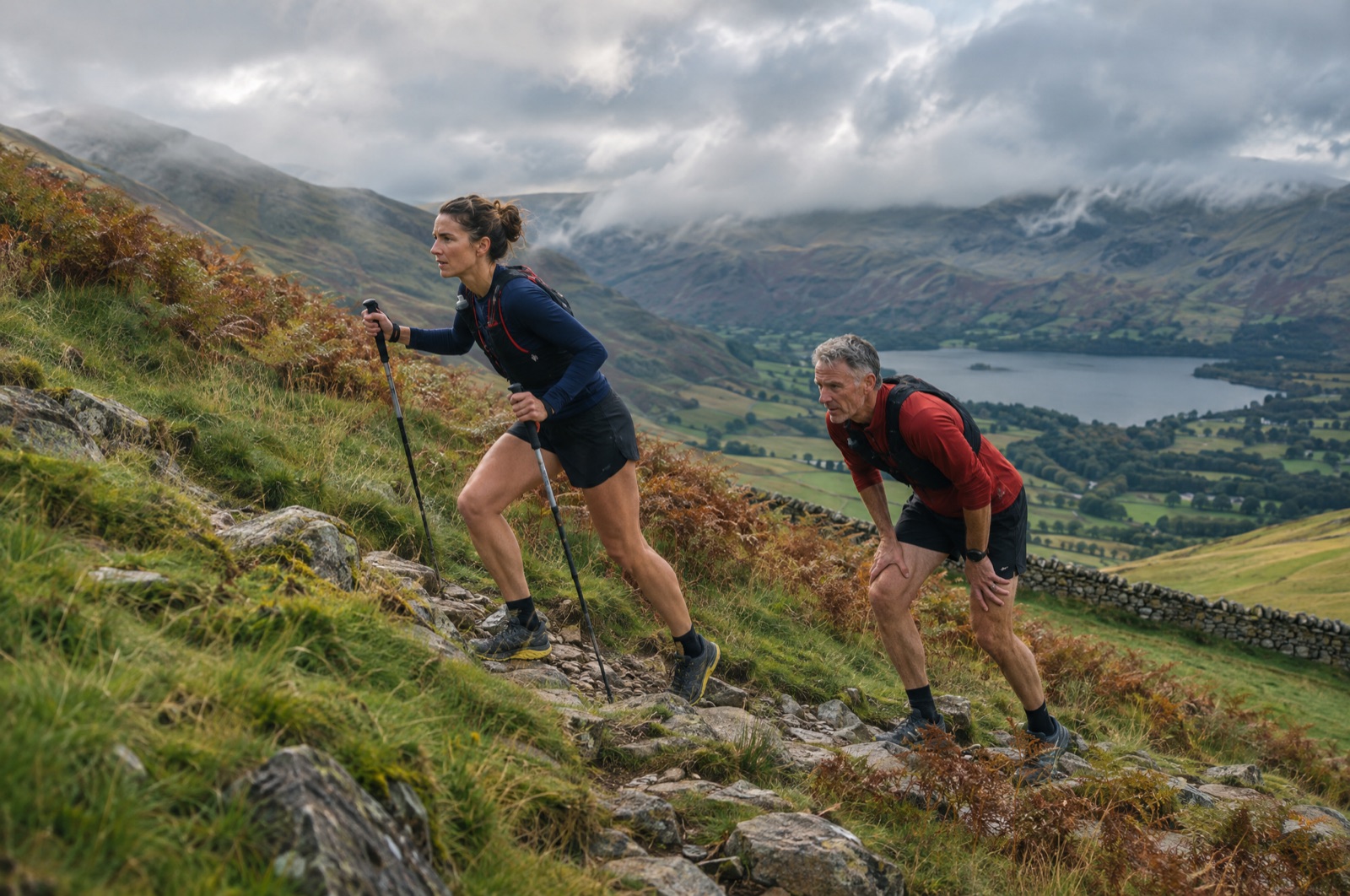
The first shock for a marathoner: even the best recreational runners walk. On a steep climb, power hiking is usually more economical than running, and the difference in pace is small. That is why ultra training includes fast uphill walking, with poles too if the race rules allow them.
The rule on race day: walk from the first steep climb, not only when you run out of strength. Energy saved early comes back in the second part of the race.
Fueling on the course: how much to eat and drink
In an ultra, eating problems often end the race. The best reference is the position stand of the International Society of Sports Nutrition (ISSN, Tiller et al., 2019). It puts the cost of running at 47–71 kcal per kilometer, and in its example a person weighing 70 kg (154 lb) uses about 4,845 kcal over 80 km (50 miles). Over 100 km that is about 6,000 kcal, so covering the whole expenditure is impossible. In the studies it cites, athletes usually took in 36–53% of what they burned.
| ISSN guidance for racing | Up to about 81 km (50 miles) | Beyond about 81 km |
|---|---|---|
| Energy | 150–300 kcal an hour | 200–400 kcal an hour |
| Carbohydrate | 30–50 g an hour | 30–50 g an hour |
| Protein | 5–10 g an hour | 5–10 g an hour |
| Fluids | 450–750 ml (15–25 fl oz) an hour | 450–750 ml (15–25 fl oz) an hour |
| Sodium | Often more than 575 mg per liter | Often more than 575 mg per liter |
In practice, fluids mean about 150–250 ml every 20 minutes, and sodium often means more than most drinks provide. In heat and humidity both needs rise, and the lower end of the range stops being enough. An example: a 100K lasting 14 hours at 40 g of carbohydrate an hour is 560 g, about 2,240 kcal, about 37% of what you use. The rest comes from reserves, fat included.
A comparison of people who finished a 100-mile race with those who dropped out is telling: 65.8 against 41.5 g of carbohydrate an hour, and about 98 against about 19 g of fat in total. It is a link, not proof: a runner who is struggling may eat less because of nausea, so cause and effect could be reversed. For long distances, though, the ISSN advises against going below 200 kcal an hour. For comparison, 213 participants in races of 44–112 km in Mallorca took in 183 kcal an hour on average.
In the marathon the reference is 60–90 g of carbohydrate an hour, and according to the ISSN 90 g may be unrealistic in races longer than 6 hours. The lower intensity has one advantage: gastric emptying worsens only above about 70% of VO2max, so solid, more calorie-dense food is easier to take. With time the appetite for salty and fatty food grows, and sweet gels lose their appeal.
- Eat early. Undereating in the first 3–4 hours usually comes back as a bad patch in the middle of the race.
- Train your stomach on long runs. The ISSN points to gradual gut training and, where needed, a diet low in FODMAPs, the easily fermented carbohydrates.
- Learn the aid station menu and eat the same foods in training.
- Watch your sodium and do not overdrink. Hyponatremia, a blood sodium level that is too low, can be life-threatening.
- Save caffeine for the second part of the race, especially when sleep is short.
- Do not bet on a ketogenic diet. According to the ISSN, the evidence that it improves ultra performance is insufficient.
Durability: the main quality in ultra
Durability, also called fatigue resistance, is the ability to keep working after many hours of effort. Two people with the same 10K time can look completely different after 40 km of a course. Four things make up that resistance:
- A base of mileage built over years. One training block will not replace it.
- Leg strength. Above all the quadriceps, which brake every step on a descent.
- Training on tired legs. Long runs on two consecutive days teach you to keep working when your legs are heavy, often at lower risk than one gigantic session.
- Descents. Muscle damage from downhill running is often the main limit in the second half of a mountain race. Train it regularly, gradually and on real terrain.
The scale of the load shows in creatine kinase, a marker of muscle damage: 274 U/l after a marathon, 2,983 U/l after 100 km and 4,970 U/l after 308 km. The authors of the ISSN position stand conclude that damage depends more on distance and time than on intensity. Threshold pace and VO2max still count, because they raise the ceiling under which you work for the whole race. In ultra, though, they are the foundation you build on, not the main aim of training.
What the preparation looks like
Good preparation starts from marathon fitness: a peak of 50–65 km (31–40 miles) a week and a longest run of 32–35 km (20–22 miles). An ultra is built on that base, with longer blocks and training closer to the terrain of the race. The ranges below are a reference point that has to be fitted to the course.
| 50K | 50 miles | 100K | |
|---|---|---|---|
| Preparation block | 16–20 weeks | 20–24 weeks | 24 weeks or more |
| Runs per week | 4–5 | 4–5 | 5–6 |
| Peak volume | Usually 7–10 hours | 9–12 hours | 11–15 hours |
| Longest session | 4–5 hours | 5–6 hours | 6–8 hours |
| Two long days in a row | A few times in the block | Regularly | Regularly, on tired legs too |
There are three phases. First the base: a lot of easy running and strength. Then specificity: climbs, descents, hiking and longer weekends. At the end comes a dress rehearsal in race conditions and a drop in volume, so that your legs arrive rested. What works depends on the course, your experience and your life outside running. At IMI a block like this is built by a human running coach in the app, who updates the plan every week and takes your planned races into account.
A long session is tempting as proof of fitness, so watch the progression. Frandsen et al. (BJSM 2025, 5,205 runners, 1,820 injuries) linked injury risk to a single run more than 10% longer than the longest of the previous 30 days.
| Element | Marathon | Ultra |
|---|---|---|
| Measure of load | Distance and pace | Hours and climbing |
| Key session | A long run with marathon pace | A long day on terrain, often two in a row |
| Race intensity | Even and high for a few hours | Clearly lower and variable |
| Strength | An addition that protects tissues | A foundation, especially for descents |
| Typical trouble spot | The wall after 30 km (mile 19) | Stomach, feet or knees after 40–60 km |
In a marathon you ask how fast you are running. In an ultra you ask how well you are eating and how long you can keep moving. People used to holding a pace often have more trouble here than those who like calm, long days.
Road or mountains, and what to do if you live on flat land
A flat 100K is monotony: thousands of nearly identical steps, a constant load on the same muscles and a head that has to cope with repetition. Running economy, pace and regular eating count, and the training resembles an extended marathon block. To feel the standard of serious road ultra, take 100 km in 9:00: that is 5:24/km (8:41/mile), the pace of a marathon in about 3:48, held for more than twice the distance.
A mountain 100K is variable. Climbs unload some muscles, descents wreck them, and you cover many kilometers hiking. The time is much longer, and night, weather and the temperature difference between valley and ridge come into play. Training needs trips to the mountains and work on descents, and a good road result gives no guaranteed advantage here.
A mountain ultra when you live on flat land
Most of the best-known ultras are mountain races, and most runners live far from mountains. Much of the work can be done close to home, as long as you know what it will not replace.
| What is missing | What to use in its place | What it will not replace |
|---|---|---|
| Long climbs | A treadmill with incline, stairs, a stairwell in a tall building, fast walking with a pack | Rocks and an uneven trail |
| Descents | Repeats on an embankment, a bridge ramp or a parking garage ramp, walking down stairs, slow lowering in squats and lunges | A long descent on rocks |
| Climbing in the week | Repeats on one hill, with the meters of ascent added up | Hours of fatigue in the mountains |
| Trail work | Forest, roots, sand, beach, uneven paths | Wet rock and exposure to the weather |
On top of that, plan 2–3 trips in the second half of the block, ideally to parts of the race course. That is our reference point. After the first such weekend your legs may hurt more than the distance suggests, because they do not know long descents, so leave yourself a few easy days afterward.
Pacing, night and low points
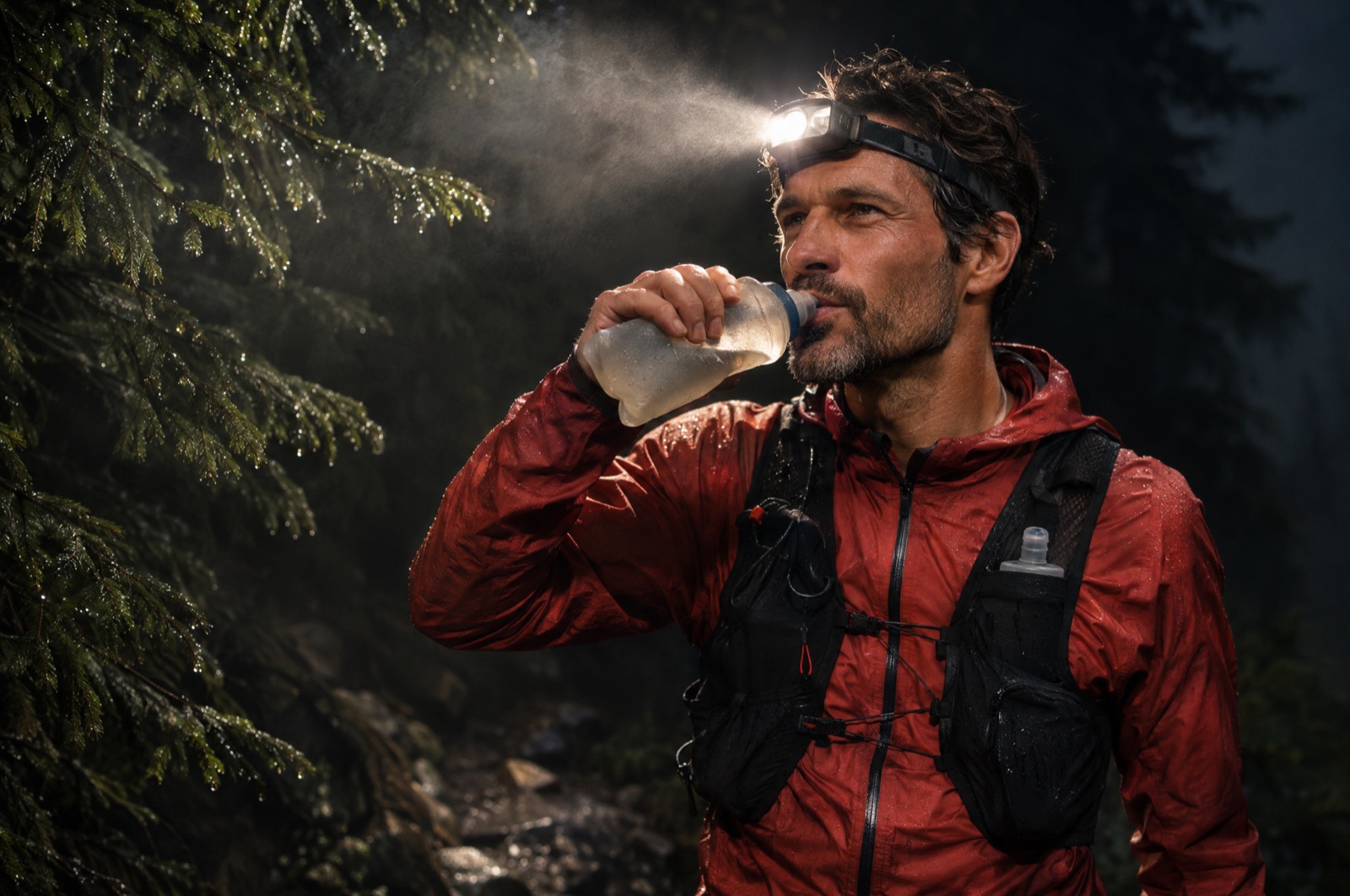
The most common mistake is a start that is too fast and does not hurt for the first 3–4 hours. Good races look boring from the outside.
- The first third. The effort should be laughably easy. Conversation is possible, and you hike the climbs.
- The middle. The first low points. Most pass after eating, slowing down and half an hour of patience.
- The last third. Here you pay for the start. If you have strength left, use it now.
Before the race, write down your times at the checkpoints in two versions: a good day and a fallback. In the mountains, the cut-offs at checkpoints often matter more than the finish cut-off.
Over long distances a phenomenon appears that marathoners do not know: the slump after dark. Body temperature, mood and appetite worsen together, especially between midnight and dawn. Practice at least one longer night session, and test your headlamp and spare battery on the trail, not at home.
A low point in an ultra is normal. Before you give up, eat, drink, slow down and wait 20–30 minutes. A large share of collapses comes from undereating. Then separate discomfort from injury: tired quads are a normal cost, and sharp pain in one place is a reason to consider stopping.
Aid stations, crew and mandatory kit
A quarter of an hour at each of six aid stations is an hour and a half on the clock. Arrive with a simple plan: what you do, what you eat, when you leave.
- Drop bags. Some races let you leave a bag on the course. Pack socks, a spare headlamp and food you like.
- Crew and pacers. The rules say whether and where family or friends may help you. In North America a pacer may often join you for the later sections; many European races allow no pacers at all. Help outside the permitted places can mean a time penalty or disqualification.
- Leaving the aid station. The chair is a trap. The longer you sit, the harder it is to get up.
Mandatory kit rules
In a trail ultra, kit (gear, in American usage) is a safety matter, and many races make it compulsory. UTMB Mont-Blanc shows how such a system works: a basic list that every runner carries in all conditions, plus extra items the organizer can activate according to the forecast, no later than 24 hours before the start. Packs can be checked at any point in the race. Missing a safety item such as the water reserve, the headlamp, the survival blanket or the smartphone means disqualification, and other missing items cost a time penalty. Poles, if you want them, have to be carried from the start.
Lists at other races follow the same logic: a fixed core, plus extra layers for cold forecasts and sun protection and more water for hot ones. Read the list for your event well before race week, because some items take time to find and all of them need testing.
Test everything on long training runs: the pack, shoes with good grip, spare socks, poles and the headlamp. Blisters can end a race that is going well, so check shoes, socks and foot lubrication in advance.
The international scene: famous races and how to get in
A good comparison comes from three races in one week. The UTMB Mont-Blanc festival in Chamonix is the final of the UTMB World Series, with one race in each category. The figures are those of the 2026 edition.
| OCC (50K category) | CCC (100K category) | UTMB (100M category) | |
|---|---|---|---|
| Distance | 60 km (37 miles) | 108 km (67 miles) | 174 km (108 miles) |
| Climbing | 3,500 m (11,500 ft) | 6,200 m (20,300 ft) | 9,700 m (31,800 ft) |
| Km-effort | 95 | 170 | 271 |
| Time limit | 14 hours 30 minutes | 28 hours | 45 hours 30 minutes |
| Pace at the limit | 14:30/km (23:20/mile) | 15:33/km (25:02/mile) | 15:41/km (25:15/mile) |
| Personal assistance | Not allowed | One person, at certain aid stations | One person, at certain aid stations |
The name of a category says little about the difficulty: the "50K" is 60 km long and equals 95 km of effort. The pace at the limit looks like a walk on paper, yet it includes every climb, every aid station and, in the two longer races, at least one night. Work it out for the intermediate cut-offs before you enter, not on the course.
Entry systems: lotteries, qualifiers and indexes
The famous races have far more applicants than places, and each handles it differently. Rules change from year to year, so check the current conditions with the organizer.
| Race | What it is | How you get in |
|---|---|---|
| UTMB Mont-Blanc, France, Italy and Switzerland, late August | A loop around Mont Blanc and the final of a worldwide series of trail events | A lottery. You need at least one Running Stone from the past two years, earned by finishing a series race (1 to 4 stones depending on the category, doubled at a Major), and a valid UTMB Index in the required category. Every stone is one more chance in the draw. Top finishers at series races qualify directly |
| Western States 100, California, late June | 100.2 miles (161 km) from Olympic Valley to Auburn, first run in 1974, with more than 18,000 ft (5,500 m) of climbing and nearly 23,000 ft (7,000 m) of descent | A lottery for a field limited to 369 runners. You need a qualifying race in the qualifying period. Each year you miss out doubles your tickets. The lottery for the 2026 race drew 11,328 applicants |
| Comrades Marathon, South Africa, June | A road ultra about twice the length of a marathon between Durban and Pietermaritzburg, with 20,349 starters in 2026. The 2027 race is its 100th edition | An entry or ballot place, plus a qualifying marathon run inside the organizer's time standard. For the 2027 race the qualifying deadline is May 3 |
The practical consequence is the same everywhere: a famous race is a project of several years. You collect qualifiers, stones or lottery tickets in smaller events, and those smaller events are where you learn the sport. In the UTMB system the category follows the effort, not the distance: 50K means 50 to 100 km-effort, 100K more than 100 and 100M more than 170.
How famous races grade a finish
At Western States a finish under 24 hours earns a silver belt buckle and a finish under 30 hours a bronze one. Under 24 hours means an average of 14:22 per mile (8:56/km) for the whole distance, every stop included. Comrades has a ladder of medals:
| Comrades medal | Finish time |
|---|---|
| Gold | First 10 men and first 10 women |
| Wally Hayward (men) | From 11th place to 5:59:59 |
| Isavel Roche-Kelly (women) | From 11th place to 6:59:59 |
| Silver | To 7:29:59 |
| Bill Rowan | 7:30:00 to 8:59:59 |
| Robert Mtshali | 9:00:00 to 9:59:59 |
| Bronze | 10:00:00 to 10:59:59 |
| Vic Clapham | 11:00:00 to 11:59:59 |
Ladders like this give every finisher, not only the front of the field, something to aim at.
Who runs ultras
There is no worldwide census of ultrarunners, but published studies paint a fairly clear picture: people come to ultras late, with a lot of running behind them.
- Experience first. In a study of 1,345 current and former ultramarathon runners (Hoffman and Krishnan, 2013), the median age at the first ultra was 36, after a median of 7 years of regular running. A quarter had run for 3 years or less.
- A lot of running, but not an absurd amount. The 1,212 who were still active had run a median of 3,347 km (about 2,080 miles) in the previous year, roughly 64 km (40 miles) a week.
- Injuries are part of the picture. In the same group, 64.6% had an injury in the past year that cost them training days, and 5.5% a stress fracture. The injured runners were younger and less experienced.
- Age is no barrier. In an analysis of more than 210,000 runners in 12-hour and 24-hour races, the average age in 2010–2020 was about 46.
- Men still far outnumber women. In 2,067 100 km races held worldwide between 1960 and 2019, about 16% of the results analyzed were women's.
If you are thinking about your first ultra, the lesson is twofold. Ultra rewards patience: most people arrive after several years of running, not several months. And the most common risk is nothing exotic: it is overuse injury, especially in runners with less experience.
When and how to choose your first ultra
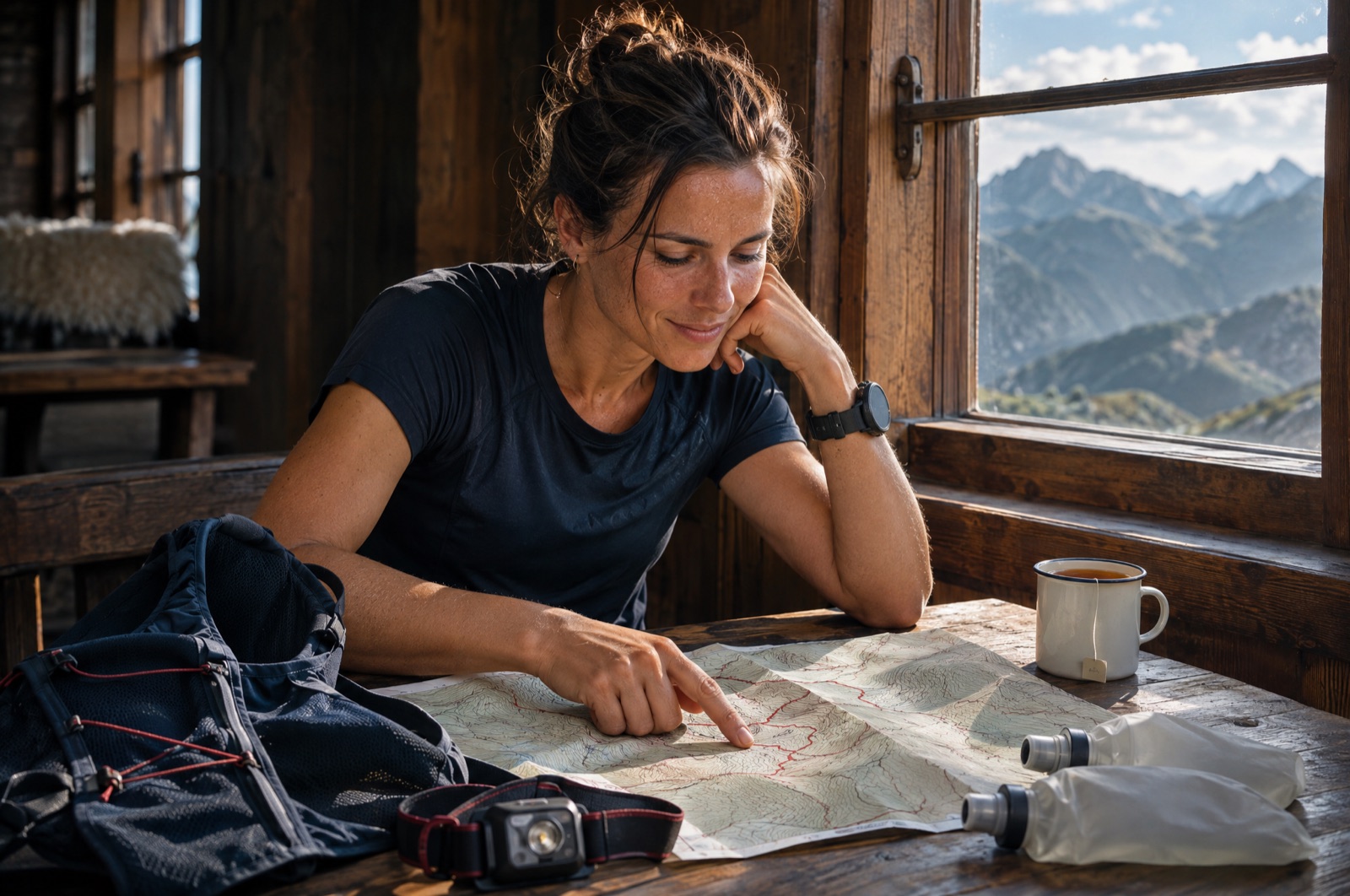
A sensible entry point is a marathon behind you, healthy legs and at least a year of regular running at a level close to a marathon peak. Without a marathon, choose marathon preparation or marathon training from zero first. Going from a half marathon straight to 70 km in the mountains is simply risky.
Put a first ultra off if:
- you have not done several continuous runs of more than 3 hours without stomach problems,
- you are returning from an injury,
- you have recurring tendon or hip pain,
- you cannot give about 7–10 hours a week at the peak of preparation,
- training would take away your sleep and recovery.
When you are ready, look for a race like this:
- A distance close to 50 km and an amount of climbing you already train.
- A time limit with a wide margin over your estimate.
- Aid stations every 10–15 km (6–9 miles), not every thirty.
- A well-marked course, run in daylight.
- A date that allows a full block and a climate you can prepare for. A cool-season race is kinder than a first ultra in heat and humidity.
- Travel and accommodation that will not eat into your sleep before the start.
A good test before you enter is one long day in the hills, lasting about half of your target race time, with the food and pace you plan for the race.
Season and recovery
The best seasons have one main goal, as with any of the running training plans on this site. A typical layout is a calm base in the off-season, a shorter tune-up race 3–4 months before the main one, then a long specific block and a taper. The tune-up race tests fueling, kit and the plan, not your fitness at its maximum. Mountain races cluster in the local summer, so in the southern hemisphere the same layout runs six months apart.
The road to 100K and beyond usually leads through 50K and 50 miles in earlier seasons. Each longer distance reveals a new problem: first eating, then feet, then the night. That is why many people run their first 100K after 2–3 years in ultra.
After your first ultra start with at least a week without running, then return gently over the following weeks. Feeling good can be deceptive, because the body rebuilds more slowly than it seems. One or two main races in a season give more than a string of long races one after another.
Health, safety and the most common mistakes
Do not take non-steroidal anti-inflammatory painkillers as a precaution before or during a long race without consulting a doctor. Pain that changes your stride, dark urine, fainting, pressure in the chest or confusion are reasons to stop and call for help. Dropping out is part of this sport. If you have a chronic condition, discuss your plans with a doctor before you start training.
The mistakes that come up most often:
- Training only on asphalt when the race is in the mountains.
- Skipping descents because they look less impressive than climbs.
- Comparing ultra pace with marathon pace.
- A long run without food, "so the body learns".
- A first race of 100K or 100 miles straight away, because a friend did it.
- Training in cool weather for a race in heat, or at sea level for a race at altitude, without any exposure to either.
- Kit assembled a week before the race.
Frequently asked questions
How long is an ultramarathon?
Formally, anything longer than 42.195 km (26.2 miles). In practice the shortest popular distance is 50 km, about 31 miles, and the classic longer ones are 50 miles, 100 km and 100 miles.
What is the best distance for a first ultramarathon?
For most runners a 50K with climbing you already train, a generous time limit, aid stations every 10–15 km (6–9 miles) and a course run in daylight. The step to 50 miles or 100K is easier once you know how your stomach and feet behave after 5 hours.
How long does it take to train for a 50K after a marathon?
Usually 16–20 weeks, if the marathon went without problems. For a mountain course, count on the upper end and plan climbs, descents and trips to real terrain into the block.
Do I need mountains to train for an ultra?
For a mountain race yes, at least on a few longer trips. Part of the work can be replaced by hill repeats or a treadmill with incline, but you cannot recreate long descents on flat land. More in the section on training on flat land.
Can I run an ultra without having run a marathon?
We advise against it. A marathon, or several continuous runs of more than 3 hours, shows how your stomach, tendons and head react. Without that knowledge a first ultra is a gamble.
Do I need poles for an ultra?
They are not essential, but on long climbs they help many people. Check the rules: poles are not allowed everywhere, and some races require you to carry them from start to finish if you use them at all. Practice with them beforehand.
How many miles or kilometers a week should I run before an ultra?
Hours matter more than distance. For a 50K it is usually 7–10 hours at the peak, and for a 100K 11–15 hours, depending on terrain and experience.
How long does it take to finish 50 miles or 100 miles?
At an average of 9:00/km (14:29/mile), stops included, 50 miles takes about 12 hours and 100 miles about 24. Mountain courses take much longer: the time limit of the 174 km UTMB was 45 hours 30 minutes in 2026.
How do I get into a race like UTMB or Western States?
Through a lottery, after qualifying. UTMB asks for Running Stones and a valid UTMB Index earned at series races. Western States asks for a qualifying race and doubles your tickets for every year you miss out. Plan several seasons ahead and check the organizer's current rules.