Contents
- Your winter in numbers
- Winter cycling training, phase by phase
- The bike or something else: the proportions of winter
- Strength: what to do in winter and what not to
- Riding outside: what changes
- Clothing: layers instead of thickness
- Safety: when to ride and when not to
- Back on the road: early spring without injury
- The most common winter mistakes
- Frequently asked questions
Your winter in numbers
A winter plan starts from the conditions, because they decide how often you get out. Three things shape the training: short days, temperatures around freezing and how wet it is. "Winter" covers very different seasons, as three cities show:
| Type of winter | Example | What it means for you |
|---|---|---|
| Cold and snowy | Minneapolis: an average January day stays well below freezing, day and night | Weeks when the road is not an option. The trainer, strength work and snow sports carry the block |
| Mild and wet | London: an average January day usually stays above freezing, and rain falls on many days of the month | You can ride most weeks, but on wet roads, in the dark and with ice possible after clear nights |
| Southern, mid-year | Melbourne: the coldest month is July, and its days are cool, not cold | The off-season falls from June to August. The road stays open, and the limit is daylight |
Less snow does not mean easier. Cold, dry weather gives good riding conditions, and wet weather around freezing can be harder than steady frost. Salt and grit cover the roads then. If you live in the tropics there is no cold season at all, and the months that play the role of winter are the hottest or the wettest ones. Then the advice on cooling indoors matters more than the advice on clothing.
Light: the biggest and least counted cost of winter
We calculated day length from the astronomical equations, for the shortest and the longest day of the year. In the northern hemisphere the shortest day is around December 21. In the southern hemisphere it is around June 21.
| City | Shortest day | Longest day |
|---|---|---|
| Edinburgh | about 6 h 55 min | about 17 h 35 min |
| London | about 7 h 50 min | about 16 h 40 min |
| Vancouver | about 8 h 10 min | about 16 h 15 min |
| Minneapolis | about 8 h 45 min | about 15 h 35 min |
| New York | about 9 h 15 min | about 15 h 05 min |
| Christchurch | about 8 h 55 min | about 15 h 25 min |
| Melbourne | about 9 h 30 min | about 14 h 45 min |
| Cape Town | about 9 h 55 min | about 14 h 25 min |
| Singapore | about 12 h 05 min | about 12 h 10 min |
In London in late December the sun rises around 8:00 and sets before 16:00, so if you work from 9 to 5 you have no daylight ride at all during the week. That is why on working days you train mostly on the indoor trainer in winter and ride outside at the weekend. The closer you live to the equator, the less this applies.
Winter cycling training, phase by phase
This layout describes a typical season with the main goal in summer. For an earlier event, shift everything accordingly.
| Northern hemisphere | Southern hemisphere | Main task | On the bike | Off the bike |
|---|---|---|---|---|
| November | May | Rest after the season, sorting out niggles | Unstructured, with no power targets | The first strength sessions with light weights, other sports |
| December | June | Habit, base, building strength | Easy rides, short trainer sessions, outside at the weekend | Strength twice a week, moving to heavier loads |
| January | July | The hardest month: keeping the rhythm | Easy volume, a little tempo on the trainer | Strength, skiing or running when conditions allow |
| February | August | The move to harder work | The first intervals on the trainer, a longer ride in good weather | Heavy strength, but without overdoing it |
| March | September | Back on the road | More riding outside, threshold intervals | Maintenance strength, once a week |
This layout rests on three principles. After the season come a few weeks of easier riding, which can include a short complete break. Hard rides on the trainer come in only in the last two months of winter. Heavy strength work starts after a few weeks of learning technique, in the first part of winter, when endurance training has a lower priority.
A professional base and your 7 hours
Professionals build their base on many hours of easy riding, and most people don't have that time. With few hours a week, some coaches recommend reverse periodization, which means starting intervals in winter. The other school says: ride more often and lighter rather than rarely and hard.
Both make sense, in different circumstances. If you ride regularly and a lot, an easy base is safe. If your hours are few, moderate efforts, meaning harder sections within a ride, help to maintain fitness. In one study of well-trained cyclists, adding one hard session every 7–10 days to easy riding protected performance through an 8-week transition period better than easy riding alone. If you have been training regularly for less than a year, continuity matters more. The whole season is covered in road cycling training plans.
How much you can lose over winter
After a complete break VO2max falls by about 4% after 3 weeks, about 10% after 5 weeks and 13–20% after roughly 2 months. In highly trained athletes, falls of 4–14% have been described for a break shorter than 4 weeks. Those figures are for stopping training altogether, and a winter with another form of activity looks different. You will not keep your summer fitness and you don't have to. What matters is avoiding a long break from all activity.
The bike or something else: the proportions of winter
In winter the bike does not have to fill every active day: you can give some of those days to other kinds of exercise. You don't have to spend the winter living on the trainer, and one long endurance ride a week is enough.
| Activity | What it gives you | What to watch |
|---|---|---|
| Cross-country skiing | Long aerobic work with little load on the joints, work for the arms and trunk | Cost, travel, dependence on snow |
| Running | Very time-efficient, and a stimulus for the bones | Start with a walk-run, because after a season on the bike the tissues are not used to impact |
| Hiking and hill walking | A substitute for the long ride | Good boots and the weather |
| Nordic walking | A shorter substitute for the long ride | Lower intensity |
| Swimming | Takes load off the spine, loosens you up | Little strength work |
| Team sports | A varied stimulus | Injury risk in sharp changes of direction |
Other sports build endurance, but they do not replace riding, because they train neither your pedaling nor your bike handling. That is why the kilometers on the road still have to come back in spring. In winter, though, regular activity matters most, so a good January does not have to be measured in kilometers.
Strength: what to do in winter and what not to
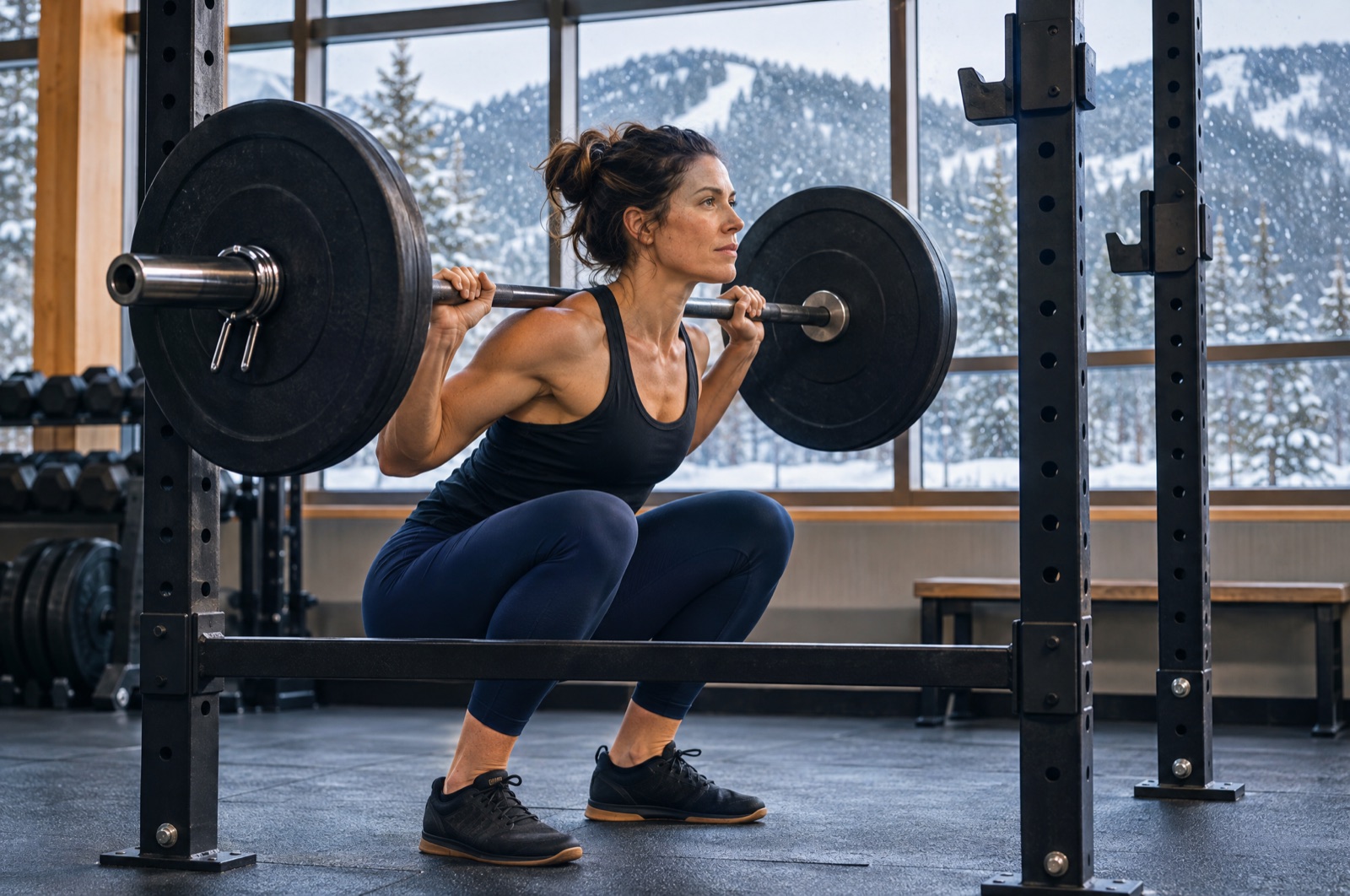
Winter is the best time for the gym, because tired legs don't spoil events or key sessions then. The best evidence is for heavy strength training, which means a high load and few repetitions, not light exercises with many repetitions.
What the research shows
- A 2014 review. It recommends heavy strength training to improve cycling economy. The strongest evidence for an effect on cycling performance is for heavy training.
- 19 well-trained female duathletes, 11 weeks (2017). The group doing heavy strength twice a week improved power in a 5-minute test after a long effort by 7.0%, and oxygen consumption at the end of a 3-hour ride fell. The difference in power between the groups was not statistically significant, however.
- Squats, 4 sets of 4RM, 3 times a week for 8 weeks (2010). 4RM is a weight you can lift at most 4 times. A group of 8 improved cycling economy by 4.8%, with no change in body mass or VO2max.
- Maintenance in season (2010). After 12 weeks of strength twice a week, one session a week for 13 weeks of the season maintained the gains and went on improving performance markers. There were only 6 people in each group, though.
- Mixed results (2015). In young elite cyclists, a 25-week program improved power in a 40-minute effort and maximal power, but did not change VO2max or economy. The findings on economy are inconsistent overall.
Most of these studies covered small groups of well-trained athletes. Nobody can promise you a specific percentage.
Principles, not a schedule
| Element | Recommendation from the review | Comment |
|---|---|---|
| Duration | About 12 weeks in the preparation period | After the transition period and learning the technique |
| Frequency | 2 sessions a week, about 1 in season | One session maintains the effect |
| Load | From 4RM to 10RM | Only once you have mastered the technique with a light weight |
| Sets and rest | 2–3 sets, 2–3 minutes of rest | Don't shorten the rest |
| Choice of exercises | The same muscle groups as on the bike | Legs and hips, as in pedaling |
| Speed | Lift with the intention of moving as fast as possible | The intention counts, not the actual speed |
| The start | Low riding volume for 2–3 weeks | Heavy, sore legs are normal at the beginning |
Without gym experience, start more modestly: shorter sessions with light weights. Introduce heavy loads under the eye of a qualified coach or physiotherapist, especially with back or knee problems.
The argument that rarely gets mentioned: bones
Road cycling gives the bones no meaningful stimulus. That is how a 2012 systematic review of 31 studies summed it up. The most consistent deficit is in the bone density of the lumbar spine. The often-quoted claim that two thirds of cyclists have osteopenia comes from a small study of 23 professionals, so it should not be applied to amateurs. The clinical meaning of these findings is also less clear than it seems.
The authors suggest weight-bearing exercise, jumping and combining cycling with other sports. With risk factors for osteoporosis, talk to a doctor. Winter is a good moment for the gym, a jump rope or a run.
Riding outside: what changes
Moderate cold is not the enemy. In a 1997 study the longest riding time at about 70% of VO2max was achieved at 10.5°C (51°F): 93.5 minutes against 51.6 minutes at 30.5°C (87°F). In winter the problems are airflow, moisture and slippery surfaces.
Wind chill on the bike
The wind chill formula used by the US and Canadian weather services combines temperature and wind. On a bike your own speed is wind as well. With no additional wind it comes out like this:
| Air temperature | 15 km/h (9 mph) | 25 km/h (16 mph) | 30 km/h (19 mph) | Descent at 50 km/h (31 mph) |
|---|---|---|---|---|
| +5°C (41°F) | +1.7°C | +0.5°C | +0.1°C | −1.3°C |
| 0°C (32°F) | −4.4°C | −5.9°C | −6.5°C | −8.1°C |
| −5°C (23°F) | −10.6°C | −12.3°C | −13.0°C | −15.0°C |
| −10°C (14°F) | −16.7°C | −18.8°C | −19.5°C | −21.8°C |
These are our calculations from the official formula. In Fahrenheit, 32°F at 16 mph feels like about 21°F, and on a 31 mph descent like about 17°F. The index describes heat loss from exposed skin, not the chilling of the whole body during effort, so it fits the face, fingers and feet well. For comparison: according to the US National Weather Service, at about −18°C (0°F) with a 24 km/h (15 mph) wind, which feels like about −28°C (−19°F), exposed skin can suffer frostbite in 30 minutes. At more extreme values it takes 10 or even 5 minutes.
How to plan the route
- Loops, not point to point. They let you shorten the ride when the weather changes or your feet get cold.
- Into the wind at the start. After a sweaty first part it is better to come back with the wind behind you.
- Forest and back roads. On a cyclocross, gravel or mountain bike you ride more slowly, so the airflow is lower and the effort higher. It is a good choice for short, harder rides on which you don't get cold.
- Keep stops short and warm. A long stop in the cold in damp clothing chills you fast. Coffee, yes, but a quick one.
- Phone and plan B. A flat tire at −5°C (23°F) is not the same as one in summer. The battery also drains faster in the cold, so keep the phone close to your body.
The winter bike
A winter bike is a separate bike used through the worst months, most often a cyclocross, gravel or mountain bike. Salt, grit and water wear out the drivetrain quickly. If you have one bike, after every ride on a salted road rinse it, dry it and oil the chain.
Wider tires and lower pressure increase grip. Studded bicycle tires are a good choice on packed snow and ice, but on dry asphalt they add rolling resistance and noise.
Wet and mild winters
Where winter means rain at 5°C (41°F) more often than frost, the bike and the clothing change more than the plan. Full fenders keep the spray off you and off whoever rides behind you. Braking distances grow, painted lines and metal covers turn slippery, and standing water hides potholes. Being wet at a few degrees above freezing cools you faster than dry frost, so carry a waterproof layer and spare gloves even on a short ride. Watch for the first clear, still night after rain: that is when damp roads freeze.
How to divide the winter week
Good proportions depend on the climate and on the number of hours. An example for 6 hours a week, without arranging them into days:
| Element | Hours | Mild, wet winter | Cold, snowy winter |
|---|---|---|---|
| Trainer | 2–3 | Working days after dark | Most of the bike sessions |
| Outside | 1–2 | The weekend, often on the road or gravel | Forest trails when the ground is frozen, or shorter rides |
| Strength | 1–1.5 | Two short sessions | Two short sessions |
| Another sport | 0–1 | A run or a walk | Cross-country skiing, if there is snow |
This is a guide. January in Minneapolis and January in London are both called winter and have little else in common, so copying the plan of a friend who lives in a different climate rarely works.
Eating in the cold
Gels and bars go hard below freezing. Carry them in a pocket close to your body or under your jacket. It is also harder to reach for food in thick gloves, so open the wrapper before you leave. When you run short of energy you slow down, and at lower power the body produces less heat. That is why hunger in winter quickly turns into feeling cold.
Prepare the bike before winter
- Fenders. They protect the drivetrain, your back and the rider behind you. In winter it is hard to spend money on the bike more wisely.
- Wet lube. Thicker, it copes better with rain and mud. After a salted road, wash the chain anyway.
- Brake pads. Grit wears them fast, so check them more often than in summer.
- Tire pressure. Go a little lower than in summer, especially on wet asphalt.
- A spare tube and tire levers. Check that you can change a tube in the cold before you have to do it at the roadside.
Clothing: layers instead of thickness
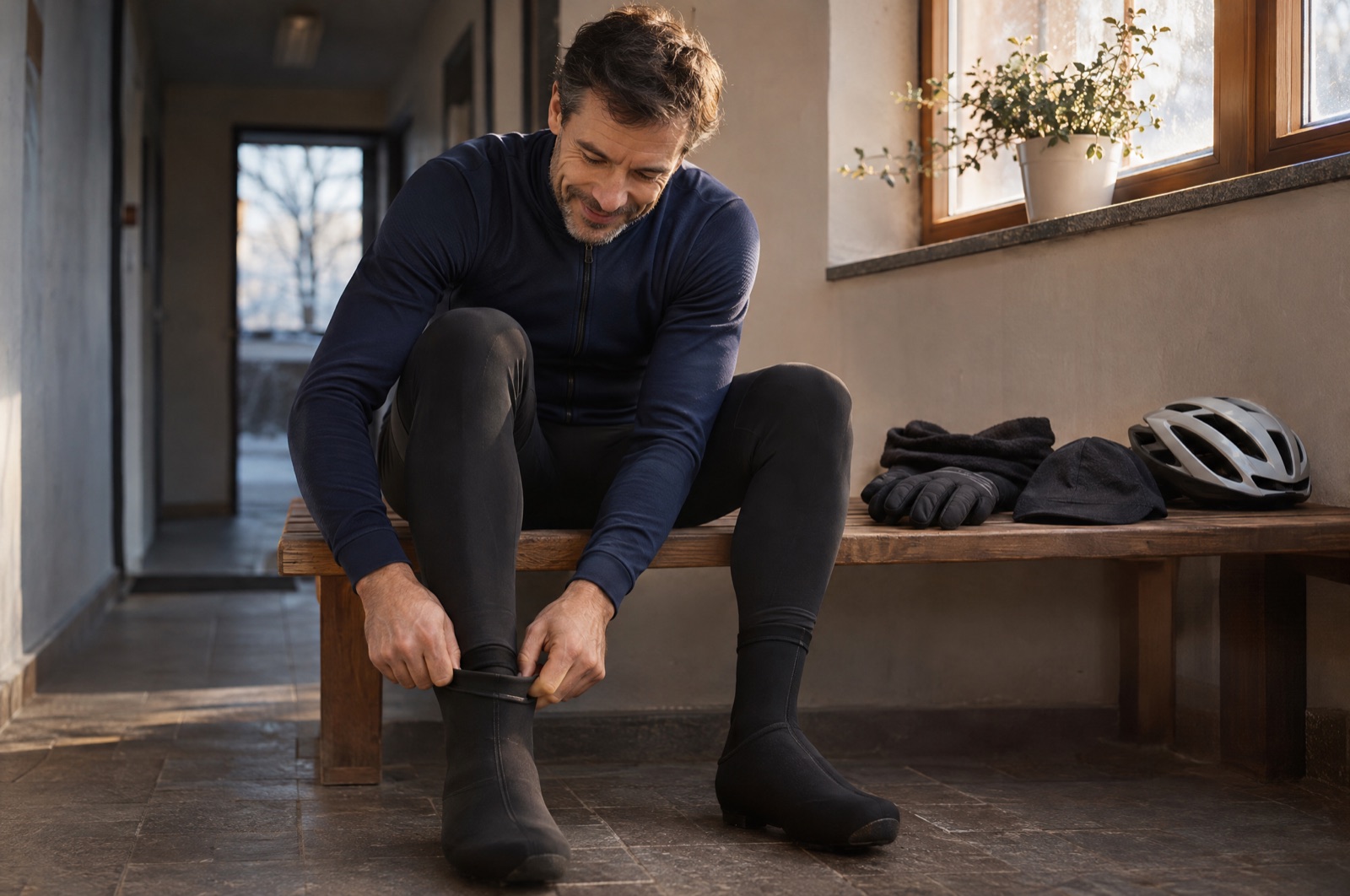
Leave home dressed so that you feel slightly cool for the first 10 minutes. If you are warm at the front door, after half an hour your clothes will be wet, and wet clothing chills you. The table is our starting point. Everyone feels the cold differently, so your own notes after a few rides will be better than any table.
| Temperature | Torso | Legs | Hands and feet | Head |
|---|---|---|---|---|
| 5 to 10°C (41–50°F) | Base layer, long-sleeve jersey, a vest in reserve | Tights or leg warmers | Thin gloves, toe covers | A headband or a cap under the helmet |
| 0 to 5°C (32–41°F) | Base layer, thermal jersey or softshell | Thermal tights | Winter gloves, shoe covers | A cap under the helmet, a neck warmer |
| −5 to 0°C (23–32°F) | Base layer, mid layer, winter jacket | Thermal tights with a windproof membrane | Thick gloves, winter shoes or shoe covers | Cap, neck warmer, consider glasses |
| Below −5°C (23°F) | Only a short ride, or the trainer | Full protection | Lobster-style gloves, chemical warmers | A neck warmer or mask, face protection |
Hands and feet
Hands and feet get cold first, because the body narrows the blood vessels of the skin and directs blood to the core. Numb fingers brake and shift badly, and that is a danger on the road. Shoes and socks must not be tight, because pressure hinders circulation. Take a spare pair of gloves on longer rides.
Painful, white or numb fingers that don't return to normal after warming need medical help. Warm them slowly.
Safety: when to ride and when not to
Even professional races have rules for days like these. The UCI Extreme Weather Protocol lists freezing rain, snow on the road, strong wind, extreme temperatures, poor visibility and air pollution. There are no fixed thresholds for cold, and the decision is made by the parties involved after assessing the conditions. If a professional may decline to ride, so may you.
| Conditions | Decision |
|---|---|
| Dry, frost without precipitation | Ride. The main problem is clothing |
| About 0°C (32°F), wet, falling in the evening | The highest risk of black ice. Choose the trainer or a daytime ride, and check the ice warnings of your national weather service |
| Freezing rain | Don't ride |
| Snow on the road, heavy traffic | Don't ride on the road. Consider forest trails or the trainer |
| Dense fog | The trainer, or a very quiet road in daylight |
| Strong wind in freezing temperatures | A short ride or the trainer |
Rules of the road that matter in winter
Traffic law differs between countries and often between states, so check your own. These examples, verified in November 2026, show the range:
- Lights. In the UK a bike ridden at night must have a white front light and a red rear light lit, and a red rear reflector. Western Australia requires a rear light clearly visible from at least 200 m. In winter "at night" covers the commute in both directions.
- Sidewalks. Don't assume you may leave an icy road for the sidewalk. The UK Highway Code forbids cycling on the pavement, the British word for sidewalk, while Western Australia lets riders of all ages use footpaths unless a sign says otherwise.
- Passing distance. The UK Highway Code asks drivers to leave at least 1.5 m at up to 30 mph, and most US states require at least 3 feet. On a slippery surface, don't count on it.
After dark, being seen matters as well. Two rear lights and reflective material on moving parts of the body, such as the ankles, are easier to read than a single light.
Lungs in the cold
Heavy breathing in cold, dry air irritates the airways. Intense running at −10°C, −15°C and −20°C (14°F, 5°F and −4°F) causes a larger fall in lung function than a similar effort at 0–22°C (32–72°F). On the other hand, 90 minutes of moderate effort at −15°C did not impair lung function more than 30 minutes, although signs of mild irritation of the airway lining appeared. In a 2022 study a heat and moisture exchanging mask reduced the fall in FEV1, the volume exhaled in the first second, after a maximal run at −15°C from 2.7% to 0.5%.
The studies were mostly of runners and people training in the cold, not cyclists, but the conclusion is consistent: keep freezing days for easy riding and move intervals indoors. With asthma or a cough after exercise, talk to a doctor.
Drinking when you are not thirsty
In a study of eight men dehydrated by 3–4% of body mass, thirst was clearly lower at 4°C (39°F) than at 25°C (77°F). So drink to a plan, not to thirst. Water in a bottle freezes, so keep it under your jacket or take a warm drink in an insulated bottle.
Air quality in the heating season
In many towns and valleys the air gets worse in winter, when smoke from heating collects under still, cold air. On the bike you breathe deeply for hours. Most countries publish a daily air quality index. On the US scale, 101–150 is "unhealthy for sensitive groups" and 151 and above is "unhealthy" for everyone. On days like that, move hard work to the trainer with the window closed and a strong fan, or change the day. Plan routes away from city centers and valley floors, where smoke lingers in windless weather.
Back on the road: early spring without injury
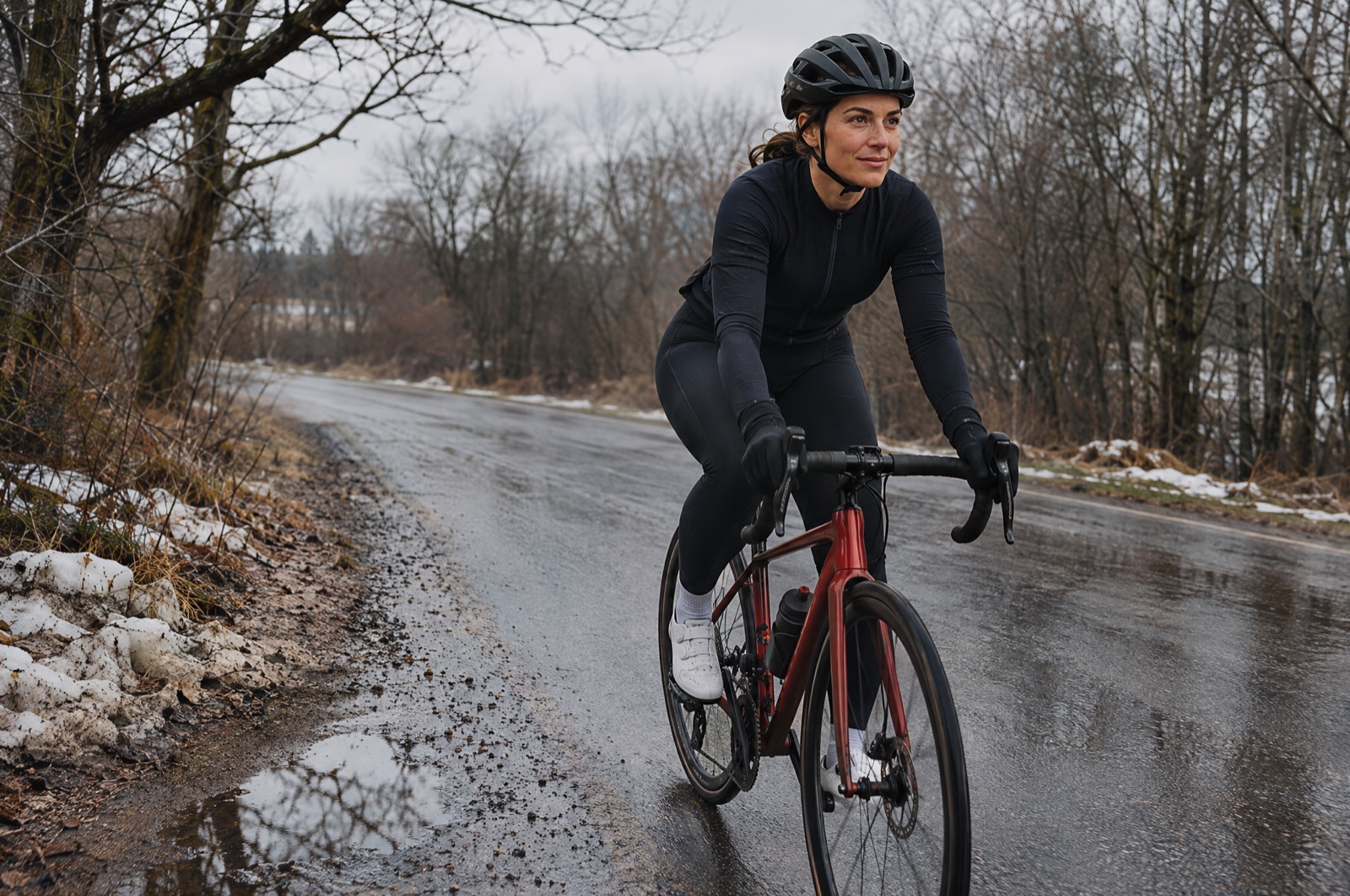
The first warm days are risky. Your legs are used to the trainer and your head wants to make up for lost kilometers. Three rules help:
- Don't increase everything at once. A longer ride, hills and hard intervals in the same week are a recipe for an overloaded knee.
- Get your bike handling back. After several months without corners and group riding, confidence takes a while to return, and the basic skills are worth a quiet ride of their own. Early spring also means grit on the shoulders and potholes left by winter.
- Compare with care. Watts on the road don't always match those on the trainer. Some studies show almost identical power, others much higher power outdoors at the same perceived effort, as the comparison of the trainer and the road explains.
Before the season, give the bike a full check. Salt and moisture wear the drivetrain, cables and bearings more than you can see from outside.
A trip somewhere warm: when it makes sense
A week in a warm place is tempting, because after winter you can ride in short sleeves again. It helps only if you have something to build on, though. A jump from 6 hours a week to 20 hours is more than three times as much riding, and your knees and sit bones pay first. Plan a lighter day in the middle of the trip and an easy week after you return, because the effect comes only after rest. Match the timing to your event: a camp too close to the goal leaves fatigue instead of fitness. You can also prepare well without a trip: a few long weekend rides in early spring go a long way.
The most common winter mistakes
- Peak fitness in midwinter. A great FTP at the turn of the year often ends in a slump by late spring.
- Nothing but the trainer. Bike handling does not improve indoors, so look for chances to ride outside in winter too.
- Summer kit in the frost. Frozen fingers brake worse, and the ride ends earlier than the plan assumed.
- Heavy strength without technique. A light weight first, load later.
- Too much running straight away. The heart can take it. The tendons cannot.
- Heading out at dusk without lights. The sun sets earlier than you remember.
- No plan for bad weather. Every outdoor session should have an indoor version.
At IMI a coach updates the plan every week: sessions are moved and the road is swapped for the trainer when the weather changes, so a cold snap does not have to break up the whole block.
Frequently asked questions
How cold is too cold to ride a bike outside?
There is no single limit, and even the UCI protocol does not set one. Ice, precipitation and wind are a bigger danger than the cold itself. Below −5°C (23°F) shorten your rides, below −10°C (14°F) the trainer is usually the better choice for an amateur, and on black ice don't take the risk at all.
Should I stop cycling in winter?
Not for long. After the season, a few weeks of easier riding with a short complete break is enough. A longer pause from all activity costs you: VO2max falls by about 4% after 3 weeks and about 10% after 5 weeks. Then keep riding regularly, indoors on dark weekdays, and add strength and other sports.
How many hours a week should I train in winter?
Our guideline is 4–8 hours a week, counting the bike, strength work and other sports. Whether you can keep that rhythm without burning out matters more than the number.
Will strength training hurt my cycling?
It should not. The 2014 review found no evidence of a gain in body mass or a worse relative VO2max. The first weeks do bring heavy legs, so start with lighter riding.
Should I ride outside when the air quality is poor?
Don't do hard training outside on warning days: move it indoors or to another day. A short, easy ride outside town is less of a problem, but with asthma or heart disease follow your doctor's advice.
Is cycling in freezing temperatures bad for you?
The body usually copes well with easy riding, but heavy breathing in severe cold irritates the airways. With heart disease, asthma or an infection, talk to a doctor.
Can I ride on the sidewalk when the road is icy?
That depends on where you live. It is forbidden in the UK and allowed in Western Australia unless a sign says otherwise. Check the local rule, and where it is legal, ride slowly and give way to pedestrians.
What tires should I use in winter?
Wider ones with some tread, at slightly lower pressure, and for ice studded tires. On wet roads without ice, a wider tire at lower pressure does most of the work.
When is winter training if I live in the southern hemisphere?
From about May to September, with the shortest days in June. Shift every month in this article by six: the northern January is your July, and the return to the road falls in September.
Should I try to lose weight over winter?
Not aggressively. A small change in body mass over winter is not a problem, but aggressive weight loss alongside heavy strength work and rising volume costs you recovery and fitness. If you want to lose weight, do it gently, and with low energy or menstrual disturbances see a doctor.
When should I start doing intervals in winter?
For a summer event, usually in the last two months of winter. With few hours available, introduce short harder efforts earlier, but in moderation. How the winter fits into the rest of the year is shown in the phases of the season.