Contents
- The key dates
- Did the French invent triathlon?
- Mission Bay 1974: a 1 dollar entry fee and car headlights
- Hawaii 1978: an argument about who is toughest
- How the Ironman became Kona
- Europe: from Pilsen and Almere to Nice and Roth
- The 1980s: how the sport spread around the world
- The road to the Olympic Games
- The wars over names and trademarks
- How the rules changed
- The professional boom: from crisis to T100
- The Norwegians: a country without a great tradition that changed the sport
- 2026: the biggest change since the Olympics
- From 15 starters to a sport for everyone
- Frequently asked questions
The key dates
| Year | What happened |
|---|---|
| 1920–1934 | French "Les Trois Sports" races combine running, cycling and swimming, but do not start a continuous sport |
| September 25, 1974 | Mission Bay Triathlon in San Diego: 46 people, the first use of the name in today's sense |
| February 18, 1978 | First Ironman on Oahu: 15 starters, 12 finishers |
| 1981 | The race moves to the Big Island, to Kailua-Kona. Japan holds its first triathlon |
| December 11, 1982 | The British Triathlon Association is founded in Reading |
| 1985 | The first Ironman races outside Hawaii, in New Zealand and Japan |
| April 1, 1989 | The ITU, today's World Triathlon, is founded in Avignon |
| 1994 | The IOC adds triathlon to the Olympic program |
| September 16, 2000 | Olympic debut in Sydney |
| 2016 | Para triathlon makes its Paralympic debut in Rio |
| 2021 | The mixed relay debuts at the Tokyo Games, Kristian Blummenfelt wins the men's gold for Norway |
| 2023–2025 | The IRONMAN World Championship is split between Nice and Kona |
| 2026 | Women and men return to Kona on one day, the PTO takes a majority of Challenge Family |
| 2027 | Start of the Triathlon World Tour with the T100 and T50 series |
Did the French invent triathlon?
The question of origins has two honest answers. Races that combined three disciplines were held in France half a century before San Diego. Today's sport, however, was born in California, and there is no evidence that its founders knew about the French predecessors.
The best-documented trail leads to the river Marne. In the 1920s the Paris sports daily L'Auto reported on races called "Les Trois Sports". In the 1920 version this was a 3 km run, a 12 km bike ride and a crossing of the Marne. Henri Desgrange, the paper's editor and the founder of the Tour de France, is said to have taken part. Further L'Auto races were held on June 19, 1921, over 14 km, and on June 18, 1922 in Villennes-sur-Seine.
The date of the first edition depends on the definition, which is why you will see 1901, 1902, 1920 and 1921. The earlier events in Joinville-le-Pont are reported to have had rowing in place of swimming, and swimming appears in the reports only in the 1920s.
Similar races took place in Marseille in 1927 and in La Rochelle in 1934. There a swim across the harbor channel (about 200 m) was combined with a 10 km bike ride and a short run. Later the names "Course des Débrouillards" and "Course des touche-à-tout" appeared, roughly the race of the resourceful and the race of the jacks of all trades. The format died out. Scott Tinley, a winner in Hawaii, brought these races back to attention only years later.
France has priority in the idea, San Diego in continuity. That is why federations count the history of the sport from 1974.
Mission Bay 1974: a 1 dollar entry fee and car headlights
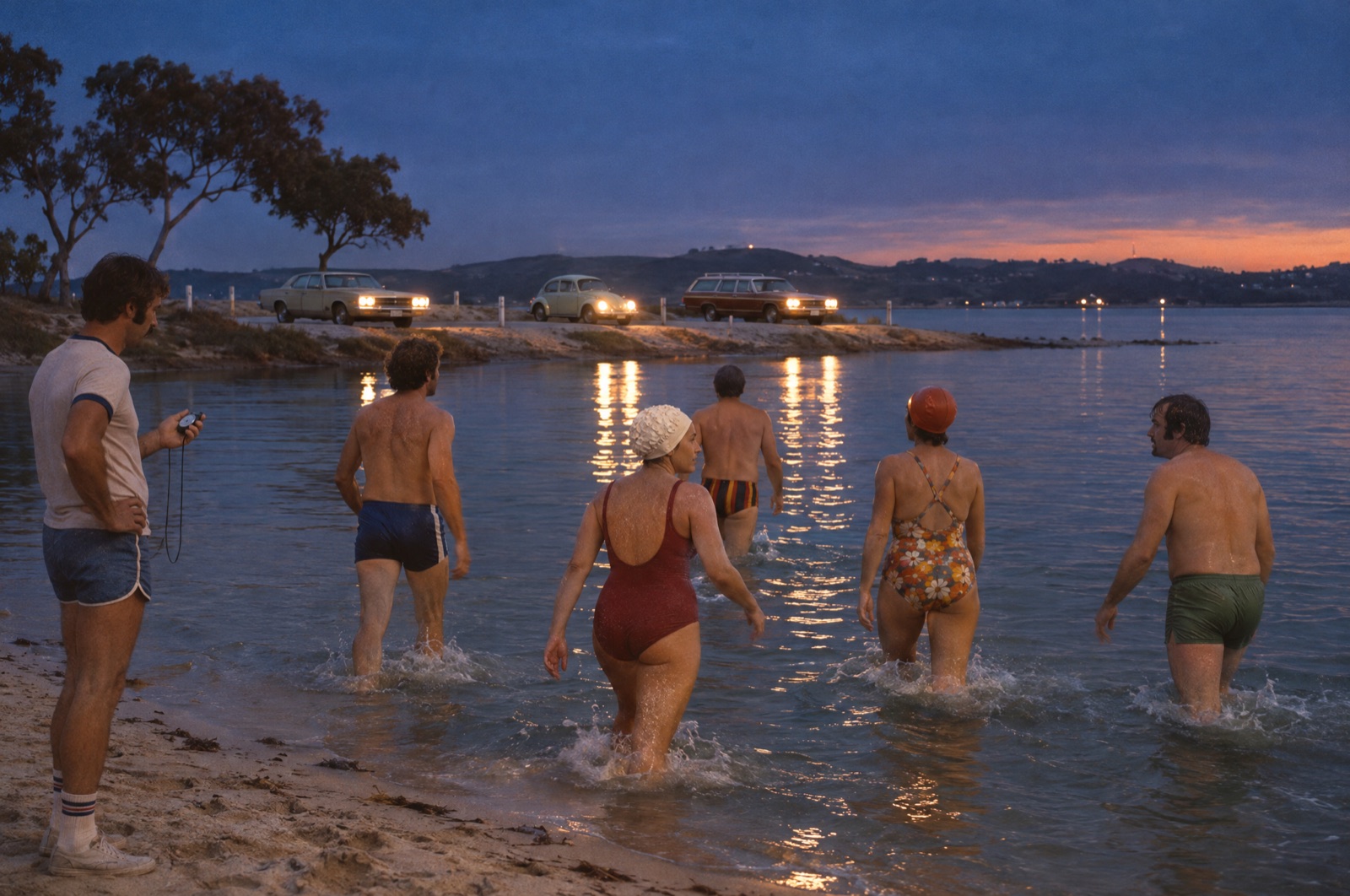
In San Diego in the 1970s Dave Pain's biathlons, a run followed by a swim, were popular. Two members of the San Diego Track Club, Jack Johnstone and Don Shanahan, wanted something new. Shanahan pushed for adding a bike leg and Johnstone agreed. Since a run and a swim was called a biathlon, Johnstone called the new format a triathlon.
The race was announced in the club newsletter for Wednesday, September 25, 1974, at 5:45 PM, by the causeway to Fiesta Island. Shanahan recalled years later that there were no police and no permits. They simply showed up.
It was not a triathlon in today's layout. The order was run, bike, swim, and there were 10–12 segments, because running and swimming alternated at the end. The last meters were run barefoot up a loose bank.
| Mission Bay, 1974 | Details |
|---|---|
| Run | about 5–6 miles (8–10 km), longest segment 2.8 miles, partly barefoot on grass and sand |
| Bike | 5 miles (8 km), two laps of Fiesta Island |
| Swim | about 500 yards (460 m), longest segment 250 yards |
| Starters | 46 people, all finished, plus one two-person relay |
| Entry fee | 1 dollar |
| Winner | Bill Phillips, aged 44 |
| Times | from 55:54 to 94:51 |
The run may have been 5 or 6 miles: the club announcement said 6 and participants remembered about 5. The finishing order was recorded with numbered popsicle sticks. The sun set before everyone had finished, so spectators lined up their cars so that the headlights lit the water.
The whole Collins family stood on the start line: John, aged 38, his wife Judy and their children, 13-year-old Kristin and 12-year-old Michael. John Collins finished in 1:11:11. A few years later he would propose something much longer in Hawaii. Johnstone, who died in 2016, also described a feeling every triathlete knows: after getting off the bike his legs seemed to belong to someone else.
Hawaii 1978: an argument about who is toughest
The idea came up at the awards ceremony after a relay race around Oahu in 1977. There was an argument about who is fittest: swimmers, cyclists or runners. John Collins, a U.S. Navy commander, proposed combining three races that already existed on the island:
- the Waikiki Roughwater Swim, 2.4 miles (3.86 km) in the ocean,
- the Around-Oahu Bike Race, 115 miles (185 km) around the island, cut to 112 miles (180 km) for the new event,
- the Honolulu Marathon, 26.2 miles (42.2 km).
That is the origin of a distance that today looks like a law of nature. Nobody calculated 140.6 miles from physiology. Three local events were joined together, and the bike race that was normally ridden over two days had to be done in one. Collins added that whoever won would be called the Ironman.
On February 18, 1978, 15 men started and 12 reached the finish. Gordon Haller won in 11:46:58. John Dunbar, who came second, ran out of water on the marathon. Collins's handwritten sheet of rules ended with the sentence "Brag for the rest of your life". Today it is a registered trademark.
A year later Tom Warren won, and Lyn Lemaire became the first woman to finish, in 12:55:38. The breakthrough came from the media: Barry McDermott described the race over ten pages in Sports Illustrated. The article carried the news of the Ironman far beyond Hawaii, and in 1981 the number of starters was more than three times that of the year before.
How the Ironman became Kona
Collins did not want to run a growing event. In 1980 it was taken over by Hank Grundman and his wife Valerie Silk, owners of Nautilus fitness clubs. Silk became race director although she had never organized a race. After their divorce in 1981 she was the one who led the race and moved it from crowded Honolulu to the Big Island. She also considered Kauai and Maui, but the course did not fit there. She paid a Honolulu agency 75 dollars for the logo.
Two further decisions shaped the sport for decades.
Television. ABC showed the Ironman in 1980. In February 1982 the cameras recorded Julie Moss, a student who was leading and running out of strength in the final meters. She fell, got up and in the end crawled to the line. Kathleen McCartney passed her just before the finish. Moss had entered to collect material for her thesis on exercise physiology. Silk did not see that finish. ABC's rights fee in 1982 is reported to have been 5,000 dollars. The scene gave the sport its message that finishing is itself a victory and turned the Ironman from a curiosity into a dream for ordinary people.
A field limit and qualification. Two editions were held in 1982, in February and October, because the race was moved to the fall. Scott Tinley and Dave Scott won them. Demand quickly outgrew the limit, so a lottery and qualification at licensed races were introduced. That system still stands behind the phrase "you have to qualify for Kona".
| Year | Starters in Hawaii | What changed |
|---|---|---|
| 1978 | 15 | First edition on Oahu |
| 1980 | 108 | Dave Scott wins in 9:24:33, ABC cameras |
| 1981 | 326 | Move to Kona |
| 1982 | limit of 1,000 | Two editions, the Moss finish |
| 1983 | more than 800 finishers | Lottery and the start of qualification |
| 1986 | limit of 1,500 from 1987 | First prize purse: 100,000 dollars |
The 1986 purse was a one-off gift from Steve Drogin, an anonymous donor at the time. This was the start of the professional Ironman. Three years earlier the event had to settle an ownership dispute: Grundman demanded 145,000 dollars for his share, and the lawyer Don Carlsmith put up the money in return for 49% of the company.
The people who built the legend
Dave Scott won six times: 1980, October 1982, 1983, 1984, 1986 and 1987. Mark Allen matched him by winning from 1989 to 1993 and in 1995. Their duel in 1989 went down in history as the Iron War. They ran shoulder to shoulder for most of the marathon and Allen won in 8:09:15. Scott Tinley and Scott Molina belonged to the same "Big Four" generation.
The most titles, however, were won by a woman. Paula Newby-Fraser of Zimbabwe won eight times between 1986 and 1996. In 2007 Britain's Chrissie Wellington took her first title, in 9:08:45.
In the 1990s Hawaii also became a German affair. Wolfgang Dittrich was the first on the podium in 1993. In 1997 Thomas Hellriegel, Jürgen Zäck and Lothar Leder took all three places. From 1993 to 2015 Germans stood on the men's podium 24 times, more than any other country. After Hellriegel came the wins of Normann Stadler and Faris Al-Sultan, and later Jan Frodeno and Patrick Lange.
Europe: from Pilsen and Almere to Nice and Roth
Triathlon reached Europe quickly. The race in Pilsen in 1980 is regarded as the first on the continent, which means it took place on the eastern side of the Iron Curtain. In 1981 the sport appeared in the Netherlands (Almere), Belgium and East Germany. In 1982 came the first races in West Germany (Essen, Hückeswagen, Gerolstein, Kehl) and the famous triathlon in Nice, organized by the agency IMG. The French channel Antenne 2 broadcast a film about it titled "Voyage au bout de la souffrance", a voyage to the end of suffering. Mark Allen was unbeaten in ten starts in Nice.
National structures grew in parallel: the French committee CONADET in 1984, turned into a federation in 1989, the German federation on February 23, 1985 in Worms, the Swiss one in 1985 and the Spanish one only in 1990. The European Triathlon Union was founded in Almere in 1984 with ten founding countries, Czechoslovakia among them. The first European championships were held in 1985 in Immenstadt.
The most important European venue is Roth. On September 22, 1984 Detlef Kühnel, a veteran of Hawaii, organized the Franken-Triathlon there for 83 people. He later bought the right to the name for Europe from Valerie Silk, and in 1988 Ironman Europe was born, the first Hawaii qualifier in Germany. The entry fee of 105 marks was the first three-digit fee for a triathlon in Germany, and 706 people started. In 1998, 4,000 people applied for 2,700 places. The Spanish chapter began with Ironman Lanzarote in 1992, founded by Club La Santa, with 148 starters in the first edition. It is the oldest race of the series that is still held in its original location.
The 1980s: how the sport spread around the world
The same decade took triathlon to every inhabited continent. The pattern repeated itself from country to country: someone read about Hawaii or saw it on television, a local club measured out a course at a lake or a beach, and a few dozen people turned up with whatever bikes they had. Wetsuits were rare, distances were whatever the venue allowed and national federations came later.
| Year | Where | What happened |
|---|---|---|
| 1981 | Japan | The country's first triathlon, at Kaike Onsen in Tottori Prefecture |
| 1982 | United States | The national federation, today's USA Triathlon, is founded and the U.S. Triathlon Series begins |
| 1982–1983 | Great Britain | 22 people found the British Triathlon Association in Reading on December 11, 1982. The first national championships follow on June 5, 1983 at Kirton Farm near Reading, with about 200 starters |
| 1983 | Australia and Canada | First Noosa Triathlon in Queensland. A long-distance race is held in Penticton, British Columbia, for the first time |
| 1985 | New Zealand and Japan | The first Ironman races outside Hawaii, in Auckland and at Lake Biwa. Japan also gets the Strongman race on Miyako Island |
| 1986 | Canada | Penticton becomes an official Ironman, the first on the North American mainland |
| 1987 | Great Britain | First London Triathlon, in the Docklands |
| 1988 | Germany and Australia | Ironman Europe in Roth and Ironman Australia in Forster join the series |
| 1989 | Worldwide | 30 national federations found the international union in Avignon |
The British championship of 1983 shows how unsettled the sport still was: a one-mile swim without wetsuits, a 40-mile bike ride and a 13-mile run. The organizers called it the first mass triathlon in Britain. Britain's first race over the full Ironman distance came only in 1990, in Cirencester.
The Ironman name traveled more slowly than the sport. After New Zealand, Japan, Canada, Germany and Australia, the next additions came in the 1990s: Lanzarote in 1992, Switzerland in 1997, Austria and Brazil in 1998. The first Ironman races on the U.S. mainland, Lake Placid and Florida, date only from 1999. For two decades an American who wanted the full distance under that name had to fly to Hawaii or abroad.
What grew fastest in those years was the short race close to home. The American series moved toward a swim of 1.5 km, a 40 km bike and a 10 km run, a format short enough for a city to host in a morning. That distance, not the Ironman, opened the door to the Olympic Games.
The road to the Olympic Games
The 1.5 km, 40 km and 10 km distance grew out of business, not out of an Olympic committee. In 1982 Jim Curl and Carl Thomas founded the American series USTS. The first round was held on June 12 at Torrey Pines over 2 km, 35 km and 15 km, and the professional purse was 800 dollars. After two years the series moved to a format close to today's.
The politics were harder. The early international bodies FIT and TFI collapsed over a dispute between a well-organized Europe and the Americans, who saw themselves as the inventors of the sport. Meetings in Vancouver brought an agreement. On April 1, 1989 in Avignon, 30 federations founded the International Triathlon Union, and Les McDonald of Canada became its first president. The Olympic distance was approved on the same day.
On August 6, 1989 Avignon hosted the first world championships, with more than 800 athletes from 40 countries. Mark Allen and New Zealand's Erin Baker won. In 1991 the IOC recognized the ITU as the sole authority of the sport, and the World Cup started with 11 races in 8 countries. The decision on the Olympics was taken on September 4, 1994.
The race on the bike changed along the way. In November 1995 the world championships in Cancún were held with drafting allowed for the first time. The run became decisive, and short-course triathlon gained pack racing that viewers could follow. The last European and German championships without drafting took place a year later. Age-group athletes stayed, as a rule, with the ban.
Sydney 2000 and the Games that followed
The first Olympic race started on September 16, 2000 beside the Sydney Opera House. The women raced a day before the men, so the first Olympic gold in the history of triathlon went to Brigitte McMahon of Switzerland, ahead of the home athlete Michellie Jones. In total 100 athletes from 34 countries took part.
| Games | Men | Women | Mixed relay |
|---|---|---|---|
| Sydney 2000 | Simon Whitfield (Canada) | Brigitte McMahon (Switzerland) | not held |
| Athens 2004 | Hamish Carter (New Zealand) | Kate Allen (Austria) | not held |
| Beijing 2008 | Jan Frodeno (Germany) | Emma Snowsill (Australia) | not held |
| London 2012 | Alistair Brownlee (Great Britain) | Nicola Spirig (Switzerland) | not held |
| Rio 2016 | Alistair Brownlee (Great Britain) | Gwen Jorgensen (United States) | not held |
| Tokyo 2021 | Kristian Blummenfelt (Norway) | Flora Duffy (Bermuda) | Great Britain |
| Paris 2024 | Alex Yee (Great Britain) | Cassandre Beaugrand (France) | Germany |
Great Britain leads the medal table with 11 medals, 4 of them gold. Frodeno is the only athlete on this list who later also won in Hawaii. In London Jonathan Brownlee received a 15-second penalty for mounting his bike before the line, a reminder that rules can decide the Games too. In Paris the problem was the Seine. The men's race was moved from July 30 to July 31 because water samples failed the standards. The relay was decided by one second: Germany 1:25:39, the United States and Great Britain both 1:25:40.
Where the relays came from
The relay is the youngest idea in the program: short, and equal for women and men. In 2009 the relay championships moved to a format of two women and two men. The mixed format has been part of the Youth Olympic Games since 2010, got its own series in 2018 and made its Olympic debut in Tokyo. Each athlete covers up to 300 m of swimming, up to 8 km on the bike and up to 2 km of running. The race lasts under an hour and a half, so it fits a television slot.
Para triathlon joins the Paralympics
Para triathlon made its Paralympic debut in Rio on September 10–11, 2016, with six medal events over the sprint distance of 750 m, 20 km and 5 km. Tokyo had eight medal events and Paris 2024 had eleven. The growth in medal events is the clearest measure of how quickly the para side of the sport has developed in under a decade.
The wars over names and trademarks
Few endurance sports have such an odd legal situation. One of the best-known names in sport is a private brand, and for millions of people it has become the name of a distance.
Ironman versus Iron Man. Silk registered the name in 1982 or 1983. Soon Marvel, the owner of the rights to the comic-book hero, got in touch. Under a settlement of 1986 the name was to appear together with the word "triathlon". Both sides agreed not to suggest any link between the brands, and in 2019 the question of fees for Marvel came back.
World championship or trademark. In 1992 the ITU protested against the use of the name "Ironman Triathlon World Championship". The head of the World Triathlon Corporation (WTC), then the owner of the Ironman, replied that his company had been first. On May 15, 1998 WTC, USA Triathlon and the ITU signed an agreement: WTC may use its mark but does not claim that this is a championship governed by the federation. The same agreement stated that drafting was to apply only to elite and junior athletes, not to age groups. In 2005 the dispute broke out again. The ITU banned racing at WTC events, USA Triathlon stopped sanctioning them, and in April 2006 the Court of Arbitration for Sport overturned the sanctions, referring to the 1998 agreement. The two sides signed a memorandum only in 2017.
A distance without a name. Only races licensed by IRONMAN may use the word. Other organizers write about full or long distance. In 2005 the 70.3 brand was born, the half distance counted in miles. That is why half Ironman is an everyday name, not an official term. More about this is on the page about triathlon distances.
Roth. In 2001 the owner of the mark demanded fewer starters, a mass start and higher fees. The organizers in Roth refused, and since 2002 the same course with the same people has run as Challenge. The biggest long-distance race in the German-speaking countries simply changed its name. Felix Walchshöfer, from the organizing family, recalled that in those years a phone call from Florida decided what the race had to do.
World Triathlon versus World Triathlon. For years two similar names were in use: the federation ITU and the private World Triathlon Corporation, owner of the IRONMAN brand. In October 2020 the federation took the name World Triathlon, and the company operates as The IRONMAN Group. Older texts are easy to misread on this point. Who is responsible for what today is described on the page about triathlon organizations.
The hands the Ironman has passed through
| Year | Owner | Price |
|---|---|---|
| 1978 | John and Judy Collins | their own idea |
| 1980–1983 | Hank Grundman and Valerie Silk (Hawaiian Triathlon Corporation) | taken over from the Collins family |
| 1983–1989 | Valerie Silk, 49% Don Carlsmith | 145,000 dollars for Grundman's share |
| turn of 1989 and 1990 | James Gills and partners, the World Triathlon Corporation is formed | 3 million dollars |
| 2008 | Providence Equity Partners | undisclosed |
| 2015 | Dalian Wanda | 650 million dollars, plus assumed debt |
| 2020 | Advance (owner of Condé Nast), with co-investor Orkila | 730 million dollars |
Silk sold the company at the turn of the year: the contract was signed in December 1989 and the new company started in 1990. In 2019 Wanda Sports went public in the United States and raised 190.4 million dollars instead of the planned 500 million. Advance completed its purchase in July 2020, already during the pandemic. From 3 million to 730 million dollars: the price rose more than 240 times in a little over 30 years.
How the rules changed
| When | Change | Why it matters |
|---|---|---|
| 1985 | First American set of safety and competition rules | The sport stops being a pastime run on local responsibility |
| 1986 | Five-year age groups in the American federation | The layout known today all over the world |
| 1987 | Hard-shell helmets mandatory at sanctioned races in the United States | Before that it was not a given |
| 1989 | The ITU sets the 1.5 km, 40 km and 10 km distance | The starting point for the Olympics |
| 1995 | First drafting at world championships (Cancún) | The bike stops deciding, the run counts |
| 1998 | An agreement limits drafting to elite and junior athletes | For age groups the ban stays the rule |
| 2004–2014 | IRONMAN draft zone shortened to 7 m | From 2015 a gradual return to a longer zone |
| 2009 | A championship season instead of a single race, mixed relays | The end of a title that depends on one day |
| 2015 | IRONMAN brings its rules closer to the ITU's | A common language after years of dispute |
| 2016 | Age-group sprint world championships become draft-legal | The first big exception to the drafting ban for age groups |
| 2022 | Women and men in Kona on separate days | A clean women's race without the influence of the men. In 2026 one shared day returned |
| March 2026 | IRONMAN: a 20 m zone and 45 seconds to pass for professionals, cameras banned | Age-group athletes stay at 12 m |
The wetsuit is a parallel story. In Hawaii it never became standard, because the water there is too warm. Temperature limits today are separate for the federation and for the IRONMAN brand. You will find the current thresholds on the page about organizations and rules.
The professional boom: from crisis to T100
First came a crisis. USA Triathlon's membership grew into the early 2010s and then the market slowed. In 2014 Life Time withdrew most of its prize money, the big purses of Hy-Vee and Rev3 disappeared, and IRONMAN cut prize money and professional places in Kona. The professionals had no say in the decisions of one dominant owner.
The answer came from the athletes themselves. In 2014 in Bahrain professionals began to talk about a union, and on July 29, 2015 the Professional Triathletes Union was founded. A year later it took the name Professional Triathletes Organisation (PTO). The commercial arm was to belong half to the athletes and half to investors. In September 2019 the PTO offered to buy IRONMAN, but the offer was rejected. A second attempt in February 2020 also failed. Challenge Family later turned out to be the realistic alternative.
In parallel, Super League Triathlon, created by Michael D'hulst and Chris McCormack, held its first race in 2017, with racing in short rounds. In 2020 in Rotterdam it presented Arena Games, an indoor triathlon that joins sport and esports.
The PTO paid out a record 1.15 million dollars at Daytona in 2020. In August 2021 the Collins Cup was held in Šamorín, Slovakia, a team contest modeled on golf's Ryder Cup. On January 30, 2024 the T100 series was born, meaning 100 km: a 2 km swim, an 80 km bike and an 18 km run. An official world championship title for long distance without drafting was agreed with World Triathlon. Money followed from Saudi Arabia through the SURJ fund, and from Cordillera, Verance Capital and Sir Michael Moritz. IRONMAN answered with its own Pro Series, a season-long points ranking across selected IRONMAN and 70.3 races, launched in 2024.
Records fell regardless of the business. Patrick Lange won in Kona in 2024 in 7:35:53, and Lucy Charles-Barclay set the women's course record of 8:24:31 in 2023. In Roth in 2026 Sam Laidlow recorded 7:21:04. Anne Haug went down to 8:02 there in 2024.
The Norwegians: a country without a great tradition that changed the sport
Kristian Blummenfelt and Gustav Iden are not the product of chance or of a big federation. Roger Gjelsvik noticed the 14-year-old Blummenfelt at a regional race and brought him to the Tertnes sports academy in Bergen. Iden joined about two years later. Arild Tveiten built the junior group on testing and numbers, from 2012 as head of development at the Norwegian federation. From 2013 the group went to altitude camps 2–4 times a year, and in 2015 it was joined by Olav Aleksander Bu, who convinced it that you have to slow down to be faster.
Bu noticed that Blummenfelt started too hard and emptied his glycogen stores. The group moved to more volume at low intensity, a lot of work near the lactate threshold and frequent lactate measurement from a finger-prick blood sample. In Rio in 2016 Blummenfelt was 13th. Then everything moved quickly:
- July 2021, Tokyo. Olympic gold for Blummenfelt in the heat of Odaiba, after a heat adaptation camp in Thailand and with measurement of core body temperature.
- May 7, 2022, St. George. The IRONMAN World Championship title in his debut at that race, in 7:49:16.
- June 5, 2022, Lausitzring. The Sub7 project: 6:44:25, the first full distance under 7 hours. This is an unofficial result, not a record under the rules.
- October 2022, Kona. Iden wins in 7:40:24 and runs the marathon in 2:36:15. That run is still the course record.
- 2025, Nice. Casper Stornes gives Norway another title, 7:51:39.
The years 2023 and 2024 showed that the method guarantees nothing. Blummenfelt was 12th in Paris and only 35th at the 2024 IRONMAN World Championship. Lactate measurement and constant data analysis have stayed in the sport all the same, among age-group athletes too. Iden returned to the podium: in 2026 he was second in Kona and won the Pro Series.
2026: the biggest change since the Olympics
As of November 2026 the picture looks like this:
- December 2025 and February 2026. The PTO and World Triathlon announce the Triathlon World Tour. The federation does not sell its authority over the sport: the PTO becomes the commercial partner and the world championship titles belong to World Triathlon. On February 11 the PTO buys a majority stake in Challenge Family.
- July 24. New brands and calendars. The WTCS, World Triathlon's championship series, becomes T50, and the T100 series becomes the T100 championship tour.
- September. Congress in Sanxenxo near Pontevedra. Thirty lower-tier races join the calendar, and a representative of LA28 presents the courses for the Los Angeles Games.
- October 10. The IRONMAN World Championship returns to Kona after three seasons of being split. Women and men race on one day. Vincent Luis wins on his debut at this championship, in 7:47:27, and Gustav Iden finishes 1:36 behind him after a 3-minute penalty on the bike. In the women's race Solveig Løvseth leads in the last mile but stops running and finishes eighth, and the title goes to Taylor Knibb in 8:36:29. The next edition is set for October 9, 2027, again in Kona.
The last act of the season is the T100 final in Qatar on December 10–12, 2026. The old split between the world of the federation and the world of IRONMAN is being replaced by a new one: the World Triathlon and PTO bloc on one side, IRONMAN on the other. There are again two camps, this time both with serious money.
From 15 starters to a sport for everyone
The professional story is only the visible part. The real change of the last 50 years is who stands on the start line. In 1978 it was 15 men who knew each other. Today the age-group field is the economic base of the whole sport.
- USA Triathlon alone counted about 303,000 active members and 829 sanctioned events in 2025.
- The IRONMAN and 70.3 series has more than 170 qualifying races and the company works in more than 50 countries.
- Challenge Roth takes about 3,500 individual athletes and 650–700 relay teams each year, in front of up to 300,000 spectators. Online registration for the 2027 race closed in under 20 seconds.
- More than 600 American age-group athletes traveled to the 2026 age-group world championships in Pontevedra as part of their national team.
Several things made this possible. Five-year age groups, introduced in the United States in 1986, gave a 50-year-old a race of his or her own. Qualification and world championships for age groups gave ordinary athletes a goal beyond finishing. The sprint and the Olympic distance made a first race possible without a year of preparation. And the wetsuit, the clip-on aero bar and later the power meter and the sports watch brought the tools of professionals into ordinary garages.
One thing has not changed since Julie Moss crawled to the line in 1982: for most people the point is still to finish. If you want to add your own finish line to this history, start with the page about your first triathlon or compare the triathlon training plans by distance. If the long race is the dream, read how registration for an Ironman works. In the IMI app the plan for your race is led by a real coach who updates it every week.
Frequently asked questions
Who invented triathlon?
The modern format and the name were created by Jack Johnstone and Don Shanahan of the San Diego Track Club. Their race was held on September 25, 1974 at Mission Bay. The first combinations of three disciplines are known from France in the 1920s, but they have no continuity with today's sport.
When and where was the first Ironman?
On February 18, 1978 on Oahu, Hawaii. Fifteen men started, twelve finished and Gordon Haller won in 11:46:58. The race moved to Kona in 1981.
Why is an Ironman 2.4, 112 and 26.2 miles?
Because John Collins joined three existing Hawaiian races: the Waikiki Roughwater Swim, the bike race around Oahu and the Honolulu Marathon. The distance comes from the local calendar, not from research.
When did triathlon become an Olympic sport?
At Sydney 2000. The decision was taken in 1994. The first gold went to Brigitte McMahon of Switzerland, and the mixed relay joined the program in Tokyo. Para triathlon has been part of the Paralympic Games since Rio 2016.
Who has won the most Ironman World Championship titles?
Paula Newby-Fraser, with 8 titles. Among men Dave Scott and Mark Allen have 6 each.
Where does the name Ironman come from?
From John Collins. When he proposed joining three Hawaiian races in 1977, he added that the winner would be called the Ironman. Today it is a registered trademark.
What was the Iron War?
The 1989 race in Hawaii between Dave Scott and Mark Allen. They ran side by side for most of the marathon and Allen won in 8:09:15, his first of six titles.
What is the Ironman course record in Kona?
For men 7:35:53 by Patrick Lange in 2024, for women 8:24:31 by Lucy Charles-Barclay in 2023. Faster times are set in Roth, where Sam Laidlow recorded 7:21:04 in 2026, but every course is different. Blummenfelt's 6:44:25 from the Sub7 project is unofficial.
Is Ironman the same as triathlon?
No. Triathlon is the sport, and IRONMAN is the trademark of one company and its race series. Challenge Roth and many independent races cover the same distance, but they are not allowed to use the IRONMAN name.
Who owns the IRONMAN brand today?
Advance, a private family-owned group and the owner of Condé Nast (as of November 2026). It bought The IRONMAN Group in 2020 for 730 million dollars.