Contents
Pace and splits
| Pace | 5:13/km |
|---|---|
| 5 km | 26:04 |
| 10 km | 52:08 |
| 15 km | 1:18:13 |
| Finish | 1:50:00 |
Your ranges from the Cooper test
This goal matches an estimated result of about 2610 m in the Cooper test, a 12-minute run for maximum distance. If you are slower today, set your own result and the ranges will follow your current fitness.
This is an estimate, not a promise of a finish time. Your coach sets the exact ranges after a test in the app.
Repeat times in each range
The middle of each range at the estimated Cooper result. Use it to check your pace on a watch or a treadmill.
| Range | 400 m | 1 km |
|---|---|---|
| Easy | 2:45 | 6:52 |
| Aerobic | 2:25 | 6:03 |
| Tempo | 2:11 | 5:28 |
| Threshold | 2:01 | 5:03 |
| VO2max | 1:51 | 4:39 |
Where to find 10 minutes after 2:00
Most people arrive here from 2:00, and the 10 minutes are about 8% of the pace. An equation from a 2023 study of 134 recreational male runners shows what each factor is worth: every kilometer run per week takes off 0.191 minutes, every point of VO2max (maximal oxygen uptake) takes off 0.594, and every BMI point adds 2.498.
| If the 10 minutes had to come only from… | Change needed | Is it realistic? |
|---|---|---|
| volume | +52 km (32 miles) a week | no |
| VO2max | +17 points | no |
| body weight | −4 BMI points | only if you are genuinely overweight |
| a bit of everything | +10 km a week, +5 VO2max, −2 BMI | yes, as the sum of small changes |
The equation has a standard error of about 10 minutes and describes averages for men, so treat it as an illustration. It shows that no single factor settles it. An extra 10 km (6 miles) a week is worth only about 2 minutes. The rest has to come from the quality of training and, for some runners, from body weight.
Where Threshold work comes in

At 1:50 you work on speed for the first time, not only on endurance. The goal corresponds to an estimated 2,610 m in the Cooper test, the result behind the ranges shown above the article. In the same study the 108–117 minute group had a VO2max of 45.7, trained 4.1 days a week and ran 45.9 km (28.5 miles). The next one, 100–107 minutes, had 48.1, 4.4 days and 54.9 km (34 miles). A 1:50 goal puts you in the first group. The second is the next step.
You have to hold 5:13/km (8:23/mile) for 110 minutes. If it feels manageable for only 40, you are not there yet. The main quality session is Threshold work: 20–30 minutes of total effort just below the pace at which your breathing stops being controlled, split into longer repeats. Over time the repeats move toward race pace. For a 2:15 goal a session like this is optional. Here it ranks alongside the long run.
At the peak of the block you land between two reference points: 45–60 km (28–37 miles) for 2:00 and 55–75 km (34–47 miles) for 1:45. Study averages are lower because they cover the whole preparation period. A sensible minimum is 4 runs a week. Threshold sessions grow only when the volume is stable, which is what an IMI coach watches when updating your plan every week.
After a 2:00 you are usually running about 40–46 km (25–29 miles) a week. Spend the extra 5–10 km on a fourth or fifth run first. Start Threshold work at 15–20 minutes in total and reach 20–30 minutes before you begin to raise the pace of the repeats. How to divide the whole block into phases is described on the main half marathon page.
The pace holds well at this level
Among 133,268 finishers of the Vienna half marathon between 2006 and 2018, the quarter of men who averaged about 1:52 ran the first 5 km at 5:10/km (8:19/mile) and the stretch from 15 to 20 km at 5:28/km (8:48/mile), 5% slower. The fastest quarter of women, averaging about 1:51, lost the same 5%. In the slowest quarter the drop was 13%. You can plan an almost even pace, though a small reserve of fitness still pays.
| Checkpoint | Even pace for 1:50 |
|---|---|
| 5 km | 26:04 |
| 10 km | 52:08 |
| 15 km | 1:18:12 |
| 10 miles | 1:23:55 |
Note what the Vienna group did: it opened faster than its average and paid for it later. Being 30–60 seconds ahead at 10 km helps only if it comes from fitness. The same lead taken from a fast opening is paid back at km 15–18.
If something cracks, it is usually between km 15 and 18 (miles 9–11). You pass 15 km after about 1:18, having spent all of it on the border of the Tempo and Threshold zones. Your breathing still holds, but your stride shortens. Rehearse this part by finishing a long run at 5:13–5:20/km (8:23–8:35/mile), with more than an hour already in your legs.
Who breaks 1:50
The results of one race describe only its own field, so the best reference is the same peer-reviewed Vienna study: 91,145 men and 42,123 women, each split into four quarters by finishing position. The average times are our conversion from the published speeds, so they are approximate.
| Quarter of the field | Men, average time | Women, average time |
|---|---|---|
| Fastest | about 1:37 | about 1:51 |
| Second | about 1:52 | about 2:06 |
| Third | about 2:03 | about 2:17 |
| Slowest | about 2:23 | about 2:36 |
For a man, 1:50 is a couple of minutes faster than the second quarter's average, which puts you in the faster half of the men's field. For a woman it beats the average of the fastest quarter, so it is a first-quarter result in the women's field. This is one race over one period: use it for orientation, not as a percentage.
What about 1:45?
The preparation barely differs, so 1:45 has no page of its own. The pace is 4:59/km (8:01/mile). Race organizers treat it as a standard target: Berlin lists a pacer for 1:45 but none for 1:50, and Copenhagen runs pace teams at both. Already have 1:50 in your legs? See the sub-1:40 half marathon, and convert paces in the pace calculator.
Pick a race, then count back through the weather
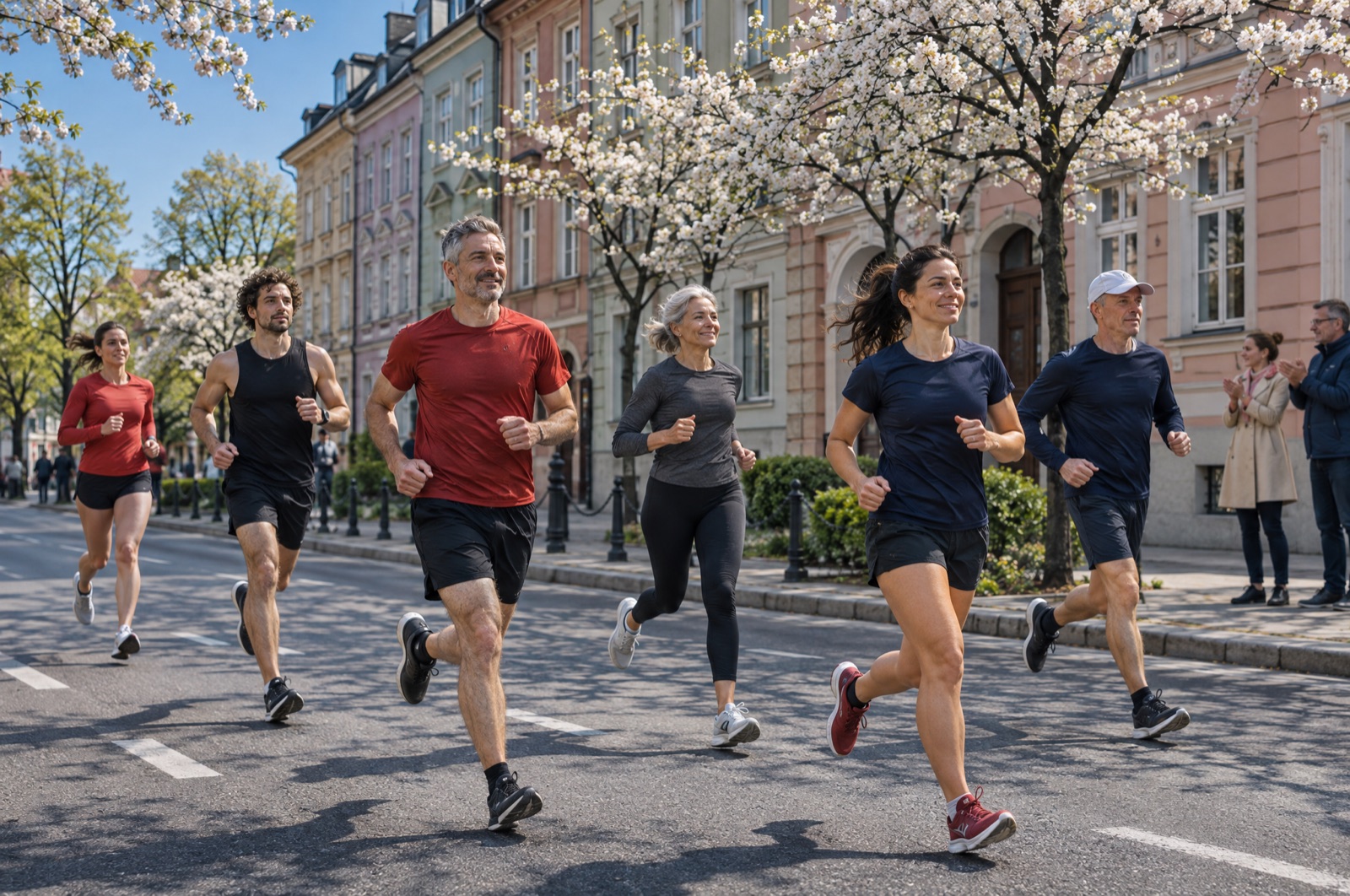
With a time goal the course matters. A record-eligible course has its start and finish no more than half the race distance apart and drops no more than 1 m per km, so a time run there is comparable anywhere. Cool weather, few turns and pacers at your goal do the rest. The races below have produced world records or publish detailed pacing arrangements (as of November 2026).
| Race | Usual month | Worth knowing |
|---|---|---|
| Lisbon | March | A men's world record of 57:20 was run here in March 2026 |
| Berlin | late March or early April | Pacers at 1:35, 1:45 and 2:00; the 3:15 limit runs from when you cross the start line |
| Buenos Aires | August | A Southern Hemisphere winter race; the current men's world record, 56:51, was set here in 2026 |
| Copenhagen | September | A 1:50–2:00 start group with pace teams at 1:50 and 1:55 |
| Valencia | October | The women's world record, 1:02:52 (2021), and a men's world record of 57:30 (2024) |
Then count 12–16 weeks back and see what the weather does to your hardest sessions. For a March race in the Northern Hemisphere the heaviest Threshold work falls in January and February, and on snow 5:13/km can be impossible. Go by effort then, not pace, or move the session to a treadmill, where a 1% incline reproduces the cost of running outdoors. For an October race the same weeks fall in summer, and in a hot climate they are warm whatever the month: go by effort, run early or use the treadmill. South of the equator the months swap and the logic stays. Treat strong wind like snow, and do not try to win the time back with the wind behind you.
A gel helps, but it does not rescue the race
A 2014 research review considers carbohydrate during a run necessary from about 2 hours, and a 1:50 race is shorter than that. The ACSM position stand gives 30–60 g per hour for efforts of 1–2.5 hours, and 1–4 g per kilogram of body weight 1–4 hours beforehand. After a normal pre-race meal you will not hit the wall the way marathoners do. One or two gels, at around 45 and 80 minutes, help over the last 5 km. Try them in training at race pace, because at 5:13/km your stomach accepts less than on an easy run.
The check before the block
For 1:50 the Riegel formula gives a 10K of about 49:51 and a 5K of about 23:55. If you have run those times in the past two months and regularly cover 45 km (28 miles) a week, the goal makes sense. If the 10K is not there yet, the sub-50 minute 10K is the natural first step. A Cooper test under 2,500 m means it is better to start with 2:00.
Three weeks before the race, test your fitness over 10 km. A result of about 49:51 means the plan stands. A result of 50:30 gives about 1:51:30 in the formula, so you start at 5:17/km (8:30/mile). In strong wind or above 18°C (64°F) the reference is 5:18–5:20/km, or about 1:52. The second check is 8–10 km (5–6 miles) at 5:13/km, which takes 42–52 minutes, in one session. It should end with something in reserve, because it is less than half the race distance.
Frequently asked questions
Is 1:50 a good half marathon time?
Yes. In the Vienna half marathon (133,268 finishers from 2006 to 2018) the fastest quarter of women averaged about 1:51, so a 1:50 sits in the first quarter of the women's field. For a man it is a couple of minutes faster than the second quarter's average, which puts you in the faster half of the men's field.
What pace is a 1:50 half marathon?
5:13/km or 8:23/mile. At even pace you pass 10 km in 52:08 and 10 miles in 1:23:55.
Is it harder to break 1:50 after 40?
Not by much. In a study of more than 300,000 marathon and half marathon runners, average times were nearly identical between 20 and 49 and slowed by only 2.6–4.4% per decade from 50 to 69. That describes people who race, not the whole population, but turning forty does not close the road to this result.
How many miles a week do you need for a sub-1:50 half marathon?
At the peak of the block, usually 50–65 km (31–40 miles) a week over 4–5 runs. In a 2023 study the runners finishing in 108–117 minutes averaged 45.9 km (28.5 miles) over 4.1 days, but that average covers the whole preparation, not just the peak weeks.
How many Threshold sessions a week do I need for 1:50?
Usually one, sometimes two Threshold sessions a week, adding up to a small part of the mileage. The rest is easy running and the long run.
What marathon time does a 1:50 half marathon predict?
About 3:49 according to the Riegel formula, but that is only a conversion. The marathon needs far more volume, and most recreational runners slow down more than the formula assumes. With little marathon experience, a more sensible starting point is the 4:00 goal.
Why did the finish clock show a slower time than my result?
Because it counts from the first wave. If you crossed the start line 15 minutes after the gun, the clock is 15 minutes ahead of you. What counts is your net (chip) time in the results.
How far is 1:50 from 1:40?
28 seconds per kilometer (46 per mile), about 10% in speed. Volume changes less than it did on the way down from 2:00, so faster work plays a bigger role. More on the sub-1:40 half marathon page.