Contents
- The same pace as a 3-hour marathon, different demands
- How much to run: five days a week
- What 4:16/km feels like from the inside
- Why VO2max alone is not enough
- Who breaks 1:30
- Even pace and the 1:30 line
- Discipline in the first 2 km
- Fueling when the race takes 90 minutes
- A recent result, not a personal best from years ago
- Frequently asked questions
Pace and splits
| Pace | 4:16/km |
|---|---|
| 5 km | 21:20 |
| 10 km | 42:40 |
| 15 km | 1:03:59 |
| Finish | 1:30:00 |
Your ranges from the Cooper test
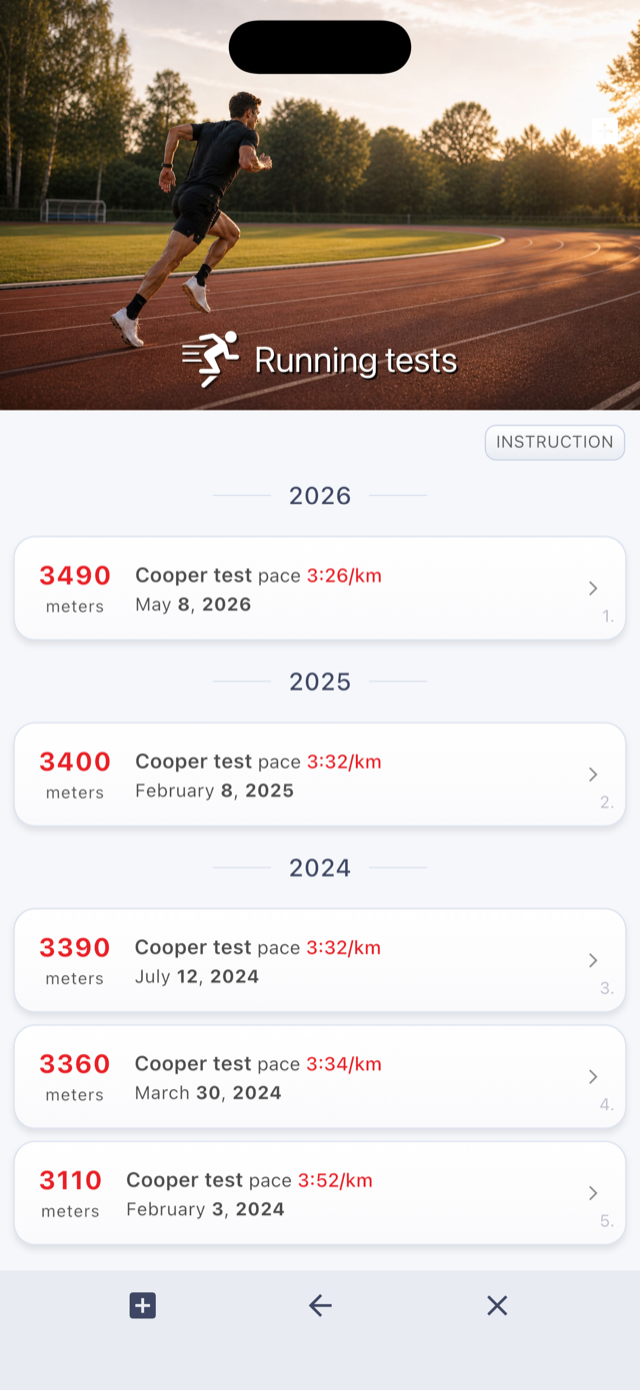
This goal matches an estimated result of about 3150 m in the Cooper test, a 12-minute run for maximum distance. If you are slower today, set your own result and the ranges will follow your current fitness.
This is an estimate, not a promise of a finish time. Your coach sets the exact ranges after a test in the app.
Repeat times in each range
The middle of each range at the estimated Cooper result. Use it to check your pace on a watch or a treadmill.
| Range | 400 m | 1 km |
|---|---|---|
| Easy | 2:16 | 5:41 |
| Aerobic | 2:00 | 5:01 |
| Tempo | 1:49 | 4:32 |
| Threshold | 1:40 | 4:11 |
| VO2max | 1:32 | 3:51 |
The same pace as a 3-hour marathon, different demands
A 3-hour marathon rests on fuel stores, running economy and legs that survive past 30 km. A 1:30 half marathon depends on how long you can hold an effort close to your threshold. Fuel moves into the background, and the main barrier is accumulating fatigue.
| What differs | 1:30 half marathon | 3:00 marathon |
|---|---|---|
| Fitness required by the Riegel formula | Cooper test of about 3,150 m | Cooper test of about 3,280 m |
| Main limiter | threshold and tolerance of the effort | volume, fuel, legs after 30 km |
| Fueling during the race | helpful, not essential | essential |
| What happens if you start too fast | minutes lost at the end | risk of running out of fuel after 30 km |
For a 1:30 half marathon the Riegel formula, which you will find in the pace calculator, gives a marathon of about 3:07:40. For 3:00 you need a half marathon of about 1:26:20. If you have a 1:30 and are thinking about a sub-3 hour marathon, the formula leaves you about 8 minutes short, so come down to around 1:26 first.
How much to run: five days a week

In a 2023 study of 134 men, the 73–92 minute group, with an average time of 1:24:30, ran 67.9 km (42 miles) a week on average, with a spread of ±25.6 km. What set it apart was the number of running days: 5.4 against 4.4 in the next two groups. This is the first level at which frequency jumps. A pace of 4:16/km needs frequent contact with fast running and good recovery between sessions.
The 55–75 km (34–47 miles) range, the reference for 1:45, stops being a ceiling here. At 1:30 its upper part is more of a starting point, usually on 5 runs a week. The core of the week is longer Threshold work and repeats at race pace, because it is hard to tolerate 4:16/km for 90 minutes if you rarely run more than a few kilometers at it in one go. The long run does not need to exceed 20–24 km (12.5–15 miles), because it is not what limits this result. The phases of the block and the taper are described on the main half marathon page.
With this goal, race pace is already Threshold work. At a result of about 3,150 m in the Cooper test the Threshold zone is roughly 4:03–4:20/km (6:31–6:58/mile), so a repeat at 4:16/km is not a light extra on top of a threshold session. It is the same stimulus. Count them together when you judge how much hard work a week contains.
A week like this leaves little room for misjudged loads. An IMI coach sees your effort rating after hard sessions, comments on them and updates the plan every week.
What 4:16/km feels like from the inside
In the ranges shown above the article, 4:16/km sits in the Threshold zone, near its slower end. For the first 7–8 km, about 32 minutes, you feel a strong but even rhythm. Between km 8 and 15 your breathing shortens and your thoughts narrow to the next kilometer. The breaking point is usually km 15–18 (miles 9–11). You pass 15 km after 1:04, and continued work near threshold starts to cost you your form. The stride shortens, the pace drops by 5–8 seconds per km, and for a few kilometers you may not notice.
Look for that moment on purpose in training. Run the last kilometers of race-pace work with your attention on stride length and arm drive, the first things to go when you slow.
Why VO2max alone is not enough
The men in the 73–92 minute group had an average laboratory VO2max (maximal oxygen uptake) of 54.5, with a spread of ±7.5 points. A runner with good economy covers the same distance using less oxygen, which is why formulas that convert a result into VO2max are only a rough guide at this pace.
At this level VO2max on its own says little. In a 2017 study of recreational marathon runners, speed at the first lactate threshold was linked to the result more strongly (correlation 0.79) than VO2max (0.54).
Who breaks 1:30
Very few runners. No official statistic covers every half marathon, but a peer-reviewed study of the Vienna half marathon gives the scale. Among its 133,268 finishers from 2006 to 2018, the fastest quarter of men averaged about 1:37 and the fastest quarter of women about 1:51 (our conversion from the published speeds). A 1:30 is about seven minutes ahead of the average of the fastest quarter of men, and more than twenty ahead of the women's.
Age matters less than you might expect. A study of more than 300,000 marathon and half marathon runners found almost no difference in average times between the ages of 20 and 49, and a slowdown of 2.6–4.4% per decade from 50 to 69.
Even pace and the 1:30 line
At this level runners fade the least. In the Vienna data the fastest quarter of men ran the first 5 km at 4:28/km (7:11/mile) and the stretch from 15 to 20 km at 4:41/km (7:33/mile), under 5% slower. In the slowest quarter the drop was 13%.
Even pace is 42:40 at 10 km and 1:08:39 at 10 miles. Because the pace decays so little here, a small cushion is enough: 20–40 seconds in hand at 10 km, earned by fitness and not by a fast first kilometer.
Round numbers pull at every level. A peer-reviewed analysis of nearly 9.8 million marathon finishing times found runners bunched just under them, and 1:30 is the half marathon twin of the 3-hour marathon. The Vienna data add a warning, though: the fastest quarter was the only group with no finishing kick on average. The last kilometer can save a result that is on the edge at 20 km, but it will not rescue one that is 20 seconds adrift.
Discipline in the first 2 km
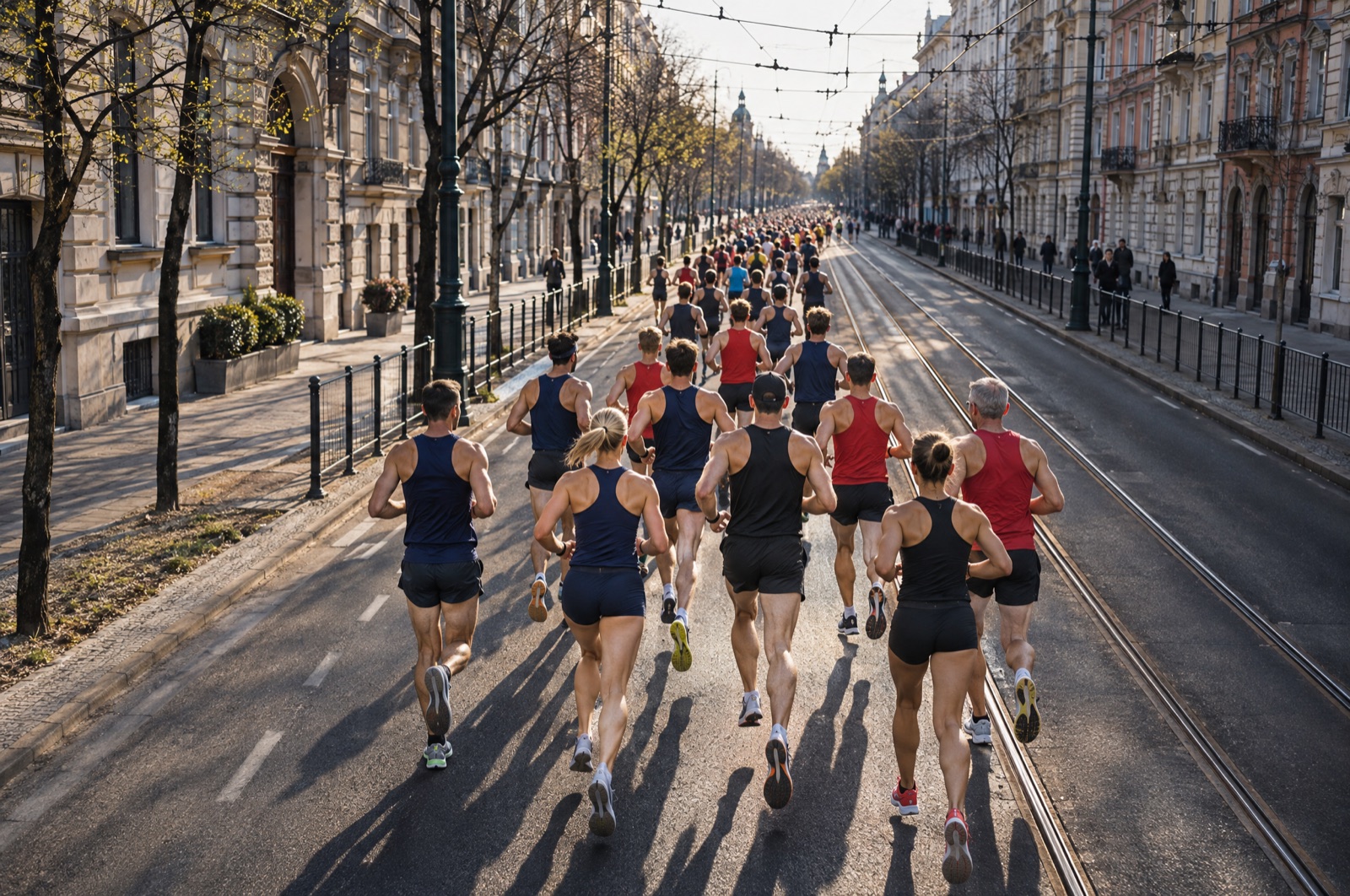
A 1:30 runner starts near the front. In Copenhagen, for example, the 1:25–1:30 start group is one of the first to go and has a pace team at 1:25. Berlin lists pacers at 1:25 and 1:35, with nothing at 1:30. You run in a dense, fast group from the first meters, and the opening kilometer is often too fast because of adrenaline. You do not go into 4:16/km on cold muscles either, so an unhurried warm-up is part of the race.
In strong wind do not defend 4:16/km at any price. Switch to 4:22/km (7:02/mile), which is 1:32, and tuck into a group. The cushion at 10 km would disappear anyway, and 1:32 in bad weather says more about your fitness than 1:33 after falling apart at km 17.
Fueling when the race takes 90 minutes
An hour and a half falls between two recommendations. A 2014 review of the research considers carbohydrate during a run necessary from about 2 hours, and for efforts of around an hour it points to smaller doses, down to a mouth rinse alone. For 45–75 minutes the ACSM speaks of small amounts, and for 1–2.5 hours of 30–60 g per hour. A 1:30 race falls at the start of that second range.
During the race the reference is 30–40 g, which is one or two gels. That is less than the lower ACSM limit, but at 4:16/km it is usually what you can take in comfortably. The meal before the start matters more.
A recent result, not a personal best from years ago
The goal makes sense with a 10K of about 40:47 and a 5K of about 19:34 (Riegel formula), run in the past two months. Without a 10K result of around 41 minutes you will usually gain faster by working on a sub-40 minute 10K. In training you can check it like this: 12–15 km (7.5–9.5 miles) of work at 4:16/km should fit into one session, with short breaks.
Frequently asked questions
Can an average runner break 1:30 in the half marathon?
Rarely without years of consistent training. Race results cannot settle it, because they say nothing about predisposition. In the Vienna half marathon the fastest quarter of men averaged about 1:37, so 1:30 is ahead even of that group's average. For most people it takes many years, five regular runs a week and Threshold work. Nobody can promise it.
What pace is a 1:30 half marathon?
4:16/km or 6:52/mile. At even pace you pass 5 km in 21:20, 10 km in 42:40 and 10 miles in 1:08:39.
Is 1:30 a good half marathon time for a woman?
Yes, a very good one. In the Vienna half marathon from 2006 to 2018 the fastest quarter of women averaged about 1:51, more than twenty minutes slower. A 1:30 is the very front of the recreational women's field.
Can I target a 3-hour marathon with a 1:30 half marathon?
Not yet. The pace is the same, but for 3:00 you need about 1:26:20 and far more volume.
How many miles a week do I need for a sub-1:30 half marathon?
In a 2023 study the group around this level ran about 68 km (42 miles) a week on 5.4 running days on average, with a wide spread. Treat the upper part of 55–75 km (34–47 miles) on five runs as a starting point.
Do I need a tune-up race before a 1:30 half marathon?
Yes, it is useful. A 10K about 3–4 weeks before the half marathon shows whether 4:16/km is realistic and does not load you the way a second half marathon would.
How far is 1:40 from 1:30?
28 seconds per kilometer (46 per mile), about 11% in speed. On top of the threshold work comes a fifth running day, and the repeats at race pace get longer. The starting point is described on the sub-1:40 half marathon page.