Contents
Pace and splits
| Pace | 5:41/km |
|---|---|
| 5 km | 28:26 |
| 10 km | 56:53 |
| 15 km | 1:25:19 |
| Finish | 2:00:00 |
Your ranges from the Cooper test
This goal matches an estimated result of about 2400 m in the Cooper test, a 12-minute run for maximum distance. If you are slower today, set your own result and the ranges will follow your current fitness.
This is an estimate, not a promise of a finish time. Your coach sets the exact ranges after a test in the app.
Repeat times in each range
The middle of each range at the estimated Cooper result. Use it to check your pace on a watch or a treadmill.
| Range | 400 m | 1 km |
|---|---|---|
| Easy | 2:59 | 7:28 |
| Aerobic | 2:38 | 6:35 |
| Tempo | 2:23 | 5:57 |
| Threshold | 2:12 | 5:30 |
| VO2max | 2:01 | 5:03 |
The pull of two hours
The number of finishers should change smoothly from one minute to the next. Around round numbers it does not. A peer-reviewed analysis of nearly 9.8 million marathon finishing times found clear bunching just under round numbers such as 4:00, which is the same pace as a 2:00 half marathon. The authors traced it to runners adjusting their effort near the finish, not to pacers or qualifying standards.
Fitness does not change on the hour, so the bunching is made in the closing kilometers. Some runners fight for the round number, and some let go once they see it is out of reach. The barrier gives you a real push, provided that 2:00 is still within reach at 20 km.
Where 2 hours sits in a big field
The best published picture of a big city race is a peer-reviewed study of the Vienna half marathon: 133,268 finishers between 2006 and 2018, split into four quarters by finishing position. The average times are our conversion from the speeds in the study.
| Quarter of the field | Men, average time | Women, average time |
|---|---|---|
| Fastest | about 1:37 | about 1:51 |
| Second | about 1:52 | about 2:06 |
| Third | about 2:03 | about 2:17 |
| Slowest | about 2:23 | about 2:36 |
Among men, two hours falls in the middle of the field, between the averages of the second and third quarters. Among women it is in the faster half, ahead of the second quarter's average. In a smaller race with many club runners, the same time can place further back.
Age changes the picture more slowly than you might think. In a study of more than 300,000 marathon and half marathon runners, average times were nearly the same from 20 to 49 and slowed by 2.6–4.4% per decade between 50 and 69. On a two-hour race that is 3–5 minutes per decade.
5:41/km feels easy for an hour
With a result of about 2,400 m in the Cooper test, 5:41/km falls in the calculator above on the border between the Tempo and Threshold zones. For the first hour the effort feels stable and controlled. After km 15 it starts to cost more and more concentration. That is why the mistake is easy to miss: 5:30/km (8:51/mile) at the start does not hurt at all.
The Vienna results confirm it. The quarter of men who averaged about 2:03 ran the first 5 km at 5:39/km (9:05/mile), which is on schedule for 2:00. Between km 15 and 20 they were at 6:04/km (9:46/mile), 7% slower. A 5% drop from 10 km onwards at 5:41/km is about 3 minutes at the finish, more than the margin most people chasing this goal have.
The 10 km window: 55:30–56:00
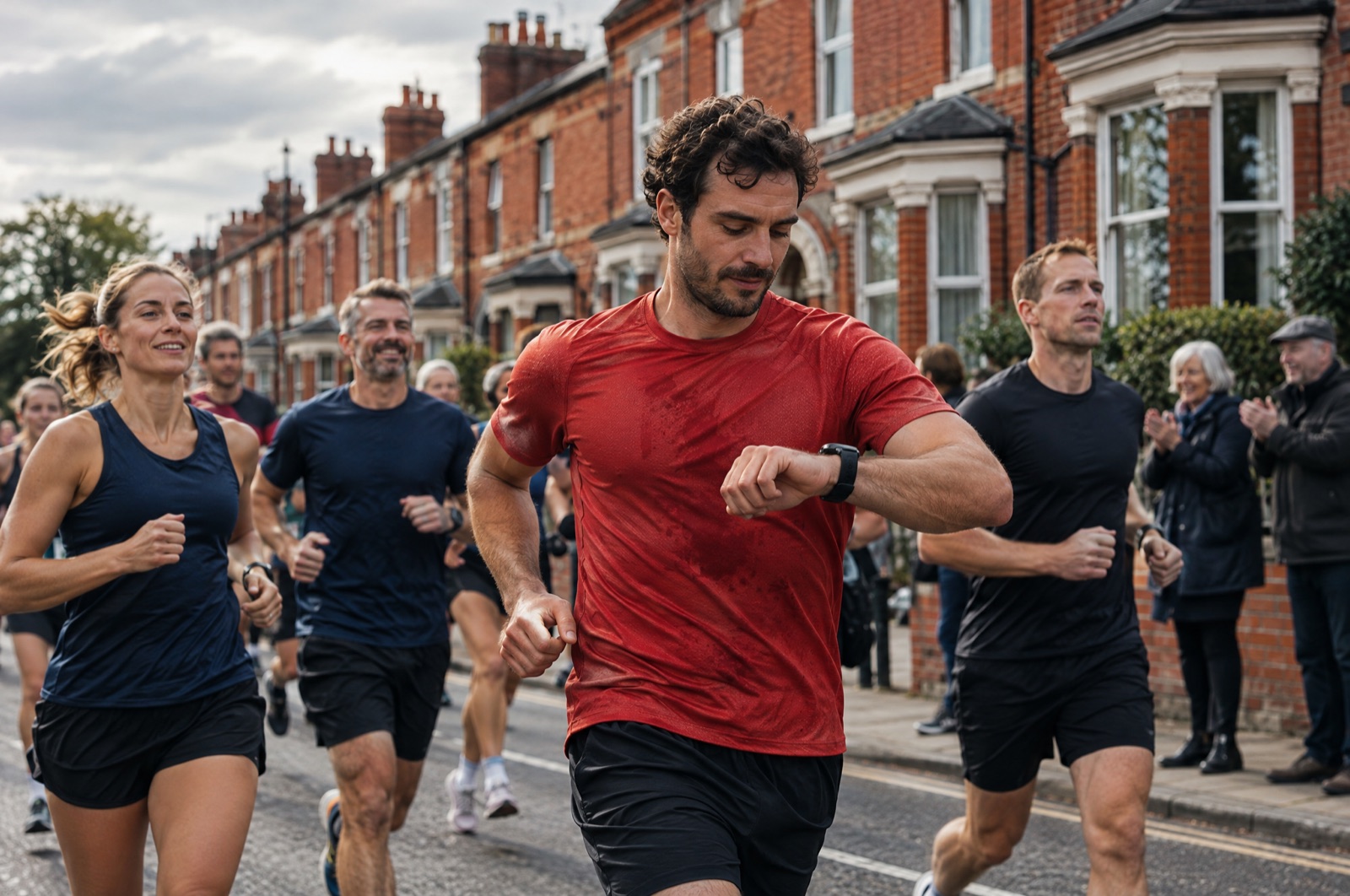
Even pace for 2:00 is 56:53 at 10 km and 1:31:32 at 10 miles. Since almost everyone slows a little in the second half, a 2:00 goal needs fitness for about 1:57–1:58, and at that fitness even pace is exactly 55:30–56:00, about a minute ahead of an even 2:00. At 10 miles that is roughly 1:29:15–1:30:00.
Do not read this as an invitation to start fast. The minute has to come from fitness, not from a quicker opening. 56:50 leaves no margin for a hill, an aid station or a crowded start. The first kilometers of a big race are often slower because of the crush. Do not win them back with a surge. Spread the loss over the next 10 km.
Line up in the right start group as well, because 2:00 is often the boundary. Copenhagen's groups split at exactly two hours, with pace teams at 1:55 and 2:00 on either side. Mumbai puts runners with a proven time of 2:00:00 or better in its first wave. Berlin lists a 2:00 pacer.
How much to run to break 2:00
In a 2023 study of 134 men, two groups sit on either side of your goal (VO2max is maximal oxygen uptake):
| Group | Average time | Running days | Per week | VO2max |
|---|---|---|---|---|
| 108–117 minutes | 1:50:48 | 4.1 | 45.9 km (28.5 miles) | 45.7 |
| 118–160 minutes | 2:09:42 | 3.6 | 39.4 km (24.5 miles) | 41.3 |
These are averages over the whole period, about 40–46 km a week. The peak is always higher, so the reference from the main half marathon page is 45–60 km (28–37 miles). Four runs a week is the optimum for a time goal, and three is the realistic minimum. See what changes on 3 runs a week.
If you already have a 2:10 half marathon behind you, progress usually means a few more kilometers each week, without one giant week. The quality comes from race pace inside the long run or in repeats, once the volume is already growing. 5:41/km has to feel familiar even when your legs have an hour of running in them. Threshold work moves that pace further from your limit. This is where a real coach is useful: at IMI the plan changes every week according to how you handle the volume, and your paces are set after a Cooper test or a 5K run.
The best check in training is 8 km (5 miles) at 5:41/km, which takes 45:30, at the end of a 16 km (10-mile) long run about 3 weeks before the race. If the last kilometer comes out the same as the first, the 55:30–56:00 window is backed up. If the pace slips by 10 seconds per km or more, aim for 2:02–2:03 and do not count on the pull of the finish. Treat this as a reference point.
Time your gels to the aid stations

Two hours is exactly the point that a 2014 review of the research names as the start of a real need for carbohydrate during a run. For 1–2.5 hours the ACSM gives 30–60 g per hour, so about 60–120 g over the whole race. The wall known from the marathon is not a threat here, but a dip in concentration at km 16–18 (miles 10–11) can cost the same minutes that separate you from the goal.
The reference is 1–2 gels, at around 45 and 90 minutes. That is below the range above, and for most runners at this effort it is enough. At 90 minutes you are near km 16, right where the field starts to stretch. Study the course map before race day and plan each gel for just before a water station, so you can wash it down. Rehearse this on a long run, because a sweet gel goes down harder at this pace than at an easy one.
A short night and an awkward start time
Start times differ a lot. In Berlin the runners leave from 10:05 am in waves, and in Copenhagen the 2:00–2:15 group is called to its start area half an hour after the first runners have gone, so a two-hour runner finishes around midday. In Singapore the half marathon starts at 4:30 am, which makes a short night part of the plan.
For a late start, bad sleep weighs more than for an early one. A 2022 review of 69 publications found that after 6 hours of sleep or less, morning efforts mostly held up and afternoon ones did not. After a bad night, move the window by a minute. 56:30 at 10 km is still ahead of even pace and saves strength for km 16–18. If you feel good at 15 km, the finish will add the rest.
In strong wind or above 18°C (64°F), settle for 5:45/km (9:15/mile), which is about 2:01:20. When 2:00 is out of reach, chasing it costs you the whole second hour of the race.
Does 2:00 mean a 4:00 marathon?
The pace is the same, the effort is not. According to the Riegel formula, which you will find in the pace calculator, a 2:00 half marathon gives a marathon of about 4:10, and 5:41/km has to be held twice as long. Thinking about a sub-4 hour marathon? Assume a half marathon of about 1:50–1:55 and far more volume.
What your 10K result says
| Result from the past 8 weeks | What it means |
|---|---|
| 10K in about 54:20 or 5K in about 26:05 (Riegel formula) and a regular 40 km (25 miles) a week | 2:00 is within reach |
| 10K in about 57 minutes | Start with the 2:15 goal or give yourself a second season |
You are 43 seconds per kilometer (69 seconds per mile) away from 2:15, and 28 seconds per kilometer short of 1:50. The second step is smaller, but it already needs dedicated Threshold work.
Frequently asked questions
Is a 2-hour half marathon a good time?
Yes. In the Vienna half marathon that time sat in the middle of the men's field and clearly in the faster half of the women's field.
What pace do I need for a sub-2 hour half marathon?
5:41/km or 9:09/mile. At even pace that is 28:26 at 5 km, 56:53 at 10 km and 1:31:32 at 10 miles. In practice aim to reach 10 km in 55:30–56:00.
Does chip time or the finish-line clock count for a 2:00 result?
Your chip (net) time counts. If your wave crosses the start line 30 minutes after the first one, the clock above the finish will show about 2:30 for a two-hour race. Go by your own watch.
Should I run with the 2:00 pacer?
It can help, as long as the pacer started in your wave: the flag is your 2:00 only if you crossed the start line together. In a crowded first kilometer, do not weave to stay with the group.
How many miles a week do I need to run a sub-2 half marathon?
At the peak of the block, about 45–60 km (28–37 miles) a week over 4 runs. Averages over the whole preparation are lower, around 40–46 km (25–29 miles). On three runs a week the goal is possible, but it needs a solid base.
How many tune-up races should I run before a sub-2 half marathon?
Usually one 10K, 3–5 weeks before the half marathon, is enough. A result of about 54–55 minutes at a controlled effort confirms the goal.
How long should my longest run be before a 2:00 half marathon?
The reference is 20–22 km (12.4–13.7 miles) about 2–3 weeks before the race. At an easy 6:30/km (10:28/mile) that takes 2:10–2:23, longer than the race itself. Repeated runs of 16–20 km do more than one record outing.
Can I break 2 hours on three runs a week?
It is possible, but it is the upper limit of that setup. It needs a good base, a 10K of about 54 minutes and exceptional consistency. Four runs a week make the goal far more comfortable.