Contents
Pace and splits
| Pace | 5:41/km |
|---|---|
| 5 km | 28:26 |
| 10 km | 56:53 |
| 15 km | 1:25:19 |
| 21.1 km | 2:00:00 |
| 30 km | 2:50:38 |
| 40 km | 3:47:31 |
| Finish | 4:00:00 |
Your ranges from the Cooper test
This goal matches an estimated result of about 2500 m in the Cooper test, a 12-minute run for maximum distance. If you are slower today, set your own result and the ranges will follow your current fitness.
This is an estimate, not a promise of a finish time. Your coach sets the exact ranges after a test in the app.
Repeat times in each range
The middle of each range at the estimated Cooper result. Use it to check your pace on a watch or a treadmill.
| Range | 400 m | 1 km |
|---|---|---|
| Easy | 2:52 | 7:10 |
| Aerobic | 2:32 | 6:19 |
| Tempo | 2:17 | 5:43 |
| Threshold | 2:07 | 5:16 |
| VO2max | 1:56 | 4:51 |
How 4 hours compares with the field
No reliable statistic covers every marathon in the world, but two large peer-reviewed studies describe big races well.
| Field | Average finish |
|---|---|
| Berlin 1999–2025, men | about 4:02 |
| Berlin 1999–2025, women | about 4:29 |
| Boston 2015–2017, men | 3:43:24 |
| Boston 2015–2017, women | 4:04:15 |
The Berlin figures come from a study of 873,334 finishers, the Boston figures from a study of 78,912. Big, flat city races are faster than small, hilly or hot ones, so a typical local marathon is slower than both.
The line means different things for men and women. Four hours sits close to the men's average in Berlin and well ahead of the women's. Even at the Boston Marathon, where most of the field has to qualify by time, the women's average was slower than 4:00.
Just beyond 4:00 the pace cracks
| Finish time, Boston 2015–2017 | Even pace | Strong fade in the second half |
|---|---|---|
| 3:00–3:30 | 65.4% | 2.7% |
| 3:30–4:30 | 44.4% | 9.9% |
| Over 4:30 | 19.6% | 37.1% |
Physiology sets no barrier here. Selection is at work: whoever fell apart did not make it under 4:00, so the group below four hours consists by definition of people for whom it worked. The bottom row needs one more caveat. Boston is a qualifying race, so its finishers beyond 4:30 are not a typical field for that time and include faster runners on a bad day. In this study of 78,912 finishers, runners in the 3:30–4:30 band who paced evenly finished 13.2 minutes faster than those who faded hard.
The attempts that fail tell you more. An even 4:00 means 2:00:00 at halfway, which leaves nothing for even a small fade. The arithmetic of prediction says the same. In a study based on the results of 164,746 British runners the median individual exponent, measured from 100 m to the marathon, was 1.12 instead of 1.06, so the typical runner slows more as the distance grows than the standard formula assumes. With that exponent a 4:00 marathon corresponds to a half marathon of about 1:50:25. By the standard formula that half marathon predicts about 3:50.
That is not an invitation to start at 5:25/km (8:43/mile). The 4:00 goal simply requires fitness for about 3:50.
The crowd just before 4:00

Economists who analyzed nearly 9.8 million marathon finishing times found a clear pattern: results bunch up at round numbers, and they give the four-hour marathon as the example. More people finish just inside a round time than just outside it. According to the authors the effect comes from planning and from extra effort close to the finish, and it is not explained by pace groups, by running with friends or by qualifying standards.
The practical reading is simple. A round barrier motivates those who still have it within reach at 40 km. If you are on schedule there, the last 2 km are worth fighting for.
How much to run: two studies, two answers
For 4:00 the reference point is a peak of 65–85 km (40–53 miles) a week. Studies report averages, and they differ:
- The Athens Marathon group that averaged about 4:01 ran 50.3 km (31 miles) a week with a VO2max (maximal oxygen uptake) of 48.3.
- The 3:30–4:00 group in a British study of recreational marathoners from 2017 trained 4.1 times a week for 15.5 km (9.6 miles) at a time, about 64 km (40 miles), and its longest run was about 6 km shorter than in the group under 3 hours.
The gap of 14 km may come from the choice of sample, the hard course in Athens and the way the data were collected. With a result of about 2,500 m in the Cooper test, what holds you back is usually volume and the length of a single run. The 3:30–4:00 group had the fewest sessions per week of all the groups in that study. It reached the goal with longer runs, not with more days.
An equation from a study of 126 men from the Basel Marathon (2013) suggests that, with training pace unchanged, moving from 60 to 80 km (37 to 50 miles) a week is worth about 7 minutes at the finish. It is an average for men, with no guarantee. Four runs can carry that, as long as they are long. With fewer days, see marathon training on 3 runs a week.
The key session of the block is a long run with a longer section at 5:41/km late in the preparation. That is when you learn the real cost of this pace after two hours on your feet. The longest run is 32–35 km (20–22 miles) about 3 weeks before the race. The training phases and the taper are described on the main marathon page.
If you run about 50 km (31 miles) a week, lengthen your runs first and only then add a fifth day. Four runs of 15.5 km make about 62 km (39 miles), 12 km more without adding a day. When that volume no longer fits into the week, your IMI coach changes the plan at the weekly update.
Eating and drinking on the four-hour line
Over four hours you have to eat regularly. The marathon reference is 60–90 g of carbohydrate per hour, so 240–360 g during the race. From a single source the body takes in about 60 g per hour, and above that you need a mix of glucose and fructose. At 5:41/km start around 60 g and raise the dose only if your stomach tolerates it. Even that is 8–12 gels of 20–30 g each, which leaves little room to improvise.
Four hours is also the threshold in the Boston Marathon study of hyponatremia, a blood sodium concentration that is too low because of excess fluid: the odds ratio was 7.4 for runners slower than 4 hours against those under 3:30. With a goal of 3:55 you are right next to that line, so drink to thirst, not by the number of aid stations.
On a warm day this goal falls first
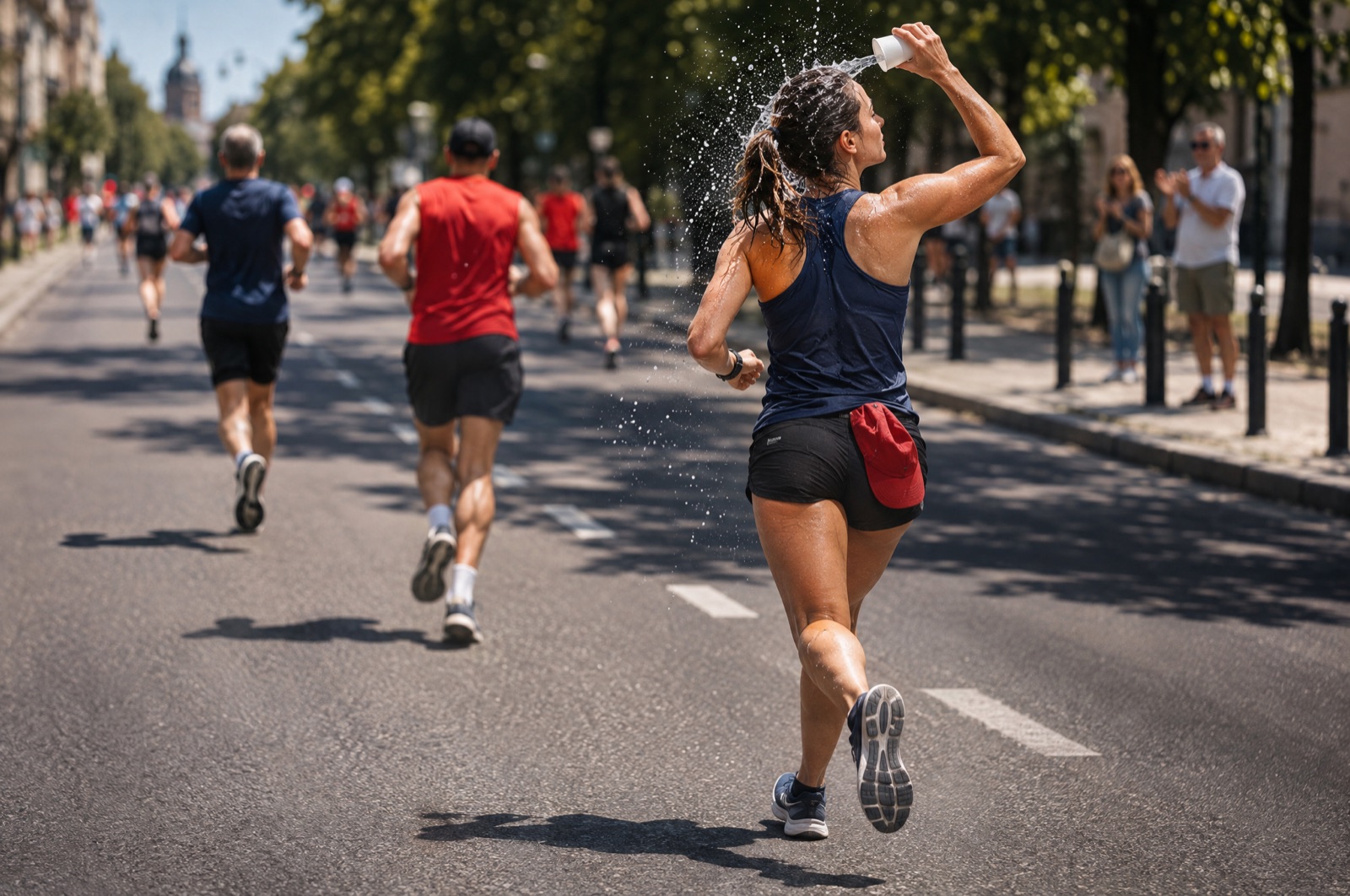
A 2007 analysis of seven North American marathons measured the loss against course records. The fastest men lost about 1.7% in the coolest conditions and about 4.5% in the warmest, and slower groups lost more. At 4:00 that difference alone, 2.8 percentage points, is nearly 7 minutes. The margin that fitness for 3:50 gives you then melts away almost entirely.
Watch the forecast from a week before the race. When it is above 15°C (59°F) at the start and is due to pass 20°C (68°F) later, set halfway at about 2:02, which is 5:47/km (9:18/mile) and gives about 4:04. An even 4:04 is worth more than 4:15 after a crack in the second half.
Which race to choose
For a time goal three things matter: a flat course, cool weather and a pace group you can trust. The last two men's world records were set in Chicago (2023) and London (2026), and Berlin has the same reputation for speed. The biggest races are spread over five continents and most of the year, but getting a place takes planning. The entry routes below are the ones the organizers published for their 2027 races.
| Race | Usual month | Main ways in |
|---|---|---|
| Tokyo | Early March | Random draw when entries exceed the field |
| London | April | Ballot, charity places, Good For Age places for UK residents |
| Cape Town | May | Ballot |
| Sydney | Late August | Ballot |
| Berlin | Late September | Lottery, plus a fast-runner route with no guaranteed place |
| Chicago | October | Drawing, or a guaranteed entry, for example with a qualifying time |
Almost everything here is decided by a draw, so have a second option. Valencia in early December and the Gold Coast in Australia, run in the southern winter, are known as flat, fast courses. Pace groups differ too. London lists pacers for finish times from 2:45 to 7:30, Chicago has teams for both 3:55 and 4:00, and Berlin puts pacemakers in every start wave.
The calendar decides your training weather. A spring race means long runs through winter and an autumn race means long runs through summer, in either hemisphere. Choose the season in which you will find it easier to keep the long runs going.
The test: a half marathon of 1:50–1:55
According to the Riegel formula a 4:00 marathon corresponds to a half marathon of about 1:55:07. That is a better reference than 2:00, because a sub-2 hour half marathon is the same pace of 5:41/km for half the distance. With a half marathon of about 1:55 and a regular 60 km (37 miles) a week the goal is possible, but with no margin. About 1:50 corresponds to the fitness for 3:50 discussed above. With 2:00 the same work is more likely to give 4:10–4:20. The formula also gives a 10K of about 52:10 and a 5K of about 25:00 (you can convert these in the pace calculator), but short distances test neither volume nor eating on the run.
The control session is the last 10–12 km (6–7.5 miles) of a long run at 5:41/km, which is 57–68 minutes, 4–5 weeks before the race. It shows what a half marathon cannot: the cost of the pace after two hours on your feet, with food on the way.
Frequently asked questions
Is a sub-4 hour marathon a good time?
Yes. In Berlin, one of the fastest big-city races, the average man finished in about 4:02 and the average woman in about 4:29 over 1999–2025, so under 4:00 you are faster than both. Even at Boston, where most runners qualify by time, the women's average in 2015–2017 was 4:04:15.
What pace is a sub-4 hour marathon?
5:41 per km or 9:09 per mile. GPS watches usually record a little more than the official distance, because nobody runs the shortest line, so the pace on your wrist has to read a few seconds faster. On an even pace you pass halfway in 2:00:00 and 20 miles in 3:03:05.
Can you run a sub-4 marathon on 4 runs a week?
Yes. That is how often the 3:30–4:00 group trained on average in the British study. The condition is longer runs: 15.5 km (9.6 miles) at a time, not 8–10 km.
What half marathon time do I need for a sub-4 marathon?
The Riegel formula gives about 1:55:07, but most amateurs slow more than it assumes, so about 1:50 is a safer basis. With 2:00 the same work is more likely to give 4:10–4:20.
Does a 4-hour pacer help?
Yes, in a big race it does, but find out before the start how the group runs. Chicago's pace teams, for example, run even splits on chip time, counted from the start line.
At what point do you know whether sub-4 is still on?
At 30 km, after about 2:50:38 on an even pace. From there the slowdown in the field becomes clear, so that time tells you more than halfway does.
What changes when you move from 4:00 to 3:30?
The pace rises by 43 seconds per km, about 14% in speed. The volume reference moves from 65–85 km to 80–110 km (50–68 miles), and the margin for error in fueling almost disappears. You will find the details on the page about the sub-3:30 marathon. The step below is the sub-4:30 marathon.