Contents
- Is a 70.3 a good first goal right now: five criteria
- When it is too early
- How many weeks and hours for a first half Ironman
- Four checkpoints along the way
- Cut-offs: do the math before you enter
- How to choose your first 70.3: course, climate and travel
- Mistakes that mostly happen in a first race
- The day before and race morning
- What goal makes sense the first time
- Frequently asked questions
Is a 70.3 a good first goal right now: five criteria
Race rules usually do not require an earlier race or any length of experience. The criteria below are a reference point derived from the cut-offs and from what a half demands in its last hour. Check them before you pay the entry fee, which at IRONMAN 70.3 races usually runs to several hundred euros or dollars.
| Area | Starting point for the build-up | Why this |
|---|---|---|
| Swim | 1,000 m without stopping, front crawl or another stroke, without panic | In 20 weeks you will get to 1,900 m, but learning to breathe from scratch takes a long time |
| Bike | 2 hours of riding outdoors, changing a tube without help | Rules ban outside assistance, so you usually fix a mechanical yourself |
| Run | 60 minutes without pain, ideally a finished 10K | The run after 90 km is the biggest mechanical load of the whole day |
| Time | 7 hours a week for the next 5 months, with room for a long session | That is the lower end of the typical 7–12 h |
| Health | No untreated injuries, and a medical check-up after 40 or if you have symptoms | A half is 6–7 hours of effort, and the preparation lasts months |
Four or five criteria met, including the health one, is a green light. Three means a shorter race along the way would help this season. Fewer than three is a signal to start with a shorter distance.
When it is too early
Most of the situations below mean a shorter race this season and the half the next.
- You cannot yet swim continuously. A half is not the moment to learn. The cut-off is less of a threat than panic after 200 meters in a crowd.
- Running already hurts at 8 km. Over 20 weeks the load will grow, and the problem with it.
- Seven hours a week is theory for now. If your calendar has not held 5 hours of exercise a week over the last two months, start by building that habit.
- The race is less than 16 weeks away and your base is low. Even people with a stable base usually need at least 16 weeks.
- You have never swum in open water. That does not rule the race out, but it calls for several sessions before race day, including in a group. In a US registry most sudden deaths and cardiac arrests happened during the swim, so practice in race conditions and warm up in the water before the start.
A shorter step is not a lost season. An Olympic-distance race 4–8 weeks earlier lets you test transitions, open water and fueling before the half. If triathlon is completely new to you, start with the beginner triathlon training plan.
How many weeks and hours for a first half Ironman
The typical range for this distance is 16–24 weeks. The lower end is for experienced athletes. For a first time, allow 20–24 weeks at an average of 7–12 hours a week. The longer block is not there for more volume. It gives you a reserve for illness, travel and slower adaptation to running.
When you lay out the calendar, count back from race day. The last two weeks are the taper, the reduction of load. The longest combined session, 3–4 hours on the bike and 60–90 minutes of running, falls 4–5 weeks before the race. For a race in mid-July that means peak volume in June and the start of a 24-week block at the turn of January and February. A race in early June moves the start to before Christmas. In the southern hemisphere the picture is mirrored: for a race at the end of January the block starts in mid-August, and the first long rides fall in late winter.
Open water is the bottleneck. In temperate climates you can only swim outdoors once the water warms up, so for an early-season race there is very little time for it. Plan those sessions as soon as the water allows.
Four checkpoints along the way
These tests show whether the preparation is going to plan. The numbers refer to a 24-week block. For a shorter block, shift them proportionally.
| Week | What should be true | If it is not |
|---|---|---|
| 6 | Three sports regularly, without pain. A 1,500 m swim in one go | Do not add volume. Fix consistency, and treat the missing swim as the priority |
| 14 | Rides of 2.5–3 h with food every 15–20 minutes. Running off the bike is becoming normal | Trim the goal, but do not give up the long ride. It is the most important element of the block |
| 18 | First open-water swim, in a wetsuit. 60–70 g/h tolerated on the bike | Add an open-water session in a group, and raise the dose in small steps |
| 20 | The longest combined session with no stomach crisis and no pain the next day | Draw the conclusion for race day: lower power, simpler food, a calmer start to the run |
This is a reference point based on typical phases: base in weeks 1–6, build in weeks 7–14, race-specific work in weeks 15–22 and a two-week taper. If two checkpoints in a row go badly, consider moving the race. A later event in the same season is a better decision than racing in pain, and in the busier regions there is another half within a couple of months, as long as places are left.
Cut-offs: do the math before you enter
For a first race, the choice of event weighs more than it seems. The overall limits look similar, but the intermediate cut-offs differ by half an hour. Below are calculations for three published sets (as of November 2026): the typical IRONMAN 70.3 limits, the Outlaw Nottingham Half in England and the Edisto Island Triathlon in the United States. Limits change between editions, so open the current athlete guide before you enter.
| What you have to do | 8:30 limit (IRONMAN 70.3) | 9:00 limit (Outlaw Nottingham Half) | 8:00 limit (Edisto Island) |
|---|---|---|---|
| Swim | 1:10, or 3:41/100 m | 1:20 including T1 | 1:20, or 4:13/100 m |
| Swim and bike | 5:30 | 5:20 | 5:00 |
| Bike after a 45-minute swim and a 7-minute T1 | 4:38, at least 19.4 km/h (12.1 mph) | 4:28, at least 20.1 km/h (12.5 mph) | 4:08, at least 21.8 km/h (13.5 mph) |
| Run if you reach the bike cut-off exactly | 2:55 after a 5-minute T2, or 8:18/km (13:21/mile) | 3:40, or 10:26/km (16:47/mile) | 2:55 after a 5-minute T2, or 8:18/km (13:21/mile) |
Even at 3:10/100 m, 24.5 km/h and 7:30/km the model further down gives 7:33, inside every overall limit in this table. So the overall limit rarely catches a prepared first-timer. The bike cut-off does. If you forecast 6:30 or more, choose a race with a bike cut-off of 5:20 or 5:30, and read how it is counted.
The bike cut-off is cumulative. It covers the swim, T1 and the ride, and the clock does not stop in transition or during a repair. With wave and rolling starts the rules differ: some races count from your own start, others from your wave, and Edisto Island counts its swim and bike cut-offs from the start of the final wave. If you start near the back, check the athlete guide. Rules are usually blunt about what happens next: once the limit passes you have to leave the course, and anyone who carries on does so without the organizer's support.
How to choose your first 70.3: course, climate and travel
For a first race, choose the day that asks the fewest new things of you.
| Criterion | What to check | Good for a first race |
|---|---|---|
| Cut-offs | Especially the swim and the bike, and what the clock starts from | A 5:20–5:30 bike cut-off if you forecast 6:30 or more |
| Swim | Lake, reservoir, river or sea. Waves, current, rolling start, the usual water temperature | A lake or reservoir with a rolling start, if open water is new to you |
| Bike course | Elevation, road surface, wind, number of laps | A flat or gently rolling course. It eases cut-off pressure but demands a steady position |
| Run course | Laps, shade, surface, aid stations | A lapped course, where you pass the same aid stations and spectators several times |
| Climate | Typical temperature and humidity on race date compared with where you train | Conditions close to those of your long sessions |
| Travel | Distance, time zones, bike transport, when you have to check in | Within driving distance, with no flight and no bike box |
| Entry | Price tiers, sell-outs, refund and deferral rules | Check early. Popular races sell out weeks ahead |
Course
The swim decides how the day starts. A lake or reservoir is the most predictable. A river can help or hinder with its current. The sea adds swell, salt water and the chance of a late change: at Noosa in Australia in November 2026 the swim was replaced by a run after sharks were spotted. A bike or run course built from laps is easier to learn and to pace than one big circuit.
Climate
Race where the weather resembles your training. Many organizers publish the typical air and water temperatures for race week. Compare those figures with your own long rides. If you train through a cool spring and race in tropical humidity, the heat becomes a fourth discipline, and you need the acclimation described in the main half Ironman guide. Heat can also cancel a race outright, as it did in Nice in June 2026. Altitude works the same way: if you live at sea level, do not take sea-level power and pace targets to a mountain venue.
The calendar matters as much as the map. A race in the other hemisphere means building your longest sessions through your own winter, mostly on an indoor trainer and in a pool, with almost no open water before you travel.
Travel
Every flight adds tasks that have nothing to do with fitness: packing and rebuilding the bike, airline rules for sports equipment, a change of time zone, unfamiliar food in the last days. None of them is hard, but all of them land in the week when you should be resting. For a first half, a race you can drive to removes most of that list. If you do fly, arrive early enough to ride the rebuilt bike, swim on the course and sleep a couple of nights in the new time zone before race day.
Where the big series race and in which months is covered in the section on where to race a half, and entries step by step in the guide on how to register for an Ironman.
Mistakes that mostly happen in a first race
- The first 20 minutes of the bike on adrenaline. Power easily drifts above the plan while everything feels easy. Set an upper limit for power or heart rate and treat it as a rule. The reference point is 72–80% of FTP, the power you can hold for about an hour, and for a first race the lower part of the range.
- New food from the aid station. The organizer's gels and drink may not suit your stomach, and not every race offers them: some small independent events provide little more than water, so you carry all your food. Serious gut symptoms are reported by 14% of starters. Before race day, find out what will be on the course and test it.
- Aiming for 90 g/h the first time. The top of the range is the result of gut training, not a target from a table. For a first race, a steady 60–70 g/h that you tolerate beats 90 g/h on paper.
- Lining up in the wrong start group. In a rolling start, where athletes enter the water a few at a time, seed yourself in a group with a similar swim time. Too fast a group means a fight, too slow means constant overtaking.
- A wetsuit tested for the first time on race day. Pressure on the neck combined with nerves easily turns into panic. Swim in it several times, in open water too. Remember also that above 24.5°C (76.1°F) a wetsuit takes age-group athletes at IRONMAN races out of the age-group rankings and world championship slots.
- No transition practice. The reference day on this site allows 10 minutes for both. Lost shoes, helmet or race number easily add another five. Rehearse the order.
- Starting the run at stand-alone half marathon pace. After 90 km your legs lie, and the first kilometers feel slower than they are. Watch the watch, not the feeling. At the reference pace of the main guide that is 6:00/km (9:39/mile).
- New equipment before the race. New shoes, a new saddle or new wheels just before race day are risk without benefit. Collect the bike from its service early enough to do at least one longer ride on it.
- Adding training in the last week. Two weeks of taper are meant to reduce fatigue. An extra session out of nerves will not improve your fitness and can take away freshness.
The day before and race morning
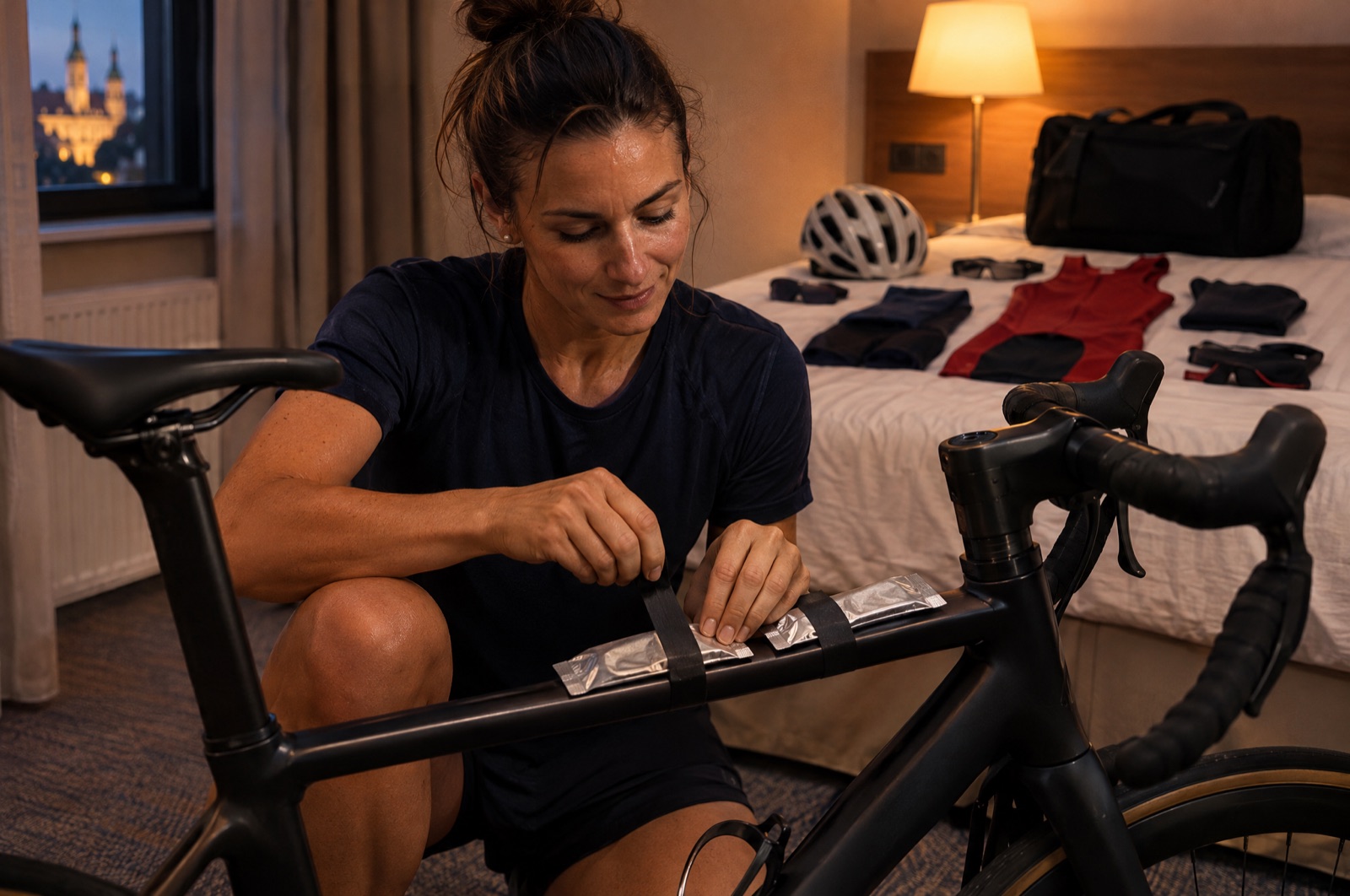
Part of the stress of a first race comes from logistics. At a half you usually have to collect your race pack at registration and rack your bike in transition, often the day before. Check it in the athlete guide and at the briefing.
- Walk the transition area. Find your spot, the entrance from the water, the bike exit and the run exit. Count the racks, because after the swim they all look the same.
- Check the water. The temperature will decide about the wetsuit, and in a sea swim add waves, salt water and current.
- Rehearse breakfast. On race day you eat what worked before your long sessions, at the same time relative to the effort.
- Pack your bike nutrition the evening before. In the morning there is little time and mistakes come easily.
- Write the cut-off on your hand. The time of day you plan to finish the bike and the time of the cut-off are two numbers to have in front of you on the course.
What goal makes sense the first time
A good goal for a first half is to finish, running most of the half marathon, and to want to come back. You can build a forecast from three numbers: the pace from your swim test, your speed on long rides and your run pace off the bike. Enter them in the triathlon time calculator.
| Swim | Bike | Run | Transitions | Finish |
|---|---|---|---|---|
| 2:15/100 m | 30 km/h (18.6 mph) | 6:00/km (9:39/mile) | 10 min | 5:59:21 |
| 2:45/100 m | 27 km/h (16.8 mph) | 6:45/km (10:52/mile) | 12 min | 6:46:40 |
| 3:10/100 m | 24.5 km/h (15.2 mph) | 7:30/km (12:04/mile) | 14 min | 7:32:49 |
This is a model at constant pace, with no wind and no hills. The first two rows fit all three sets of limits with room to spare. The third finishes inside 8:30 by almost an hour, but it reaches T2 at about 4:48. That is 42 minutes inside a 5:30 bike cut-off and only 12 minutes inside a 5:00 one, so a single puncture decides the day. At that pace, choose a race with the longer bike cut-off.
Compare your forecast with past results from the same race, because course and weather alone can move the result by tens of minutes.
At this stage what helps most is someone who notices that you have skipped the swim for the third week in a row. At IMI a real coach runs your plan in the app, and the work starts with an athlete survey and tests: the 12-minute Cooper test or a 5K run, FTP on the bike and a 200 m swim. Without a power meter the coach builds the bike plan on heart rate.
Frequently asked questions
Can a half Ironman be my first triathlon?
Yes, race rules usually do not forbid it. It is wiser, though, to race at least once at a shorter distance first, to get to know transitions and open water in a crowd.
How many weeks do I need to train for my first half Ironman?
Allow 20–24 weeks at an average of 7–12 hours a week. A 16-week block makes sense with a stable base in three sports.
Can I do a half Ironman if I cannot swim front crawl?
If you are learning to swim from scratch, probably not this season: 20 weeks is not much, even though the cut-off allows an easy pace, 3:41/100 m for 1:10. Comfort in open water matters more than speed. If 200 m is a challenge today, choose a race next season.
What is the cut-off time for a half Ironman?
At IRONMAN 70.3 races, usually 1:10 for the swim, 5:30 for swim plus bike and 8:30 overall. Other organizers set their own: the examples on this page run from 8:00 to 9:00 overall, with bike cut-offs from 5:00 to 5:30.
Can I walk part of the half marathon?
Yes. Walking is not forbidden, and with an 8:30 limit you have about 2:55 for the half marathon even if you reach the bike cut-off exactly. Walking through aid stations makes eating and drinking easier.
Do I need a power meter for my first half Ironman?
No. You can ride a half on heart rate and feel, holding an effort at which you can comfortably speak in full sentences. A power meter makes it easier to respect the upper limit in the first 20 minutes, but it is not a condition of racing.
How far should I ride before a half Ironman?
The longest sessions are usually 3–4 hours on the bike with a run of 60–90 minutes. You do not have to ride the full 90 km at race pace. It matters more that a few of your longest rides last as long as the bike leg will on race day.
What is the easiest half Ironman for a first-timer?
There is no single answer, because the easiest race is the one closest to your training. Look for a calm lake or reservoir swim, a flat or gently rolling bike course, mild temperatures on race date, a bike cut-off of 5:20 or more and a venue you can reach without a flight.