Contents
- 1.5 km, 40 km, 10 km: the same distance at the Games and in age-group racing
- How long an Olympic triathlon takes
- Where the time goes
- What decides the result
- What has been measured in a race
- 1,500 m: the line where the rules change
- The bike: even, and without drafting
- Transitions at big races
- Nutrition and equipment
- Olympic or sprint: which to choose
- What an Olympic triathlon training plan has to cover
- Olympic-distance races around the world and their cut-offs
- Mistakes typical of the Olympic distance
- Frequently asked questions
Triathlon time calculator
- Start0:00
- Swim:/100 m
- T1swim to bike:
- Bikekm/h
- T2bike to run:
- Run:/km
- Finish
Cut-offs depend on the race. Check the rules of your event.
Where you gain the most
Time arithmetic only. A harder bike leg can cost you more on the run.
1.5 km, 40 km, 10 km: the same distance at the Games and in age-group racing
An age-group athlete covers exactly what the Olympic medalists cover. The difference is in the rules you race under, and sometimes in what an organizer means by the name, so read the course page before you pay.
The Olympic distance is a 1,500 m swim, a 40 km bike and a 10 km run (0.93, 24.9 and 6.2 miles), 51.5 km in total. World Triathlon rules call it the standard distance. In the United States you will also see "international distance", as at the Chicago Triathlon. The 5150 race brand took its name from the 51.5 km. Triathlon made its Olympic debut in this format in Sydney in 2000, a story told on the history of triathlon page.
Names can still mislead. Some races sold under the Olympic label have a shorter swim, and bike legs are not always exactly 40 km. Look at the meters in the water first, because 500 m more or less changes the preparation of anyone who is not a confident swimmer.
The standard distance also has a higher age limit. World Triathlon requires athletes to be 18, while the sprint is open from 16. The official distance has a tolerance: the rules allow a 10% deviation on the bike course with the delegate's approval. All formats are compared on the triathlon distances page.
How long an Olympic triathlon takes
At typical age-group paces the race takes about 2:45, and anywhere from just under two and a half hours to well over three, depending on how you swim and ride. There is no official statistic of age-group times, so the table collects what can be calculated or has been measured in studies.
| Reference | Time | What it is |
|---|---|---|
| 1:50/100 m, 35 km/h, 4:30/km and 4 min of transitions | 2:25:04 | Constant-pace model |
| 2:15/100 m, 32 km/h, 5:10/km and 5 min of transitions | 2:45:25 | Constant-pace model, the reference on this page |
| 2:45/100 m, 27 km/h, 6:15/km and 7 min of transitions | 3:19:38 | Constant-pace model |
| 17 well-trained men, draft-illegal race | 2:19:50 | Study average, selected field |
| World Triathlon professionals | 1:47–1:56 men, 1:57–2:08 women | Means of three performance groups in a study, pack riding |
The course moves these figures a lot: climbing, wind, long transition areas and segments that are not as long as the name says. Only compare a time with a time from the same race, and last year's results, which the organizer publishes, are a better reference than any average.
You can work out your own target from three paces in the calculator at the top of this page. A reference point: 2:15/100 m, 32 km/h (19.9 mph), 5:10/km (8:19/mile) and 5 minutes of transitions give 2:45:25.
Where the time goes
The 17 well-trained men recorded 26:28 in the water, 1:10:33 on the bike and 42:49 on the run. That is 18.9% of the time for the swim, 50.5% for the bike and 30.6% for the run. Typically the swim takes 16–19% of the time, the bike 50–55% and the run 29–31%.
With a slower swim the proportions shift toward the water. Here is the arithmetic for the pace from the previous section, together with what the same improvement gives.
| Segment | Time | Share of time | Improvement | Gain |
|---|---|---|---|---|
| Swim | 33:45 | 20.4% | 10 s/100 m | 2:30 |
| Bike | 1:15:00 | 45.3% | 1 km/h | 2:16 |
| Run | 51:40 | 31.2% | 10 s/km | 1:40 |
| Transitions | 5:00 | 3.0% | 1 minute | 1:00 |
The swim is about one fifth of the time. An improvement of 10 s/100 m gives more than 1 km/h on the bike. The bike and the run are still almost 77% of the race, so energy saved in the water only makes sense if you turn it into a stronger finish.
The assumed 5 minutes of transitions is a reference point, and the long runs through transition at big races can stretch it. Every extra 100 m at 6:00/km (9:39/mile) is 36 seconds. You cannot win that back, but you have to include it in your time goal.
What decides the result
At elite level the run has the strongest link with finishing position. An analysis of the nine most important men's races from 2000–2008 gave a correlation of 0.83 for the run, 0.62 for the bike and 0.36 for the swim. A newer study of 113 races confirms the direction: the run coefficient for men rises from 0.13 in the super sprint to 0.39 at the Olympic distance.
Another paper, on professionals from 2015–2020, points to the swim as the best single predictor, although the strongest pair was the bike with the run. These results can be reconciled. An athlete who misses the first pack out of the water usually does not catch it on the bike, and then the run decides the places inside the pack.
That mechanism does not apply to age-group athletes, because they race draft-illegal, which means no riding on another athlete's wheel.
| Element | Elite | Age group |
|---|---|---|
| Bike | Drafting allowed, oxygen uptake up to 14% lower | Drafting banned, you work with no shelter from the wind |
| Power relative to maximum | About 60–63% of maximal power at a heart rate above 90% | A similar heart rate without the shelter of a pack |
| Role of the swim | A place in the first pack | Your own minutes and energy cost |
| Run | Decides the places | Shows who paced the race well |
Pacing also depends on age and sex. In an analysis of the top 20% of age-group athletes, women started the bike 1.6% harder relative to their own average than men, and athletes aged 20–29 started the run 2–3% faster than older groups. So the best strategy may be individual, and you test it in training.
What has been measured in a race
There are few measurements from real age-group races. In one such study, researchers fitted 17 well-trained men with heart-rate monitors and sensors during a draft-illegal race. Each had done laboratory tests in all three disciplines beforehand, so their individual thresholds were known.
| Measure | Swim | Bike | Run |
|---|---|---|---|
| Average heart rate, % of maximum | 89.8% | 91.1% | 90.7% |
| Time above threshold, by heart rate | 91.9% | 78.8% | 56.0% |
| Average time | 26:28 | 1:10:33 | 42:49 |
Heart rate and power tell different stories here. On the bike, average power lay between the aerobic and anaerobic thresholds even though heart rate was high. Only 22.8% of the time was spent above threshold power, and 5.1% above maximal power. Those spikes are climbs, corners and overtaking. Even trained athletes ride less evenly than they think, and this is the cheapest area to improve.
The biggest difference in intensity is in the run. Splitting the group into the 9 faster and 8 slower athletes gave this picture:
| Measure | Faster | Slower |
|---|---|---|
| Total time | 2:12:24 | 2:28:12 |
| Swim | 23:34 | 29:45 |
| Bike | 1:08:54 | 1:12:25 |
| Run | 39:57 | 46:02 |
| Run time above threshold, by heart rate | 82.4% | 26.2% |
On the bike the slower group lost only 3:31. In the water they lost 6:11 and on the run 6:05, and they reached threshold far less often. The groups did not differ in intensity distribution in the water or on the bike, so the difference only showed on the run.
That run is hard for a specific reason. After 40 km on the bike the energy cost of running rises by 1.6–11.6%, on top of faster breathing and a higher heart rate. How evenly you ride may also affect how quickly your body switches to running. The study covered a small group of men, so treat it as a pointer, not a rule. The conclusion for training is still clear: practice running off the bike at close to threshold pace, and ride in a way that makes it possible.
Safety matters more than the result. If you feel chest pain, palpitations or weakness, stop and talk to a doctor.
How to convert your 10K personal best
The time you lose running off the bike depends on your experience and on how you ride, so there is no single number. For first calculations assume 5–10% slower than a fresh run and then check it in a bike-run session. That is a working assumption, not a research result. Fresh-run targets are covered on the 10K training plan page.
| Fresh 10K | Off the bike, 5% slower | Off the bike, 10% slower |
|---|---|---|
| 40:00 | 42:00 | 44:00 |
| 45:00 | 47:15 | 49:30 |
| 50:00 | 52:30 | 55:00 |
| 55:00 | 57:45 | 1:00:30 |
1,500 m: the line where the rules change
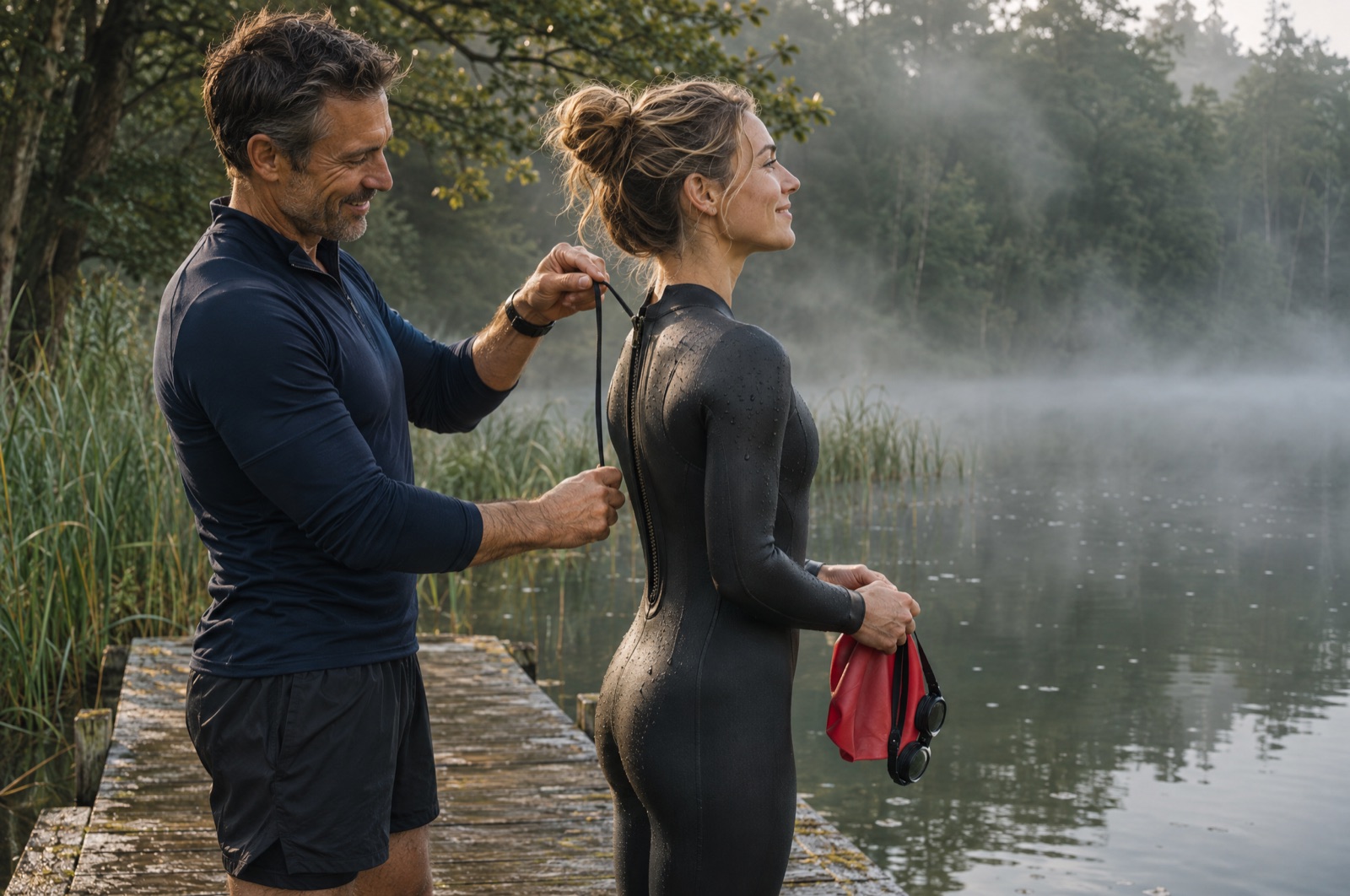
This is the last distance with the lower wetsuit threshold. Under World Triathlon rules, for age groups up to 55–59 and swims of up to 1,500 m, wetsuits are forbidden from 22°C (71.6°F). For 1,501 m and longer the ban only starts at 24.6°C (76.3°F). In a lake at 23°C, an athlete racing a 1.9 km swim may wear a wetsuit and an athlete racing 1.5 km may not. From the 60–64 category the ban starts at 24.6°C at every distance, and at 15.9°C (60.6°F) and below a wetsuit is mandatory for everyone.
Other rulebooks draw the line elsewhere. Most races in the United States follow USA Triathlon rules: wetsuits are allowed up to 78°F (25.6°C), may be worn without eligibility for awards up to 83.9°F and are banned from 84°F (28.9°C). IRONMAN's 2026 rules let age-group athletes wear a wetsuit up to 24.5°C (76.1°F), but they describe IRONMAN and 70.3 events and do not mention the 5150 format explicitly. Check the athlete guide, and be ready for 1,500 m in a tri suit alone, even if you plan to race in a wetsuit.
| Rule or race | Swim limit | Pace required |
|---|---|---|
| World Triathlon maximum for age groups, 1,001–1,500 m | 1:10 | 4:40/100 m |
| Chicago Triathlon, international distance | 1:00 from the last wave start | 4:00/100 m |
The swim becomes a real constraint here for people who would get through a shorter race on breaststroke. At 2:15/100 m, about 34 minutes, you have margin. If you are still learning front crawl, you do not.
Open water adds its own variables. In cold water of 12–12.9°C the swim is shortened to 750 m, and below 12°C (53.6°F) it is canceled. Sea swims bring swell, currents and occasionally wildlife, and an organizer can replace the swim with a run at short notice. If your race has a sea swim, practice in the sea, and have a plan for a day when the swim does not happen.
A wetsuit gives about 3% over 1,500 m, roughly a minute for 34 minutes in the water. Other measurements reach almost 13%, but few trials were run in water at typical race temperatures. Swimming behind someone lowers oxygen uptake by 8–11% and raises speed by about 3%. For this much time in the water it is the cheapest energy saving before the run. The best distance is 0–50 cm behind the feet of the swimmer ahead.
The bike: even, and without drafting
Age groups race the Olympic distance draft-illegal. The zone is 12 m (39 feet) from the front wheel, you have 25 seconds to pass, and the drafting penalty is 1 minute in the penalty box. A second drafting offense means disqualification. The penalty for lesser infringements is 15 seconds, more than the 10 seconds in a sprint.
The sum is simple. The gain from 25 seconds on a wheel is not worth a minute in the box. To pass through the zone in 25 seconds you need to be at least 1.7 km/h (about 1 mph) faster. If you are, overtake decisively. If you are not, stay 12 m behind.
The rule exists because the advantage is huge. At 39.5 km/h (24.5 mph), riding on a wheel means 14% lower oxygen uptake, a 7.5% lower heart rate and almost 31% less ventilation, and the run after such a ride was faster. In draft-legal age-group racing, which the rules allow at the sprint distance, clip-on bars are banned and only drop handlebars are permitted.
How should you ride without drafting? Going from 32 to 33 km/h gains 2:16 over 40 km and takes about 10% more power on the flat. The run is 10 km, so every 10 s/km slower costs 1:40. The break-even point is about 14 s/km. If you know your FTP, the power you can hold for about an hour, take 82–90% of FTP as a starting point to test in bike-run sessions. The bike is short enough that the margin is small and the run matters proportionally more.
Transitions at big races
For professionals, transitions are about 1.2% of the time. For an age-group athlete, 5 minutes is 3%, and more in a long city transition area. Big events mean long runs and crowds. Hamburg describes its transition area as probably the longest in the world, about 500 m, which is 3 minutes at 6:00/km before you have touched your bike.
- Before the start, walk the route from the water to your spot and from your spot to the mount line. In a big transition area it is easy to run down the wrong row.
- Your gear has to be in the box or within 0.5 m of your number.
- Fasten your helmet before you touch the bike. Take the mount and dismount lines literally.
- Race number on the front for the run. A race belt helps.
Nutrition and equipment
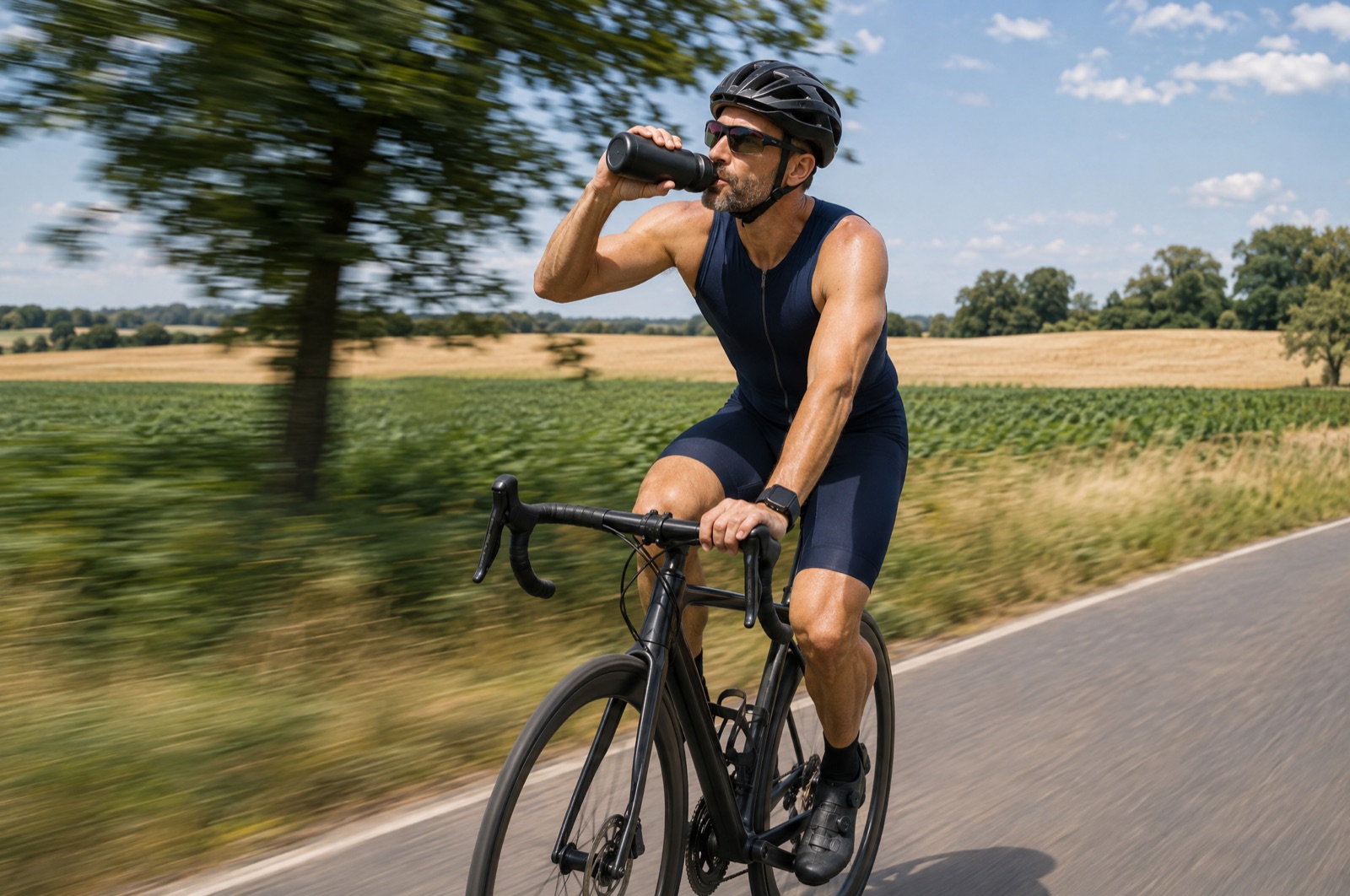
For a race of about 2:45 the same rules apply as for any effort of 2–3 hours: up to about 60 g of carbohydrate per hour, less if you are less trained. Eat on the bike, because a hard run is not kind to the stomach. With a finish around 2:15 you are at the lower edge of those guidelines, so less is usually enough. In heat, water matters more.
Set up your equipment in this order: position, bike and clip-on bars, wheels. An aerodynamic position pays over 40 km if you can run 10 km after it. A wetsuit can be up to 5 mm thick, you carry your bottle on the frame or the handlebars, and for the run you wear shoes you trust for 10 km at a hard pace.
Olympic or sprint: which to choose
Compared with the sprint, the distance is exactly twice as long. At constant pace and with 5 minutes of transitions the time grows 1.94 times, and in practice the pace drops, so do not simply double your sprint time.
| Your situation | Choose |
|---|---|
| You have not raced a triathlon yet | A sprint first, the Olympic distance as the next step |
| You swim well and want to test yourself over the official distance | Olympic |
| You want a federation format with age-group championships | Olympic, the standard distance in the World Triathlon rules |
| You are building toward a half Ironman | Olympic, as the last step before the half |
If the next goal is longer, the half Ironman training plan page shows what changes when the race lasts six hours instead of three.
What an Olympic triathlon training plan has to cover
After a sprint you usually need 14–20 weeks and 6–10 hours a week. A beginner is closer to 16–20 weeks on 7–10 hours. Adding kilometers is not enough, because the order of topics matters.
| Phase | Priority |
|---|---|
| Base | Continuous swimming up to 1,500 m, bike volume, running durability |
| Build | Threshold on the bike and on the run, even riding without power spikes |
| Race-specific | A strong bike followed immediately by a run near threshold. A rehearsal of fueling and the wetsuit |
| Taper | Freshness, short efforts, less volume |
Three principles follow from the data:
- The run gets quality. This is where faster and slower athletes differed most clearly, and run threshold counts for more than at shorter distances.
- Learn to ride evenly. Practice riding climbs without power spikes. A power meter helps, but discipline is enough.
- Do not push the swim to the end of the list. About 20% of the time and 2:30 for every 10 s/100 m are real reserves.
The test late in the build-up is a bike segment at race pace and a run that does not fall apart after the first 2 km. That session is very demanding, so do it rarely.
In the IMI app a real coach sets up your plan after a survey and tests (the 12-minute Cooper test or a 5K run, FTP on the bike, a 200 m swim) and then updates it every week. If you do not have a power meter, the bike plan is built on heart rate.
Olympic-distance races around the world and their cut-offs
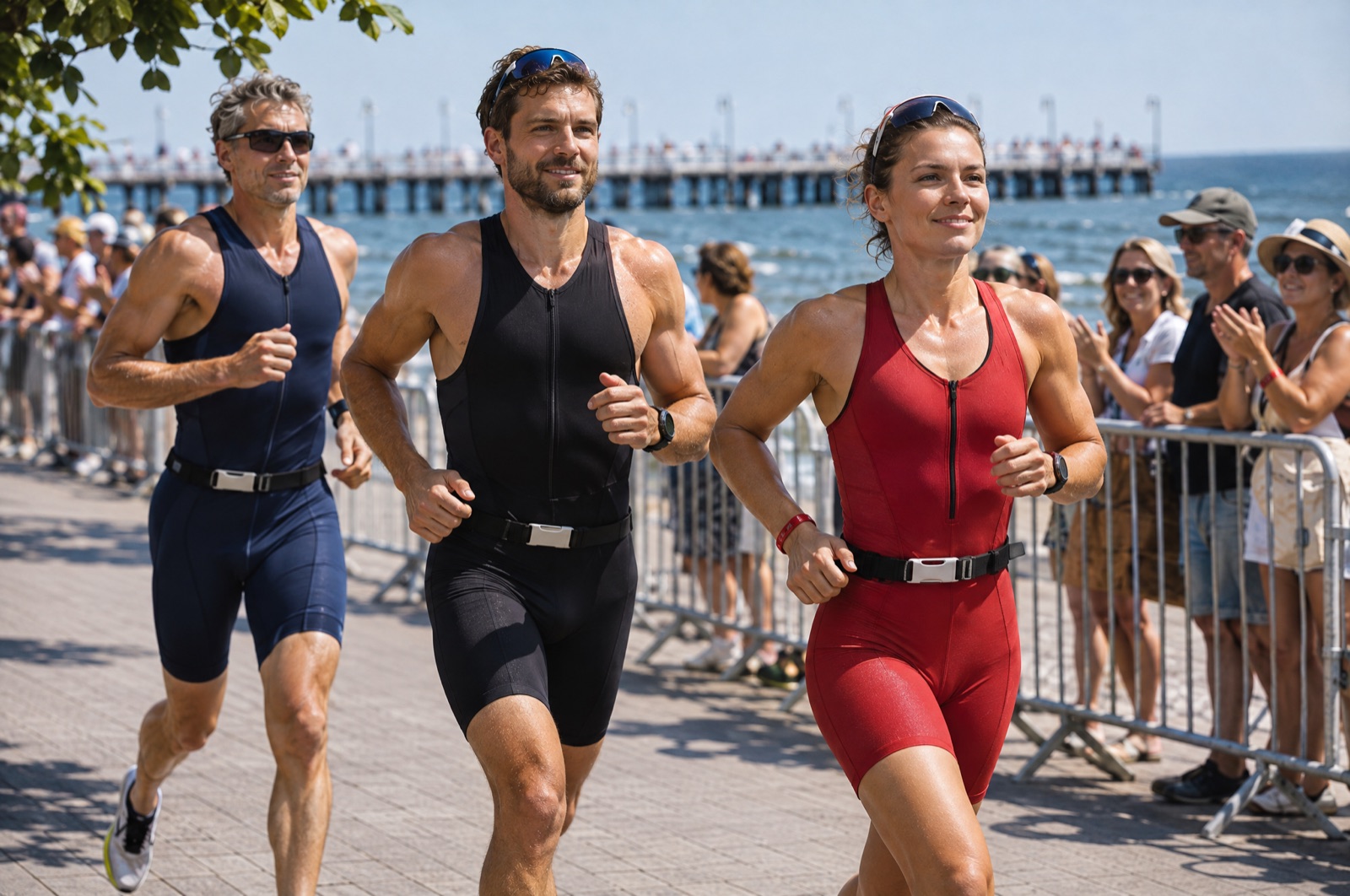
This is the one distance you can race almost anywhere, under one of three kinds of organizer. Who runs the race decides the rulebook, the wetsuit line and the limits.
| Type of race | Examples | What to expect |
|---|---|---|
| Federation championships | World Triathlon age-group standard-distance championship, Hamburg, September 2027 | World Triathlon rules, entry through your national federation |
| Brand series | 5150 races, run by the IRONMAN Group | The series' own rulebook and wetsuit thresholds |
| Big independent events | Noosa in Australia, Chicago in the United States, Hamburg's open races in Germany | Large fields, long transition areas, national federation rules |
Qualification for the world championship runs through national federations, each with its own criteria. USA Triathlon, for example, awards its places by age-group finishing position at its national championships. Noosa, held in late October or early November, calls itself the biggest Olympic-distance triathlon in the world. The organizations behind these races are explained on the triathlon organizations page.
The season depends on the hemisphere. In Europe and North America most races fall between May and September. In Australia, New Zealand, South Africa and South America the season runs through the southern summer, so a northern athlete can race in what is winter at home, and the reverse.
Cut-offs are stricter than they look
Limits differ from race to race, and many big events publish clock times instead of elapsed times: in Chicago the swim closes one hour after the last international-distance wave starts. The limit that catches people is usually the cumulative one at the end of the bike. As an illustration, suppose you have to be off the bike 2:45 after your start. Use 50 minutes in the water and 5 in T1 and you have 1:50 left for 40 km, which means at least about 22 km/h (14 mph). Move the same cut-off to 2:30 and it is about 25 km/h (16 mph). Add a puncture or a headwind and the bike cut-off, not the finish line, is what ends the day. Do this sum with the figures from your own athlete guide before you enter.
Popular races also sell out and cap their fields, so decide early. And because open-water swims are sometimes shortened or canceled, it helps to have a second race in mind for the same season.
Mistakes typical of the Olympic distance
- Treating it as a short race. Almost 3 hours close to threshold is a heavy load.
- Uneven riding. Even good age-group athletes spent 5% of the time above maximal power.
- A run with no bike-run sessions. A pace from a fresh training run tells you nothing about 10 km after 40 km on the bike.
- Underestimating the swim. 1,500 m is twice as much as in a sprint.
- No plan for a non-wetsuit swim. Under World Triathlon rules most categories swim without one from 22°C, and 1,500 m in a tri suit alone is a different effort.
- A time goal from another event. Climbing, wind and the real length of the segments move the result by many minutes.
- Getting the format wrong. Entering an "Olympic" race that turns out to have a shorter swim or a longer bike, or assuming the wetsuit rule from a different rulebook.
Frequently asked questions
How long is an Olympic triathlon?
51.5 km (32 miles): a 1,500 m swim, a 40 km bike and a 10 km run. The rules call it the standard distance, and some races in the United States call it the international distance.
What is a good Olympic triathlon time?
There is no official average. At 2:15/100 m, 32 km/h, 5:10/km and 5 minutes of transitions the model gives 2:45, and 17 well-trained men in a study averaged 2:19:50. Differences between courses are large, so compare yourself at the same race.
How long does it take to train for an Olympic triathlon?
After a sprint, usually 14–20 weeks on 6–10 hours a week. For a beginner, closer to 16–20 weeks and 7–10 hours.
How old do you have to be to race the Olympic distance?
Under World Triathlon rules, 18. National federations and organizers can set their own limits, so check the race rules.
Is drafting allowed in an Olympic triathlon?
Not for age-group athletes. The draft zone is 12 m and the penalty is 1 minute. Pack riding belongs to elite racing.
Do I need a wetsuit for an Olympic triathlon?
It depends on the water temperature and the rulebook. At 15.9°C (60.6°F) and below a wetsuit is mandatory. Under World Triathlon rules it is forbidden from 22°C for age groups up to 55–59, and under USA Triathlon rules it is allowed up to 78°F (25.6°C).
Can an Olympic triathlon be my first triathlon?
Yes, it can, but 1,500 m requires confident swimming and swim cut-offs can be stricter than they look. It is calmer to start with a sprint and make the Olympic distance the next step. The beginner triathlon training plan page helps you choose.
Is 5150 the same as the Olympic distance?
Yes, as far as the distance goes. 5150 is a race brand named after the 51.5 km.
What is the difference between a sprint and an Olympic triathlon?
The Olympic distance is exactly double: 1,500 m, 40 km and 10 km against 750 m, 20 km and 5 km. At the same paces the model gives about 2:45 against about 1:25, and in practice the pace drops over the longer race.