
Contents
- How to use the 10K calculator
- The one-hour line and other numbers
- Why the 10K is a threshold race
- Threshold pace in practice
- What changes between 60 and 40 minutes
- A 10K training experiment with amateur runners
- Phases of a 10K training plan
- How to pace a 10K
- Fueling, heat and race day
- Common 10K training mistakes
- Test runs during the block
- How a 10K plan changes when life gets in the way
- Choosing a 10K: course, season and climate
- Injury risk and strength training
- After the 10K: half marathon and marathon
- Frequently asked questions
Choose your goal


Pace calculator
Splits
| Point | Split pace | Time |
|---|
Equivalent results
| Distance | Estimate |
|---|
Estimated with the Riegel formula. Most amateurs slow down more than this over longer distances.
How to use the 10K calculator
The calculator above the text is set to 10 km (6.2 miles). Pick a mode and your units, kilometers or miles.
- Pace. Enter a goal time and you get pace, speed and splits. 50:00 is 5:00/km, 8:03/mile and 12 km/h (7.5 mph).
- Time. Enter a pace and you see the finish time. 5:30/km (8:51/mile) gives 55:00.
- Distance. Enter a time and a pace. An hour at 5:30/km is about 10.9 km (6.8 miles), which tells you whether an easy run will cover the full race distance.
Use the pacing setting too, because the second half decides a 10K. For a 50:00 goal with the second half 2% faster, the first 5 km takes 25:15 (5:03/km) and the second 24:45 (4:57/km). At 4% it is 25:30 (5:06/km) and 24:30 (4:54/km). For a first race with a time goal, choose even pace or 2%.
If your watch is set to miles, a 10K is 6.21 miles. At 8:03/mile you pass 3 miles in 24:08 and 6 miles in 48:17, and the last 0.21 mile takes about 1:43.
The one-hour line and other numbers
How fast is a typical 10K? Results from a single race only describe that race's field, and nobody keeps a reliable worldwide register. A huge city event full of first-timers is slower, and a small race that attracts club runners is far faster. A few fixed points say more than any average.
- The hour. A 60-minute 10K means 10 km/h (6.2 mph) without walking breaks. It is the first time goal for most runners, and three runs a week can prepare it.
- 50 minutes. At 12 km/h (7.5 mph) consistency alone is no longer enough, and you need real threshold work. It is the time of someone who trains all year round.
- 40 minutes. At 15 km/h (9.3 mph) you reach club level, usually after several years of training and with two quality sessions a week.
To compare women and men, or runners of different ages, use the world records and age grading explained further down, in the section on choosing a race. Your most useful benchmark is your own last result.
Why the 10K is a threshold race

The lactate threshold is the intensity above which fatigue starts to build quickly. Researchers distinguish several thresholds, but a runner only needs the practical definition: the pace you can hold for about an hour when you are fit and race day goes well.
That is why the 10K is such a good test. At a finish time of about 50 minutes you run at roughly 92% of your speed in the 12-minute Cooper test, which is the middle of our Threshold range (88–94%). At 40 minutes it is about 93%, and at 60 minutes about 91%. At every level the 10K falls inside the same range. In a 5K you run above it, and in a half marathon close to its lower edge.
VO2max, your maximal oxygen uptake, sets the ceiling, and running economy decides how much oxygen a given speed costs. For an amateur, though, threshold pace is the easiest of the three to improve, because that is where most people have the most ground to make up.
Time goals in numbers
| Goal | Pace per km | Pace per mile | Cooper test, about | 5K equivalent, about | Group |
|---|---|---|---|---|---|
| 60:00 | 6:00 | 9:39 | 2,190 m | 28:47 | finish |
| 55:00 | 5:30 | 8:51 | 2,380 m | 26:23 | improve |
| 50:00 | 5:00 | 8:03 | 2,600 m | 23:59 | improve |
| 45:00 | 4:30 | 7:15 | 2,870 m | 21:35 | race the clock |
| 40:00 | 4:00 | 6:26 | 3,210 m | 19:11 | race the clock |
The 5K equivalent comes from the Riegel formula. If your 5K already beats the equivalent of your goal and your 10K still lags, you are usually short of volume. If it is slower, the 10K goal may be too ambitious.
Threshold pace in practice
You can set your Threshold range from the Cooper test. At 2,600 m your average test pace is about 4:37/km (7:26/mile), and the 88–94% range works out to 4:55–5:15/km (7:55–8:27/mile). A 50:00 goal, 5:00/km, sits in its faster half, so the goal matches the test.
In training there is a simpler check. At threshold pace you can speak in short sentences. Easy, full sentences mean the pace is too gentle, and single words mean you have drifted into the VO2max range. If 3 km at this pace costs you as much as a race, the range is too fast or the previous days were too hard.
How to read your 5K against your 10K
Multiply your 5K time by 2.085. The result is the equivalent 10K time.
| Your results | 10K equivalent | What it tells you |
|---|---|---|
| 5K 24:00, 10K 50:30 | 50:02 | Well balanced. The next step is threshold work |
| 5K 24:00, 10K 53:00 | 50:02 | You have the speed but lack tempo endurance. More threshold work and a longer long run |
| 5K 25:30, 10K 52:30 | 53:10 | The 10K is better than the 5K. You are probably short of speed, or the 5K was not a full effort |
Compare results from the same period, ideally no more than 8 weeks apart.
What changes between 60 and 40 minutes
The same 10K is a different effort at every level. At 60 minutes you are out there for a long time and have room to react. At 40 minutes each kilometer lasts only 4 minutes, and a mistake in the first 2 km is hard to repair.
| Goal | Main limiter | What helps most |
|---|---|---|
| 60:00 | Consistency, endurance for the full 10 km | Three regular runs, a long run of 10–14 km (6–9 miles) |
| 55:00 | Holding pace after 6 km | A progression run, a fourth run |
| 50:00 | Holding 5:00/km from 6 to 9 km | One threshold session every week, a fourth run |
| 45:00 | Endurance for the second half | A fifth easy run, long threshold repeats, 45–55 km (28–34 miles) a week |
| 40:00 | Volume and speed | 55–70 km (34–43 miles) a week, two hard sessions |
A 10K training experiment with amateur runners
Most research on intensity distribution deals with competitive athletes. A 2014 experiment looked at amateurs preparing specifically for a 10K. With an average time of about 39 minutes they were well trained, but not professionals.
| Group | Low zone / between thresholds / high zone | Before | After | Improvement |
|---|---|---|---|---|
| Polarized | 77 / 3 / 20 | 39:18 | 37:19 | 5.0% |
| Between thresholds | 46 / 35 / 19 | 39:24 | 38:00 | 3.6% |
The 41-second difference was not statistically significant. Both groups improved, and the advantage of polarized training became significant only among the runners who really stuck to the prescription. Three things follow:
- Both approaches work over 10 weeks. There is no single magic ratio.
- The amount of hard work was similar, about 20%. The difference was whether the rest was truly easy.
- The hardest part is keeping easy runs easy.
A later meta-analysis of 13 studies and 348 athletes weakens the case for polarization. Overall there was no difference between it and a pyramidal distribution, in VO2max or in time trials. Competitive athletes may gain more from polarized training, and recreational runners from the pyramid, which contains a larger share of threshold work. For an amateur that is good news: threshold pace is fine, as long as you do not run everything at it.
A 6-month observation of eight well-trained runners points the same way: time spent in the low zone was linked to performance in cross-country races of about 4 and 10 km. The sample was small, so treat it as a hint.
Elite runners usually train pyramidally, with a shift toward polarization before key races. So do not treat the 80/20 rule (80% easy, 20% hard) as dogma. It is a starting point.
What survey data on amateurs adds
In a study of 2,303 recreational runners the median mileage was about 48 km (30 miles) a week. Its 10K findings stand out.
| Difference in 10K time | Value |
|---|---|
| Regular tempo runs | −7.2%, the largest effect at any distance |
| Regular intervals | −2.5% |
| Women compared with men | +18.5% |
Survey data cannot prove cause, but at a 50-minute level 7.2% is more than 3.5 minutes. The sample was also a fast one: the men's median 10K was 44:51.
How much you can gain in 10 weeks
In the experiment above the improvement was 3.6–5.0%. From 50:00 that means about 47:30–48:12. Those runners were already at about 39 minutes, so slower runners may improve more, but do not count on it. A goal more than 10% faster in 8–10 weeks is rarely realistic for someone who already runs regularly.
Phases of a 10K training plan
A 10K training block usually lasts 8–12 weeks. Eight if you already run 3–4 times a week, 10–12 if you are coming back from a break or stepping up from the 5K.
| Phase | Length | What happens |
|---|---|---|
| Base | about 2–3 weeks | Volume settles, strides, hills, strength work |
| Build | about 4–5 weeks | Threshold work takes the lead, the long run grows, race pace appears in the second part |
| Peak and taper | about 2–4 weeks | More time at goal pace, a slight drop in volume, a short and sharp final week |
Weekly numbers
| Goal | Runs per week | Weekly distance | Longest run |
|---|---|---|---|
| 60:00 | 3 | 25–30 km (16–19 miles) | 10–14 km (6–9 miles) |
| 55:00 | 3–4 | 30–38 km (19–24 miles) | 12–15 km (7.5–9 miles) |
| 50:00 | 3–4 | 35–45 km (22–28 miles) | 14–16 km (9–10 miles) |
| 45:00 | 4–5 | 45–55 km (28–34 miles) | 14–18 km (9–11 miles) |
| 40:00 | 5–6 | 55–70 km (34–43 miles) | 16–20 km (10–12 miles) |
These are our reference points, not requirements. Consistency over several months counts for more than any single week. Three runs a week are enough to finish, and four runs suit most time goals.
A week in numbers
For a 50:00 goal, 40 km (25 miles) and 4 runs, the proportions might look like this: about 30–32 km easy, including a longest run of 14–16 km, about 4–6 km near threshold, and 2–3 km faster once the block gets that far. For a 60:00 goal, 25 km (16 miles) and 3 runs, 20–22 km easy with a long run of 10–12 km and 3–4 km at tempo in one session is enough. The hard part rarely exceeds 20–25% of the volume. This is a reference point, not a plan.
Priorities when time is short
- The threshold session. It has the strongest effect on the result.
- The long run. Even 14–16 km at conversational pace buys comfort in the last two kilometers of the race.
- Short, fast repeats. They matter more for results under 45 minutes.
- An extra easy run and strength work. They build durability and mileage.
One safety rule comes from a study of 5,205 runners. The risk of an overuse injury rose when a single run was more than 10% longer than the longest run of the previous 30 days. Jumps of 10–30% were linked to roughly 1.6 times the risk. So extend the long run in small steps.
How to pace a 10K
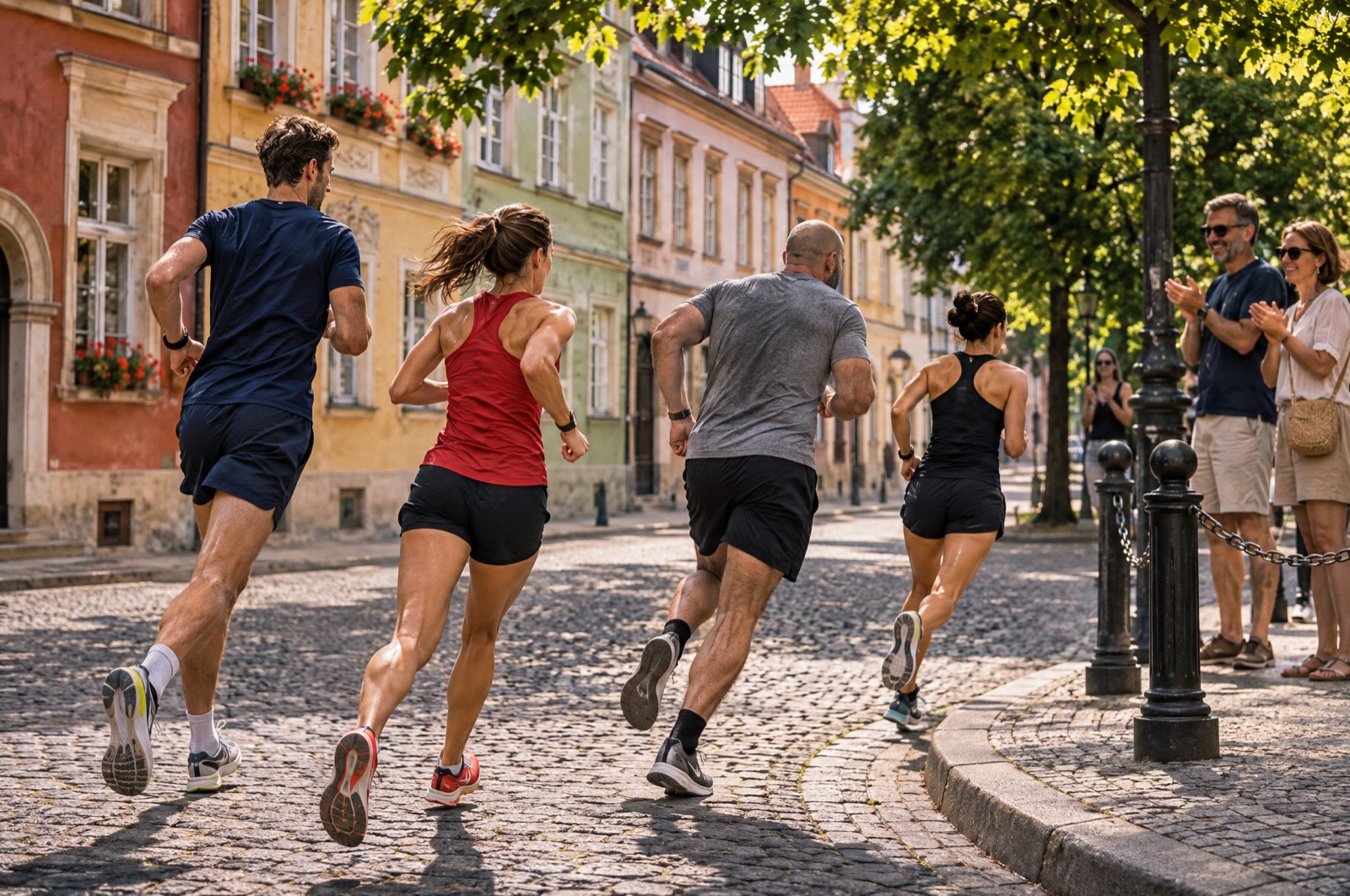
Keep the first half under control and run the second on what is left.
| Section | How it feels | Mistake to avoid |
|---|---|---|
| 0–2 km | Too easy. That is how it should be | Weaving past people in the crowd, running your 5K record pace |
| 2–5 km | The first real rhythm, breathing strong but even | Pushing on because you feel you have something in hand |
| 5–8 km | The key section. Most goals are lost here | A lapse in concentration, pace slipping by 5–10 s/km |
| 8–10 km | Harder and harder, but the finish is in sight | Sprinting from 9 km instead of raising the pace gradually |
Elite runners set 10,000 m records with a U-shaped profile (faster at the start and the end, slower in the middle), and in championship races they speed up at the end. An amateur gains more from an even run with a small reserve. Running 5 s/km too fast for the first 5 km gains only 25 seconds. Fading by 15 s/km over the second 5 km loses 75 seconds.
At even pace your halfway split is exactly half of your goal. Most runners cover a little more than 10 km on the day, so set a slightly faster pace on your watch, or go by the official kilometer or mile markers.
Course and crowd in numbers
| What happens | Cost at 5:00/km | What to do |
|---|---|---|
| 100 m of extra distance, 1% of the course | 30 s | Cut corners on the inside line, do not zigzag |
| First kilometer 20 s slow because of the crowd | 20 s, if the rest of the run is even | Win it back at 5 s/km over the next four |
| A U-turn on the course | A few seconds each | Check the map before the start |
| Starting too far back | Up to several dozen seconds of overtaking | Line up in the corral that matches your goal |
Crowding is one reason personal bests are rarer at the biggest races. On a course with several thousand runners, plan a calm first kilometer. Your chip time is what counts, so there is nobody to chase in the first 500 m.
Fueling, heat and race day
For most amateurs a 10K lasts about an hour, so gels are not needed. At that duration a mouth rinse or a few sips of a carbohydrate drink is enough, after a light meal 2–3 hours before that you have tested in training. If you will be running for more than 75 minutes, one gel can help, but try it in training first.
The most sensible supplement is caffeine: 3–6 mg per kilogram of body weight, most often 60 minutes before the effort, according to the position stand of the International Society of Sports Nutrition (ISSN). The response is individual.
Temperature matters at short distances too. An analysis of 1.8 million marathon results put the optimum between 3.8 and 9.9°C (39–50°F), depending on level. Over an hour of running the effect is smaller, but heat moves the goal, not just your comfort. Humidity adds to it, because sweat that cannot evaporate does not cool you. On a hot, humid morning, run by breathing and effort and let the pace be what it is.
Warm-up
The faster the goal, the longer the warm-up. For a 60-minute goal, 10 minutes of jogging with a few accelerations is enough. For a 40–45 minute goal the norm is 15–20 minutes with strides, because you start the race straight at a pace close to threshold.
Common 10K training mistakes
- Training at one pace. Many people run every session "a bit hard". That is neither recovery nor a stimulus.
- Treating the 10K as a long 5K. You can hold 5K pace for 5 km at most, and you pay for it in the second half.
- A long run that is too short. 8 km (5 miles) on a Sunday will not prepare you for the last part of a 10K. The long run should match the race distance, and ideally exceed it.
- Testing too often. A hard run every week "to check your form" eats the sessions that build that form.
- A goal not based on numbers. Choose the goal from a test or a recent result, not from a round number. If your Cooper test is 2,300 m, your current equivalent is about 57 minutes. A 55-minute goal is realistic, and 45 minutes is not.
- Too much taper. For a 10K one lighter week is enough, sometimes two at high volume. Volume drops and intensity stays.
Test runs during the block
A test run is there to give you information. In an 8–12 week block two are enough.
| When | What | The question it answers |
|---|---|---|
| Start of the block | Cooper test or a 5K | Which goal and which ranges are realistic today |
| About 3–4 weeks before the race | A 5K race or time trial | Whether to raise the goal, keep it or lower it |
Convert the 5K result by multiplying by about 2.085: 25:00 gives about 52:07. Any measured 5K will do, including the free weekly timed 5K events held in many countries. The conversion is most reliable when you have the volume for the longer distance. In the study of 2,303 amateurs the formula held up well at 10K.
How a 10K plan changes when life gets in the way
| Situation | What a coach does for a 10K |
|---|---|
| Two weeks off, 5 weeks before the race | Drops part of the race-pace work, returns through threshold, often corrects the goal by a minute or two |
| Threshold pace feels harder and harder | Checks sleep, stress and volume. Often removes a hard session for a week instead of sharpening it |
| Heat on race day | Changes the plan for the first 5 km and treats the time goal as flexible |
| Knee pain on downhills | Avoids descents, shortens the long run, considers a small increase in cadence, and refers you to a physiotherapist (physical therapist) if the pain persists |
| Only 3 days a week | Keeps the threshold session, the long run and one easy run, and replaces the rest with strength work |
Choosing a 10K: course, season and climate
There is a 10K somewhere in every month of the year. Four things decide whether a race is a good place to chase a time.
- A certified course. World Athletics and AIMS accept one measuring method, the calibrated bicycle, and national federations follow the same principles. The course is measured along the shortest route a runner can take, with a safety margin of one part in a thousand, about 10 m over a 10K.
- A flat profile. For record purposes World Athletics allows a net drop of no more than 1 m per km and a start and finish no farther apart than half the race distance. A course outside those limits can flatter your time, and a hilly loop will cost you some.
- A cool season. In temperate parts of the Northern Hemisphere that means autumn through spring. In Australia, New Zealand, South Africa and South America the calendar is reversed. In the tropics there is no cool season, so races start at or before dawn and humidity decides the day.
- Wind and field. Exposed seafront and riverside courses can be fast or slow depending on the day. A field with plenty of people at your pace gives you shelter, and one so large that you cannot run freely in the first kilometer costs time.
A few well-known races show how much the setting matters.
| Race | When | Conditions | What it means for your block |
|---|---|---|---|
| 10K Valencia, Spain | January | Winter morning on the Mediterranean coast. A women's world record of 28:46 was set here on January 14, 2024 | The block falls in November and December, in the cold and dark |
| TCS World 10K Bengaluru, India | Late April | The hot season in southern India | Race the field and your effort, not a time from a cool day |
| Launceston Running Festival 10K, Tasmania, Australia | Late May or early June | Autumn turning to winter in the Southern Hemisphere. The organizers call it Australia's fastest road race | The block runs from March to May, the reverse of a northern calendar |
| Peachtree Road Race, Atlanta, USA | July 4 | Midsummer heat and humidity. The organizers count more than 55,000 runners and walkers | Do not plan a record. Treat it as a hard training run |
For a fast time, look for a certified, flat course in your coolest season. Dates move from year to year, so check them and the time limit on the organizer's official page.
Age grading: one scale for every age
The simplest common scale is your time as a share of the world record for your sex. On the road the 10K records stand at 28:46 for women and 26:31 for men. Age-grade tables apply the same idea with a standard for each age and sex, which puts a 30-year-old and a 55-year-old on one scale. The WMA age-grading tables, used by masters federations such as USATF Masters, read the percentage on a scale: from 60% local class, from 70% regional, from 80% national and from 90% world class.
| 10K time | Men, % of world record | Women, % of world record |
|---|---|---|
| 60:00 | 44% | 48% |
| 55:00 | 48% | 52% |
| 50:00 | 53% | 58% |
| 45:00 | 59% | 64% |
| 40:00 | 66% | 72% |
The values are approximate and have no age adjustment, so they apply to runners in their prime (about 20–35). For older runners the standard is slower, so the same time scores higher.
Injury risk and strength training

A recreational runner has on average 7.7 injuries per 1,000 hours of running, less than half the rate of a beginner. At 4 hours a week for 12 weeks that is 48 hours, or statistically about 0.4 of an injury. 70% of injuries affect the knee or the lower parts of the leg: knee 28%, foot and ankle 26%, lower leg 16%. Threshold work and intervals on hard surfaces load exactly those places, which is why strength work should be a fixed part of the week. In a review of 24 studies it also improved running economy by 2–8%.
If pain lasts longer than a few days or changes your stride, drop the hard sessions and see a physiotherapist or doctor. No 10K time is worth it.
After the 10K: half marathon and marathon
A good 10K says a lot about your readiness for a longer distance. From 50:00 the Riegel formula gives about 1:50:19 for the half marathon and 3:50:01 for the marathon. For amateurs it works well up to the half marathon, but at the marathon it gives half of all runners a time at least 10 minutes too fast. For the marathon, 4:00–4:10 is a more realistic assumption, and more at low mileage. You will find predictions with different exponents on the pace calculator page.
10K or straight to the half marathon
| Choose the 10K when | Choose the half marathon when |
|---|---|
| You have not been running long and want a first time goal | You have a 10K behind you and regularly run for more than 60 minutes |
| You have 3 hours a week | You have 4 hours a week or more |
| You want to race often during the season | You prefer one bigger goal for several months |
| You want to improve your speed before a longer distance | You have good speed and want to test your endurance |
You do not have to work all of this out yourself. At IMI a real coach sets your ranges after a test, usually the Cooper test, and updates your plan in the app every week.
Frequently asked questions
What is a good 10K time?
It depends on the field, your age and your sex. The first landmark is the hour, 6:00/km without walking. Under 50 minutes takes structured threshold work, and 45 or 40 minutes usually several years of training. Against the world records, 50:00 is about 53% for a man and 58% for a woman.
How long does it take to train for a 10K?
8–12 weeks if you already run regularly. Starting from zero, first allow a few months to build up to continuous running.
How many times a week should I run to train for a 10K?
Three runs are enough to finish, and four suit a time goal. Five or more help when the goal is 45 minutes or faster.
Do I need to run 10 km in training before the race?
Yes, and more, but at an easy pace. A continuous 10 km at race pace is not needed and costs you freshness before the race. Practice goal pace in repeats.
How many kilometers or miles a week should I run for a 10K?
From 25–30 km (16–19 miles) for a 60:00 goal to 55–70 km (34–43 miles) for 40:00. These are our reference points, and consistency over several months is what counts.
How many miles is a 10K?
10 km is 6.21 miles, so the halfway point is just past the 3-mile marker.
What is a certified 10K course?
A course officially measured for World Athletics, AIMS or a national federation, with a small margin that protects against a short distance. Only on such a course is 10 km certain to be 10 km.
What is the best time of year to race a 10K?
Your coolest season with dry roads. In temperate climates that is autumn or spring, which fall in opposite halves of the calendar in the two hemispheres. Deep winter gives good temperatures but also wind, ice and a shorter block on dry ground.
Can I run a 10K without training?
Usually yes, if you already run regularly and can comfortably do 50–60 minutes, though without a time goal. Without that base it usually ends in walking and sore legs, and the jump in distance raises the risk of injury.
Do I need a gel for a 10K?
Usually not. At around an hour a good meal before the run is enough. For longer efforts a carbohydrate drink can help.