Contents
- What "from zero" means
- Four stages to 21 km
- Why it cannot go faster: the 10% math
- Conditions for starting the half marathon block
- How to choose a race date
- How long your half marathon will take
- Fueling and shoes: here they matter for the first time
- Your first race: a plan for the day
- Common first half marathon mistakes
- Health before the first step
- Frequently asked questions
What "from zero" means
A half marathon is 21.0975 km, or 13.1 miles. "From zero", or "couch to half marathon", means here that you do not run regularly, even if you do another sport. Cycling, the gym and team sports help your heart and lungs, but they do not fully prepare your Achilles tendon for more than 20,000 steps in a single race.
Some people do reach the finish 16 weeks after their first steps, but the injury risk is high. A plan of 7–9 months is slower, but it ends at the start line more often than at the physical therapist's office.
Four stages to 21 km

| Stage | Goal of the stage | Time |
|---|---|---|
| 1. Run-walk | 30 minutes of continuous, easy running, 3 times a week | 8–12 weeks |
| 2. First 10K | 10 km without a break, a base of 20–25 km (12–16 miles) a week | 8–12 weeks |
| 3. The block itself | Long run up to 18–22 km (11–14 miles), peak of 35–45 km (22–28 miles) a week | 12–16 weeks |
| 4. Taper and race | Less volume, fresh legs | Included in stage 3 |
Together that is 28–40 weeks, or about 7–9 months. A sporting past can shorten stage 1. After a long break or with a high body weight, assume the upper end.
In stage 1, which we describe on the beginner running plan page, frequency is what counts: three short sessions after which your legs do not hurt for more than a day. In stage 2 one longer run is added, but the whole week is still easy, and it is not time for speed yet. Only in stage 3 does structure appear: the long run makes up about half of the volume on three runs and less on four, and one session faster than easy running joins it, most often short repeats at half marathon pace. The order is: legs first, then kilometers, pace last.
Every 3–4 weeks plan a lighter week. It often takes more discipline than another long run, because you feel fresh and it is tempting to push.
Why it cannot go faster: the 10% math
In the study by Frandsen and colleagues (BJSM 2025; 5,205 runners from 87 countries, 18 months, 588,000 runs recorded on Garmin watches), 1,820 people were injured, which is 35%. The risk did not clearly depend on changes in weekly mileage. It depended on a single run longer than the longest of the previous 30 days.
| Jump relative to the longest run in 30 days | Injury hazard ratio |
|---|---|
| More than 10–30% | 1.64 |
| More than 30–100% | 1.52 |
| More than 100% | 2.28 |
This is an observational study, and the authors suggest that even jumps below 10% are not entirely safe. So treat 10% as the upper safety limit.
Now the arithmetic. If your longest run grows by 10% at a time, about 15 steps lead from 5 km to 21.1 km, and about 8 steps from 10 km. The long run usually happens once a week, and every few weeks it has to be shortened. Even from 10 km that comes to 10–12 weeks of lengthening alone, before you add fitness work and the taper.
The second reason is that beginners are more prone to injury. The meta-analysis by Videbæk and colleagues gives 17.8 injuries per 1,000 hours of running in novices against 7.7 in recreational runners. Definitions of injury differ between studies, but the scale is clear. The body needs time to move from the first group to the second.
Conditions for starting the half marathon block
Before you begin stage 3, check five conditions. The first two are absolute.
- You can run 10 km without a break and walk normally the next day.
- You have had 6 weeks without pain that changed the way you run.
- You have been running 3 times a week for at least 2 months.
- Your weekly volume is about 20–25 km (12–16 miles), and preferably 25 km or more.
- You realistically have 4–6 hours a week for the block, including the long run.
If the last condition is out of reach, see what changes with half marathon training on three runs a week. A 12-week block makes sense on a comfortable 25–40 km (16–25 miles) a week. For a first half marathon choose 16 weeks. What the block itself looks like is described on the main half marathon page.
How to choose a race date
The most common mistake is choosing the date before judging your fitness. Count back instead. A race 18 weeks away is realistic but tight if you can already run 30 minutes without a break, because stages 2 and 3 then have to fit into 18 weeks instead of 20–28. From complete zero it is not enough. Pick a race at least 7–9 months ahead and run a 5K or a 10K on the way. An intermediate race teaches you crowds, pace and morning logistics with fewer nerves.
Then match the calendar to where you live. In the Northern Hemisphere the big half marathons cluster in spring and autumn: Lisbon in March, Berlin in late March or early April, Copenhagen in September, Valencia in October. South of the equator the seasons are reversed and the main races fall in the cooler middle of the year, such as the Gold Coast in July and Buenos Aires in August. In hot, humid climates races start before dawn: Singapore's half marathon is flagged off at 4:30 am.
For a first race, three things on the organizer's page matter more than the scenery. The time limit and how it is measured: as of November 2026, Copenhagen allows 3:00 and Berlin 3:15, both counted from the moment you cross the start line, and Singapore 3:45. The slowest pacer, which in Berlin and Copenhagen is 2:30. And the entry deadline. Once you know the date is realistic, do not put off entering, because popular races fill many months ahead.
How long your half marathon will take
Up to this distance a forecast from a 10K is reliable, and you can calculate it in the pace calculator. Vickers and Vertosick (2,303 recreational runners) showed that the Riegel formula is accurate here.
| Your 10K time | Half marathon forecast | Pace per km | Pace per mile |
|---|---|---|---|
| 55:00 | about 2:01 | 5:45 | 9:15 |
| 60:00 | about 2:12 | 6:16 | 10:06 |
| 65:00 | about 2:23 | 6:48 | 10:56 |
| 70:00 | about 2:34 | 7:19 | 11:47 |
For reference, among the 133,268 finishers of the Vienna half marathon from 2006 to 2018, the slowest quarter of men averaged about 2:23 and the slowest quarter of women about 2:36 (our conversion from the speeds in a peer-reviewed study). A debut in 2:20–2:40 is therefore completely normal. The best goal is to finish without a crisis and without an injury. Time goals are described on the sub-2:15 page and the ones that follow.
Fueling and shoes: here they matter for the first time

In a 5K or a 10K you can skip eating during the race. At 2:20 you are on the course long enough for it to matter. Beyond 90 minutes carry gels or a carbohydrate drink. For the race take 1–2 gels, to be eaten after about 45 and 90 minutes, and one more for a longer time. Every long run over 90 minutes is a rehearsal: will your stomach accept it, does the belt stay in place, what happens in warm weather.
Buy running shoes at the start of stage 2 at the latest, not a week before the race. On race day wear what you have already done several long runs in. The same goes for socks and clothing, because chafing after 15 km can spoil more than poor fitness.
Your first race: a plan for the day
- Start group. Give an honest time. In a group that is too fast, everyone will be passing you for the first few kilometers.
- The first 3–4 km. Run 3–5 seconds per kilometer (5–8 per mile) slower than goal pace. If you plan 2:20, which is 6:38/km (10:41/mile), and your first kilometer is 6:15, you have too much adrenaline, not too much fitness.
- The middle. From km 8 to 15 hold an even rhythm and eat according to plan. This is where the first gel is most easily forgotten.
- The end. The first crisis usually comes at km 16–18 (miles 10–11). Slowing by a few seconds is normal.
- After the finish. A few days without running are part of the plan. Do not sign up for the next race straight away.
Common first half marathon mistakes
- Easy runs that are too fast. If you cannot speak in full sentences, the pace is too high.
- Making up a missed long run. After a week off, go back to a shorter distance.
- Entering without stage 2. Without 10 km of continuous running, a half marathon block is too big a jump.
- A first 5 km that is too fast. A crisis at km 16–18 is often the result of an ambitious opening.
- Ignoring pain. Pain that gets worse during a run is a reason to stop the session and see a doctor or a physical therapist.
Health before the first step
If you have heart disease, high blood pressure or diabetes, are pregnant, or have spent years without sport, talk to a doctor before you start training. The same applies to chest pain, palpitations or dizziness during exercise. This is general information, not medical advice.
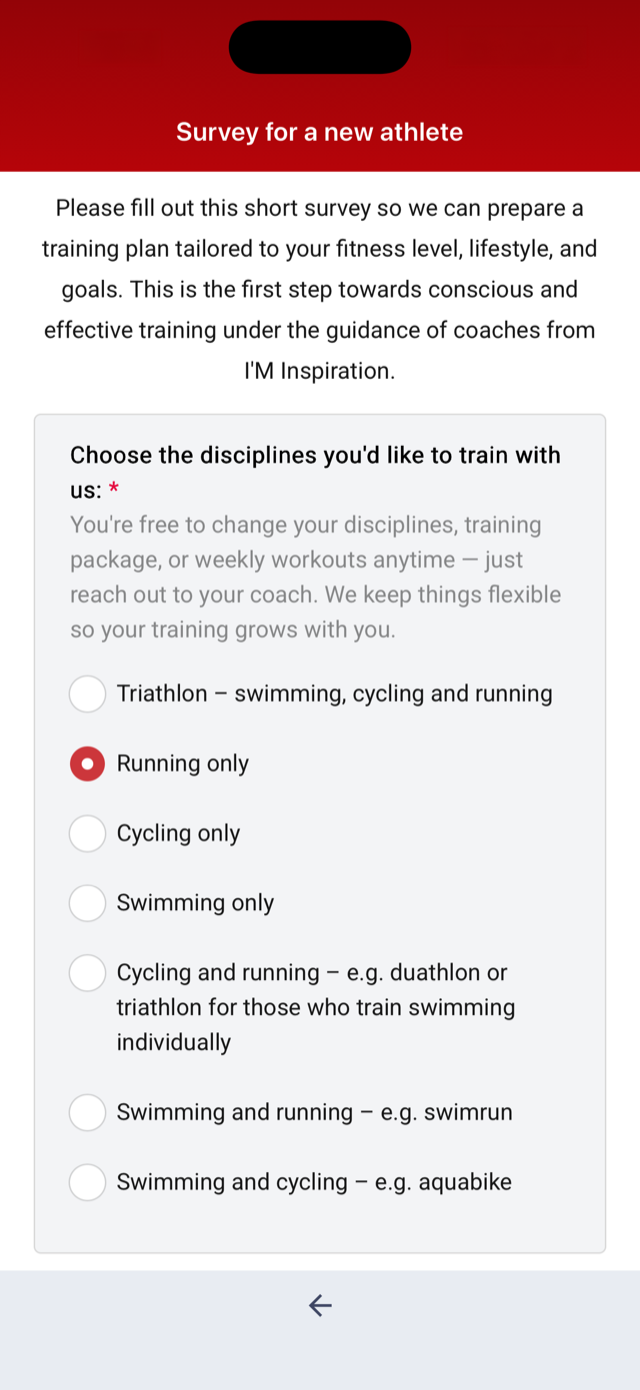
At IMI you start with an athlete survey and a control test (the 12-minute Cooper test or a 5K), and a real coach builds your plan in the app and updates it every week. Early on, most still depends on your patience with the first stage.
Frequently asked questions
Can you go from couch to half marathon in 12 weeks?
For most people no, or at least not safely. 12–16 weeks is the time for someone who already runs regularly.
How long does couch to half marathon take?
Usually 28–40 weeks, about 7–9 months: 8–12 weeks of run-walk, 8–12 weeks to a first 10K and 12–16 weeks for the half marathon block.
How many days a week do I need to run for a half marathon?
Three is the realistic minimum, and four is the more comfortable option once your body handles the load. In the run-walk stage three short sessions are enough.
How long should my longest run be before a first half marathon?
Usually 18–22 km (11–14 miles), 2–3 weeks before the race. Repeated runs of 16–20 km mean more than a single record one.
How many miles a week do I need for a first half marathon?
At the peak of the block, usually 35–45 km (22–28 miles) a week. Start the block from about 20–25 km (12–16 miles), the base you build on the way to your first 10K.
What should I do if I miss a few weeks?
Do not make them up. Go back to the distance that last felt comfortable and extend it in small steps. If too few weeks then remain before the race, run a shorter distance on that date and move the half marathon to the next season.
Can I walk part of a half marathon?
Yes. Walking on hills or at aid stations is a sensible method in a first race, as long as you stay within the time limit of the event. A 3-hour limit works out at 8:32/km (13:44/mile).
Do I need to race a 10K before a half marathon?
Formally no, in practice yes. A 10K race checks your pace and teaches you how a race day works.