Contents
Choose your plan
Every distance in one table
The table sets each race distance next to the preparation time, counted from a level at which structured training can start safely. The weeks and hours are our reference point, and the hours are a weekly average, not the peak week.
| Distance | Swim | Bike | Run | Total | Weeks | Hours a week |
|---|---|---|---|---|---|---|
| Sprint | 750 m | 20 km | 5 km | 25.75 km (16 miles) | 12–16 | 5–8 |
| Olympic | 1.5 km | 40 km | 10 km | 51.5 km (32 miles) | 14–20 | 6–10 |
| Half Ironman, 70.3 | 1.9 km | 90 km | 21.1 km | about 113 km (70.3 miles) | 16–24 | 7–12, peak 10–14 |
| Ironman, full distance | 3.8 km | 180 km | 42.2 km | about 226 km (140.6 miles) | 24–36 | 10–18, peak 14–22 |
One distance, several names. World Triathlon calls the Olympic distance "standard", and in the United States you will also see "international". The half is "middle distance" in federation language and 70.3 in the IRONMAN series, after its length in miles: a 1.2 mile swim, 56 mile bike and 13.1 mile run. The full distance is "long distance", "iron-distance" or 140.6: 2.4, 112 and 26.2 miles.
Where you can race each one. Sprint and Olympic races are organized by clubs, cities and national federations almost everywhere the sport exists. Half and full distances are dominated by international series such as IRONMAN and Challenge Family, alongside independent organizers, and the popular ones sell out many months ahead (see how to register for an Ironman). That shapes the choice: a sprint may be 30 minutes from home next month, while a full distance often means travel, a hotel and an entry bought a year in advance.
The details of cut-offs and names are in the separate overview of triathlon distances. If you are coming into the sport from zero, start with the page on the beginner triathlon training plan.
Why plans quote different numbers
Compare a few plans and you will find contradictions. What usually differs is the moment from which they count the preparation.
| Type of plan | Half Ironman | What it actually measures |
|---|---|---|
| This page | 16–24 weeks, 7–12 hours | The race-specific preparation, on top of an existing base |
| A full-season plan | More weeks, because it starts in the off-season | The whole season: base period, build and the specific part |
| A 2019 study | 20 weeks at 11.9 hours a week on average | Experienced recreational triathletes, one program |
Someone who ran a half marathon last season and trains regularly starts from a different place than someone returning after five months off. If your starting point is low, extend the period, not the volume.
How to choose a distance
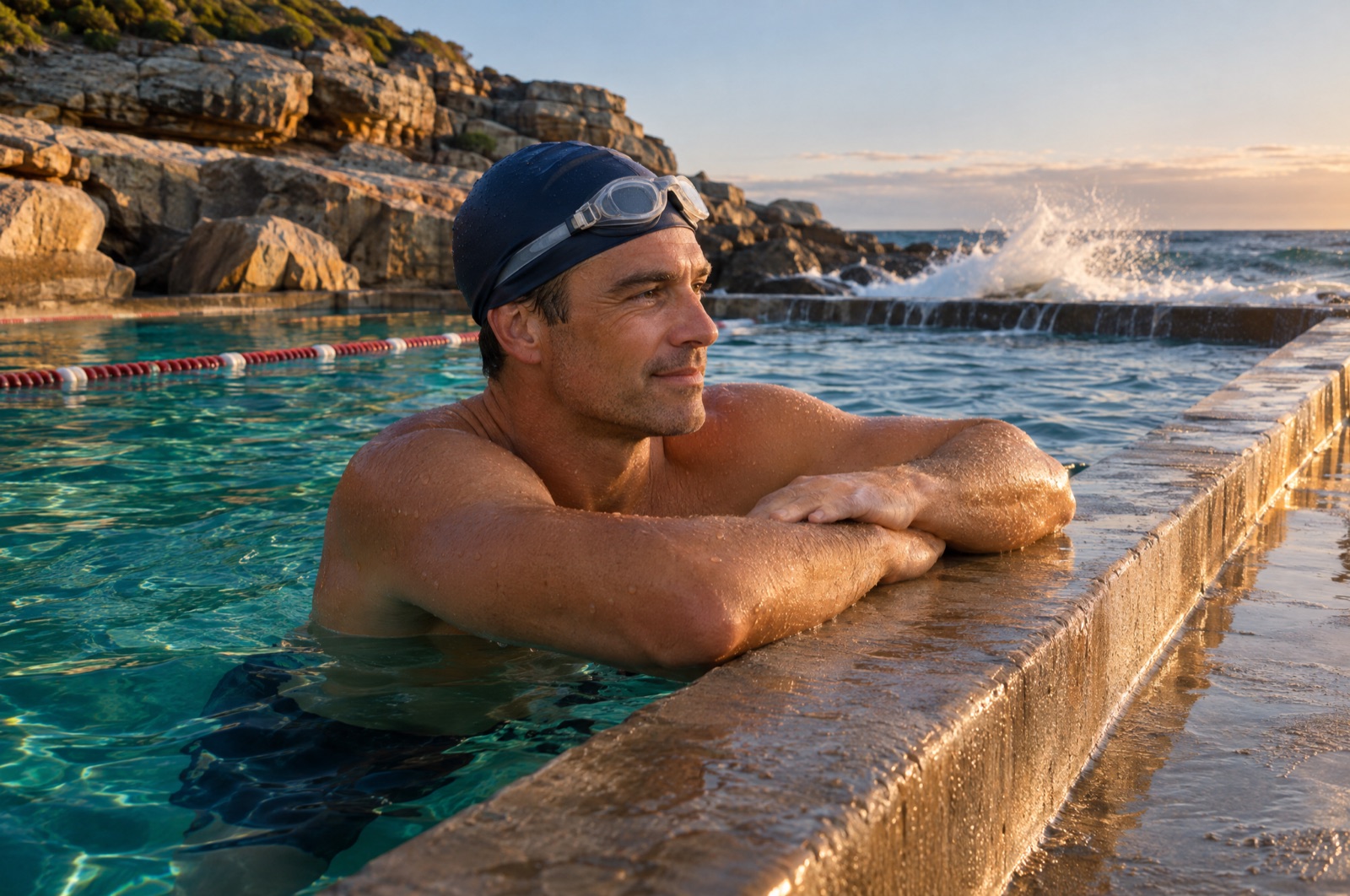
The popular advice is "start with a sprint". It is almost right, but it skips three questions that settle the choice.
Question 1: can you swim the distance without standing up
The swim is where a race most easily ends early. On the bike and the run you can slow down and, as a last resort, walk for a while, although cut-offs apply there too. In deep water you cannot stand, and the swim cut-off comes first. So start with a simple check: can you swim the whole distance in a pool without stopping. Then work out your pace. World Triathlon sets a maximum time in the water for age-group athletes (the amateur categories), and organizers often set a stricter one.
| Swim distance | 2:00/100 m | 2:30/100 m | 3:00/100 m | 4:00/100 m | World Triathlon limit, age groups |
|---|---|---|---|---|---|
| 750 m (sprint) | 15:00 | 18:45 | 22:30 | 30:00 | 30 min |
| 1.5 km (Olympic) | 30:00 | 37:30 | 45:00 | 1:00:00 | 1:10 |
| 1.9 km (half) | 38:00 | 47:30 | 57:00 | 1:16:00 | 1:40 |
| 3.8 km (full) | 1:16:00 | 1:35:00 | 1:54:00 | 2:32:00 | 2:20 |
If you train in a yards pool, the four paces are about 1:50, 2:17, 2:45 and 3:39 per 100 yards. At 4:00/100 m, which is very slow, you fit inside the federation limit for 1.9 km but not for 3.8 km. Race brands can be stricter. IRONMAN 70.3 races typically allow 1:10 for 1.9 km and IRONMAN races 2:20 for 3.8 km. Both work out to 3:41/100 m, so 4:00/100 m passes at neither. Individual races differ, and the athlete guide of your event has the final word. Check the limit of your specific race, not the federation table.
Question 2: how many hours do you have in your worst week
When planning, most people count their best week, and a plan breaks in the worst one. Look at your calendar for the last three months, work out the real average and see how much is left in the weakest week. Only then decide.
| Real time per week | What is sensible | What needs a rethink |
|---|---|---|
| Up to 5 hours | Sprint or super sprint, goal: finishing | Olympic only with a strong base from another sport |
| 5–8 hours | Sprint, and with a base also Olympic | A half needs longer weekends than this average suggests |
| 7–12 hours | Olympic, half Ironman | Full distance only with a very long build-up |
| 10–18 hours for months | Full distance | You need to ask your family, not only yourself |
Question 3: how big a step are you taking
The jumps between distances are uneven. The kilometers double and the effort changes character. Each step has its own threshold.
| Step | What is new |
|---|---|
| Sprint to Olympic | Pacing. For the first time, a bike leg ridden too hard can take the whole 10 km run away. |
| Olympic to half Ironman | Eating and drinking during the race, and a long ride followed by a half marathon. |
| Half to full distance | Organizing your life, recovery, a marathon after 180 km, patience for a whole year. |
Race labels differ more than you think
Watch the labels in race calendars. Only the federation distances are fixed, and organizers use the word "sprint" freely. Two races in one Canadian series, for example, listed their 2026 sprint as 750 m, 28 km and 5 km and as 500 m, 25 km and 5 km. World Triathlon's own super sprint is a range: a 250–500 m swim, 6.5–13 km bike and 1.7–3.5 km run. Read the meters in the race information, not the label.
How to read a triathlon training plan
You can understand a good plan in ten minutes if you know where to look. A schedule is a record of decisions. Your job is to work out which decisions stand behind it.
A glossary: without it, a plan is code
| Term | What it means | What to look at |
|---|---|---|
| Zone, Z1–Z5 | A defined range of effort | Which test it comes from. A zone without a test is an opinion. |
| RPE | Rating of perceived exertion, usually on a 1–10 scale | A good substitute when you have no power measurement |
| FTP | The power you can hold for about an hour | The basis of bike zones. Needs a power meter or a smart trainer. |
| 200 m test, 400 m test, CSS | Ways of assessing swim pace | Whether the test comes back in the plan or is a one-off |
| Cooper test (a 12-minute run), 5K | The reference point for the run | Done rested, not after a hard session |
| Brick | A combined session, usually a ride with a run straight after it | The aim: pace, rhythm, fueling, not fatigue for its own sake |
| Recovery week | A lighter week after a block of work | Whether the plan has one at all |
| Taper | A deliberate cut in volume before a race | Volume drops, intensity does not disappear |
Five things to check in every plan
- The starting point. Does the plan say what you must be able to do to begin week one? If it does not, it is not a plan for anyone in particular.
- The backbone of the week. Which 2–3 sessions matter most? If all of them look equally important, you will not know what to save at the first change.
- The rhythm of load. Does a lighter week appear every few weeks? In Stöggl and Sperlich's study the polarized group worked in a rhythm of 2 weeks of load and 1 lighter week.
- Specificity at the end. In the last 4–6 weeks, do the sessions resemble the race, including the time of day, the food and the equipment?
- What if a session falls out? The most important question. A good plan says what to skip. If it does not, you will decide on your own, usually late in the evening and under stress.
Warning signs in a plan
- Every week is longer than the one before. The body needs a step down to absorb the work.
- The long ride and the long run grow together, week after week, on the same two days. Without lighter weeks that is an easy route to overload.
- A "hard test" appears in the final week before the race.
- Swimming is nothing but a total of meters. Without drills and open water the plan ignores the main risk.
- The plan gives paces without a test or converts them from a personal best set years ago.
- The plan has no climate. Sessions written for a cool morning do not transfer unchanged to 32°C (90°F) and high humidity.
How to build a season

A season is planned backwards from the main race. In Europe and North America most races fall between May and September. In Australia, New Zealand, South Africa and much of South America the season runs through the opposite half of the year, and near the equator races are spread across the calendar. Wherever you are, count the preparation weeks back from your race date.
| Example race date | 16 weeks back | 20 weeks back | 24 weeks back | 36 weeks back |
|---|---|---|---|---|
| May 30, 2027 | February 7 | January 10 | December 13, 2026 | September 20, 2026 |
| July 11, 2027 | March 21 | February 21 | January 24 | November 1, 2026 |
| September 5, 2027 | May 16 | April 18 | March 21 | December 27, 2026 |
| December 5, 2027 | August 15 | July 18 | June 20 | March 28 |
The dates are examples to show the arithmetic. For a race in late May in the northern hemisphere, 24 weeks of preparation begin in mid-December: the base is built in winter, in the pool and on an indoor trainer, and open water arrives only at the end. For a race in early September the same 24 weeks begin in March, and the main work falls in warm months with long days. A race in early December in Sydney or Cape Town turns the picture around: the base falls in the southern winter and the race-specific weeks in spring. In hot, humid climates the limit is not daylight or cold but heat, so the longest sessions move to early morning.
A, B and C races
Not all races are equal. A simple division gives the season an order:
| Type | How many a season | How you prepare | What for |
|---|---|---|---|
| A, main | 1–2 | A full taper, the whole plan leads to this date | The goal of the season |
| B, important | 1–3 | A few lighter days, no full taper | Checking form, race routine |
| C, training | As you like | The race replaces a hard session | Testing changes, transitions and the water |
Before an A race over the half distance, a C race over the sprint distance in similar conditions gives you something training cannot: a rehearsal of the travel, the breakfast, the transition set-up and your nerves in a crowd in the water.
Water has a calendar of its own
A pool works all year. Open water does not, and the limits run in both directions. World Triathlon makes a wetsuit mandatory at 15.9°C (60.6°F) and below and shortens the swim in cold water: 3.8 km becomes 3 km at 14–14.9°C, and 1.5 km becomes 750 m at 12–12.9°C. In cool air, at 15°C or below, the water temperature used for the decision is adjusted downwards. At the warm end, wetsuits are forbidden for most age-group athletes from 22°C (71.6°F) in swims up to 1,500 m and from 24.6°C (76.3°F) in longer ones, swims longer than 750 m are cut to 750 m at 31–31.9°C, and at 32°C (89.6°F) and above the swim is canceled. IRONMAN events and some national federations, USA Triathlon among them, use their own thresholds, so read the rules that apply to your race.
For planning, that means two things. In a cool climate an early-season race leaves you only a few short, cold open-water sessions, while a late-summer race gives you the whole summer. In a warm climate you may never race in a wetsuit at all, so there is little point in training in one. When you plan a race, put the first and last possible open-water session in the calendar, not only the race date.
Periodization: what changes over time
Periodization means deliberately changing what you train from one period to the next. The body absorbs work in waves, and the same stimulus has less and less effect after a few weeks. The split and the proportions depend on the method. In the 2019 study of recreational triathletes preparing for a half, the program ran for 20 weeks after 3 transition weeks: 7 general weeks followed by 13 specific ones. A season-long plan adds a base and a build period in front of a specific block of similar length. The long specific period at the end is the common ground. What changes is how much base and build you get before it.
Four phases and their jobs
| Phase | Main job | Typical mistake | Sign that it is working |
|---|---|---|---|
| Base | Aerobic volume, swim technique, strength | Too much tempo work, because easy feels too easy | Volume grows without constant tiredness |
| Build | Threshold, race pace, regular bricks | Hard sessions in every discipline at once | Power or pace rises at the same heart rate |
| Specific | Race power and pace, fueling, race equipment | Testing a gel for the first time a week before the race | You finish long sessions evenly and can work the next day |
| Taper | Cutting volume and resting | Panic and adding sessions | Light legs and a restless head, which is normal |
The reference point for a half is a two-week taper: volume drops by about 30%, then by about 60%. That agrees with a 2007 meta-analysis of 27 studies (Bosquet and colleagues), in which the best result came from a 2-week taper with an exponential cut in volume of 41–60%, with no change in the intensity or frequency of sessions. The longest session falls 4–5 weeks before the race: 3–4 hours on the bike and a 60–90 minute run. For the full distance it is usually 5–7 hours on the bike and a 45–90 minute run, 4–6 weeks out. Notice that the run off the bike for the full distance is no longer than for the half. A long session costs more than it gives when it ruins the following week.
Polarized training: what is really known
Polarized training is a distribution in which you spend most of your time working very easily, a fair share very hard and little in the middle. Two thresholds mark out three zones: Z1 lies below the first, Z2 between them, Z3 above the second. A pyramidal distribution has more work in the middle and less at the top. Online it often reads as "80/20 or failure". The research is more careful.
| Study | Who | Result | Limitation |
|---|---|---|---|
| Stöggl and Sperlich 2014 | 41 well-trained athletes, 9 weeks | Polarized: VO2peak +11.7%, the largest rise in time to exhaustion (+17.4%) | Laboratory tests, not races. For time to exhaustion there was no significant difference between groups. |
| Stöggl and Sperlich 2015, review | Well-trained and elite athletes | The distribution described most often is the pyramid, some intervention studies support polarization, there is no single optimal model | Different measurement methods, large variation between individuals |
| Sellés-Pérez et al. 2019 | 13 recreational triathletes, half distance, 11.9 hours a week on average | The groups did not differ significantly: 2 seconds separated them in a race lasting over 5 hours. In both groups more time in Z2 was linked to a better result in some segments. | Small sample, correlations within groups, men only |
What follows for someone with a full-time job
Look at the numbers from the Sellés-Pérez study at 11.9 hours a week. The polarized group (84.5/4.2/11.3%) did about 81 minutes in Z3 and 30 minutes in Z2. The pyramidal group (77.9/18.8/3.3%) did about 24 minutes in Z3 and 134 minutes in Z2. Both roads ended in practically the same result at the finish line. In both groups Z1 took at least three quarters of the time, so the agreement is where it counts most.
- Easy training has to be really easy. That is the common denominator of all the models. The 2015 review gives 75–90% of time in Z1 for elite athletes.
- Do not throw Z2 out on principle. For a half, work around race pace is simply specific. The authors of the study explicitly advise amateurs preparing for this distance not to give it up.
- Count sensibly. A one-hour interval session is only partly time in Z3, because the warm-up and the recoveries fill the rest. A distribution counted in sessions and one counted in minutes are different things, and mixing them causes many arguments.
- Two hard stimuli a week is a sensible reference point. The 2015 review gives two high-intensity sessions a week as a value that allows adaptation without chronic stress. That applies to well-trained people and usually to one sport, so in triathlon count them in total, not in each discipline separately. This is our practical conclusion, not a study result.
How to manage three disciplines

Race time does not tell you how much time to give each discipline. Take a model sprint at 2:15/100 m, 32 km/h (19.9 mph), 5:10/km (8:19/mile) and 5 minutes of transitions. You can put in your own paces in the triathlon time calculator. This is arithmetic, not race results:
| Leg | Time in the model | Share |
|---|---|---|
| Swim | 16:53 | 19.8% |
| Transitions (T1 and T2) | 5:00 | 5.9% |
| Bike | 37:30 | 44.0% |
| Run | 25:50 | 30.3% |
The model finishes in 1:25:13. The swim takes about a fifth of the time and the transitions about 6%. Should swimming get a fifth of your training for that reason? No. Race time shows where there is time to gain. It does not say how each sport is trained. Each discipline has its own logic.
Swim: skill before volume
Swimming is the most technical of the three sports. Two shorter sessions a week usually give more than one very long one, because you are learning a movement. People who start swimming as adults lose most through body position and breathing, less often through strength. So you build a new distance in the water through repetition, drills and open water. Adding meters alone is not enough.
Bike: the most volume at the lowest cost
The bike takes around half of race time and provides volume without the impact that loads the run. For many amateurs it is the cheapest route, in terms of wear on the body, to more endurance. Even riding means more than average speed. The reference point for a half is 72–80% of FTP, but the final test is the run: do you run the half marathon after that ride, or walk it.
Run: the body sets the ceiling
Running loads the body mechanically more than the other two sports. In a study of triathletes cited in the 2019 review by Etxebarria and colleagues, 50% of injuries were linked to running, 43% to cycling and only 7% to swimming. The cardiovascular system adapts fast, tendons and bones more slowly. That is why someone with a strong engine from cycling easily overloads the legs when they start running. Run volume should grow more slowly than your head would like. Several shorter runs a week are usually better than one long run and two random ones.
Bricks: the link between bike and run
Running off the bike costs more energy than an ordinary run. The 2000 review by Millet and Vleck gives a rise in energy cost of 1.6–11.6%, depending on the level of the athlete, and the clearest change in movement is a more forward-leaning trunk. A brick session mainly teaches sensible cycling, because it shows at once what riding too hard costs. A short run after every key ride can be worth more than one huge brick a month, and an occasional brick with a long run costs a lot of recovery. In the build phase you add them regularly, and in the specific phase they become a rehearsal of pace and fueling.
Strength: protection against injury
The 2019 review names strength training as the most effective intervention for preventing overuse injuries. It describes the best performance effects with two sessions a week for 12–24 weeks. That concerns mainly trained athletes, so a beginner starts with simpler and lighter work, ideally under the eye of a specialist.
How much time to give each discipline
There is no universal split, but the logic is simple. First set the minimum that maintains each sport, then send the free hours where you lose most or where a cut-off threatens you. This is our reference point, not a study result.
| Your situation | Where the extra hours go | What to watch |
|---|---|---|
| Weak swim, the cut-off is close | More frequent, shorter sessions in the water | Bike and run stay in the plan, they do not vanish |
| Confident swim, weak bike | The bike, because it is about half of race time | Regular running |
| A runner starting triathlon | Water and bike | The temptation to run as much as before |
| A cyclist starting triathlon | Swim technique and a run that grows calmly | The heart and lungs can take more than the tendons |
| Few hours, short distance | Evenly, with no favorite | Regularity instead of one long session |
What to save when the week falls apart
| How much time you have | Priority | What to let go |
|---|---|---|
| Two sessions instead of six | Your weakest sport, and one ride or run with some pace | Easy filler sessions |
| No pool for a week | Bike and run, without adding extra | Making up the swimming later |
| Illness with fever | Rest, and a return once the symptoms have gone, after seeing a doctor if in doubt | Everything. There is nothing to make up. |
| Pain that changes the way you move | Stopping that sport and seeing a specialist | Running "to see if it passes" |
At IMI these decisions are made by a real human coach in the app, and the plan is updated every week on the basis of what you actually did. A 200 m swim test, an FTP test and the Cooper test or a 5K set the starting point, and without a power meter the bike plan is built on heart rate. Before a first long race, read your first half Ironman or your first Ironman.
Frequently asked questions
Which triathlon training plan should a beginner choose?
Most often a sprint: 12–16 weeks at 5–8 hours a week. If swimming is your problem, look for a super sprint or a race with a pool swim, where the water leg is shorter than 750 m.
How long does it take to train for a triathlon?
From an existing base, 12–16 weeks for a sprint, 14–20 for an Olympic distance, 16–24 for a half and 24–36 for the full distance. If you start from a low level, add weeks rather than hours.
How many hours a week do you need to train for a triathlon?
On average from 5–8 hours for a sprint to 10–18 hours for the full distance. The peak of a half Ironman build is 10–14 hours and of a full-distance build 14–22 hours.
Can I train for a half Ironman in 12 weeks?
Only if you already have a solid base in all three sports, for example after an Olympic season. From a normal starting point this page counts 16–24 weeks, because the long ride, the run off the bike and race fueling need several blocks of work. With less time, choose a later race or a shorter distance.
How many sessions a week is the minimum in triathlon?
For a sprint it is usually 4–6 sessions a week spread over the three sports. For the Olympic distance a typical week has 2–3 sessions in each discipline.
Can I train for a triathlon without open water nearby?
Yes, for most of the build. You develop technique in the pool, the bike on the road or an indoor trainer, and a running base. Open water still has to appear before the race, ideally several times and in a wetsuit if you plan to race in one.
Polarized or pyramidal training for a half Ironman?
Neither is clearly better. A study of recreational triathletes found no difference in finishing time, although the sample was small. The shared advice is a lot of easy work, and for a half also regular work around race pace.
How long before the main race should the taper start?
For a half the reference point is two weeks: first a cut in volume of about 30%, then of about 60%. For short distances the taper is shorter, depending on how important the race is.
Is a sprint triathlon always 750 m, 20 km and 5 km?
No. Those are the World Triathlon distances, and many organizers use the word for shorter or longer courses, especially on the bike and in pool-based events. Train for the meters and kilometers in the race information of your event.