Contents
- Stuck at 47 minutes
- The key session for this goal: long threshold repeats
- The second half is the whole result
- Cool-season races: the start corral and the wind
- Signs of form three weeks before the race
- 45 minutes is not worth the same for everyone
- Who this goal is for
- A marathon now, or one more season at 10K
- Frequently asked questions
Pace and splits
| Pace | 4:30/km |
|---|---|
| 5 km | 22:30 |
| Finish | 45:00 |
Your ranges from the Cooper test
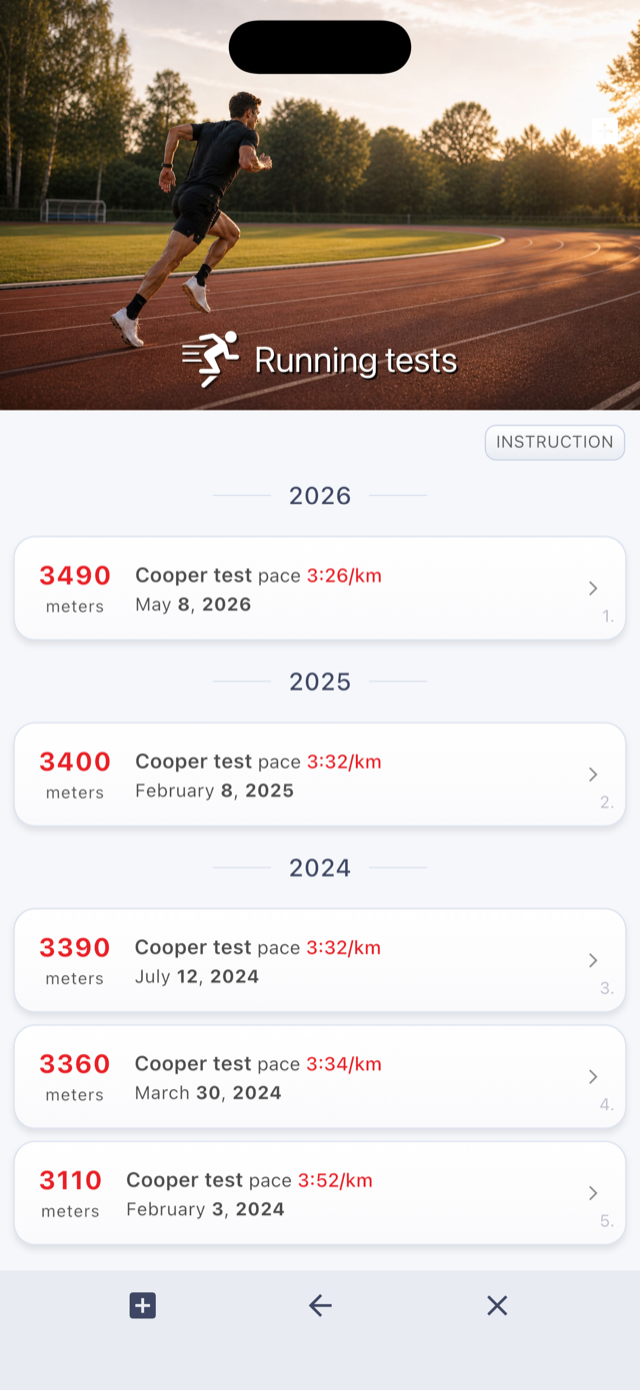
This goal matches an estimated result of about 2870 m in the Cooper test, a 12-minute run for maximum distance. If you are slower today, set your own result and the ranges will follow your current fitness.
This is an estimate, not a promise of a finish time. Your coach sets the exact ranges after a test in the app.
Repeat times in each range
The middle of each range at the estimated Cooper result. Use it to check your pace on a watch or a treadmill.
| Range | 400 m | 1 km |
|---|---|---|
| Easy | 2:30 | 6:14 |
| Aerobic | 2:12 | 5:30 |
| Tempo | 1:59 | 4:59 |
| Threshold | 1:50 | 4:36 |
| VO2max | 1:41 | 4:13 |
Stuck at 47 minutes
A week of one hard session, a long run and two light runs has already given what it could. At this point two options are tempting.
| Decision | What happens |
|---|---|
| More hard sessions | A short-lived gain, then fatigue, a higher risk of overload and a drop in the quality of the work. |
| More easy kilometers | Less spectacular, but it builds the base that makes the hard sessions go better. |
The second one usually works. In the Cooper test this goal is an estimated 2,870 m, and many runners have that aerobic capacity, but they lack the endurance to use it for 45 minutes. A fifth running day can be short and still strengthens the whole structure.
In numbers: from 47:30 you are 15 seconds per kilometer short, about 5.6% in speed. At 50 minutes the reference point was 35–45 km in four runs, and here it is 45–55 km (28–34 miles) in five. The whole increase is easy running. The fifth run can be 5–7 km (3–4.5 miles), which at 6:00/km is 30–42 minutes. At an average of about 5:45/km the full week comes to between about 4 h 20 min and 5 h 15 min on your feet. Add the fifth run and leave the other sessions unchanged for a few weeks. Watch whether the threshold repeats start to feel easier.
The key session for this goal: long threshold repeats
What changes from the 50-minute goal is the length of the work. There, shorter threshold repeats were enough, run at a pace you could hold for about an hour. Here longer ones make sense, 8–15 minutes each, with a total close to half of your race time. In the panel above the article the Threshold range is about 4:27–4:45/km (7:10–7:39/mile), and you run the long repeats in its faster part, about 4:30–4:35/km (7:15–7:23/mile). From a 47–48 minute level, start at about 4:40–4:45/km and work down to that pace during the block.
Race pace is added toward the end of the preparation, but in repeats of 2–3 km, not as one continuous run. Your body should know 4:30/km as a rhythm, not as an all-out effort. A full 10 km at race pace in training costs as much as a race and teaches nothing more.
Add two short strength sessions and strides. A pace of 4:30/km loads the calves and tendons harder, and tissues that are not ready interrupt progress more often than a lack of fitness does.
The second half is the whole result
A first half in 22:30 is comfortably within reach when your 5K equivalent is about 21:35. The second half decides. A study from Oslo (16,315 participants in a 10K) shows that it is on average 3.4% slower for men and 4% slower for women. Here that is about 50 seconds, so with a typical fade 45:00 would need an opening half of about 22:05. A time under 45 minutes means breaking that pattern.
A pace of 4:30/km lies near the fast end of the Threshold range, so after 3 km single words instead of sentences are normal and do not mean you have to slow down. The first kilometer is 4:30–4:35, and slower still in a crowd. Up to 5 km you hold the pace and make nothing up. Between 6 and 8 km the body asks for 4:40, and that is what the long threshold repeats were for. After 8 km (5 miles) less than ten minutes remain, so you are allowed to speed up.
An even 4:30/km on the watch over a real distance of 10.1 km gives 45:27. So aim for about 4:27/km (7:10/mile) by your watch. Heat is expensive at this pace, which is why it is better to plan this result for a certified, flat race in the coolest part of your year.
Cool-season races: the start corral and the wind

The fastest 10Ks are run in cool air, close to the optimum from an analysis of 1.8 million marathon results, about 4–10°C (39–50°F). In the Northern Hemisphere that points to late autumn through early spring, and in the Southern Hemisphere to the middle of the calendar year. The trouble starts before the gun. You stand in the corral in thin race clothes, and at 4:30/km the first kilometer cannot stand in for a warm-up. Do it just before you enter the corral and keep an old top on until the last moment.
Strong wind costs more than cold. When it blows, run the first 5 km in 22:40–22:45, tuck in behind a group on the upwind stretches and accept a result of about 45:20–45:30. Rain at 5°C (41°F) is a reason to keep your gloves on all the way to the finish.
If your coolest race morning is still warm and humid, the corral problem disappears and another one takes its place. Plan a few seconds per kilometer slower from the start, because pace lost in a fade costs more.
Signs of form three weeks before the race
| What you see | What it means |
|---|---|
| You finish long repeats at 4:30/km with something in hand | The goal is realistic, stick to the plan |
| The last repeat is clearly slower than the first | Race pace is too ambitious, aim for 45:30–46:00 |
| A 5K of about 21:35 in training or a race | The equivalent has been reached |
| Easy runs feel heavier and sleep gets worse | Too much work. Back off for a week before your body does it for you |
At IMI signals like these reach a real coach together with your own rating of the effort, and the plan in the app changes every week.
45 minutes is not worth the same for everyone
How many runners break 45 minutes depends on the race: at a mass 10K it is a narrow group at the front of the amateur field, and at a race with many club runners a much larger one. Last year's results of your own race tell you most.
The same time is worth more for a woman. In a study of 2,303 recreational runners, women ran the 10K 18.5% slower than men on average. The world records show the same asymmetry: 45:00 is about 59% of the speed of the men's 10 km road record (26:31) and about 64% of the women's (28:46).
Who this goal is for
The goal is realistic if you already have 47–48 minutes for 10K or about 22:30–23:00 for 5K, and at least a year of regular running. With a time over 50 minutes, go through the sub-50 10K first. We do not promise a time. If pain keeps interrupting your sessions, see a specialist.
A marathon now, or one more season at 10K

A 45:00 result gives about 1:39 for the half marathon, so a sub-1:40 half marathon is within reach. The marathon prediction is about 3:27, and after adding the 10 minutes by which such predictions tend to be too fast for amateurs, about 3:37, so a sub-3:30 marathon needs additional endurance work.
Many runners go straight to the marathon after breaking 45 minutes. Sometimes it is better to stay with the 10K for one more season and try to go lower.
Frequently asked questions
Is 45 minutes a good 10K time?
Yes. Holding 4:30/km for 10 km usually takes several years of regular training and four or five runs a week. For a woman it is a stronger result still.
What pace is a 45-minute 10K?
4:30 per kilometer or 7:15 per mile, which is 13.3 km/h (8.3 mph). Halfway comes at 22:30.
Are four runs a week enough for a sub-45 10K?
Sometimes, but four is the minimum. Five are often needed to move on from 47 minutes.
How many miles a week do you need for a sub-45 10K?
A common reference point is 45–55 km (28–34 miles) over five runs. The increase over a sub-50 week should be easy running, not extra hard sessions.
What 5K time matches a 45-minute 10K?
About 21:35. Look at the sub-22 minute 5K as well, because the two levels are close.
Is a sub-45 10K worth aiming for after 40?
Yes, if your training history allows it. Endurance declines gradually with age, and the difference between your thirties and forties is usually small. The plan just needs to leave more room for recovery.
How much harder is a sub-40 10K than a sub-45?
By 30 seconds per kilometer, or 12.5% in speed. Five runs become a necessity, and a sub-40 10K adds a second hard day.