Contents
Duathlon distances under World Triathlon rules
The familiar four-step table (sprint, standard, middle, long) simplifies the rules. Appendix A of the World Triathlon competition rules has an extra row for the standard distance and gives the long distance as a range.
| Distance | Run 1 | Bike | Run 2 | Minimum age |
|---|---|---|---|---|
| Super sprint | 1.7–3.5 km | 6.5–13 km | 0.85–1.75 km | 15 |
| Sprint | 5 km | 20 km | 2.5 km | 16 |
| Standard, shorter variant | 5 km | 30 km | 5 km | 18 |
| Standard | 10 km | 40 km | 5 km | 18 |
| Middle | 10 km | 60 km | 10 km | 18 |
| Long | 10–20 km | 90–150 km | 20–30 km | 18 |
As of November 2026, rules in the edition of December 13, 2025. In miles, the sprint is 3.1, 12.4 and 1.55, and the standard distance 6.2, 24.9 and 3.1. In the version with a bike the order is always the same: run, bike, run. The variants are cross duathlon, the off-road version on a mountain bike, and winter duathlon, in which skis replace the bike.
Organizers keep to these numbers loosely, and race series use their own. The Powerman series calls 10, 60 and 10 km "Classic" and 5, 30 and 5 km "Short". Triathlon festivals often add a duathlon wave on the triathlon's bike and run course: one 2026 race in a Canadian series listed a "sprint duathlon" of 2, 28 and 5 km. Duathlon has no fixed standard in the way the marathon does, so check the real length of each leg. Who writes which rules is explained on the page about triathlon organizations.
The world championship distance keeps changing
The standard 10-40-5 has counted as the championship distance since 1994, but recent editions looked different. The world championships have been searching for a format from the very beginning.
| Years | Distance (run, bike, run) |
|---|---|
| 1990–1992 | 10-60-10 km |
| 1993 | 5-50-5 km |
| From 1994 | 10-40-5 km, with variations on the bike |
| 2023 | 5-20-2.5 km |
| 2024 | 4.79-19.4-2.5 km |
| 2025 | 5-30-5 km |
The first world championships were held in 1990 in Cathedral City, California, and the first title went to the American Kenny Souza. Since 2017 the titles have usually been awarded at the World Triathlon Multisport Championships. The 2025 edition took place in Pontevedra, Spain, and the 2026 titles were decided in mid-November in Abu Dhabi. The 5-30-5 variant from the first table is therefore a real format: it was the world championship distance in 2025.
Variants of duathlon
The name "duathlon" covers several formats. Some use different equipment, and one even has a different second sport.
| Variant | Format | Distance under World Triathlon rules |
|---|---|---|
| Cross duathlon, sprint | Trail run, mountain bike, trail run | 3–4 km, 10–12 km, 1.5–2 km |
| Cross duathlon, standard | As above | 6–8 km, 20–25 km, 3–4 km |
| Mixed relay, 4 people | Each person does a short duathlon | 1.5–2 km, 5–8 km, 0.75–1 km per leg |
| 2x2 relay | A woman and a man alternate, each racing twice | As above, per leg |
| Winter duathlon | Running and cross-country skiing, no bike | For age groups, a 6 km run and 12 km of skiing |
Local off-road races are often longer or shorter than the federation's cross distances. Read the kilometers, not the name of the category.
How a duathlon differs from a triathlon
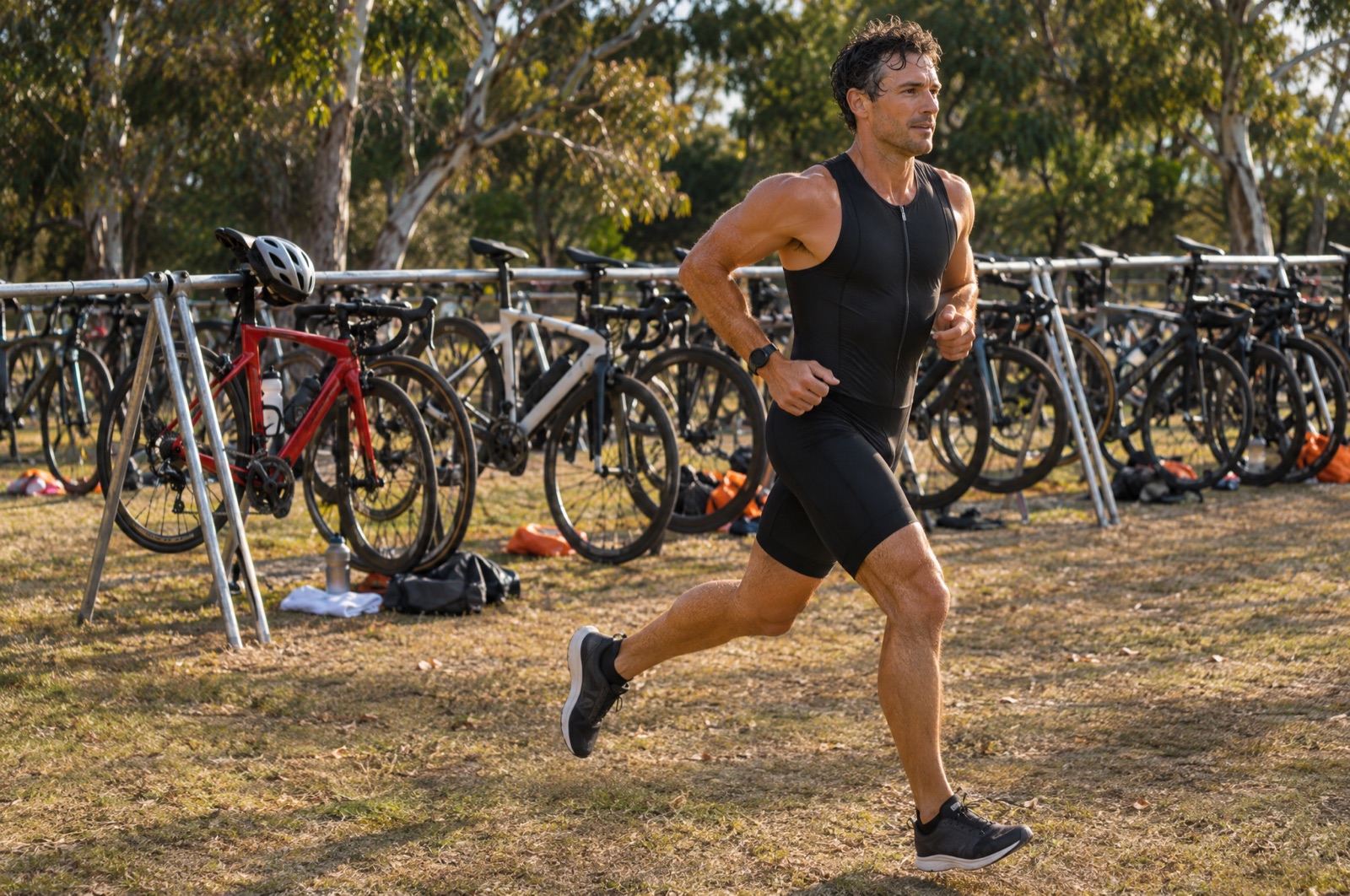
"A triathlon without the swim" is misleading shorthand. Without water the logic of the whole race changes: you do the same sport twice, with a long bike leg in between.
| Sprint duathlon | Sprint triathlon | |
|---|---|---|
| Legs | 5 km, 20 km, 2.5 km | 750 m, 20 km, 5 km |
| Total running | 7.5 km, in two parts | 5 km |
| Start | On land, at race pace straight away | In the water, in a crowd, controlling your breathing |
| You begin the bike | After a run, with warm and tired legs | After a swim, with fresher legs |
| T1 | Running shoes to bike | Wetsuit, cap, goggles |
| Main limiter | Legs and tolerance of running fatigue | Confidence in the water |
| Season | In cool climates often spring and autumn, when open water is too cold. In warm climates all year. | The months when the water allows it |
| Special equipment | No wetsuit, goggles or pool | A wetsuit, depending on the water |
How much running there is in a duathlon
Take someone who runs at 5:00/km (8:03/mile) and rides at 30 km/h (18.6 mph), with no transition time and no drop in pace.
| Race | Running time | Total time | Share of running |
|---|---|---|---|
| Sprint triathlon with a 3:00/100 m swim | 25 min | 1:27:30 | 29% |
| Sprint duathlon | 37:30 | 1:17:30 | 48% |
| Standard duathlon | 1:15:00 | 2:35:00 | 48% |
| Middle distance duathlon | 1:40:00 | 3:40:00 | 45% |
The calculation is approximate, but it shows the essential point: in a duathlon you run for almost half the time, and in a sprint triathlon for less than a third. Someone with a running base has a real advantage here. Whoever comes from swimming and cycling will feel for the first time how hard the second run is on the legs.
When your triathlon becomes a duathlon
Few people think of this before race day. When conditions make swimming impossible, World Triathlon rules allow a change of format, and the preferred option is a duathlon with a shorter first run. The swim can be canceled in very cold or very warm water or for poor water quality, and in cool water the rules also take the air temperature into account. If you race early in the season or after heavy rain, have a scenario for a run instead of the swim and keep your shoes to hand.
The second run: where the result is often decided
In a triathlon you run once, after the bike. In a duathlon the second run comes after a run and a ride, and the first run takes the freshness out of your legs before you get on the bike. There is little research on duathlon itself. The 2000 review by Millet and Vleck on the bike-to-run transition in Olympic-distance triathlon shows the mechanism: ventilation and heart rate rise, and the energy cost of running is higher by 1.6–11.6%, depending on the level of the athlete. In a duathlon the fatigue of the first run comes on top, so this is a cautious extrapolation, not a measurement. It is why the first few hundred meters of the second run can feel unpleasant even in excellent form.
The proportions of the runs are not constant
| Distance | Run 2 as a share of run 1 | What follows |
|---|---|---|
| Sprint 5-20-2.5 | 50% | A short, sharp finish. Overdo the 5 km and you pay on the bike and in the second run. |
| Standard 10-40-5 | 50% | 10 km at pace is a very long opening. This is where it is easiest to ruin the whole race. |
| Standard 5-30-5 | 100% | The runs are equal, so the second run stops being a short finish. |
| Middle 10-60-10 | 100% | The first serious test of fueling and pacing |
| Long 10-150-30 | 300% | The second run is three times as long as the first, after several hours of riding |
"The second run is only the finish" holds for the sprint and the standard distance. At the long distance it is 20–30 km after 90–150 km on the bike. In Zofingen in Switzerland, the most famous long duathlon, the race ends with a long run, not a sprint to the line.
How to pace it
- Keep the first run below your pace from a standalone running race. Fresh legs, the crowd and adrenaline make the pace feel easy. This is a very common mistake in duathlon, and with a 10 km first run the most expensive one.
- The first minutes on the bike are recovery. After T1 your heart rate is high. Settle your breathing, take a drink and only then get up to speed.
- The end of the bike leg prepares the run. In the last minutes a lighter gear and a higher cadence give you a better entry into T2 than riding flat out to the line.
- Start the second run with a short stride. The legs find their rhythm by themselves. Forcing a longer stride in the first minutes costs you.
Work out what a faster start gives you. A first run in a sprint that is 15 s/km (24 s/mile) harder is a gain of 1:15 over 5 km. If the second run slows by 30 s/km as a result, you hand back exactly the same over 2.5 km, not counting the loss on the bike. The proportions are the same at the standard distance: 2:30 gained over 10 km and 2:30 lost over 5 km.
How to train the second run
These principles separate preparing for a duathlon from preparing for a triathlon.
| Element | What for | What to watch |
|---|---|---|
| Run, bike, run in one session | The only way to feel the full shape of the race | Rarely and with sensible volume, because the recovery cost is high |
| A short run off the bike | The routine of the change and the rhythm of the first minutes | Often and short is better than rarely and long |
| Running at race pace when tired | Holding technique on tired legs | Only after a running base is in place |
| Bike work after a run | Riding with an elevated heart rate after the first leg | Not every ride has to be hard |
| Leg strength and resilience | Withstanding two runs and the work on the bike | Pain in a tendon or knee is a signal to change something, and persistent pain a reason to see a doctor |
Running on tired legs gives the most. If you come from running, concentrate on the bike and the change to the run. If you come from cycling, on the resilience of your legs over two runs. The reference points for the base are the running training plans and the cycling training plans.
What to train, depending on where you come from
| Your base | Biggest gap | Main emphasis |
|---|---|---|
| Running | Power and confidence on the bike, riding close to others, cornering | Regular riding, long rides included, while you maintain your running without adding to it |
| Cycling | The legs' tolerance of impact, two runs in one race | A gradual rise in running, strength work, short runs after rides |
| Triathlon | A hard run from the first minute, without the calmer entry through the water | Work at pace at the start of the race, and run, bike, run sessions before the season |
| No base | Everything at once | Regularity, running and easy riding, then a first short race |
The first transition is not like a triathlon's
After the run you arrive in transition with a high heart rate, but with no wetsuit and no water in your ears. The change can be short, and it is easy to rush it. Practice four movements in a fixed order: helmet, bike, run to the line, mount after the line. In T2 you rack the bike first and only then unfasten the helmet. If you ride in running shoes, the change comes down to those two movements. In cycling shoes you add a change of footwear. Rehearse both versions and choose the one that is repeatable, not the one that looks fastest.
Food and drink: the bike is the best moment
It is hard to eat while running, so you take in fuel mainly on the bike. The sprint in our example lasts about 1:20, so water or a sports drink is usually enough. The standard distance is 2:35. At 40 g of carbohydrate per hour you need about 100 g, for example a bottle of drink and three gels. The middle distance is 3:40. At 50 g per hour that comes to about 185 g, which is two bottles and five gels. Here a bottle counts as 30 g and a gel as 25 g. Eaten entirely on the bike, the middle-distance amount would be about 90 g per hour of riding, so keep a gel or two for the second run. Test it in training first, because the stomach reacts differently after a hard run than on an easy ride, and in hot weather your fluid needs rise well above what a single bottle covers.
How much time you need
Duathlon has no single norm, so go by the duration of the effort. A sprint lasts about as long as a sprint triathlon and the standard distance about as long as an Olympic triathlon, so the frames from the table of triathlon training plans are a good reference: 12–16 weeks for a sprint and 14–20 for the standard distance, if you have a base. The middle and long distances need longer preparation, much like a half and a full-distance triathlon. Someone who runs regularly and adds only the bike usually needs less time than someone starting both sports. If the first run is the question mark, a 5K or 10K training plan shows what that leg demands on its own.
At IMI a real human coach builds the plan in the app around your race and updates it every week. The starting point is a set of tests: the 12-minute Cooper test or a 5K for the run and FTP on the bike, and your completed sessions flow in from Garmin or Apple Watch.
Equipment for a duathlon
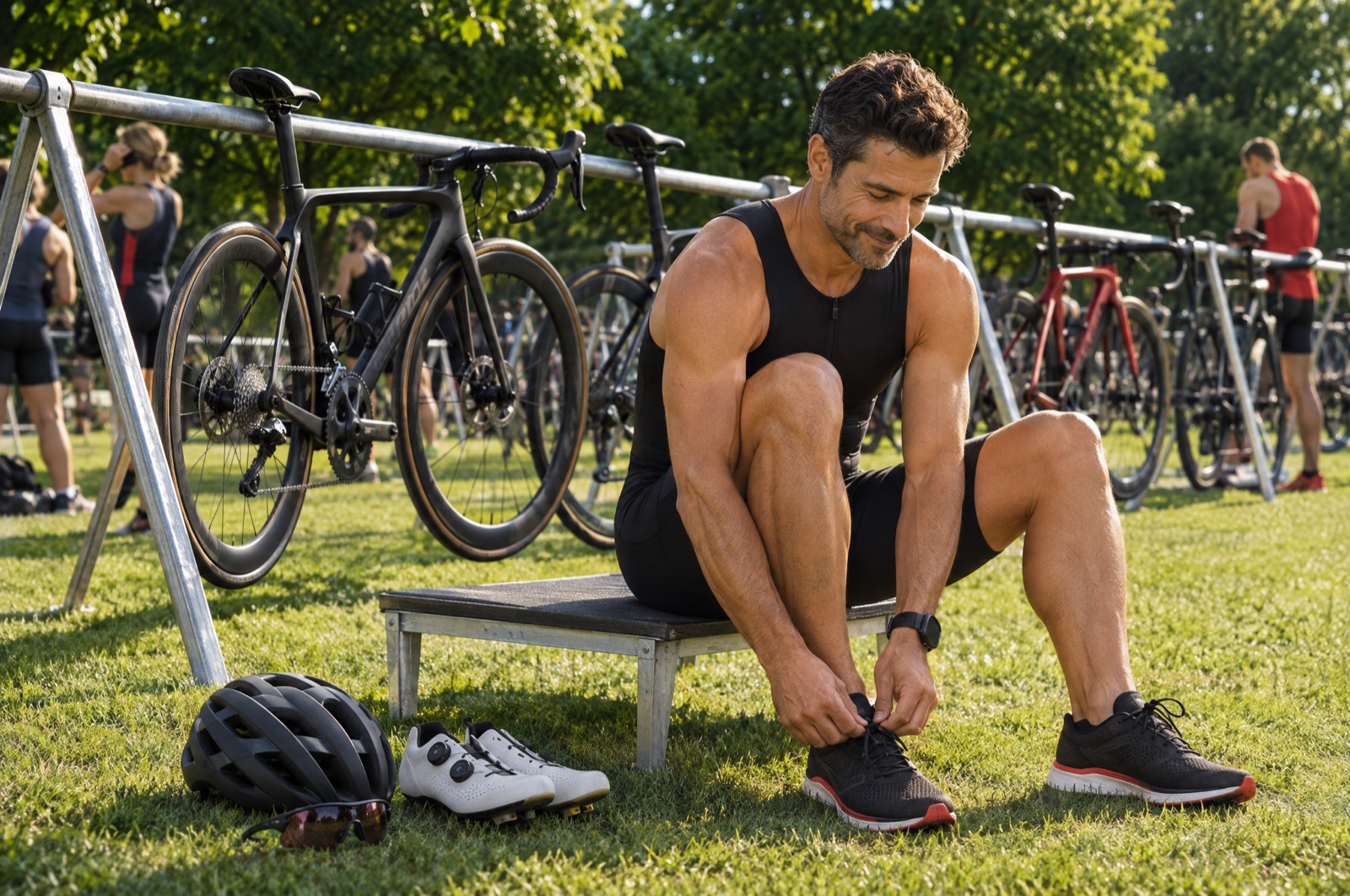
Duathlon is the cheapest route into multisport: no water, no wetsuit, no pool. The equipment does have a few details that neither of the two sports has on its own.
| Item | What you need to know |
|---|---|
| Running shoes | You can run both runs in the same pair. At World Triathlon events only one pair of running shoes may lie by the rack, no further than 0.5 m from your box. |
| Elastic laces | They speed up both transitions at short distances. Test them in training first. |
| Bike | The race rules decide. Draft-legal races, where you may ride on another athlete's wheel, require a road bike with drop handlebars. Non-drafting races usually accept road and time trial bikes, and many accept any roadworthy bike. |
| Helmet | Mandatory. It must be fastened from the moment you take the bike off the rack until you rack it again after the leg. |
| Cycling shoes | They save power on a longer bike leg. In a sprint, changes in running shoes can be quicker for a beginner. |
| Clothing | One outfit for the whole race. For an early-spring or late-autumn race prepare options for the cold, such as arm warmers, if the rules allow them. |
| Race number | On the run course the number must be visible from the front. A race belt makes both transitions easier. |
| Headphones | Banned on every leg of a World Triathlon event. |
One rule is specific to duathlon. You begin with a run, so the bike and helmet wait in transition from the start. World Triathlon rules say that in the transition area during the first leg the helmet strap must stay unfastened, and fastening it early can be treated as an infringement. Fasten it only when you come back for the bike.
Drafting in duathlon
World Triathlon allows riding on a wheel for elite, under-23 and junior athletes at short distances. For age groups in a sprint the choice belongs to the organizer, and at the standard, middle and long distances drafting is illegal. National federations mostly follow the same division, but the athlete guide of your race has the final word.
In non-drafting races the draft zone is 12 m (39 feet), and you have 25 seconds to ride through it. The time penalty for drafting is 30 seconds in a sprint, a minute at the standard distance, 2 minutes at the middle distance and 3 minutes at the long distance. After the first run, people of similar pace can end up riding side by side, so watch the gap from the first minutes.
Where to race: championships, series and national scenes
Duathlon is smaller than triathlon, but it has a stable international calendar, with world and continental titles, one global series and national championships in most countries where triathlon is established. The dates below come from World Triathlon's calendar, as of November 2026.
| Event | What it is | Most recent and next edition |
|---|---|---|
| World Triathlon Duathlon Championships | World titles at the short distances for elite and age-group athletes | Abu Dhabi, November 2026, within the Multisport Championships. Next: Edmonton, Canada, July 17, 2027. |
| World Triathlon Powerman Long Distance Duathlon Championships | World titles at the long distance | Zofingen, Switzerland, September 6, 2026. Next: Zofingen, September 4, 2027. |
| Europe Triathlon Duathlon Championships | European titles | Next: Cáceres, Spain, June 5, 2027 |
| Europe Powerman Middle Distance Duathlon Championships | European titles at 10-60-10 km | Next: Alsdorf, Germany, May 9, 2027 |
Dates and hosts can still move, so confirm them before you book travel. Other continental confederations may hold their own championships, listed in the same calendar.
National scenes
What you find close to home depends on the country, and three patterns repeat.
- Stand-alone duathlons in the cool months. In temperate climates duathlon fills the part of the year when lakes are too cold: early spring and autumn in much of Europe and North America, and the cooler months elsewhere. For triathletes these races open or close the season.
- A duathlon wave at a triathlon. Many triathlon events offer a run-bike-run option on the same day and course, often with a shortened first run. It is the easiest duathlon to find, and the one whose distances are least standard.
- Big participation events. Powerman Malaysia in Putrajaya drew 4,500 athletes from over 30 nations in 2026 and is billed by its organizers as the world's biggest duathlon. Large city duathlons elsewhere often use their own labels and distances, so read the course details.
The national federation's calendar is the best place to start. It also tells you which races are national championships and which count as qualifiers.
What to check in the race information
| Point | What to look for |
|---|---|
| Course | The number of laps on each leg, the surface, and whether roads are closed to traffic |
| Cut-offs | Separate limits for the first run, for the first run plus the bike, and for the finish. A limit of 1:20 for a 10 km first run, for example, means 8:00/km (12:52/mile), which is run-walk pace. |
| Bike rules | Drafting or non-drafting, and which bikes and handlebars are allowed |
| License | Whether you need an annual federation membership or a one-day license, and whether you buy it in advance |
| Start format | A mass start, waves or a rolling start, in which athletes set off a few at a time |
| Relay and children's races | Many events have teams of 2 or 3 and short distances for children, which makes duathlon an easy family day |
Cut-offs in amateur duathlons tend to be friendly, but after a mechanical problem on the bike the margin shrinks fast. Entry fees follow the same pattern as in triathlon: lowest for early entry and at small local races, with a day license on top where the federation requires one.
Championships for age-group athletes
In duathlon, amateurs in the age categories have a realistic route to international events. You do not enter a world or continental championship as an individual. You race as a member of your country's age-group team, and your national federation decides who is on it: usually through the national championships or named qualifying races, with slots that roll down to the next finisher if a winner declines. Expect to need an annual license and to pay the entry fee, a team fee and often for team kit yourself. The criteria and costs change every season, so read your federation's current selection policy before you plan a year around it.
Powerman and the long distance
Powerman is the duathlon brand for middle and long distances, run by the International Powerman Association, which describes it as the world's largest duathlon series. Its races are held in Europe and Asia among other places, and its best-known event is Powerman Zofingen in Switzerland, held since 1989. The organizers call it the toughest duathlon in the world, and the long distance world championships have been held there for years.
How many kilometers Zofingen really has
The name 10-150-30 is more a brand than a measurement. Before you plan the race, check the real course of that edition.
| Version | Run 1 | Bike | Run 2 |
|---|---|---|---|
| Course names used by the organizer, 2026 and 2027 | 10 km | 150 km | 30 km |
| Championship course, 2026 | 10.8 km | 148.2 km | 26.7 km |
| Championship course, 2025 | 10.8 km | 148.2 km | 26.72 km |
| 1997–1999 and 2003 | 8.5 km | 150 km | 30 km |
The second run differs by about 3 km, and on an off-road run course that is a big difference for a plan. In 2026 the bike course also gained a new section through Oftringen because of construction work on the final stretch.
How fast the racing is
In 2026 more than 700 people from 40 countries took part. The men's race was won by Émile Blondel-Hermant in 5:50:30, a new course record by eight minutes. The women's race went to Merle Brunnée in 6:45:51, which gave her a fifth world title. The oldest entrant was the 83-year-old German Paul Thelen.
What it means for an amateur
- A long duathlon resembles a half or full-distance triathlon more than a sprint. You prepare for many hours of effort and for eating on the move.
- Zofingen means riding and running in hilly terrain. A plan built for a flat race is not enough here.
- A shorter distance exists too. The Short Distance in Zofingen is, according to the organizer, a 10 km run, 50 km on the bike and a 5 km run, which lets you feel the atmosphere without the full course. Elsewhere in the series "Short" means 5-30-5 km and "Classic" 10-60-10 km.
- The long distance world championships have been held since 1997 and in recent years have taken place in Zofingen. The next edition is planned there for the weekend of September 4–5, 2027. The organizers are also planning a new duathlon series, with a target start in 2028.
Who duathlon is for
| Who you are | What you gain | What to watch |
|---|---|---|
| A runner who does not swim | The simplest way into multisport | The bike, cornering, riding in a group. If the bike is new to you, start with the beginner cycling plan. |
| A cyclist | A strong middle leg and a new goal | Two runs. The bike will not rescue weak running. |
| A triathlete | A race in spring or autumn, outside the open-water season | A lot of running. The race should not pull you out of your main preparation. |
| Someone afraid of the water | A race day without a lake | A full transition area and the bike are new skills |
| A family | Children's distances at many events, for the youngest too | The timetable of the children's and adults' races |
If the water starts to tempt you after a duathlon, the natural next step is a first triathlon. You already know the transition area, the middle leg and the run off the bike, so the main new subject will be swimming.
Frequently asked questions
What are the distances in a duathlon?
Under World Triathlon rules a sprint is 5-20-2.5 km, the standard distance 10-40-5 km or 5-30-5 km, the middle distance 10-60-10 km and the long distance 10–20, 90–150 and 20–30 km. The order is run, bike, run.
How is a duathlon different from a triathlon?
There is no swim, and the run appears twice. You run for almost half of the race time, so the result depends on running and pacing, not on confidence in the water.
Is a duathlon easier than a triathlon?
No. It is easier to organize and cheaper, but no less demanding. Two runs load the legs more than one, and a start at race pace gives you no calmer way into the effort.
Which duathlon distance should I start with?
For most people the sprint, 5-20-2.5 km. If you can run 5 km without walking and ride 20 km, it is a good first race. What remains is to add the run off the bike and rehearse the transitions. The standard distance opens with a 10 km run and needs a more solid base.
How do I train for a sprint duathlon?
With an existing base, 12–16 weeks is usually enough. A duathlon training plan for this distance turns on two things: the run off the bike and a controlled first run on race day. Use sessions that combine run, bike and run rarely, and a short run off the bike more often.
What bike do I need for a duathlon?
The race rules decide. Draft-legal races require a road bike with drop handlebars. Non-drafting races, the usual format for age-group athletes beyond the sprint, generally allow time trial bikes too, and many local events accept any roadworthy bike.
What should I wear for a duathlon?
One outfit for the whole race, because there is no wetsuit to change out of: a tri suit, or running shorts and a top, suits most people. Add a race belt, since the number must be visible from the front on the run, and for a cold spring race arm warmers if the rules allow them. The helmet is mandatory on the bike.
When and where are the duathlon world championships?
The 2026 titles at the short distances were decided in Abu Dhabi in November. On World Triathlon's calendar the next championships are in Edmonton, Canada, on July 17, 2027, and the long distance championships in Zofingen, Switzerland, on September 4, 2027.
What is Powerman?
It is the duathlon brand for the longer distances. The most famous race, Powerman Zofingen, is traditionally a 10 km run, 150 km on the bike and a 30 km run. The real courses of recent editions are slightly different: 10.8 km, 148.2 km and 26.7 km.
Do I need a license for a duathlon?
It depends on the country and the race. Events sanctioned by a national triathlon federation usually require an annual membership or a one-day license, and championships always do. Independent races may not ask for one.