Contents
- Finishing is closer than you think
- Are you ready for a first Ironman: a decision table
- How much training a first Ironman takes
- The planning year: what happens when
- Winter and the off-season: the hardest part of the project
- Cut-offs: how much margin you really have
- How to choose your first Ironman race
- Health before you enter
- Mistakes specific to a first Ironman
- The conversation everything starts with
- Frequently asked questions
Finishing is closer than you think
You do not have to be fast to reach the finish. In a peer-reviewed analysis of 677,702 age-group results at IRONMAN races from 2002 to 2022, the mean finish time was 12:38 for men and 13:32 for women. That mean is more than three hours inside the usual 17-hour limit.
That study, though, counts only people who crossed the line. It does not say how many dropped out on the course or how many paid the entry fee and never reached the start because of an injury, an illness or a block that went wrong. So the selection begins before race day. That is why this page is about getting to the start healthy and with a margin.
Are you ready for a first Ironman: a decision table
Race rules usually do not require any previous results. The table below is a reference point. For scale: in a 1999 study, lower-level athletes who finished an Ironman had about 6 years in triathlon behind them and about 21.5 weeks of preparation.
| Signal | Green | Yellow | Red |
|---|---|---|---|
| Experience | A half distance finished with something in reserve in the last 2 seasons | Olympic distance, with a half planned before the full | No triathlon of any kind |
| Training now | 8–10 h a week for several months | 5–7 h a week | Under 5 h, or with gaps |
| Time for 30 weeks | 12–15 h on average, one weekend day free for the long session | 10–12 h, but a peak without travel | You cannot point to the Saturdays |
| Bike | 4-hour rides without back or neck pain | Rides of 2–3 h | The bike comes out only in season |
| Run | A half marathon without injury | 10 km (6.2 miles) regularly | Recurring pain at 8–10 km |
| Swim | 2 km continuous, at ease in open water | 1 km continuous, little open water | 400 m is a struggle |
| Home and work | The conversation has happened and the priority is agreed | Agreed, but without details | The subject has not come up yet |
One red field does not cancel the plan, but it sets your first priority. Two or more are a good reason to do a first half Ironman before the full. A half the year before teaches eating, running off the bike and power discipline in a rehearsal that is half as long.
How much training a first Ironman takes
Typical figures are 10–18 hours a week in the build phase, 14–22 at the peak and 6–9 in recovery weeks, and most age-group athletes average 12–15 hours. For a first race you do not need to reach the top of the range. It matters more that the weeks are repeatable.
| Your realistic average | What it gives you | What to expect |
|---|---|---|
| 8–10 h | 240–300 h in 30 weeks | Finishing is possible with a good base and higher peaks. The aim is a calm day |
| 11–13 h | 330–390 h | Solid preparation to finish, with room for strength work and recovery |
| 14–16 h | 420–480 h | A margin for weather and a bad patch, but harder to combine with a job and family |
These bands are a reference point. Finishing takes less training than studies of professionals suggested, and the result depends more on weekly cycling distance and the longest ride than on training pace. That is not an invitation to cut corners. You pay for too little preparation with a long day that ends just before the cut-off, and with a higher risk of injury.
The planning year: what happens when
Registration usually opens during the previous season, so the first step is a decision, not a workout. Count the dates back from your race.
| Time to the race | What you decide | What should be ready |
|---|---|---|
| 12–14 months | The race, agreement at home, the budget, leave from work | Entry paid, accommodation penciled in, refund rules checked |
| 9–11 months | Health check, swim technique, strength, rebuilding after the season | Base training started, a plan for the off-season |
| 6–9 months | Regular weeks, work in all three sports, bike fit | Bike position settled, a training camp planned if you need one |
| 3–6 months | Long rides, a nutrition rehearsal | The first 80 g/h in training |
| 6–10 weeks | A tune-up race over the half distance | Lessons from the tune-up race written down |
| 4–6 weeks | The biggest training day, a race plan on paper | Decided: power, food, equipment, kit |
| 3 weeks | Taper, calm weeks at work, sleep | Bike serviced, logistics closed |
| After the race | At least two easy weeks | No training goals and no heavy work commitments |
Plan the tune-up half 6–10 weeks before the Ironman and treat it as a rehearsal of power and eating, not as a race. For a full distance in early August that window runs from late May to late June. For one in early March in the southern hemisphere it falls between Christmas and late January. Choose the tune-up when you choose the main race, because popular 70.3 events also sell out. The half Ironman guide covers that distance in detail.
Winter and the off-season: the hardest part of the project
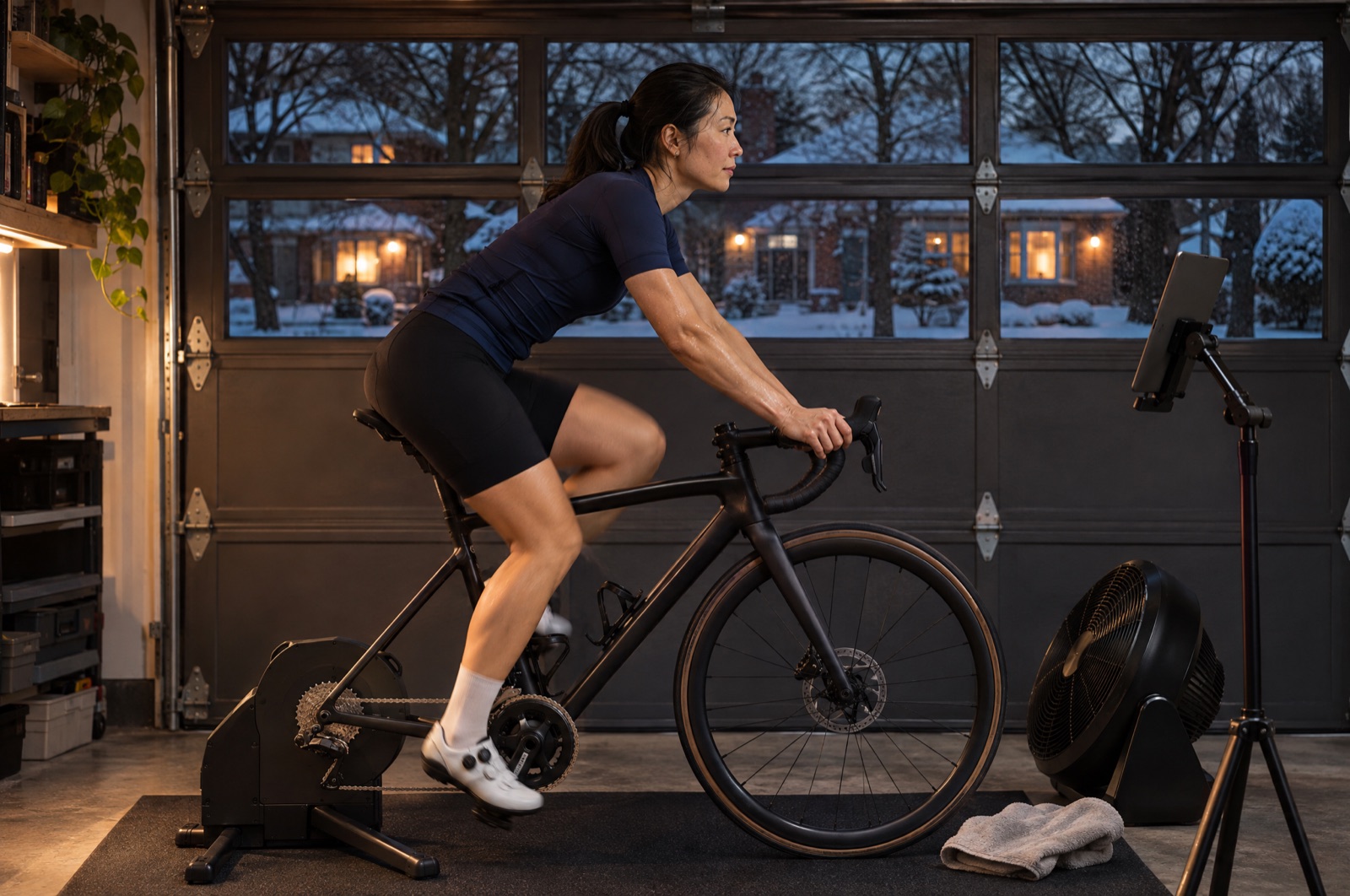
For a race in July or August, a 30-week block starts in December or January. For a race in early June, 30 weeks back is already early November. In the northern hemisphere the base phase and part of the build therefore fall in winter, the season of winter cycling training with few long rides outside. The southern hemisphere has the same problem at a different time of year: for Ironman New Zealand in early March the block begins in early August, in the middle of the southern winter. For a first Ironman this is a practical issue, because weekly cycling distance and the longest ride are among the best predictors of the result.
- The trainer solves volume, not everything. An hour on the indoor trainer is even, with no descents or traffic lights, and mentally harder for it. It will not teach you to hold the aerobars for five hours outdoors.
- Plan the long outdoor rides from spring. The first 4 hours outside are a good moment to test your position, not only your fitness.
- Open water comes late. In colder climates lakes and the sea warm up only toward the end of spring. Before a race in early summer that leaves a few weeks, so use every opportunity.
- Running in winter. Slippery surfaces and darkness are common reasons for skipped sessions. Decide the substitute in advance, a treadmill for example, instead of counting on the weather.
- Heat can be an off-season too. If you live in the tropics or somewhere with a very hot summer, the months of extreme heat, humidity or heavy rain do what snow does elsewhere: they move long rides indoors or to the hours before dawn. Plan for them the same way.
In the off-season, maximum volume matters less than coming out of it without injury and with regular swimming. A race late in your local season, September or October in the northern hemisphere, softens the problem, because the longest rides fall in summer. The hardest weeks then land in the holiday season and on family trips.
Cut-offs: how much margin you really have
The standard set of limits at IRONMAN races is 2:20 for the swim, 10:30 for the swim plus the bike and 17:00 overall, as at IRONMAN Texas 2026. Some races are stricter, with 16 hours to the finish and 10 hours to the end of the bike, a set some independent races use. There may also be checkpoints within a leg. Check the limits in the athlete guide of your race before you enter.
| Scenario | Swim + T1 | Bike | Margin to the 10:30 cut-off | Run inside the 17:00 limit (T2 10 min) |
|---|---|---|---|---|
| Calm | 1:30 | 7:00 (25.7 km/h, 16.0 mph) | 2:00 | 8:20, which is 11:51/km (19:04/mile). Walking is enough |
| Slow | 1:45 | 7:45 (23.2 km/h, 14.4 mph) | 1:00 | 7:20, which is 10:26/km (16:47/mile) |
| Borderline | 2:10 | 8:15 (21.8 km/h, 13.6 mph) | 0:05 | 6:25, which is 9:07/km (14:41/mile) |
At a race with a 16-hour finish and a 10-hour bike cut-off, do the sum more strictly. The borderline scenario is out, because 10:25 is past the 10-hour limit. The slow scenario leaves a 30-minute margin and 6:20 for the marathon, which is 9:00/km (14:30/mile).
The table shows two things. First, the run is the least dangerous limit. With 7–8 hours in hand you can finish with a run-walk. Second, the whole margin is built on the bike, because 10:30 is a combined limit. A swim at 3:41/100 m and a ride at 22.5 km/h (14.0 mph) is the pace that only just clears both. In practice, aim for at least an hour in hand after the bike.
With a rolling or wave start the rules differ between races: some count the limit from the official start, others from the moment you cross the timing mat. Some combine both, with your overall time measured by your chip and the bike cut-off fixed to a time of day, so entering the water late shortens your ride. Some road closures also run to fixed hours regardless of when you started. Check this in the guide, especially if you are in a late wave.
What finish time to expect in a first Ironman
Build the forecast from the paces of your long training sessions. The table is a simple sum at constant pace, with no wind or climbs, and the run pace includes walking through aid stations. You can enter your own paces in the triathlon time calculator.
| Swim | Bike | Run | Transitions | Finish |
|---|---|---|---|---|
| 2:15/100 m | 28 km/h (17.4 mph) | 6:30/km (10:28/mile) | 20 min | 12:45:31 |
| 2:30/100 m | 26 km/h (16.2 mph) | 7:00/km (11:16/mile) | 25 min | 13:50:47 |
| 3:00/100 m | 24 km/h (14.9 mph) | 8:00/km (12:52/mile) | 30 min | 15:31:36 |
The third row leaves close to an hour and a half before the 17:00 limit. At a race with a 16-hour finish and a 10-hour bike cut-off, the same day ends about half an hour before the limit and leaves about 20 minutes in hand after the bike, so at that pace a race with a 17:00 limit is the safer choice.
How to choose your first Ironman race
For a first attempt, predictability matters most. Over the same distance the mean finish time differs by almost two hours from one venue to another. Broadly you have three routes. The guide to the full distance lists the races by continent.
| Route | What it looks like | What you gain | What you give up |
|---|---|---|---|
| The nearest full distance | Whichever race, branded or independent, is within a day's drive | The bike travels with you, lower costs, a climate you train in, family at the finish | The date and the course choose you. An independent race may have tighter limits and gives no IRONMAN World Championship slots |
| An IRONMAN-brand destination race | A large event picked for its course and climate, reached by plane | A 17:00 limit at most races, a big field around you all day, frequent aid stations | The entry alone usually runs to several hundred euros or dollars and rises with each price tier, plus flights, bike transport and several nights. Popular dates sell out |
| Challenge or a well-known independent race | Challenge Roth, Challenge Almere-Amsterdam, a long-running national race | The same distance, often a lower fee and a strong local atmosphere | Roth sells out almost as soon as entries open. Elsewhere the fields are smaller and the rules are the organizer's own |
- Date and climate. In June 2026 IRONMAN Frankfurt was shortened because of heat and Nice was canceled. Organizers publish typical air and water temperatures on each race page, so compare them with the conditions you train in. A race in early autumn gives you a longer summer to train in and usually lower temperatures, though there is no guarantee. Remember that the seasons are reversed in the southern hemisphere, so December in Western Australia is early summer.
- Travel. A race you can drive to means no bike case, no baggage risk and no jet lag. If you fly across time zones, plan to arrive several days before the race, and count those days into your leave and your budget.
- Course. Loops have an advantage: aid stations come around more often and your supporters see you several times. On a multi-loop course you may have to count the laps yourself. A flat course is not automatically easier, because you never stop pedaling, but it is more predictable than a mountain course for a first pacing plan.
- Water. A wetsuit helps weaker swimmers. At IRONMAN races age-group athletes may wear one when the water is at or below 24.5°C (76.1°F), so a warm-water race can mean 3.8 km without it. A sea swim with waves is a different task from a lake or a river.
- Registration. The most popular races sell out many months before race day, some within weeks of opening, while others stay open into the season. For the race you want, a year ahead can already be too late. The steps are in the guide on how to register for an Ironman.
- Refunds. Check the withdrawal, transfer and deferral rules before you pay. They differ between organizers and change from season to season, and some races sell a refund add-on at registration. The cancellation in Nice showed that these rules can matter.
Health before you enter
A US registry of deaths and cardiac arrests in triathlon shows a rate of 1.74 per 100,000 participants, but 18.6 per 100,000 in men over 60. Most sudden events happened in the swim, and relevant cardiovascular changes were found in 27 of the 61 people examined after death. Before a first full distance, especially if you are over forty, have heart disease in the family or get symptoms during exercise, see a doctor before the block begins. At Norseman, 56% of athletes on average reported overuse problems during preparation, so take pain that persists straight to a doctor or physiotherapist.
Mistakes specific to a first Ironman
- A plan built for a time instead of for finishing. A first Ironman teaches you how your body behaves after 8 hours. Nobody has that knowledge in advance.
- Too much running volume. You do not need a marathon in training. The longest run is 2:00–2:30, and anything beyond it raises injury risk for little gain.
- Too few rides over 4 hours. Only after the fourth hour do you find out about your position, your saddle and your food. Without those rides you meet the problems on race day.
- Riding at half-distance power. For seven hours on the bike a sensible IF, the fraction of threshold power (FTP), is closer to about 0.62 than to 0.75.
- Copying a fueling plan from the internet. The 80–100 g/h range is the result of months of training. About 31% of starters report serious gut symptoms.
- Drinking "just in case". Drinking beyond thirst and losses can lead to hyponatremia, a blood sodium concentration that is too low. At one edition of Ironman New Zealand, 18% of finishers had it.
- No plan B. Before the race, settle three versions: a good day, heat and a stomach crisis. It is hard to write new rules in the middle of a crisis.
- Last-minute logistics. At some races you hand in your transition gear in numbered bags. Pack them from a list, with spare food and socks.
- Going straight back to work and training. Inflammation after an Ironman lasts at least 5 days. Plan the recovery and lighter duties.
The conversation everything starts with

A first Ironman is a shared decision. In a study of partners of endurance athletes, the main stressor was frequent absence. Before you enter, be specific: how many Saturdays, what it costs, which date and what will change at home. 30 weeks at 13 hours is 390 hours of training alone, without travel and recovery. The main Ironman guide breaks that down into a week.
It also helps to have someone who looks at how your weeks are going from the outside. At IMI a real human coach runs your plan in the app and updates it every week, starting from the athlete survey and the tests: the Cooper test (a 12-minute run) or a 5K, an FTP test and a 200 m swim. Without a power meter the plan is built on heart rate.
Frequently asked questions
Can I do an Ironman without doing a half Ironman first?
Yes. Race rules usually do not forbid it and some people do exactly that. A half before the full is still the cheapest way to test your eating, your power and your run off the bike.
How many years of training do you need before a first Ironman?
From a low base, allow at least a year for the project itself, and more often two seasons with shorter races. There is no single number: in an older study, lower-level finishers had about 6 years in the sport.
How many hours a week should I train for my first Ironman?
An average of 12–15 hours over a block of 24–36 weeks, with more at the peak. Less can be enough with a good base, but your margin on race day will be smaller.
Can you walk the marathon in an Ironman and still make the cut-off?
Often yes, if you have a margin after the bike. With a 17:00 limit, 10:00 on the clock as you finish the bike and 10 minutes in T2, you have about 6:50 for the marathon, roughly 9:43/km (15:38/mile). That is a brisk walk with stretches of running.
Is 6 months enough to train for an Ironman?
Yes, but only from a good base: for someone who has finished a half and trains 8–10 hours a week, 24 weeks is a reasonable minimum. From a lower base, six months usually means adding volume too fast, so pick a later race or start with a half.
Is it realistic to finish a first Ironman?
Yes, if you reach the start healthy and with the block done. The age-group mean, 12:38 for men and 13:32 for women, is more than three hours inside the usual 17-hour limit. What those figures do not show is how many people drop out before race day.
When should I sign up for my first Ironman?
More than a year ahead, because popular editions can sell out within months of opening. Before you pay, check the cut-offs, the refund rules and the date.
Should my first Ironman be an IRONMAN-brand race or an independent one?
Choose by cut-offs, climate and travel before the logo. An independent race close to home is cheaper and simpler, but if your bike forecast is over 7:30, look for a 17:00 limit with 10:30 to the end of the bike. The brand matters only if you want that series' title or a path to its world championship.