Contents
- The crack opens after 10 km
- What 2:15 feels like from the inside
- Even pace to 10 km is rarely enough
- What limits you is time on your feet
- Plan the long run in minutes
- Does walking ruin a 2:15?
- Gels: this is where they first matter
- Cut-offs, waves and pacers
- Where 2:15 sits in a big race
- Three checks before you enter
- Frequently asked questions
Pace and splits
| Pace | 6:24/km |
|---|---|
| 5 km | 32:00 |
| 10 km | 1:03:59 |
| 15 km | 1:35:59 |
| Finish | 2:15:00 |
Your ranges from the Cooper test
This goal matches an estimated result of about 2150 m in the Cooper test, a 12-minute run for maximum distance. If you are slower today, set your own result and the ranges will follow your current fitness.
This is an estimate, not a promise of a finish time. Your coach sets the exact ranges after a test in the app.
Repeat times in each range
The middle of each range at the estimated Cooper result. Use it to check your pace on a watch or a treadmill.
| Range | 400 m | 1 km |
|---|---|---|
| Easy | 3:20 | 8:20 |
| Aerobic | 2:56 | 7:21 |
| Tempo | 2:39 | 6:39 |
| Threshold | 2:27 | 6:08 |
| VO2max | 2:15 | 5:38 |
The crack opens after 10 km
Fast runners hold their pace almost evenly. Slower groups do not, and the gap opens in the second half. The best published picture comes from the Vienna half marathon: 133,268 finishers between 2006 and 2018, split into four quarters by finishing position, with speed measured over each 5 km.
| Group | Average finish, approx. | First 5 km | Km 15–20 | Slower by |
|---|---|---|---|---|
| Men, fastest quarter | 1:37 | 4:28/km | 4:41/km | 5% |
| Women, third quarter | 2:17 | 6:15/km | 6:49/km | 8% |
| Men, slowest quarter | 2:23 | 6:20/km | 7:17/km | 13% |
| Women, slowest quarter | 2:36 | 6:52/km | 7:54/km | 13% |
Look at the third row. The slowest quarter of men opened at 6:20/km (10:12/mile), slightly faster than 2:15 pace, and by km 15–20 they were down to 7:17/km (11:44/mile). These are group averages converted from the speeds in the study, not individual stories, but the direction is clear.
At 6:24/km a 10% drop is 38 seconds per kilometer, about a minute per mile, or roughly 7 minutes over the last 11 km. A 2:15 goal turns into 2:22. The pace is not high. Time is the problem: your legs work without a break for more than two hours.
What 2:15 feels like from the inside
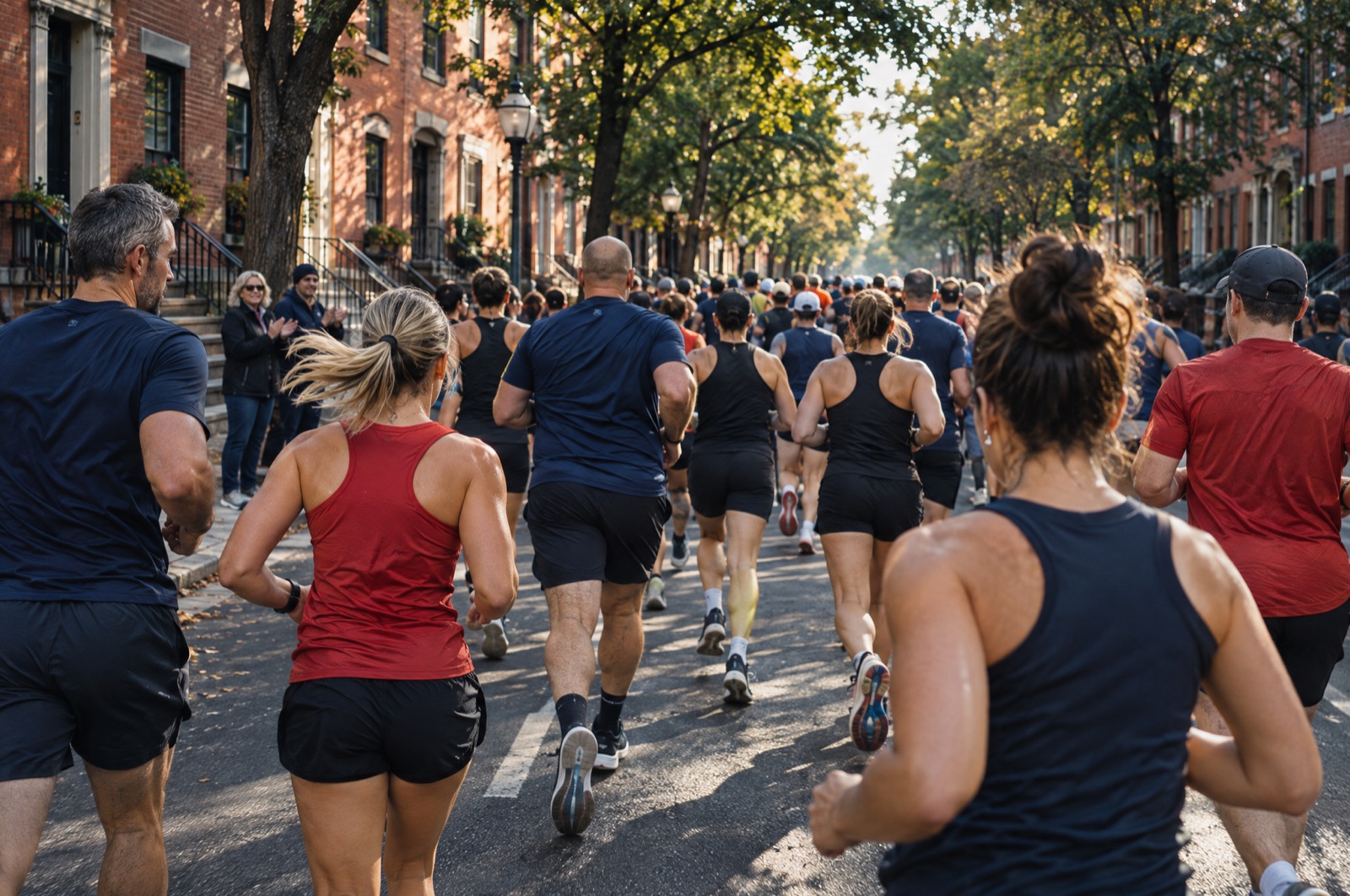
- To 10 km. 64 minutes pass. Your breathing is under control and a short conversation is possible. The biggest risk is a group running 20 seconds per km faster that feels comfortable to follow.
- Km 10–15. You start to feel your hips and calves. The muscles are tiring, but your breathing is still under control. You pass 15 km after about 1:36.
- Km 15–18 (miles 9–11). The typical breaking point. Your legs are now past the length of most of your training runs. A gel taken earlier and a shorter stride help.
- Km 18–21. About 20 minutes remain and walking is at its most tempting. Three kilometers at 7:00/km (11:16/mile) instead of 6:24 cost almost 2 minutes.
Even pace to 10 km is rarely enough
Even pace for 2:15 means 1:03:59 at 10 km and 1:42:59 at 10 miles. The Vienna numbers show why that plan often fails: runners around this level typically lose 8–13% of their speed late in the race.
A faster start does not repair the finish. It is the usual cause of the problem. A plan of "6:24 from start to finish" assumes a closing stretch that most people at this level do not have yet. What works is a reserve of fitness, not a reserve of minutes: if a recent 10K points to about 2:12, then 6:20–6:24/km feels controlled at halfway and still leaves something for the end. The preparation exists so that the last 10 km stop being a separate race.
What limits you is time on your feet
This goal corresponds to an estimated 2,150 m in the Cooper test, the result used for the ranges shown above the article. Your cardiovascular system adapts faster than tendons and bones, though, so at 2:15 minutes per week matter more than speed.
The closest reference is a 2023 study of 134 men. The group with times of 118–160 minutes (average 2:09:42) trained 3.6 days a week and ran 39.4 km (24.5 miles) a week, with a VO2max (maximal oxygen uptake) of 41.3 and a BMI of 27.1. The 73–92 minute group had 54.5 and 23.3. From the equation in that paper, 1 BMI point translates to 2.5 minutes and 10 km a week to 1.9 minutes. These are averages for men aged about 44, so do not read them as a forecast. They show a direction: body weight and consistency can give you more than hard sessions.
Plan the long run in minutes
The reference from the main half marathon page for a first finish is a peak of 35–45 km (22–28 miles) a week, at least 3 running days and 12–16 weeks of preparation. A 12-week block makes sense if you already run 25–40 km (16–25 miles) a week comfortably. Running less than that? Start with half marathon training from zero. Only have three days? See what changes on 3 runs a week.
A longest run of 20–22 km (12.4–13.7 miles) at 7:00–7:45/km (11:16–12:28/mile) takes 2:20–2:50, which is longer than the race itself. So fit the longest outing to how you handled the previous ones, and count its length in time. The most useful version is a long run that finishes at race pace or slightly slower, on tired legs. It trains exactly the part that falls apart in the table above.
Minutes have a second advantage: they survive the weather. If your race is in early spring, the longest runs land in midwinter, and on an icy sidewalk nobody should be chasing kilometers. If it is in autumn, they land in late-summer heat, where chasing pace is the mistake.
If you run 25–30 km a week comfortably, you are 10–15 km short of the 35–45 km peak, spread over the whole block. The long run gets them first, but watch the proportions. With 20 km in the long run and 36 km in the week, that is 56% of the volume. The other runs are there to give you easy time on your feet and nothing more.
Does walking ruin a 2:15?
A minute of walking every 5 km, at about 10:00/km (16:06/mile), costs very little. To keep the 6:24/km average you then run about 6:20/km (10:12/mile), only 4 seconds faster. Walking through an aid station is a good trade if it lets you drink and eat calmly and the final part stays a run. The bad trade is walking the last 5 km, because there the pace drops by minutes.
Gels: this is where they first matter

A 2014 review of the research points to about 2 hours as the moment from which carbohydrate during a run starts to make a real difference. From a single source the body oxidizes up to about 60 g per hour, and the 2016 ACSM position stand gives 30–60 g for efforts of 1–2.5 hours. The same review notes that doses should come down at low intensity. At 6:24/km you do not need to aim for 60 g.
Two or three gels rehearsed on long runs are usually enough. A gel holds about 20–30 g of carbohydrate, so that is roughly 20–40 g per hour. Take the first one after about 45 minutes, before you feel a dip. Check what the race hands out and where, and carry your own if it is not the product you trained with. The same pace in a marathon has to be held twice as long, which is covered on the sub-4:30 marathon page.
Your real start time matters too. In big races the slower groups set off well after the gun. At Copenhagen the race starts at 9:30 am, but the over-2:15 group is called to its start area for 10:15, so the finish comes after midday. An early breakfast will not last that long, so plan a small meal closer to your own start. The ACSM gives 1–4 g of carbohydrate per kilogram of body weight 1–4 hours before exercise.
Midday sun changes the pace as well. Marathon data from seven North American races show that slower runners lose more in the heat than the front of the field, and a late wave runs in the warmest part of the day. Above 15°C (59°F) and in sunshine, the reference is 6:35–6:40/km (10:36–10:44/mile), or 2:19–2:21. That result without a collapse after 15 km beats a 2:15 plan that ends in 2:25.
Cut-offs, waves and pacers
At 2:15 you are well inside every limit listed here. A 3-hour limit is 8:32/km (13:44/mile). What differs between races is how the limit is measured, and that is worth reading before you enter. These are the rules of recent editions, checked in November 2026.
| Race | Time limit | How it works |
|---|---|---|
| Copenhagen | 3:00 | Net time, counted from crossing the start line |
| Berlin | 3:15 | Counted from crossing the start line, plus a cut-off point at km 18 at a fixed time of day |
| Singapore | 3:45 | Start at 4:30 am |
| Great Run events, UK | none stated | A sweep vehicle at 17:00/mile (10:34/km); slower runners finish on the sidewalk |
Two details catch people out. A cut-off at a fixed time of day, like Berlin's at km 18, or a limit counted from the gun, is tighter for someone who crosses the start line 30 or 40 minutes after the first wave. And your result is your net time, so the clock above the finish will show a number that has nothing to do with you. Trust your watch.
2:15 is also a common boundary. Copenhagen's start groups split at exactly 2:15, with pace teams at 2:15 and 2:20. Berlin lists a 2:15 pacer. Mumbai seeds its waves from a previous result, with one band ending at 2:15:00. Declare an honest time: in a group that is too fast, everyone passes you for the first few kilometers, and that is how a 6:10 opening kilometer happens.
Where 2:15 sits in a big race
The results of one race describe only its own field, but the Vienna study lets you place this time in a big city race. These are the average finish times of each quarter of the field, converted by us from the published speeds.
| Quarter of the field | Men, average time | Women, average time |
|---|---|---|
| Fastest | about 1:37 | about 1:51 |
| Second | about 1:52 | about 2:06 |
| Third | about 2:03 | about 2:17 |
| Slowest | about 2:23 | about 2:36 |
A woman who runs 2:15 finishes close to the middle of the women's field, slightly ahead of the third quarter's average. A man with the same time is in the slower half of the men's field, but ahead of the slowest quarter's average. In a smaller race with many club runners, the same time can place further back.
Three checks before you enter
- A 5K in about 29:20 or a 10K in about 1:01 at a sensible effort. This is an estimate from the Riegel formula, which you will find in the pace calculator.
- A Cooper test of about 2,150 m.
- A recent long run of 90–120 minutes finished without pain and with something left for the next day.
Is your 10K better than that? Look at the sub-2 hour half marathon. An IMI coach sets your paces after a Cooper test or a 5K and changes the plan every week, so after an illness you do not go straight back to the pace you ran before the break.
A 2:00 half marathon is 43 seconds per kilometer faster (69 seconds per mile) and a different problem. Here you are limited by minutes on your feet. There you have to hold 5:41/km after km 15.
Frequently asked questions
Is 2:15 a good time for a first half marathon?
Yes, it is a sensible goal for a debut. In the Vienna half marathon a woman with that time finished close to the middle of the women's field, and a man in the slower half of the men's field. In a first race, what counts most is reaching the finish without pain and without fading after 10 km.
What pace is a 2:15 half marathon?
6:24/km or 10:18/mile. At even pace you pass 5 km in 32:00, 10 km in 1:03:59 and 10 miles in 1:42:59.
How many miles a week should I run for a 2:15 half marathon?
A peak of 35–45 km (22–28 miles) a week on at least 3 running days is the usual reference for a first finish at this pace. If you already run 25–40 km (16–25 miles) comfortably, 12 weeks are enough to get there.
What happens if I start a 2:15 half marathon too fast?
You pay after km 15. A start around 6:10–6:20/km on good fitness is one thing. A few kilometers at 5:30/km (8:51/mile) are something else entirely. If you cannot say a short sentence at 5 km, slow down.
Can a training long run last longer than the half marathon itself?
Yes. The race takes 2:15, and 20 km at 7:00–7:45/km takes 2:20–2:35. That is why the total minutes in the week matter more than one longest outing.
Does chip time or gun time count in a half marathon?
For your result, almost always chip (net) time, from the moment you cross the start line. Cut-offs are different: some races count them from the gun or set them at a fixed time of day, so check the rules if you start in a late wave.
Can I run-walk a 2:15 half marathon?
Yes. A one-minute walk every 5 km costs only about 4 seconds per kilometer of running pace. What costs minutes is unplanned walking in the last 5 km, so plan the walks early and keep the end for running.