Contents
- Why one distance has so many names
- How long a half Ironman takes for age-group athletes
- What the effort looks like hour by hour
- What decides the result
- Half and full distance in one table
- Intensity: the bike at 72–80% of FTP and what that means
- Nutrition: the first distance where it is a discipline of its own
- Heat: what the tables do not show
- Why people do not finish
- The week in numbers
- Equipment and rules
- What it costs
- Where to race a half: series, seasons and continents
- How to set up your preparation
- Frequently asked questions
Choose your goal
Triathlon time calculator
- Start0:00
- Swim:/100 m
- T1swim to bike:
- Bikekm/h
- T2bike to run:
- Run:/km
- Finish
Cut-offs depend on the race. Check the rules of your event.
Where you gain the most
Time arithmetic only. A harder bike leg can cost you more on the run.
Why one distance has so many names
The same race goes by several names. Some are plain descriptions and some are brands. The triathlon distances page sets them side by side.
- Half Ironman, half iron, half distance are the everyday names. They describe the proportion to the full distance.
- 70.3 is the total length in miles, about 113 km. IRONMAN 70.3 is a trademark and applies only to that organizer's races.
- Middle distance is the World Triathlon term, and the one many independent organizers use for a race of 1.9, 90 and 21.1 km.
| Segment | Distance | Reference time | Pace | Share of time |
|---|---|---|---|---|
| Swim | 1.9 km (1.2 miles) | 42:45 | 2:15/100 m | 12% |
| Bike | 90 km (56 miles) | 3:00:00 | 30 km/h (18.6 mph) | 50% |
| Run | 21.1 km (13.1 miles) | 2:06:36 | 6:00/km (9:39/mile) | 35% |
| Transitions | T1 + T2 | 10:00 | not applicable | 3% |
| Total | 113 km (70.3 miles) | 5:59:21 | not applicable | 100% |
This table is not a statistic. It is the reference day of this page: an age-group athlete who finishes in about six hours at an even 2:15/100 m, 30 km/h and 6:00/km, with 10 minutes for both transitions (T1 after the swim, T2 after the bike). Every calculation below starts from it.
How long a half Ironman takes for age-group athletes
With ordinary age-group paces, about six hours, and anything from under five to over seven and a half depending on level. No federation publishes official average times for the distance: organizers publish the results of each race, not world averages. The table is arithmetic at even pace, with no wind or hills.
| Swim | Bike | Run | Transitions | Finish |
|---|---|---|---|---|
| 1:45/100 m | 35 km/h (21.7 mph) | 4:50/km (7:47/mile) | 6 min | 4:55:31 |
| 2:15/100 m | 30 km/h (18.6 mph) | 6:00/km (9:39/mile) | 10 min | 5:59:21 |
| 2:45/100 m | 27 km/h (16.8 mph) | 6:45/km (10:52/mile) | 12 min | 6:46:40 |
| 3:10/100 m | 24.5 km/h (15.2 mph) | 7:30/km (12:04/mile) | 14 min | 7:32:49 |
Even the last row reaches the finish almost an hour inside the usual 8:30 limit of IRONMAN 70.3 races. Slower athletes are rarely caught by the finish limit, more often by the bike cut-off, as you will see further down. You can enter your own paces in the triathlon time calculator.
Performance starts to decline earlier than most people think, but not in every discipline at once. An analysis of 840,100 finishes at 690 IRONMAN 70.3 races from 2004 to 2018 placed the start of the decline in overall time at about 32 for men and 31 for women. It began earlier in the swim, at 26 and 28 in the run, and not until 34 and 35 on the bike.
In another sample, 823,459 finishes at 787 races from 2004 to 2020, women were 24% of finishers. Men were faster in every age group, and the gap between the sexes narrowed after 50.
A caveat: these studies describe people who reached the finish line. DNFs (Did Not Finish) are not in them. Course, weather and the make-up of the field also matter so much that the sensible thing is to compare your result with the rest of the field on the same day.
What the effort looks like hour by hour
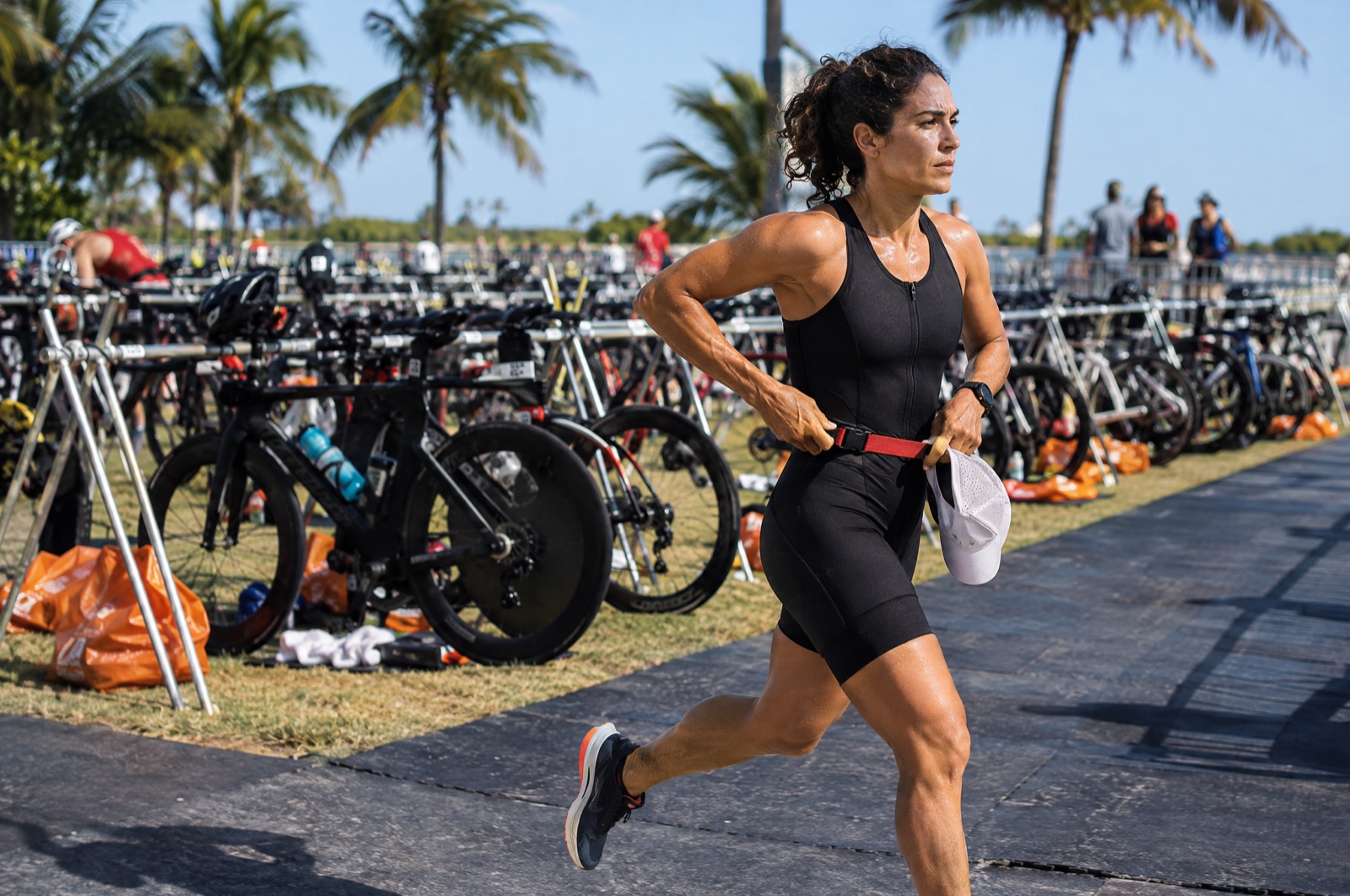
This is the day of someone who finishes in about six hours at the reference paces. The carbohydrate column is a running total at the lower end of the range, 70 g/h on the bike and 60 g/h on the run.
| Time from start | Where you are | What you feel | What matters | Carbs eaten |
|---|---|---|---|---|
| 0:00–0:43 | Swim | Heart rate higher than it should be, a crowd for the first 300 m | Breathing and a straight line, not pace | 0 g |
| 0:43–0:48 | T1 | A moment of dizziness after leaving the water | Calm, the order of actions | 0 g |
| 0:48–1:48 | Bike, hour 1 | The power feels ridiculously easy | Staying in range, first food after 10–15 minutes | about 70 g |
| 1:48–2:48 | Bike, hour 2 | The best part of the day, the temptation to push grows | Eating every 15–20 minutes | about 140 g |
| 2:48–3:48 | Bike, hour 3 | Neck and saddle pain, the food starts to bore you | Position, caffeine if you have practiced it | about 210 g |
| 3:48–3:53 | T2 and the first meters of the run | Legs that do not feel like yours, a pace that seems too slow and is often too fast | The watch, not the feeling | about 210 g |
| 3:53–4:53 | Run, 0–10 km | Sustainable, first signals from the stomach | Using every aid station | about 270 g |
| 4:53–5:59 | Run, 10–21 km | This is where the day is decided, heart rate climbs at the same pace | A short stride, keeping the food going, cooling | about 335 g |
In a half, the hardest decision is made when everything is still easy. The second hour on the bike feels best, and its cost only shows at kilometer 14 of the run. In a shorter race you feel a pacing mistake and can wait it out. Here it stays with you for an hour or two.
What decides the result
The study of 823,459 finishes at 787 races mentioned above also compared the segments. Run time correlated with the final result at 0.89–0.90 and bike time at 0.86–0.87. The swim came out clearly weaker, and its link with the result fell with age. When all the segments were put together, though, their contributions did not differ significantly, so no single discipline wins the race on its own.
In practice run time also depends on the bike. If you ride the 90 km too hard or eat too little, you will see it in your run split. The highest correlation for the run does not mean everything is decided on the run, because the cause often lies earlier.
The swim is 12% of the reference time, and it still has a price. The difference between 2:00 and 2:30/100 m is about 9.5 minutes, as much as a run that is 27 s/km slower. Leaving the water with a very high heart rate also spoils the start of the bike.
What each improvement is worth
Arithmetic for the reference paces: 2:15/100 m, 30 km/h, 6:00/km.
| Improvement | Gain at the finish |
|---|---|
| 10 s/100 m in the water | 3:10 |
| 1 km/h on the bike (from 30 to 31 km/h) | 5:48 |
| 10 s/km on the run | 3:31 |
| 1 minute in transitions | 1:00 |
The faster ride looks best here, but 1 km/h more takes about 10% more power on the flat, and the gain disappears once the run slows by 16–17 s/km. That is not much: going from 6:00 to 6:17/km (9:39 to 10:07 per mile) is enough.
Half and full distance in one table
The full distance is more than two halves. The kilometers double, but intensity, food and training each change in their own way.
| What we compare | Half Ironman | Ironman |
|---|---|---|
| Distance | 1.9 km, 90 km and 21.1 km | 3.8 km, 180 km and 42.2 km |
| Usual overall limit at IRONMAN races | 8:30 | 17:00 |
| Serious gut symptoms | 14% | about 31% |
| Bike, reference point | 72–80% of FTP | IF about 0.60–0.75 |
| Carbohydrate on the bike | 70–90 g/h | 80–100 g/h |
| Week, on average | 7–12 h | 10–18 h |
| Training block | 16–24 weeks | 24–36 weeks |
At double the distance the bike is ridden more gently, and the marathon still starts after seven or eight hours of effort, not three or four. The bill for the extra length arrives at the end of the day: on the run and in the stomach, where serious symptoms are more than twice as common. The longer race has its own page: the Ironman training plan.
Intensity: the bike at 72–80% of FTP and what that means
FTP (Functional Threshold Power) is an estimate of the power you can hold for about an hour. The reference point for the bike in a half is 72–80% of FTP. That corresponds to an IF (Intensity Factor, normalized power divided by FTP) of 0.72–0.80.
| FTP | 72% of FTP | 80% of FTP | Power at 65 kg (143 lb) |
|---|---|---|---|
| 180 W | 130 W | 144 W | 2.0–2.2 W/kg |
| 220 W | 158 W | 176 W | 2.4–2.7 W/kg |
| 260 W | 187 W | 208 W | 2.9–3.2 W/kg |
| 300 W | 216 W | 240 W | 3.3–3.7 W/kg |
The top of the range is not a target for a first race. Riding above 80% makes sense only if you are racing for the front of your age group and know from earlier races that you can still run afterward.
Where should you sit within 72–80%? Ride time decides. FTP is an effort of about an hour, and the bike in a half lasts 2.5–3.5 hours. Someone who rides 2:30 can aim for 78–80%. Someone who rides 3:15 is wiser to start at 72–74%.
Even riding counts too
VI (Variability Index) is the ratio of normalized power to average power. The closer to 1.00, the more even the ride. In triathlon, keep VI at 1.05 or below. On a flat course an age-group athlete should hold 1–2% more power in the second half than in the first. It is a good test of discipline: if your power drops after 45 km, the first half was too hard.
If you do not have a power meter
You can ride by heart rate and feel. The upper limit is an effort at which you can comfortably speak in full sentences. In heat, heart rate rises at the same power, so the same heart rate then means a slower ride than on a cool day.
The run off the bike
The first kilometers off the bike lie. In a study of 13 women, after 45 minutes of riding at about 70% of VO2max, running economy got worse at every speed, most of all in the least experienced athletes. In some moderately trained triathletes running mechanics change, while in elite athletes economy stays the same. Only regular practice of running off the bike improves it. That session is called a brick, because that is how heavy your legs feel when you get off the bike.
A sensible order on race day: the first 3 km a little slower than target pace, then hold, and the last 5 km are everything you have left. If your run is around 2:10, a short walk through each aid station costs little and lets you drink and eat calmly.
Nutrition: the first distance where it is a discipline of its own
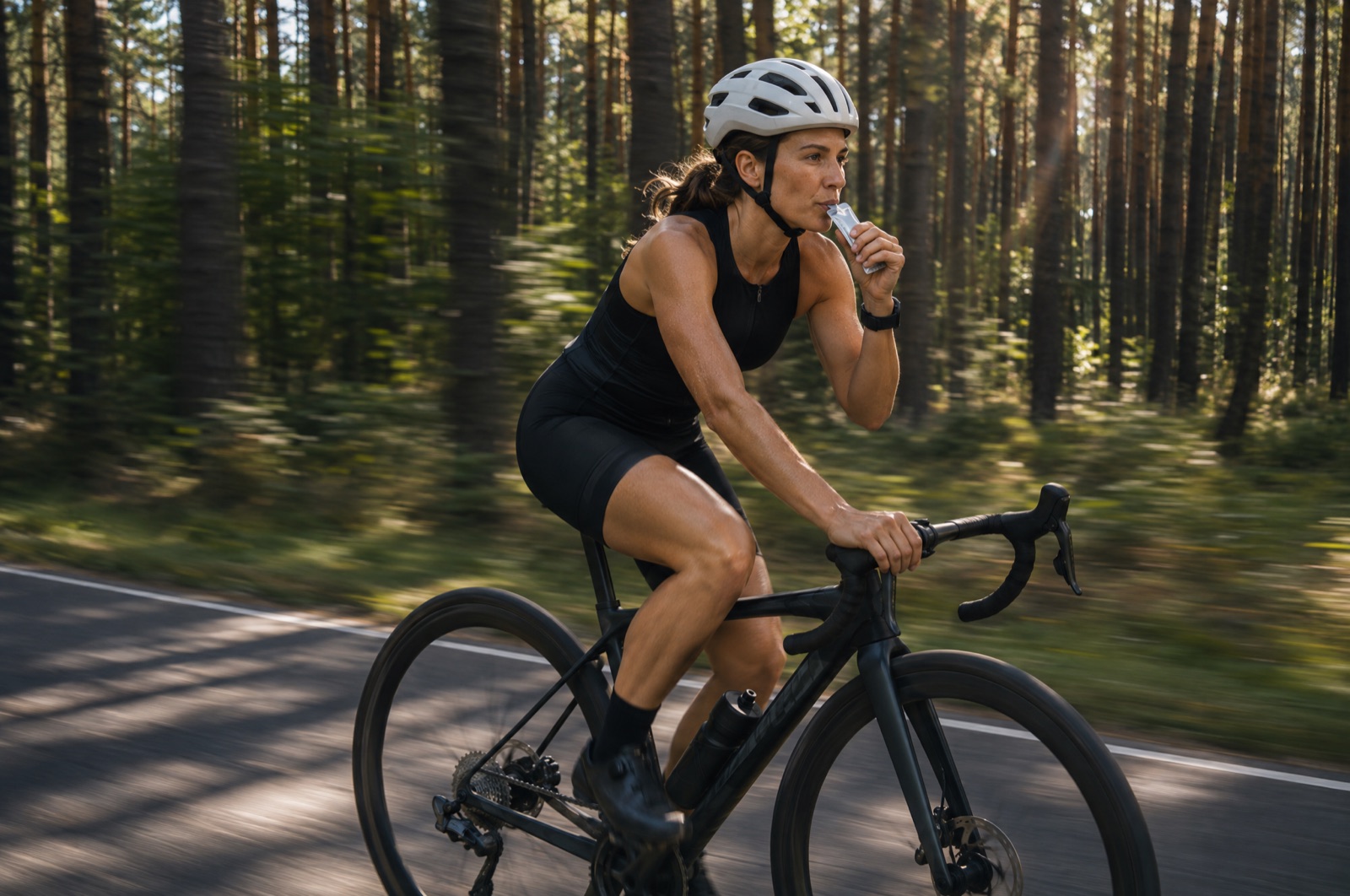
The reference point is 70–90 g of carbohydrate per hour on the bike and 60–80 g on the run. At the reference times that is about 335–440 g over the whole race, or 13–18 gels of 25 g or the equivalent in drinks. In energy terms that is about 1,350–1,750 kcal.
What the research says
- The upper limit of absorption. The gut absorbs glucose alone at up to about 60 g/h. A glucose and fructose mix uses a second transporter, which is why the guideline for efforts longer than 2.5 hours is about 90 g/h from a mix. At lower intensity oxidation falls, so lower the dose.
- What age-group athletes really eat. In a study of 221 athletes, average intake in long triathlons was 62–71 g/h. So 70–90 g/h is a target that takes preparation, not the average.
- Is it worth going to 120 g/h? In very well-trained cyclists, 120 and 90 g/h were compared. Oxidation of the ingested carbohydrate rose, but use of the body's own glycogen stayed the same. A benefit for an age-group athlete in a half has not been shown, and the gut risk rises.
The gut: one in seven has serious symptoms
In the same study, serious gastrointestinal complaints were reported by 14% of starters at 70.3 races and about 31% at the full distance. Carbohydrate intake was similar, so the difference came from the length of the effort more than from the dose. In the marathon and in cycling it was about 4%. Symptoms were linked mainly to a previous history of gut problems, and a study of a 70.3 race in 2016 found the same.
The good news: the gut can be trained. Two weeks of regular carbohydrate intake during running cut symptoms by about 60% in 25 runners, with less carbohydrate malabsorbed. A 2023 systematic review confirms the direction, but studies are few and one of them found no change. Treat it as a strong pointer, not a certainty.
What follows in practice:
- Getting to 70–90 g/h takes weeks. Raise the dose gradually on long rides, starting from what you tolerate today.
- The run tolerates less than the bike, because the stomach is shaken. Hence the lower range.
- Practice with exactly what you will use on race day, including the drink from the aid stations or your own supply.
- Practice at race power. Eating 80 g/h on an easy ride does not prove you can eat it at 78% of FTP.
Sodium: less certainty than the labels suggest
Sweat contains sodium, but its concentration varies widely between people. In trained athletes the averages were 30–49 mmol/l depending on intensity, about 700–1,100 mg per liter. At one liter of sweat per hour, that is what you lose in an hour.
Do you have to replace all of it? A model from Monash University indicates that less than half of the losses is enough, unless you sweat at least 1.5 l/h, your sweat has at least 40 mmol/l of sodium and you replace more than 90% of your fluid. At 1 l/h and 40 mmol/l that comes to less than about 460 mg of sodium per hour.
On the other hand, in a randomized study of 26 triathletes in a half, the group taking salt capsules (113 mmol of sodium, about 2.6 g for the whole race) finished faster and had higher blood sodium afterward. It is one small trial, and strength and jump height after the race fell equally in both groups. A 2015 consensus gives 20–70 mEq/l of sodium in sweat and, for efforts longer than an hour, recommends a drink with 0.5–0.7 g of sodium per liter. There is no single dose for everyone, because we sweat differently. Start with a few hundred milligrams per hour and adjust it in hot training sessions.
Drinking
The 2015 medical consensus recommends drinking to thirst, because the main cause of dangerous hyponatremia (too little sodium in the blood) is too much fluid. In a half the problem is rarer than at the full distance, but do not force yourself to drink beyond thirst.
Caffeine
The effective dose is 3–6 mg per kg of body weight, according to the position stand of the International Society of Sports Nutrition. For a 70 kg (154 lb) athlete that is 210–420 mg. Intake about 60 minutes before exercise has been studied most, which is why in a half caffeine usually goes into the last hour of the bike. Responses are individual: anxiety and sleep problems can appear, and very high doses bring side effects more often. Test it in training.
Heat: what the tables do not show
With a morning start, the run usually falls in the hottest part of the day, in a temperate summer as much as in the tropics. In a half in tropical Guadeloupe, athletes lost an average of 3.7 kg (8.2 lb) of body mass, or 4.8%.
In 2026 heat changed the race itself. At the end of June the authorities of the Alpes-Maritimes department canceled both races in Nice, the full-distance IRONMAN and the IRONMAN 70.3, because of a heat wave. The decision came on the Friday, two days before the start, with about 4,500 athletes entered. So check the refund and deferral rules before you enter and keep a backup race in the season in mind.
What you can do:
- Acclimation. The minimum is 6–7 heat exposures, ideally on consecutive days. Most protocols last 8–14 days. Start earlier than two weeks before the race, before the taper, which is the reduction of load before race day.
- How long. Sessions should last at least 60 minutes. The main changes appear after about a week, and two weeks give the full benefit.
- Passive methods. A sauna at about 80°C (176°F) or more, or a bath in water of about 40°C (104°F), for at least 30 minutes, usually right after training. It is a load on the circulation, so build up to that duration gradually. With high blood pressure, heart disease or in pregnancy, talk to a doctor first.
- Losing acclimation. The range is wide: from losing one day of acclimation for every two days without heat to keeping most of the benefit for 2–4 weeks, because studies measure it with different protocols. It is safer to finish acclimation close to race day.
- The first heat of the year. In two triathlons in Melbourne with a similar level of heat stress, the first, held on an unusually hot day at the start of summer, had 15 cases of heat illness, including 3 of heat stroke. The second, two months later, had none. An early-season heat wave anywhere is the same scenario.
- Pacing. In heat, lower your power range and your run pace. If heart rate climbs clearly at constant power, your body is cooling itself at the expense of muscle work.
- Cooling. Ice under your suit and water over your head at aid stations work from the first kilometers of the run, not only once the crisis starts.
Symptoms such as confusion, sweating that stops, dizziness or nausea mean leaving the course and getting medical help. No result is worth it.
Why people do not finish
Organizers record where someone dropped out but not why, so there is no ranking of causes. The mechanisms are known, though.
- The swim cut-off. It mainly catches people who train in a pool and race in open water. Waves, sighting and panic in the crowd make them swim longer.
- The bike cut-off. It is cumulative with the swim and T1. A flat tire plus a strong wind can use up the whole margin.
- Mechanicals. A puncture is a small thing only if you can fix it.
- The stomach. One in seven reports serious symptoms. Not all of them leave the course, but vomiting or diarrhea can turn the run into a walk.
- A bike ridden too hard. On the run the stomach stops accepting food and heart rate climbs while pace drops.
- An injury brought to the start line. Pain that was there in training comes back at kilometer 12.
| Limit | IRONMAN 70.3, typical | Challenge St. Pölten, Austria | Outlaw Nottingham Half, England | Edisto Island Triathlon, USA |
|---|---|---|---|---|
| Swim | 1:10 (3:41/100 m) | 1:10, plus up to 5 min of transition | 1:20 including T1 | 1:20 |
| Swim and bike | 5:30 | 5:30 | 5:20 | 5:00 |
| Overall | 8:30 | 8:30 | 9:00 | 8:00 |
As of November 2026. Limits change between editions and are counted differently: from your own start, from your wave or from the last wave. Open the current athlete guide before you enter.
The overall limit is rarely the problem. Even at 3:10/100 m, 24.5 km/h and 7:30/km the calculation gives 7:33. The differences that matter are in the middle: a bike cut-off at 5:00 instead of 5:30 takes half an hour away from exactly the athletes who have none to spare. The calculations for a first race are on the first half Ironman page.
The week in numbers
Typical numbers for this distance are 7–12 hours a week on average, 10–14 at the peak and 5–7 in recovery weeks. Most people do well on an average of 9 hours if the hours are sensibly distributed.
| Phase | Weeks in a 24-week block | Goal | Characteristic element |
|---|---|---|---|
| Base | 1–6 | Volume in three sports, swim technique, strength | Consistency matters more than intensity |
| Build | 7–14 | Threshold and race pace | A regular brick, the long ride up to 3.5–4.5 h |
| Race-specific | 15–22 | Race power, the run off the bike, a fueling rehearsal | A long ride with segments at race power |
| Taper | 23–24 | Freshness without losing fitness | Volume at about 70%, then about 40% of normal |
In a 16-week block the phases shrink at the expense of the base, so that version makes sense for people who already have one. For a first race it is better to allow 20–24 weeks.
The checkpoint is the longest combined session: 3–4 hours on the bike and 60–90 minutes of running, 4–5 weeks before the race. You do not need to cover the whole distance in training. Recovering from such a rehearsal costs more than the rehearsal gives.
How to divide the time
On race day the bike is 50% of the time, the run 35% and the swim 12%. You do not divide training the same way. Swimming gains from frequency, not length, so three shorter sessions work better than one long one. Running loads muscles and joints the most, so its volume grows more slowly. The bike gives a lot of aerobic work with less load on the legs, which is why it usually gets the longest blocks.
Simple arithmetic: at 9 hours, a 3.5-hour long ride and a 1.5-hour long run take 5 hours. That leaves 4 hours for swimming and shorter sessions. At 7 hours only 2 hours are left, which is why the peak of a block on such a low average needs clearly longer weeks, and in lighter weeks the long sessions get shorter.
A half Ironman alongside a full-time job
A half can be combined with work without rearranging your whole life, provided the days of the week have fixed roles. At 9 hours, four short days of about 45–60 minutes give 3–4 hours, and the weekend takes the rest. Assign the key sessions to the days that go wrong least often. If Tuesday tends to be unpredictable, do not put your only hard bike session there. A long ride on Saturday, with preparation and a meal, takes most of the morning, not the whole day. At the full distance Saturday disappears completely.
Equipment and rules
- Bike. A well-fitted road bike is enough to finish, and clip-on aerobars, which support your forearms, are the cheapest aerodynamic gain. Check that the organizer allows them on your bike. A time-trial bike makes sense if you race several times a year.
- Wetsuit. IRONMAN's 2026 rules allow age-group athletes to wear one up to and including 24.5°C (76.1°F) and require it below 16°C (60.8°F). From 24.5 to 28.8°C you may still wear one, but you are then left out of the age-group rankings and world championship slots, and above that it is banned. Races under World Triathlon rules ban wetsuits from 24.6°C at this swim length, and most USA Triathlon races allow them up to 78°F (25.6°C). Warm lakes and warm seas can exceed all three lines, so build your confidence in the water without a wetsuit too.
- Drafting, riding on a wheel. At IRONMAN races age-group athletes must keep a 12 m zone and have 25 seconds to pass. Middle distance is draft-illegal for age-group athletes under World Triathlon rules as well.
- Rule changes in 2026. Since March 2026, containers on the top tube can be up to 10 cm (4 in) high at IRONMAN races, and a front zipper undone at the bottom or uncovered shoulders bring a warning, then a penalty of 30 or 60 seconds if not corrected.
The rules of your specific race take precedence.
What it costs
Entry fees are the most visible cost and the least comparable one. IRONMAN 70.3 races sell entries in price tiers, and the price rises as each tier sells out, so the same race costs the early entrant clearly less than the late one. Add a federation membership or a day license where the race requires one.
Equipment prices vary enormously, and the bike most of all. Its price says little about how fast you will ride in an uncomfortable position.
- Buy first: a bike fit, good tires, running shoes, a reserve for servicing.
- You can rent: a wetsuit for the first season, if that is possible where you live.
- You can postpone: a time-trial bike, carbon wheels, an aero helmet.
- Do not forget to add: pool entry, sports nutrition for training, and travel. For a race away from home, flights, bike transport and two or three nights of accommodation can cost more than the entry itself. At 70–90 g/h, every long ride is several gels.
Where to race a half: series, seasons and continents
There is a half-distance race somewhere in the world in almost every month. The table shows how the season runs in each region. Calendars change every year, so take it as a map and confirm the date on the race page.
| Region | When the season runs | What to know |
|---|---|---|
| United States and Canada | Spring to late autumn, roughly March to December | The longest season and the largest number of IRONMAN 70.3 races, plus many independent halves |
| Europe | Spring to early autumn | IRONMAN 70.3 and Challenge races alongside independents such as the Outlaw Nottingham Half. Cold water early, heat in midsummer |
| Middle East and South Asia | The cooler months | Races are scheduled around the heat, so the season is the northern winter |
| Southern Africa, Australia and New Zealand | Mostly the southern summer and the months either side of it | A mirrored calendar: high summer falls in January, so a northern athlete can race in what is winter at home |
| Latin America and Southeast Asia | Varies by country | In the tropics heat and humidity are a factor in every month |
The IRONMAN 70.3 World Championship changes host from year to year, and athletes qualify at 70.3 races during the season. Confirm dates before you enter. How entries, price tiers and refunds work is described in the guide on how to register for an Ironman, and who is who among the organizers on the triathlon organizations page.
Check that the race is still a half. The 100 km format of the T100 series is a 2 km swim, an 80 km bike and an 18 km run. After the Professional Triathletes Organisation took a majority stake in Challenge Family in February 2026, some Challenge races began moving to it: The Championship in Šamorín, for example, is listed at the 100 km distance for 2027. If you race one of those, scale the numbers on this page down.
How to set up your preparation
The plan itself is the easy part. The hard part is fitting three disciplines around work and correcting the weeks that did not go to plan. An illness in week 9 or a business trip at peak volume changes the layout of the weeks that follow. A fixed plan written months earlier cannot take that into account.
At IMI a real coach runs your plan in the app and updates it every week, starting from tests: the 12-minute Cooper test or a 5K run, FTP on the bike and a 200 m swim. Without a power meter the coach builds the bike plan on heart rate. Data flows in from Garmin or Apple Watch, so the coach works with your numbers and not with general ranges. You start with the athlete survey in the app.
If this is your first time at this distance, read about your first half Ironman. If you are considering a shorter step on the way, see the Olympic distance. If the half is a stage on the way to the full distance, see the Ironman training plan.
Frequently asked questions
How long does it take to train for a half Ironman?
Usually 16–24 weeks. The lower end suits people with a stable base in three sports, the upper end a first race at this distance.
How many hours a week do you need to train for a half Ironman?
On average 7–12, at the peak 10–14, and 5–7 in lighter weeks. Most people do well on an average of about 9 hours.
What is a good half Ironman time?
There is no official average. With ordinary age-group paces (2:15/100 m, 30 km/h and 6:00/km) the model gives about six hours, and the usual limit at 70.3 races is 8:30. The course alone can change the result by tens of minutes, so compare yourself with results from the same race.
How many carbs per hour should I take in a half Ironman?
The reference point is 70–90 g/h on the bike and 60–80 g/h on the run. Age-group athletes in studies ate 62–71 g/h on average. You reach the range after several weeks of gradually raising the dose in training.
Do I need a triathlon bike for a half Ironman?
No, you do not need one to finish. A well-fitted road bike with clip-on aerobars is enough. A time-trial bike makes sense when you race several times a year and care about the result.
What is the cut-off time for a half Ironman?
At IRONMAN 70.3 races, usually 1:10 for the swim, 5:30 for swim plus bike and 8:30 overall. Other organizers set their own limits, from about 8:00 to 9:00 overall in the examples on this page.
Do you need to run a half marathon in training?
No, the full distance in training is not necessary. The longest run usually comes close to it in time, and the main rehearsal is the combined session: 3–4 hours on the bike and 60–90 minutes of running.
When should I start tapering for a half Ironman?
Two weeks out. Volume first drops by about 30%, then by about 60%, and intensity stays in short doses.
Is a half Ironman the same as a 70.3?
The distance is the same: 1.9 km, 90 km and 21.1 km, 70.3 miles in total. IRONMAN 70.3 is the brand name of one organizer's races. Other organizers call the same race a half or middle distance, and their limits and rules can differ.