Contents
- Five things to know before you pay
- Choosing a race: region, season and course
- The full distance without the brand
- Registration step by step
- Prices and tiers: why waiting costs money
- What you get for the entry fee
- Withdrawal, transfer and deferral
- Licenses, memberships and medical forms by country
- Travel, accommodation and getting the bike there
- Qualifying for the world championships: Kona and 70.3
- All World Athlete (AWA)
- How it works at Challenge and Roth
- Six mistakes people make when registering
- Frequently asked questions
Five things to know before you pay
- The name is a brand, the distance is not. Only races licensed by The IRONMAN Group are called IRONMAN and 70.3. The same 3.8 km, 180 km and 42.2 km (140.6 miles) are offered by independent races, often for less money, but without a slot for the world championship in Kona.
- Popular races sell out early. Registration for the classics opens right after the previous edition, up to a year ahead. IRONMAN Copenhagen 2027, with more than 3,000 places, sold out in August 2026 within about an hour. The 2026 edition had taken under two days.
- The price rises as places are sold. Entry fees are tiered. Whoever pays first pays least, and the cheapest tier can disappear in one evening.
- You get little back if you withdraw. Partial refunds, transfers and deferrals exist, but they depend on the region, the edition and the day you signed up. Read the policy before you pay, not after.
- The full-distance world championship is in Kona again. From 2023 to 2025 it was split between Kona and Nice. Since 2026 women and men have raced on one day in Hawaii.
Choosing a race: region, season and course
The series has several dozen full-distance IRONMAN races a year and far more 70.3 events. Europe and North America have the densest calendars, but every inhabited continent has at least one full-distance race.
| Region | Examples, with the month of the 2027 race where it has been announced |
|---|---|
| Europe | Lanzarote (May), Hamburg, Klagenfurt and Frankfurt (June), Thun and Vitoria-Gasteiz (July), Tallinn, Kalmar, Copenhagen and Vichy (August), Nice, Emilia-Romagna and Wales (September), Calella-Barcelona and Cascais (October) |
| North America | Texas (April), Jacksonville (May), Lake Placid (July), Ottawa (August), Wisconsin, Maryland and Chattanooga (September), California (October), Florida (November), plus the world championship in Kona (October) |
| Asia and the Middle East | Races in Taiwan, Vietnam, the Philippines, Japan and Malaysia, and from December 2026 Muscat in Oman |
| Oceania | Taupō in New Zealand (March), and in Australia Cairns, Port Macquarie and Busselton in Western Australia |
| Latin America | Brazil, Cozumel in Mexico and Valdivia in Chile |
| Africa | South Africa |
The list is as of November 2026. Races, dates and venues change every season. Confirm the date on the official page of the race before you book anything.
How to choose
- Count back from the race to your training season. The longest weeks fall two to three months before the race. A June race in Europe or North America means long rides in early spring. A race in March in New Zealand or in December in Western Australia suits athletes who train through the southern summer, and asks a northern athlete to do the biggest block in the dark months, largely indoors.
- Check heat and humidity as well as cold. Langkawi, Cozumel and Da Nang are hot and humid races. A June date in central Europe does not guarantee cool weather either: IRONMAN Frankfurt was shortened in 2026 because of heat. Lanzarote and Wales have a reputation for wind and climbing.
- Look at the cut-off. The usual limit is 17 hours, but some races give less. If you expect to need the last hour, check your paces in the time calculator and read the cut-offs of all formats on the page about triathlon distances.
- Price the whole trip. A race you can drive to with the bike in the car can cost far less in total than one that needs flights, a bike box and a week of accommodation.
- Do a 70.3 first. It uses the same registration system, the same rules and the same race-week routine at half the distance. If you have not raced at all, start with a local sprint and the page for beginners.
You must be 18 on race day for both IRONMAN and 70.3. Relays, where three people share one race, are offered at many 70.3 events and are a good way to see a big race from the inside.
The full distance without the brand

If your goal is the distance and not the logo, the choice is wider. Independent organizers on several continents offer the same 226 km under names like "full distance", "long distance" or "iron-distance". They cannot use the IRONMAN name and they give no slot for Kona, but the finish line is just as far away.
| IRONMAN-branded race | Independent full-distance race | |
|---|---|---|
| Name on the medal | IRONMAN | The race's own name |
| Kona qualification | Yes, through slots | No |
| Entry fee | In Europe about 780–880 euros for 2027 at the first tier still open in November 2026 | Often lower, but the most famous races charge about the same |
| Cut-off | Usually 17 hours, less at some races | Set by the organizer. Check it, because it can be shorter than 17 hours |
| Refunds and transfers | Regional brand policy | The organizer's own terms, sometimes more flexible, sometimes none at all |
| License | The host country's rules apply | The host country's rules apply if the race is sanctioned |
Three examples show the range. Challenge Roth in Germany is the best-known full distance outside the IRONMAN system, and its online registration for 2027 closed in under 20 seconds. The Outlaw in England is a long-running independent full distance with its own entry system and cut-offs. Norseman in Norway is an extreme race entered by ballot, with 334 start slots for 2027. Between these sit many smaller races where you can still enter a few months ahead.
What to compare before you choose: the cut-off, the refund terms, whether the course is closed to traffic, the number of aid stations and the size of the field. A small race with 300 starters is a different day from a brand race with 3,000. The numbers behind a full-distance day are worked through on the page about your first Ironman.
Registration step by step
- Choose the race and the date. Check the distance, the cut-off and the entry requirements.
- Read the rules and the withdrawal policy before you pay. These are the documents you will rely on later. Save a copy of both, because the page can change.
- Create an account on the registration platform. In many regions registration runs on ACTIVE, the brand's partner since 2013, and in some countries a local operator uses its own system. Always enter from the official race page, never from an advertisement or a link in a group chat.
- Enter your details exactly as in your ID. Your date of birth decides your age group, and the match between your name and your ID decides whether you can collect your race pack. The age group is based on your age on December 31 of the race year. Use the same name, date of birth and email for every race, so that your results end up in one athlete profile.
- Pay when you register. A place is yours only when the payment has gone through. If the fee is in a foreign currency, your card or the payment operator sets the exchange rate on the day.
- Check the confirmation. You should have an email from the platform, a payment receipt and a registered status in your account.
- Sort out the license. Depending on the country you add a one-day license in the form, buy it later in your profile or show your federation membership at check-in.
- Put the deadlines in your calendar. The last day of each refund tier and the last day for a transfer are the days after which you lose money.
- Read the athlete guide. It is published before the race and contains the cut-offs, check-in hours and transition rules. Athlete check-in and bike check-in usually close the day before the race, and some races give each check-in hour a limited number of places.
- Bring photo ID. It is required when you collect your race pack at check-in.
How far ahead to register
The registration calendar and the training calendar are two different things. The classics sell places up to a year before the race, so you pay long before the first workout aimed at that distance. Before you pay, answer two questions: do you have enough time to prepare from today to race day, and will you know before the last refund deadline whether you will be ready.
Allow 16–24 weeks for a half and 24–36 weeks for a full distance, counted from a level at which the plan proper can start safely. For a 70.3 at the end of August, preparation therefore begins between mid-March and early May. For a full distance in early September it begins between late December and the second half of March. In the European policy we read, the last partial refund deadline fell about six weeks before the race, which is when your form is already visible. More about choosing a distance and preparation time is in the overview of training plans, and about a debut at the half on the page your first half Ironman.
Prices and tiers: why waiting costs money
IRONMAN price tiers depend mostly on the number of entries, not on the date. At one European 70.3 in 2026 the first 300 places cost 310 euros and the last 500 cost 400 euros. The order of payment decides the price, so a cheap tier can be gone in an evening. A difference of 90 euros matters less than the bigger cost of waiting: losing the place.
| Race | Entry fee | How it rises |
|---|---|---|
| Full IRONMAN in Europe, 2027, first tier open in November 2026 | 778–880 euros | Number of places sold |
| Challenge Roth, 2027, late entry draw | 779 euros, relay 879 euros | Fixed price after winning the draw |
Prices are the first available tier, without service fees, as we found them in early November 2026. The price shown on the official page today can be higher. We list European races because those are the prices we could check. Races in other regions follow the same tier logic in their own currency, so look at the registration page of your race for the current tier.
On top of the entry fee come processing fees. ACTIVE describes its fee as payment for software and services, and when you transfer an entry you usually do not get it back. The one-day license, where required, is a separate line on the bill.
What you get for the entry fee
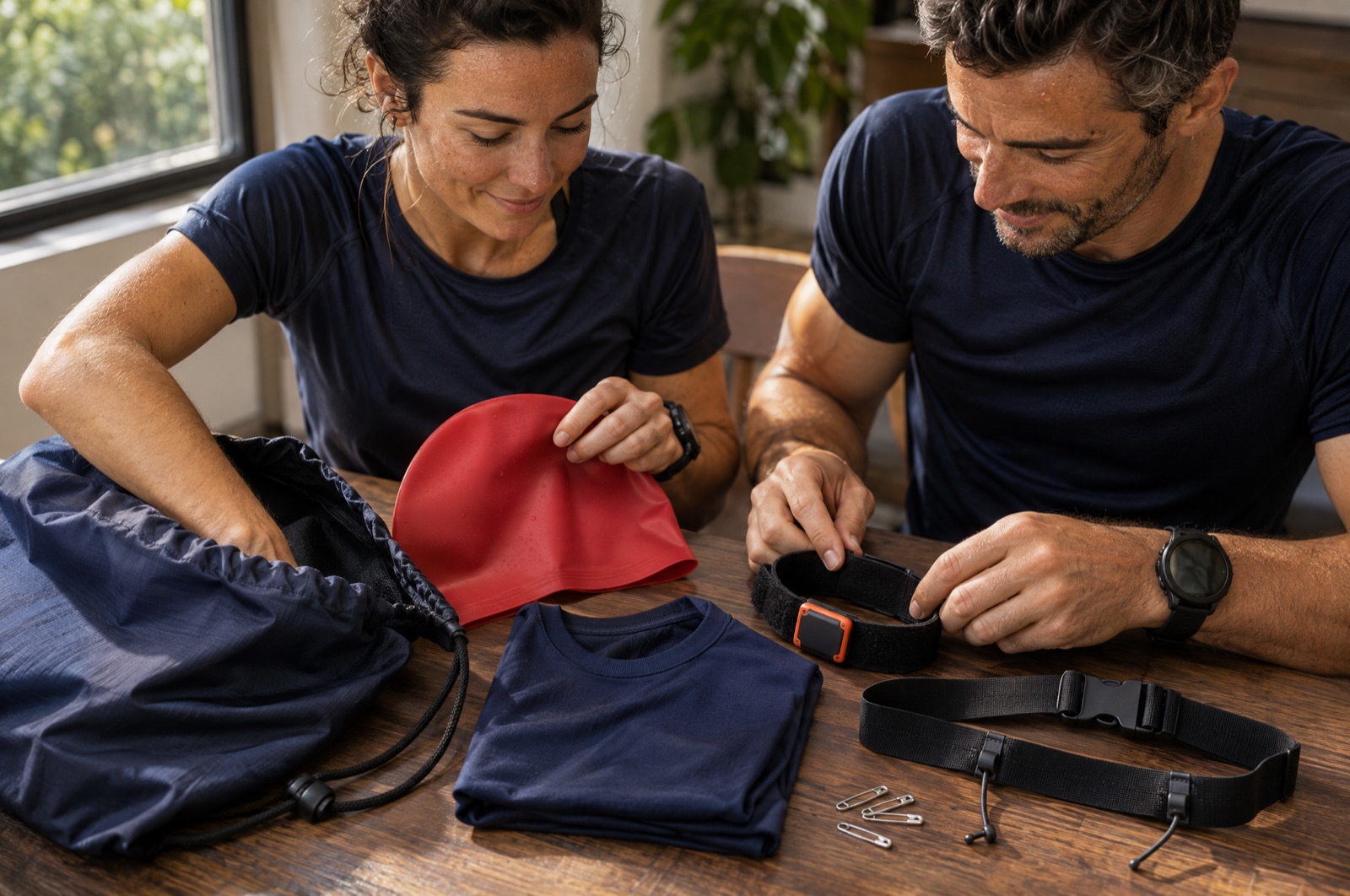
"Race pack" has no single definition, but at a brand race it normally contains:
- your race number, stickers for the bike, helmet and bags, and a wristband that gets you into transition,
- a swim cap,
- a timing chip on loan, to be returned after the race,
- bags for your bike gear, run gear and street clothes,
- a participant shirt or another souvenir, and a medal if you finish inside the cut-off,
- food and drink at the aid stations and at the finish, timing and medical cover on the course.
Independent races add their own extras, such as a pre-race meal or a finisher shirt, and sometimes guarantee them only if you pay by a certain date. The entry fee does not cover accommodation or travel, and extras such as medal engraving or photo packages are bought separately. If you want to change your shirt size, there is usually a deadline weeks before the race.
Check what the insurance covers. Where a race includes accident insurance, it is often limited to the host country and to permanent injury or death. That is not a policy for medical costs. Some race rules state plainly that participants are not covered by the organizer's general policy. Before you travel, check that your own policy covers taking part in organized sports events, not just leisure activity.
Withdrawal, transfer and deferral
This is where it is easiest to lose money, because the terms differ by region, by race and by year. The table shows the pattern that IRONMAN policies have followed in recent seasons. It is typical practice, not a promise for your race: the withdrawal policy of your own edition is the only document that counts.
| Option | How it typically works | What to check in your policy |
|---|---|---|
| Partial refund | A share of the entry fee if you withdraw early, a smaller share closer to the race, then nothing. In the policy of one European 70.3 in 2026 the steps were 50% until four months before the race and 25% until about six weeks before | The percentages, the dates, and whether service fees are returned |
| Transfer to another race | Usually once, to a race of the brand in the same region and the same year that is still open. Later entrants pay a transfer fee, and you pay any price difference | Which races you may move to, the fee and the last day |
| Deferral to next year | Not a standard right. Where it exists, it is usually reserved for athletes who entered early, as a deferral to the same race or a voucher for the next season | Whether it exists at all for your race and your entry date |
Flex90: why the first 90 days matter
Flex90 is IRONMAN's name for the benefits given to athletes who enter within the first 90 days after registration opens. The details vary by region and season, but the logic is the same everywhere it is offered: early entrants get better transfer terms and some way of moving the entry to the following year, and later entrants usually get neither. Signing up early therefore brings a lower price and more room to change your mind. The price of that flexibility is committing a year ahead.
Dates differ between editions, so do not carry them from one race to another. You cannot transfer into a race that is sold out, and transfer deadlines can fall weeks before the race you are leaving and before the one you are joining.
Four points of the withdrawal policy that are easy to miss
- A medical note usually gives no exception. The policy we read for 2026 says so directly. Injury is treated like any other reason.
- A transfer cancels the right to a refund. After you move, you get no money back for the old race or the new one and you cannot use any other option.
- The price difference works one way. Moving to a cheaper race gives no refund, moving to a more expensive one means paying the difference.
- Entries paid with a voucher or discount code, and deferred entries, are normally excluded from a partial refund and a further transfer.
One more thing to know: in many countries the usual consumer right to cancel an online purchase does not apply to entries for an event on a fixed date. The first sentence of the European policy we read says exactly that. What counts is the race's own rules.
Deferral for pregnancy
IRONMAN's global pregnancy policy is an exception to all of the above. An athlete who becomes pregnant after registering can, on presenting a document, move the entry to the same race in a following year, by up to two years. Deferral is also provided for adoption, surrogacy and a partner giving birth within a set time around the race.
Refund protection
Some registration forms offer a refund option or an insurance policy at checkout, and some races sell it only at the moment you register. Before you tick the box, check which events it covers, whether a medical certificate is needed and what happens to the service fee. Check too whether your travel insurance already covers cancellation of a sports event. Race rules often state that the organizer may cancel the event, for example because of weather, without an obligation to return the fee.
Can you buy an entry from someone else?
At IRONMAN races, no. Entries are personal and cannot be passed to another athlete. One 2026 rule book threatens disqualification and a two-year ban from the organizer's races, and a person racing on someone else's entry has no insurance. Many independent races do allow a name change, but only through the organizer, by a deadline and for a fee.
Sold out? The legitimate options
When a race is full, look at the registration page first. Some independent races open a waiting list, and at a brand race the relay or a shorter distance may still be open. A transfer from another race of the brand works only into races that are not sold out. Do not pay anyone privately for a place.
Licenses, memberships and medical forms by country

The race belongs to the brand, but the license belongs to the country. Where a race is sanctioned by the national federation, you need that federation's membership or a one-day license, and the entry form normally offers it. The table gives the picture in 2026. Check the athlete information of your edition, because organizers and federations change these rules.
| Country | What you need at a sanctioned race |
|---|---|
| United States | USA Triathlon annual membership or a one-day license bought with the entry, priced by distance at 14.99–34.99 dollars |
| Great Britain | Home Nation membership or a British Triathlon Race Pass for that event. The federation says residents of other countries do not need one |
| Ireland | Triathlon Ireland membership or a One Day Membership: 36 euros up to middle distance, 42 euros for long distance |
| Australia | AusTriathlon membership or a One Day Licence for the event, priced by distance |
| Germany | The license of your own national federation or a DTU day license |
| France | A French license or the Licence Expérience bought through the organizer and priced by distance |
| Italy | A license of a federation recognized by World Triathlon, with proof of payment, or a FITri day card: 35 euros for middle distance, 45 euros for long |
| South Africa | Triathlon South Africa annual license or, typically, a temporary day license sold with the entry |
Medical certificates: France and Italy
In most countries a signed waiver or health declaration is all the organizer asks for. Two countries in the table are known for more. France replaced the old medical certificate with a health questionnaire for athletes without a French license. If any answer is "yes", a certificate from a doctor is needed again. Italy asks athletes without a recognized license for a form signed by a doctor that lists a medical examination, a urine test, a resting and an exercise ECG and spirometry.
Two details from Italy catch travelers out. The application in the federation's MyFITri system must be filed by 11:59 AM on the Friday before the race, and it cannot be done on site. And the medical form is specific: a general note from your doctor that you are healthy is not enough.
Whether your home license is accepted abroad is the organizer's decision. Take a digital and a printed copy with proof that it is valid on race day. More about federations, day licenses and what they insure is on the page about triathlon organizations.
A waiver is not a check-up
Most IRONMAN races ask for no medical certificate. By entering you accept the risk yourself. A signature does not mean anyone has looked at your heart. If you are starting from zero, have risk factors or worrying symptoms, talk to a doctor before you register. With chest pain, palpitations or fainting, do not train and see a doctor. On race day the decision of the medical team is final, and being taken off the course by medical transport means disqualification.
Travel, accommodation and getting the bike there
For most athletes a full-distance race is also a trip, and the trip has its own deadlines.
- Book accommodation when you register. Rooms near the start sell as fast as the race. Choose a rate you can cancel until you are past your refund deadline.
- Arrive at least two or three days early. Athlete check-in and bike check-in close the day before the race, and you need time to build the bike, ride it and see the swim venue. For a race in a different time zone or a much hotter climate, add more days.
- Stay for the day after. If you are aiming at a slot, the ceremony is usually the next day and you must be there in person. If you are not, you will still be glad not to fly with legs that have just done 226 km.
- Flying with a bike. Airlines treat bikes as special baggage with their own size, weight and fee rules, and may limit the number of bikes per flight. Book the bike when you book the seat. Use a hard case or a well-padded bag, mark where your saddle and bars sit before you take them off and carry the tools to rebuild everything. Ask the airline about CO2 cartridges and the batteries of electronic shifting before you pack them.
- Driving. The simplest option where it is possible: the bike stays assembled, you carry spare wheels and food you know, and you are not tied to a flight if the race is delayed.
- Bike transport services. At some large races specialist companies collect bikes in major cities and deliver them to the venue. It costs more than a bike bag and saves the rebuild.
- Insurance. Check that your travel policy covers participation in a race, medical treatment abroad and the bike in transit. The entry fee and the license cover none of these.
Add it up before you choose. Entry fee, license, flights or fuel, bike transport, five or six nights, food and a day off work after the race: for a race abroad the entry fee is often not the largest item.
Qualifying for the world championships: Kona and 70.3
A 70.3 qualifies you for the 70.3 World Championship, not for Kona. A slot for Hawaii, which is the right to buy an entry to the championship, is earned at full-distance IRONMAN races. Independent races and Challenge events are not part of this system. The one exception in the series is 70.3 Hawaii, which also offers a small number of Kona slots.
| Championship | 2026 | 2027 | Later |
|---|---|---|---|
| IRONMAN (full distance) | Kona, October 10, women and men on one day | Kona, October 9 | Kona |
| IRONMAN 70.3 | Nice, September 12–13 | Chattanooga, United States, August 28–29 | Oman in 2029. For 2028 and 2030 IRONMAN is looking for hosts, because Nice withdrew |
Nice is therefore no longer a venue of the full-distance world championship. It remains the home of a regular IRONMAN race in September.
The automatic slot and the Performance Pool
On July 2, 2025 IRONMAN announced a system based on performance, not on the number of starters in an age group. It has applied since the 2026 qualifying cycle and has two stages.
- Automatic slot. Every age group, women and men separately, has one place for the athlete who wins it. If the winner declines, the slot passes to second and then to third place. If none of the three takes it, the slot goes into the pool.
- Performance Pool. The remaining slots are allocated by age-graded result, not by place in the age group. Since November 2025 women and men at the full distance have had separate pools, and the share of each gender follows its share of the start list.
An example: 50 slots and 22 age groups with a winner leave 28 slots in the pool. With 80% men on the start list, about 22 go to men and 6 to women. In 70.3 the genders have had separate rankings from the start and the split is 50:50. Older articles may describe the July 2025 mechanism, with one ranking regardless of gender, which no longer applies at the full distance.
How the age-graded result is calculated
You multiply your finish time by the factor of your age group, known as the Kona Standard. The base is women and men aged 30–34 with a factor of 1.0000. The standard is built from the results of the best 20% in each age group in Kona over five consecutive years, and the equivalent for 70.3 from the last five 70.3 world championships. IRONMAN publishes the factors for each age group and sex on its qualification pages and updates them every year, so check the value for your age group before you race.
An example with an illustrative factor of 0.94, not taken from the current table: a man aged 45–49 with a time of 12:00:00 has a result of 11:16:48, the same as a man aged 30–34 who crosses the line in 11:16:48. If the 30-year-old finishes in 11:30:00, the slot goes to the older athlete, who was 30 minutes slower on the clock. The factor levels out how fast each age group races in Kona. It is not a bonus for age.
Age group and date of birth
What counts is your age on December 31. At a qualifying race it is December 31 of the year of that race, and at the championship it is December 31 of the championship year. If you qualify in the fall of 2026 for Kona 2027 and move up an age group in 2027, you will race in Hawaii in the older group. How such a move affects the age grading in the ranking is not clearly described, so before a race in the last year of your age group, check the current slot rules.
Taking the slot and the roll-down
Slots are allocated at a ceremony after the race, usually the next day. You must be there in person, with photo ID and a credit card, because you pay the full championship entry fee on the spot. Payment is often by card only. The fee you paid for the qualifying race is not carried over to the championship, and if you are absent the slot moves on.
Do not leave before the ceremony. The roll-down, in which unclaimed slots pass to the next athletes, can go deep, because many people decline on account of cost and travel. A slot can go to an athlete far down the ranking who is there in the room.
How many slots, and where to find them
In the 2027 qualifying season full-distance races have between 45 and 100 slots. The season opened in Tallinn on August 22, 2026 with 45 slots. Vichy and Wales have 50 each, and Emilia-Romagna, Calella and Cascais 55 each. In 2026 Hamburg and Frankfurt had 60 each. The qualifying window for the 2027 70.3 World Championship opened on July 5, 2026, and most European 70.3 races have 25 or 30 slots per gender. IRONMAN publishes the full lists on its qualification pages.
Other ways to Kona
- Legacy. For loyal age-group athletes: at least 12 full-distance IRONMAN finishes, a racing history over at least 12 years and recent full-distance finishes. Applications open once a year for a short window, and an accepted application only puts you on a waiting list. Check the current conditions on the official Legacy page.
- Lottery. It no longer exists. It ended in 2015, when WTC, then the owner of the brand, agreed to hand over more than 2.7 million dollars after claims that the lottery was illegal under Florida law.
- IRONMAN Foundation auctions. Championship places are also auctioned for charity, and the winning bids can be many times the entry fee.
- Xclusive Challenge. A paid route. The number of places for 2027 has not been published.
All World Athlete (AWA)
AWA is a ranking of age-group athletes, not a qualification. Points are awarded for your place relative to the winner of your age group, and the three best results of the season from IRONMAN and 70.3 races count. Status earned in one year applies through the next. The status has three levels: Gold, Silver and Bronze. The benefits are earlier registration for selected races for Gold, priority service and recognition in the ranking. The status does not give a slot for Kona, although for the championship in St. George IRONMAN invited AWA athletes when places were left. Check the current thresholds in the ranking panel of your account.
How it works at Challenge and Roth
Challenge Family is a private network of races with different rules from IRONMAN. Many of its events also take entries through ACTIVE, with a separate form for each race, and each organizer writes its own terms. Two things can differ from the IRONMAN pattern: at some Challenge races an entry may be passed to another person for a small fee, and a refund option, where offered, is sold only at the moment of registration.
Challenge races qualify for The Championship in Šamorín, Slovakia. In the 2026 edition of one qualifier the first six in each age group received a slot, with a roll-down no further than 12th place, and athletes had four weeks to confirm, with no ceremony on site. From 2027 part of the series races under the T100 name, so read the rules of the edition you enter.
Challenge Roth
The best-known full distance outside the IRONMAN system is due on July 4, 2027, with 3,500 individual athletes and 700 relay teams. Online registration on July 13, 2026 closed in under 20 seconds. The form works in two steps: you pre-register, receive a code and then complete the entry.
The second chance is the Late Entry Draw. A ticket costs 10 euros, of which 5 euros go to charity. At least 300 individual and 25 relay places go into the draw. Tickets for the 2027 race were sold until November 9, 2026 and the draw took place on November 11. A win means a charge of 779 euros on your card, and the place cannot be passed on. Individual starters without a license from their national federation need a German day license. Roth's refund scale for 2027 is more generous than most: 90% until October 31, 2026, falling in steps to 60% until noon on the day before the race.
Six mistakes people make when registering
- Paying before reading the policy. Only after registering does it turn out that there is no refund and a transfer is impossible.
- Relying on old numbers. Cut-offs, prices and dates change between editions. Take them from the rules of this year's race.
- Assuming the entry fee insures you. This matters most for races abroad.
- Going home before the ceremony. If you are aiming at a slot, book your return for after the slot allocation.
- Not putting the last refund date in the calendar. After it passes you get nothing back, even with a medical note.
- Leaving the license to the last minute. A membership card or a doctor's appointment can take weeks, and in Italy the application for a day card closes on the Friday before the race.
Once the race is paid for, what counts is a plan for your date. In the IMI app a real coach updates it every week, and you begin with an athlete survey and control tests. The demands of the two distances are compared on the pages about the half Ironman and the Ironman.
Frequently asked questions
How do I register for an Ironman?
Choose a race on its official page, read the rules and the withdrawal policy, create an account on the registration platform, enter your details as in your ID and pay. Add the one-day license if the host country requires it. No qualification is needed for a regular race.
Do you have to qualify for an Ironman?
No. Anyone aged 18 on race day can enter a regular IRONMAN or 70.3 while places are available. Qualification applies only to the world championships in Kona and to the 70.3 World Championship.
How much does it cost to enter an Ironman?
In Europe the first tier still open for 2027 races in November 2026 was 778–880 euros without service fees. Travel and accommodation often cost more than the entry.
When does Ironman registration open and how fast do races sell out?
The most popular races open right after the previous edition, up to a year ahead. Copenhagen 2027 sold out within about an hour, while other races stay open for months. The opening date is published on the race page.
Can I get a refund if I get injured?
Only within the deadlines of your edition's policy. Typically you get part of the fee back several months out, a smaller part closer to the race and nothing in the final weeks. A medical note usually gives no exception, so note the last refund date when you register.
Can I transfer my Ironman entry to another person?
No. Entries are personal. Depending on the region you can transfer to another race of the brand in the same year, or defer if you entered in the first 90 days. Many independent races do allow a name change through the organizer.
How old do you have to be to do an Ironman?
18 on race day, for both a full IRONMAN and a 70.3. Your age group is set by your age on December 31 of the race year, but the minimum of 18 applies on the day of the race.
Do I need a triathlon license or a medical certificate?
It depends on the country. Most federations require an annual membership or a one-day license bought with the entry. A signed waiver or health declaration is the usual requirement, France uses a health questionnaire and Italy requires a detailed medical form from athletes without a recognized license.
How do I qualify for Kona?
Win your age group at a full-distance IRONMAN race, or earn a slot from the Performance Pool with your age-graded result. You must attend the slot ceremony in person and pay the entry fee on the spot. A 70.3 race does not give a slot for Kona.
Is the Ironman World Championship still held in Nice?
No. Since 2026 the full-distance championship has been held only in Kona. Nice hosted the 70.3 World Championship in 2026 and remains the venue of a regular IRONMAN race.
What is Flex90?
IRONMAN's name for the benefits given to athletes who register in the first 90 days after entries open. Depending on the region and the season these are better transfer terms and a deferral or a voucher for the following year. Check what it includes for your race.