Contents
- Is an hour a good 10K time?
- Why time on your feet matters
- The backbone of a sub-60 10K training plan: a long run longer than the race
- Race day: crowds, water and the hour
- Heat: at 25°C (77°F) the hour gets longer
- Is this goal for you?
- Choosing your first 10K
- What comes after the hour
- Frequently asked questions
Pace and splits
| Pace | 6:00/km |
|---|---|
| 5 km | 30:00 |
| Finish | 1:00:00 |
Your ranges from the Cooper test
This goal matches an estimated result of about 2190 m in the Cooper test, a 12-minute run for maximum distance. If you are slower today, set your own result and the ranges will follow your current fitness.
This is an estimate, not a promise of a finish time. Your coach sets the exact ranges after a test in the app.
Repeat times in each range
The middle of each range at the estimated Cooper result. Use it to check your pace on a watch or a treadmill.
| Range | 400 m | 1 km |
|---|---|---|
| Easy | 3:16 | 8:11 |
| Aerobic | 2:53 | 7:13 |
| Tempo | 2:37 | 6:31 |
| Threshold | 2:25 | 6:01 |
| VO2max | 2:13 | 5:32 |
Is an hour a good 10K time?
It depends on who is standing next to you at the start. The same hour looks different from race to race. At a mass city event full of first-timers it can put you well into the faster half, and at a small race that draws club runners it can be close to the back. No statistic covers every race, so last year's results of your own race are the best guide to where you would finish.
What the time says about you does not change: a 60-minute 10K is the result of someone with regular training behind them, who can run for an hour without stopping. Age counts too, because the same hour reflects more fitness at 50 than at 30.
Why time on your feet matters
Over a short stretch, 6:00/km feels comfortable to many people. The problem starts after 35–40 minutes, when muscle fatigue turns the same pace into something quite different. An hour of continuous running tests the legs more than the lungs.
The comparison with the 5K shows it well. The equivalent of 60:00 is about 28:47 for 5K. People who are new to the 10K often have a 5K under 29 minutes and still finish the 10K over the hour. The speed is there and the endurance is not yet. Hard sessions will not close that gap. Easy kilometers will.
The backbone of a sub-60 10K training plan: a long run longer than the race
Three days a week are enough for this goal. The backbone of the week is a long run that gradually grows to 12–14 km (7.5–9 miles), which is about 90–110 minutes at your easy pace. In the panel above the article, with your ranges from the Cooper test, the Easy range for this goal starts at about 7:37/km (12:15/mile). You do not need to reach the upper end quickly. Once 12 km is a normal weekend run, 10 km stops being daunting.
Be careful how fast you extend it. A study by Frandsen and colleagues (British Journal of Sports Medicine, 2025) followed 5,205 runners for 18 months. When a single run was 10–30% longer than the longest run of the previous 30 days, the hazard ratio for injury was 1.64. That is an observation, not proof of cause, but the practical conclusion is simple: lengthen your longest run in small steps.
Allow 8–12 weeks for the block, and for a first serious goal choose the upper end.
In numbers that is about 25–30 km (16–19 miles) in three runs, roughly 3–4 hours of running. A 14 km long run is then about half of the weekly volume. Three runs are enough, but the other two must stay short and easy. If your legs have not recovered three days after the long run, shorten it by 2 km and stay there for a week. At IMI a real coach makes corrections like this and updates your plan in the app every week.
Race day: crowds, water and the hour

A pace of 6:00/km puts you in the middle of the crowd. The first two kilometers usually come out slower, because the field is dense. Do not make it up by weaving along the sidewalk. Losing 15–20 seconds at the start is safe. Losing 2 minutes at the end after starting too fast is not. Data from a 10K in Oslo show that amateurs run the second half 3.4–4% slower on average. Over an hour that is about a minute.
You may stop at a water station, but do the math. A twenty-second stop is 2 seconds on every kilometer, the entire cushion of a 59:40 plan. On a cool day water is not essential, and in heat drink to thirst. You do not need a gel. A small portion of carbohydrate before the start is enough.
Kilometers 6–8, roughly miles 4 and 5, are the hardest. The fatigue is obvious and the finish is still far away. Think only about the next marker. At 8 km (5 miles), judge whether you have anything in reserve, and only then spend it.
Heat: at 25°C (77°F) the hour gets longer
Heat costs more here than at faster goals. An analysis of seven North American marathons showed that finish times lengthen as the temperature rises, and that slower groups lose more than the front of the field. Those are marathon data, but you also spend a full hour on the course, often in the sun.
If your race falls on a day of about 25°C (77°F) with sun, take 6:20–6:30/km (10:12–10:28/mile) as your reference, which is 1:03:20–1:05:00. Drink to thirst, and over the last 3 km judge the effort by your breathing. A slower time on such a day says nothing about your fitness. Keep the record attempt for the cool part of your year. Where it is warm and humid all year, compare your result with the same race a year earlier, not with a time run in cool air somewhere else.
Is this goal for you?
- Yes, if you can run for about 40 minutes without stopping and your 5K is under 30 minutes. Then the next block can bring 60:00.
- Not yet, if 5 km is the limit of what you can do. It is better to start with a sub-30 minute 5K.
- See a doctor first, if you have chest pain, dizziness during exercise or a chronic illness.
A check two weeks before the race is 7 km at 6:00/km, which is 42:00, after an easy warm-up. The last kilometer should be demanding, but not a fight. If the pace drops at 5 km, aim for about 6:10/km (9:55/mile) and a finish of about 1:01:40. The pace calculator will give you the splits for either plan.
Choosing your first 10K
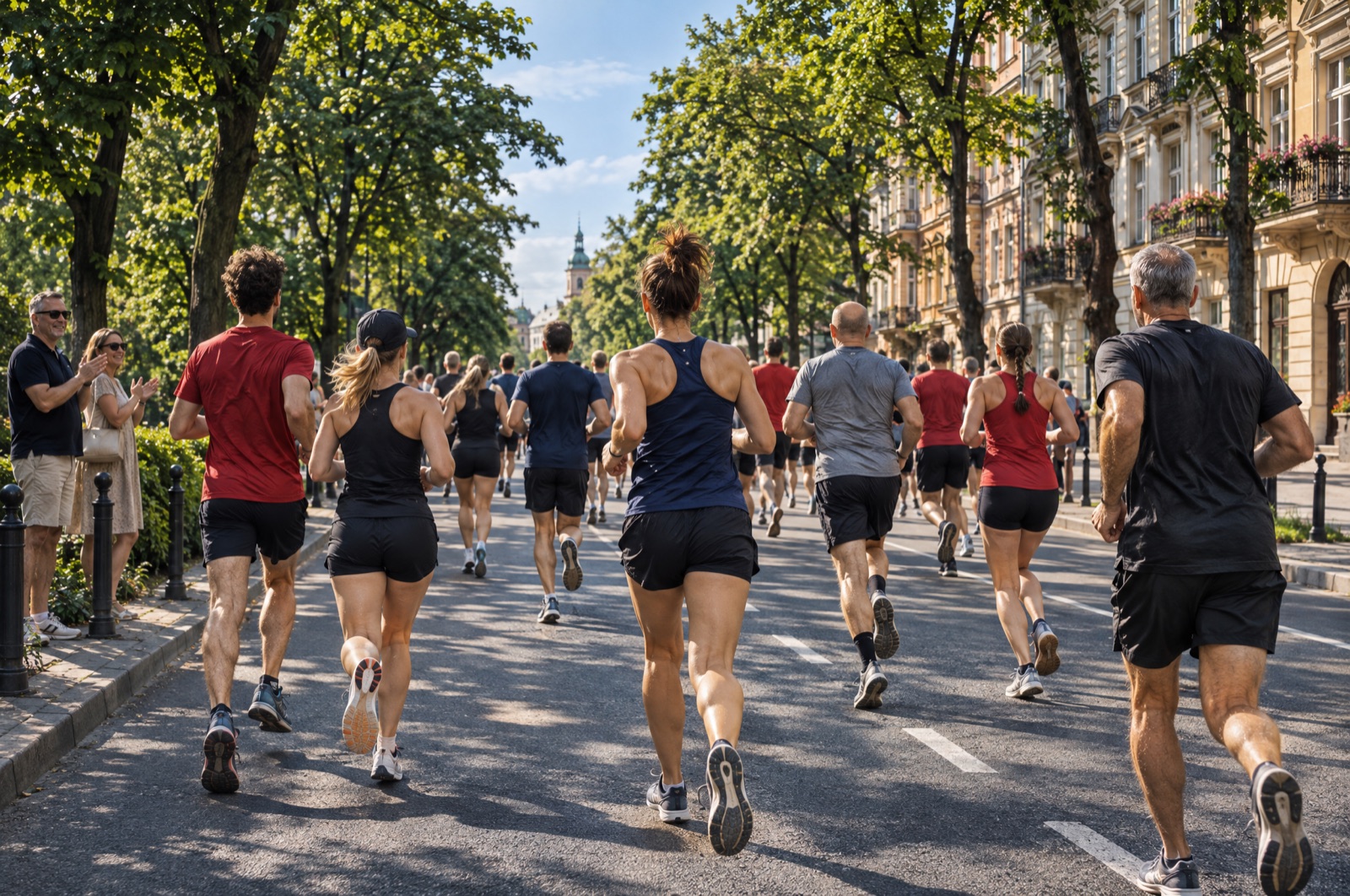
For a first race, choose a flat, certified course and the cool season where you live, which falls in opposite halves of the calendar in the two hemispheres. The 10K training plan page explains how courses are measured and what to look for.
The biggest 10Ks are huge. The Peachtree Road Race in Atlanta, held every July 4, counts more than 55,000 runners and walkers. At 6:00/km you will always have people around you. A midsummer race like that is a celebration, so do not plan a record there.
Start in the corral or wave that matches an hour, not further forward. And check the time limit in the race rules before you sign up. Many mass races are generous, but some smaller, faster ones close the course after 90 minutes.
What comes after the hour
A 60:00 result predicts about 2:12 for the half marathon, which leads straight to a sub-2:15 half marathon. For the marathon it gives about 4:36, but for half of all amateurs that kind of prediction is at least 10 minutes too fast. Before you get there, the next step can be a sub-55 10K.
A 55-minute goal needs a 5K that is 2:24 faster: down from about 28:47 to about 26:23. At 60 minutes the missing piece is usually endurance. At 55 you add a fourth run and a progression run.
Frequently asked questions
Is 60 minutes a good 10K time?
Yes, especially early on. It is the time of someone who trains regularly and can run for an hour without stopping. How many runners you finish ahead of depends on the race: more at mass events, fewer at club races.
What pace is a 60-minute 10K?
6:00 per kilometer or 9:39 per mile, which is 10 km/h (6.2 mph). Halfway comes at 30:00.
How many times a week should I run to break 60 minutes for 10K?
Three runs a week are enough, about 25–30 km (16–19 miles) in total. A fourth helps if your legs handle the load well.
What 5K time do I need for a sub-60 10K?
About 28:47. Many runners already have a faster 5K and still finish the 10K over the hour, which means endurance, not speed, is the missing piece.
How long does it take to go from 5K to 10K?
Usually 8–12 weeks, if you already run 5 km comfortably. People who are only starting to run need more time.
Can I walk part of a 10K and still finish under an hour?
You can. A minute of walking at 10:00/km (16:06/mile) costs about 24 seconds compared with running at 6:00/km, though, so it is better to train for continuous running.
Is 60 minutes a good 10K time after 50?
Yes, and the time means more with every decade, because endurance declines gradually with age. Age-grade tables convert a result for your age. For scale: 60:00 is about 44% of the speed of the men's 10 km road world record (26:31) and about 48% of the women's (28:46).