Contents
Pace and splits
| Pace | 4:59/km |
|---|---|
| 5 km | 24:53 |
| 10 km | 49:46 |
| 15 km | 1:14:39 |
| 21.1 km | 1:45:00 |
| 30 km | 2:29:18 |
| 40 km | 3:19:05 |
| Finish | 3:30:00 |
Your ranges from the Cooper test
This goal matches an estimated result of about 2840 m in the Cooper test, a 12-minute run for maximum distance. If you are slower today, set your own result and the ranges will follow your current fitness.
This is an estimate, not a promise of a finish time. Your coach sets the exact ranges after a test in the app.
Repeat times in each range
The middle of each range at the estimated Cooper result. Use it to check your pace on a watch or a treadmill.
| Range | 400 m | 1 km |
|---|---|---|
| Easy | 2:31 | 6:18 |
| Aerobic | 2:13 | 5:34 |
| Tempo | 2:01 | 5:02 |
| Threshold | 1:51 | 4:39 |
| VO2max | 1:42 | 4:16 |
The fuel margin disappears
A model from 2010 shows that a runner weighing 75 kg (165 lb) with the fitness for 3:42 needs about 20 kcal of carbohydrate per kilogram of body weight, around 1,500 kcal. A typical person of 70 kg (154 lb) has about 88 g of glycogen, stored carbohydrate, in the liver and about 310 g in the leg muscles. That is about 400 g, or about 1,600 kcal. The balance comes out almost at zero, and that is the arithmetic for a slower pace than yours.
In the same model the collapse of pace, the wall described on the main marathon page, falls at an effort of 80–95% of VO2max (maximal oxygen uptake) around mile 21, about 34 km. The Cooper test will not show the two things that decide the outcome here: full stores at the start and regular eating on the way. After carbohydrate loading the body can hold up to about 570 g in the leg muscles and about 160 g in the liver, almost twice the usual amount. No other reserve of fuel comes this cheaply.
At 4:59/km you pass 34 km after about 2:49. About 40 minutes of running remain, and that is when a gel is hardest to take. So plan your last gel for 30 km (mile 18.6).
How many gels for three and a half hours
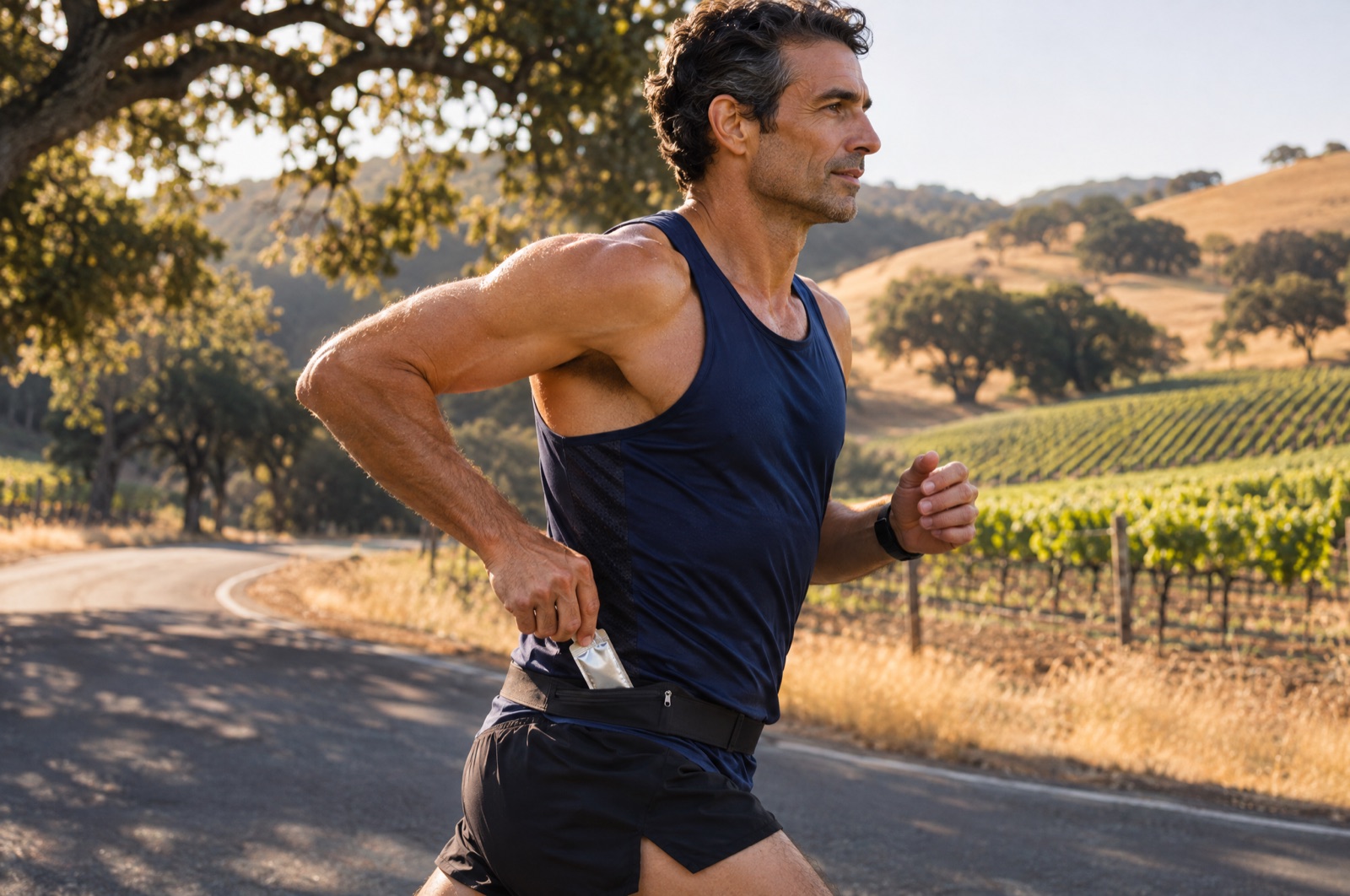
From a single source the body takes in about 60 g of carbohydrate per hour, and above that you need a mix of glucose and fructose. The reference is 60–90 g per hour, which over 3.5 hours means 210–315 g, so 7–15 gels of 20–30 g each. At 4:59/km a gel is harder to take than on an easy run, so practice it at race pace.
Check what the organizer provides too. Drinks are standard at big races, for example at 20 aid stations one to two miles apart in Chicago, but gels are not guaranteed and may not be the kind you trained with. Assume that you carry seven or more gels yourself. Test the belt or pockets on a long run, because at this pace everything bounces.
Even pacing is the norm here
In a study of 78,912 finishers of the Boston Marathon from 2015 to 2017, 65.4% of runners between 3:00 and 3:30 ran an even race, and only 2.7% faded hard in the second half. In the 3:30–4:30 band it was 44.4% and 9.9%. Among those under 3:00, 82% ran evenly. The faster the group, the smaller the gap between the two halves.
Halfway in 1:45:00 is an even pace, but it leaves no margin, and even careful runners usually lose a little after 30 km. The prediction formulas say the same from the other side. The standard formula turns a 3:30 marathon into a half marathon of about 1:40:43, while the median exponent from a study based on the results of 164,746 British runners, 1.12, gives about 1:36:37. So measure your fitness for 3:30 by a goal of about 3:25.
Round numbers also pull. In an analysis of nearly 9.8 million finishing times, results bunched up at round numbers, and the authors put it down to planning and extra effort near the finish. If you are inside the goal at 40 km, the last 2 km are worth fighting for.
Do you really need 80–110 km a week?
The reference for 3:30 is a peak of 80–110 km (50–68 miles) a week. The Athens Marathon study shows less: the group that averaged about 3:17 ran 72.1 km (45 miles) a week with a VO2max of 56.2, and the group that averaged about 3:46 ran 57.4 km (36 miles) with a VO2max of 51.7. The estimated Cooper test result for this goal is about 2,840 m.
An equation from a study of 126 men from the Basel Marathon (2013, times of 2:45–4:26) gives, for an average training pace of 5:50/km (9:23/mile) and 15% body fat, about 3:41 at 60 km (37 miles) a week, 3:34 at 80 km (50 miles) and 3:28 at 100 km (62 miles). A rise in body fat from 15% to 20% adds about 7 minutes, and to 25% about 28 minutes. The distances in the studies are averages over the whole period, and our reference is the peak week, so the numbers do not contradict each other. Because the equation counts the average, four extra weeks at 70 km can be worth more than one week at 100 km, especially if that week ends in a forced break.
Running economy gives a reserve as well. In a British study of recreational marathoners from 2017, the 3:00–3:30 group worked at 68.8% of VO2max at 10–13 km/h, and the 3:30–4:00 group at 76.1%. A pace of 4:59/km is 12 km/h, the middle of that range. The core of the block is a long run with a dozen or more kilometers at race pace, with rising volume. That session teaches you to tolerate the pace after 25 km. It is not the place to prove you can run the whole race.
At this volume the pace of the rest of the week counts too. If your Cooper test result is about 2,840 m, 4:59/km sits in the Tempo range, and Easy running is about 5:55–6:45/km (9:31–10:52/mile). The gap is deliberate. If you run the easy kilometers at 5:20/km (8:35/mile), you pile up fatigue and arrive at the long run without fresh legs.
What if the goal is 3:45?
It is the same training block, so 3:45 has no page of its own. The pace is 5:20/km (8:35/mile). In Berlin that is about 17 minutes faster than the average man and about 44 minutes faster than the average woman. For many people it is a sensible intermediate step between 4:00 and 3:30.
Is 3:30 a Boston qualifying time?
For some age groups, yes. The standards for the 2027 and 2028 Boston Marathons are 3:25 for women aged 18–34, 3:30 for women aged 35–39 and for men aged 55–59, and 3:45 for women aged 45–49. Men under 35 need 2:55. Meeting the standard only lets you apply: for 2027, runners had to beat it by at least 5 minutes and 17 seconds, so a woman of 37 needed 3:24:43, not 3:29:59. Only a net (chip) time from a certified marathon course counts. London's Good For Age places, open to residents of the United Kingdom, required women aged 18–39 to run under 3:38 for the 2027 race, and that time does not guarantee a place either.
A bad night and a morning start

Most marathons start early in the morning, and with a 3:30 goal you are usually placed in one of the front waves, so you set off soon after the gun. After a bad night an early start is good news. In a 2022 review of 69 publications, performance dropped consistently after a night without sleep and after waking earlier than usual, and efforts later in the day suffered, while morning efforts mostly held up. The review did not concern the marathon itself, so treat it as a hint, not a guarantee. If you travel across time zones, arrive early enough for your mornings to feel like mornings.
After a bad night give up the extra margin. Halfway in 1:44–1:45 still leaves the goal open. Put off the decision to speed up until 30 km, which you pass at about 2:29 on an even pace.
Where 3:30 sits in the field
No reliable statistic covers every marathon, but big races are well documented. At Boston in 2015–2017, where most runners qualify by time, about 31% of the 78,912 finishers ran under 3:30. In Berlin, a flat course that attracts people chasing a result, the mean finish over 1999–2025 was about 4:02 for men and about 4:29 for women, so 3:30 is more than half an hour faster than the average man and about an hour faster than the average woman.
Across marathons of every kind, including small, hilly and hot ones, sub-3:30 is rarer than at the big city races.
When is 3:30 realistic?
A half marathon of about 1:40:43 is the value from the Riegel formula, the same one the pace calculator uses. The argument about margin above suggests a safer basis of about 1:38, which is below a sub-1:40 half marathon. An IMI coach sets your ranges after a Cooper test or a 5K and decides every week whether the next portion of volume makes sense.
The test in training is 15 km (9.3 miles) at 4:59/km, about 1:15, late in a long run, 4–5 weeks before the race. If the pace does not fall apart with a gel in the middle, the goal is backed by fitness.
Frequently asked questions
Is 3:30 a good marathon time?
Yes. In Berlin it is more than half an hour faster than the average man (about 4:02) and about an hour faster than the average woman (about 4:29), and even at Boston, where most runners qualify by time, only about 31% of finishers got under it. For women aged 35–39 it is also the Boston qualifying standard for 2027 and 2028.
What pace is a 3:30 marathon?
4:59 per km or 8:01 per mile, which is 12 km/h. Halfway comes at 1:45:00 and 30 km at about 2:29.
How many carbs should I load before a 3:30 marathon?
10–12 g per kilogram of body weight per day for 36–48 hours: that is what the American College of Sports Medicine gives for efforts longer than 90 minutes. At 70 kg (154 lb) it is 700–840 g a day, far more than most people eat without a plan. Choose easily digested foods with little fiber, such as white rice, pasta, white bread and bananas. Practice it before a long run.
What half marathon time do I need for a 3:30 marathon?
The Riegel formula gives about 1:40:43, but most amateurs slow more in the marathon than it assumes, so a recent half of about 1:38 is a safer basis.
What 10K time do I need for a 3:30 marathon?
At least about 45:40: that is what the Riegel formula gives for 3:30. It is a minimum, because most runners slow more in the marathon than the formula assumes, and a good 10K says little about preparation for 42 km.
Can you train for a 3:30 marathon with a full-time job?
Yes, but this is where the week starts to get tight. At 60–80 km (37–50 miles) it is about 6–8 hours of running a week, and a peak above 80 km is more than 8 hours. What counts most is how many weeks you can sustain.
How long does it take to go from 4:00 to 3:30?
Usually more than one training block. It is 30 minutes, or 43 seconds per km (69 seconds per mile), and the peak week grows from 65–85 km to 80–110 km. A sensible intermediate step is 3:45. Volume has to grow without breaks in training, and no single session will speed that up.
What separates 3:30 from 3:00?
The difference is 43 seconds per km, about 17% in speed, and a different limit. Here fuel and weeks of volume count most, while for a sub-3 hour marathon the effort already lies close to the upper limit of what can be sustained for almost 3 hours.