Contents
- Why the first months are the riskiest
- Find your starting point
- Walk-run: what it is and why it works
- Conversational pace, or how slowly to run
- How to tell you are ready for the next stage
- The myth of the 10 percent rule
- Common injuries and what to do
- How many times a week to run, and why rest days exist
- Strength and food at the start
- Running gear and conditions that matter
- Your first 5K: realistic times
- When things go wrong
- What comes after 30 minutes of continuous running
- How much even a small dose of running gives you
- Frequently asked questions
Why the first months are the riskiest
Novice runners suffer 17.8 injuries per 1,000 hours of running, and recreational runners 7.7. That is the result of a meta-analysis of injury studies. For every hour run, a new runner is exposed to about 2.3 times more risk.
In practice, three half-hour runs a week for 9 weeks add up to 13.5 hours, or about 0.24 injuries per person. Roughly one injury for every four people. An experiment gave a similar picture: in the Dutch GRONORUN study of 532 beginners, about 20% of participants were injured during an 8-week or 13-week preparation.
Definitions of injury differ between studies, so this is a rough calculation. The answer is a sensible dose. The heart and lungs get used to effort faster than tendons and bones, which makes the first weeks a bad time to find out how much you can do.
Find your starting point
A plan for someone who played a team sport two years ago does not suit a person who has spent ten years at a desk. Start with an honest assessment.
| What you can do today | Where to begin | Approximate time to 30 minutes of running |
|---|---|---|
| A brisk 30-minute walk is a struggle | Walking only, 3–5 times a week, then walk-run | 12–16 weeks or more |
| You walk comfortably for 30–45 minutes | Short running segments with longer walks between them | 9–13 weeks |
| You can run 5–10 minutes without stopping | Longer running segments with short walk breaks | 6–9 weeks |
| You can run 20 minutes without stopping | You already have a base. Lengthen the run and move on to a 5K goal | 3–5 weeks |
This is our guideline, based on the beginner program of the UK's National Health Service (NHS) and the plans from the GRONORUN study. Nobody has to fit into it. Repeating a stage is better than skipping one.
Before you leave the house
See a doctor before you start if you have heart disease, high blood pressure, diabetes, chest pain or fainting episodes, if you are pregnant, or if you are very overweight and your joints hurt. The NHS gives the same advice to anyone with concerns about their health. How you get to see a doctor differs between health systems. The list of reasons does not. For people with obesity, low activity and joint pain, the Cooper Institute recommends walking tests in place of running tests. In that case start your training with walking too.
Walk-run: what it is and why it works
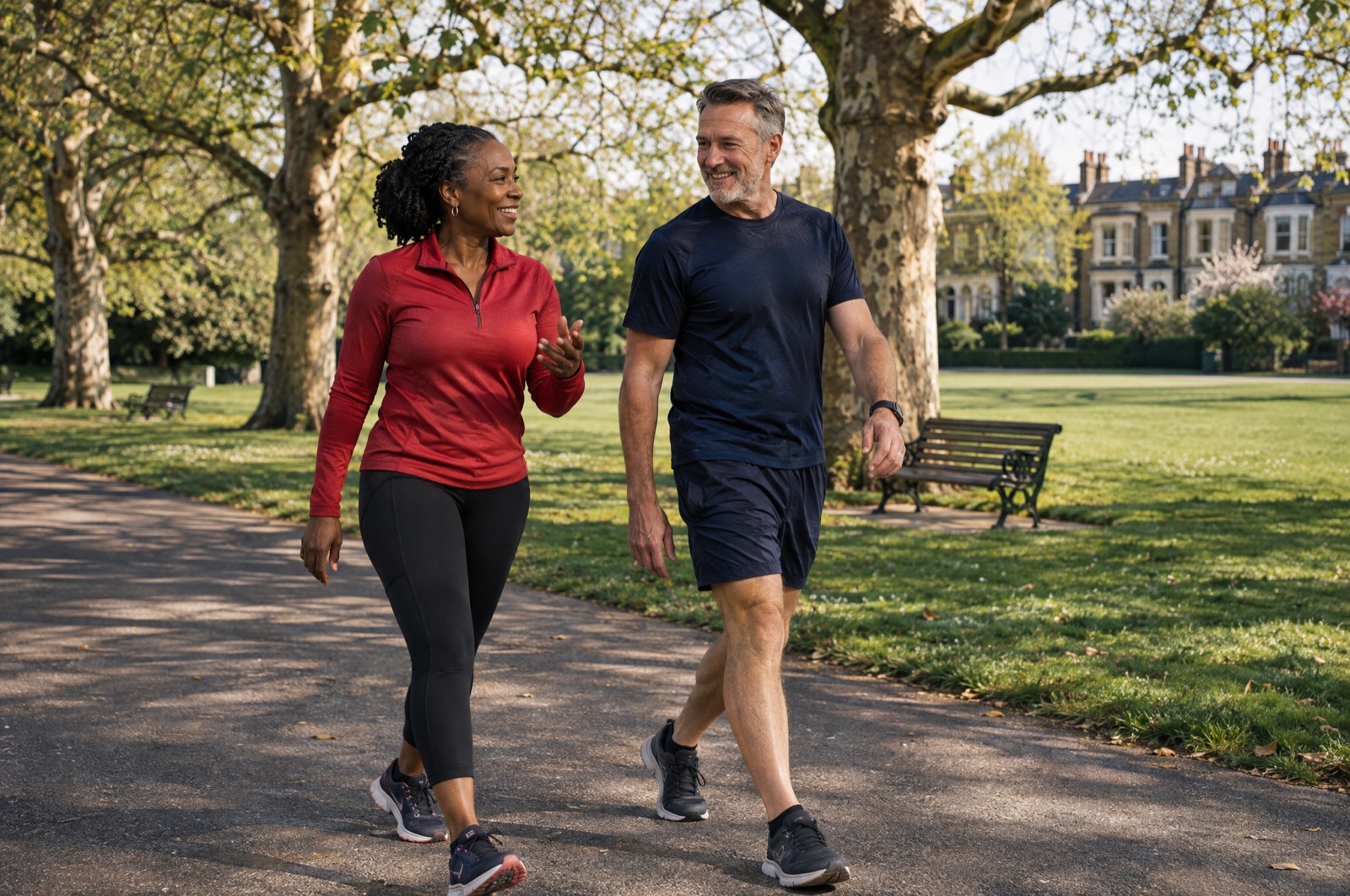
Walk-run, also written run-walk or run/walk, means alternating running with walking. It is the standard way to take a non-runner to a first 5K: the NHS in the United Kingdom builds its beginner program on it, and so do beginner groups at running clubs all over the world.
The outline of the NHS program is simple: 9 weeks, 3 runs a week with rest days between them. The first week alternates one minute of running with a minute and a half of walking, and the final stage is 30 minutes of continuous running. The NHS says plainly that you can take longer than 9 weeks.
Walking is part of the training. The breaks let you keep moving for longer, while each running segment stays short and easy to tolerate.
The rules you need
- 3 sessions a week, with a rest day between them. A fourth session at the start usually gives less than it costs.
- About 20–30 minutes in total, plus a few minutes of walking to warm up and to finish.
- Change one thing at a time: lengthen the run or shorten the walk, but not both at once and not together with a faster pace.
- Move on when the previous stage feels easy. Finishing a session at your limit is a sign to repeat it.
- Take the breaks on schedule. Start walking before you feel you have to.
Conversational pace, or how slowly to run
Most people start too fast. The best gauge is the talk test. Say a few sentences out loud while you run. If they come out comfortably, the pace is right.
The talk test has been studied as a stand-in for the ventilatory threshold, the intensity at which breathing clearly speeds up. In a 2015 paper, three levels of speech were checked on 30-minute runs with 16 people:
| State of speech | What it looks like | How many completed 30 minutes |
|---|---|---|
| Comfortable | You speak in full sentences | 16 of 16 |
| Uncertain | You can speak, but no longer comfortably | 13 of 16 |
| Not possible | Single words only | 2 of 16 |
The first level is an effort suited to healthy adults. The other two are useful later, in harder training. A heart rate monitor and knowledge of your maximum heart rate are not needed.
What if conversational pace is slower than walking
That happens. Shorten the running segment and take very short steps. Week by week the same pace will cost less. The number on the watch does not matter now. Many people start at 7:00–8:30/km (11:16–13:41/mile), and that is fast enough. In heat and humidity the same effort produces a slower pace still, and the talk test adjusts for that without any calculation.
How to tell you are ready for the next stage
A plan for beginners does not need fixed dates. Criteria work better.
| Sign | What it means | What to do |
|---|---|---|
| The last running segment is as easy as the first | You have mastered the stage | Lengthen the run or shorten the walk |
| You talk in full sentences in the last segment | The pace is right | You can move on |
| The last minutes are hard, but you finish | You are still working on the stage | Repeat the session 1–2 times |
| You do not finish the session, or leg pain the next day makes walking difficult | Too much | Go back a stage, add a rest day |
| Stiffness or pain returns in the same place | A sign of overload | Reduce the running and read the section on injuries |
How to measure progress without a watch
At the start, pace says little. Better indicators are the total minutes of running in a week, the longest continuous running segment, and whether you can say a full sentence near the end of a session. Write them down in a notebook or on your phone. After 6–8 weeks the same route usually takes fewer minutes at a similar effort.
The myth of the 10 percent rule
The most popular advice for new runners is to increase weekly distance by no more than 10%. In research it has held up worse than you might expect.
| Study | What was tested | Result |
|---|---|---|
| GRONORUN, 2008 | 532 beginners preparing for a 6.7 km (4-mile) run: an 8-week plan against a 13-week plan following the 10% rule | 20.3% injured against 20.8%. No difference. |
| Nielsen et al., 2014 | 874 beginners with GPS watches over one year | No difference in overall risk. An increase of more than 30% over 2 weeks was linked to more of the injuries typical of high volume, but at the edge of statistical significance. |
| Frandsen et al., 2025 | 5,205 runners with Garmin watches over 18 months | Week-to-week changes were not linked to injury. What counted was a single run more than 10% longer than the longest of the previous 30 days. |
The last study changes how to think about progression. Compared with a run no longer than 110% of the longest in the past month, the risk of an overuse injury was about 1.6 times higher with a jump of 10–30% and about 2.3 times higher when the distance doubled. It is an observation, and the participants were older than typical novices (mean age 45.8), but the practical conclusion is simple.
Watch the longest run, not only the week. If your longest run lasted 20 minutes, the next one should not last 30. An ambitious weekend run with a faster friend, after three weeks of gentle walk-run sessions, can be riskier than adding 10–15% across the week.
Common injuries and what to do

The knee suffers most often. The reported rate of leg injuries ranges from 19.4% to 79.3% between studies, because so much depends on the definition of injury and the length of follow-up. Where it hurts is clearer: in a review of 36 studies and 10,688 injuries, 70% affected the knee or the leg below it (knee 28%, foot and ankle 26%, lower leg 16%). In papers that reported the sexes separately, the knee accounted for 40% of injuries in women and 31% in men. Among diagnoses, the leaders are patellofemoral pain (17%), Achilles tendinopathy (10%) and medial tibial stress syndrome (8%).
| Name | Where it hurts | What usually makes it worse | First step |
|---|---|---|---|
| Runner's knee (patellofemoral pain syndrome) | Around or under the kneecap, on stairs and when sitting with bent knees | Downhills, a sudden rise in distance | Shorter runs, no downhills, consider a slightly higher cadence, meaning shorter and quicker steps |
| Shin splints (medial tibial stress syndrome) | The inner edge of the shin bone, over a longer stretch | Building up too fast, hard surfaces | Less running, more walking, review after 1–2 weeks |
| IT band syndrome (iliotibial band) | The outside of the knee, building during the run | Long downhills | A break from the trigger, hip strength work under a physiotherapist's eye |
| Achilles tendon | Above the heel, stiff in the morning | Hill running, a sudden rise in volume | Fewer hills, gradual strengthening exercises |
| Plantar fascia | Under the heel, sharp pain on the first steps in the morning | A rise in volume, standing | Less running, foot and calf exercises |
The table helps you get oriented, but it does not replace a diagnosis. That comes from a physiotherapist (physical therapist) or a doctor.
When to stop and see a specialist
- Pinpoint pain in a bone, especially if it grows with jumping, on stairs or at night. It may mean a stress fracture.
- Pain changes the way you run or walk.
- Pain does not go away after a few days off, or returns at every attempt.
- Swelling, redness, a joint that feels unstable.
- Chest pain, breathlessness out of proportion to the effort, fainting. In that case stop at once and contact a doctor, and with severe symptoms call your local emergency number.
Muscle soreness after the first runs is something else. It appears a day or two after the effort, is spread across the muscles on both sides, and goes away by itself. That is normal.
How many times a week to run, and why rest days exist
Rest days are part of the training, because tissues get stronger after the effort, not during it. Three sessions a week with a rest day between them is the pattern used by the NHS and by most similar programs. Two sessions will keep the habit alive, but progress will be slower. Five sessions are too many for most beginners.
If you feel like doing more, add movement without impact: cycling, swimming, walking, simple strength exercises. Fitness grows while your legs rest from running.
After a break of more than two weeks, go back one or two stages, and after a shorter one repeat the last stage you had mastered. A single missed session is simply gone. Do not make it up the next day.
Strength and food at the start
Two short strength sessions a week are a sensible addition from the start, although the research on running economy was done on people with at least six months of running behind them. Simple exercises are enough: squats, lunges, calf raises, glute bridges, planks. Most injuries affect the knee and the leg below it, so direct the work there. If something hurts, choose the exercises with a physiotherapist.
For sessions of 20–30 minutes you do not need gels or sports drinks. An ordinary meal a few hours earlier and water are enough. Fueling on the move starts to matter in efforts longer than 90 minutes. In hot weather, drink before and after, and take water with you if the session runs long.
Running gear and conditions that matter

- Running shoes. The NHS advises running shoes that support your feet. You do not need a racing shoe with a carbon plate: the measured energy savings were in high-level runners at paces of 3:20–4:17/km (5:22–6:54/mile).
- A watch. Not necessary; the stopwatch on your phone will do. What counts is minutes of running, not kilometers or miles.
- Being seen. Choose lit routes and take care with headphones near roads. After dark wear something reflective, and where there is no sidewalk, run facing the oncoming traffic. Road rules differ between countries, so check your own.
- Ice and cold. On an icy sidewalk shorten your stride or move the session to a treadmill. Minutes of movement count, not distance covered in snow.
- Heat and humidity. Run early in the morning or after sunset, slow down and shorten the running segments. In a tropical climate this is not a seasonal adjustment but the normal way to train, and the talk test still works.
- Treadmill. A good answer to icy winters and to hot, humid seasons alike. The 1% incline that better matches running outdoors was tested at faster running. At walk-run pace air resistance is small, so you do not have to worry about it.
Your first 5K: realistic times
A race is not compulsory, but it can be the best motivation to stay with running for longer than a few weeks.
Many people put it off for fear of finishing last. Some arithmetic helps. 5 km is 3.1 miles, and the finish time follows directly from the pace you can hold while still talking.
| Pace per km | Pace per mile | 5K time |
|---|---|---|
| 6:00 | 9:39 | 30:00 |
| 7:00 | 11:16 | 35:00 |
| 8:00 | 12:52 | 40:00 |
| 9:00 | 14:29 | 45:00 |
| 10:00 | 16:06 | 50:00 |
The slowest rows are a brisk walk with short stretches of running, and at large 5K events with thousands of participants that is an ordinary sight. Fields differ a great deal from one race to another, so there is no single "average" worth chasing. For a first race, walk-run pace fits well. A pace of 8:00/km (12:52/mile) is 40:00 at the finish, and nobody at the finish line asks how much of it you walked. If an event publishes a time limit, check it before you enter.
A good place for a trial run is one of the free weekly timed 5K events organized by volunteers in parks in many countries. Pace does not matter there, and the format is more social than a race. Charity runs and fun runs work the same way.
When things go wrong
| Situation | Sensible reaction |
|---|---|
| One missed session | Let it go and return for the next one. Do not combine two sessions |
| A break of up to two weeks, for example with a cold | Repeat the last stage you had mastered. Do not run with a fever |
| A break of more than two weeks | Go back 1–2 stages, even if you feel fine |
| Out of breath after a few minutes of running | Almost always the pace is too fast. Slow down to the talk test |
| Motivation drops after 3–4 weeks | Find someone to run with or enter a short event. The NHS points out that running with a friend or a group can be safer and more enjoyable |
| Work does not allow 3 sessions | Two sessions will keep the habit, but progress will be slower. Stretch the stages out |
| A heatwave or a week of ice | Keep the minutes, drop the pace, or move indoors. The stage counts the same |
The most important skill in this period is coming back after a break. The program should fit you, not the other way around. The NHS explicitly allows its 9 weeks to be stretched.
What comes after 30 minutes of continuous running
Once you can run for 30 minutes, you can start training for a goal. The next steps:
- Keep three sessions and add time in small steps, watching the longest run as described above.
- After a few weeks, check your fitness over 5K or with the Cooper test, a 12-minute run for maximum distance.
- Choose a realistic goal, for example a 5K in 30 minutes or a first 10K in 60 minutes.
- Add strength work if you do not have it yet. A review of 24 studies showed running economy improving by 2–8% in people with at least six months of experience, which is your next stage.
If you want somebody to watch your progression and adjust the load, a human coach in the IMI app builds the plan from a survey and updates it every week. For most people starting out, the principles on this page are enough.
How much even a small dose of running gives you
In a study of 55,137 adults followed for an average of 15 years, runners had a 30% lower risk of death from any cause and a 45% lower risk of death from cardiovascular causes, and their life expectancy was about 3 years longer. The benefits were similar regardless of the dose. Even less than 51 minutes a week was enough, once or twice a week and slower than about 9.7 km/h (6 mph). This is an observational study, so it does not prove cause, and runners differ from non-runners in other habits too. It is good news for a beginner: even a small dose of running is worth it.
The World Health Organization recommends that adults do at least 150 minutes of moderate-intensity activity a week, or at least 75 minutes of vigorous-intensity activity, plus muscle-strengthening work on 2 or more days. By its count about 31% of the world's adults do not reach that level. Three walk-run sessions of 30 minutes give you 90 minutes toward it, and the WHO's own summary fits the first weeks well: any amount of physical activity is better than none.
Frequently asked questions
How long does it take a beginner to run a 5K?
Usually 9–13 weeks to 30 minutes of continuous running. The NHS program assumes 9 weeks, and the Dutch plans before a 6.7 km run lasted 8 and 13 weeks. At 7:00/km (11:16/mile), 30 minutes is about 4.3 km (2.7 miles), so you reach the full distance in the following weeks, and taking longer is not a mistake.
How often should a beginner run?
3 times a week with a rest day in between. That is the standard in programs for beginners.
What is a good running pace for a beginner?
One at which you can speak in full sentences. For many people that is 7:00–8:30/km (11:16–13:41/mile). Conversational pace matters more than the number on the watch.
Is walk-run real running?
Yes, and at an early stage it is often better than forcing a continuous run. Walking is part of the training: the breaks let you keep moving for longer.
Can I run every day as a beginner?
At the start it is better not to. Your legs need a rest day. On days without running you can walk, cycle or do strength exercises.
Can I start running if I am overweight?
Yes, but it is better to begin with walking and add running gradually. With joint pain or a lot of excess weight, talk to a doctor or a physiotherapist before you start.
How should I breathe when running?
You do not need a special technique. Breathe through your nose and mouth, whichever is comfortable. Being out of breath almost always means the pace is too fast, not that your breathing is wrong, so slow down until you can say a full sentence.
What should I do if I get a side stitch?
Slow down or walk, and breathe calmly and more deeply than usual. A stitch usually passes within a few minutes. If it keeps coming back, avoid a large meal just before the run and start more slowly. Chest pain is something else: stop running and contact a doctor.
Should I work on my running form?
Not at the start. Run with short, light steps and do not reach far out in front with your foot. Form is worth looking at once you run regularly and nothing hurts.
My knee hurts after the first week. What should I do?
Take a few days off running, then return with shorter segments and no downhills. If the pain does not ease or changes the way you walk, see a doctor or a physiotherapist.