Contents
- Triathlon distances at a glance
- What the same distance is called in different countries
- Where the numbers come from
- Cut-off times and the pace they require
- Time split: how long each discipline really takes
- The swim distance can change on race day
- Draft-legal and non-drafting: the same distance, a different effort
- Why your 40 km may be 36 km
- Relays, para triathlon and other formats
- Challenge, T100, 5150 and other brand names
- Ultra: distances longer than an Ironman
- How to choose a distance by the numbers
- Frequently asked questions
Triathlon distances at a glance
The table covers the formats you will meet on start lists around the world. The figures for super sprint, sprint, standard (Olympic), middle and long distance come from the World Triathlon competition rules. The brand formats are conventions, not federation standards.
| Distance | Swim | Bike | Run | Total | Status |
|---|---|---|---|---|---|
| Super sprint | 250–500 m | 6.5–13 km | 1.7–3.5 km | 8.5–17 km | World Triathlon standard, a range |
| Sprint | 750 m (0.47 miles) | 20 km (12.4 miles) | 5 km (3.1 miles) | 25.75 km (16 miles) | World Triathlon standard |
| Olympic (standard) | 1,500 m (0.93 miles) | 40 km (24.9 miles) | 10 km (6.2 miles) | 51.5 km (32 miles) | World Triathlon standard |
| T100, the 100 km distance | 2 km | 80 km | 18 km | 100 km (62.1 miles) | Format of the T100 series, also used by Challenge |
| Half, 70.3 | 1.9 km (1.2 miles) | 90 km (56 miles) | 21.1 km (13.1 miles) | 113 km (70.3 miles) | Fits the World Triathlon middle distance range |
| French L | 3 km | 80 km | 20 or 30 km | 103–113 km | National format, the run depends on the race |
| French XL | 4 km | 120 km | 30 km | 154 km | National format |
| Full distance, Ironman, 140.6 | 3.8 km (2.4 miles) | 180 km (112 miles) | 42.2 km (26.2 miles) | 226 km (140.6 miles) | Fits the World Triathlon long distance range |
World Triathlon defines middle and long distance as ranges, not as single numbers. Middle distance is a swim of 1,900–2,999 m, a bike of 80–90 km and a run of 20–21.9 km. Long distance is 3,000–4,000 m, 91–200 km and 22–42.2 km. The full distance from Hawaii is therefore only one of many formats the federation counts as long. A race of 3 km, 100 km and 25 km would fit the same range.
National federations add their own ranges. The German federation defines a sprint as 500–750 m, 18–22 km and 4.5–5.5 km, so a German sprint can have a shorter swim than a sprint elsewhere and both follow their own rules. USA Triathlon sorts races into four bands by leg length: short, intermediate, long and ultra. On the bike these are 8–30 km, 30.1–50 km, 50.1–99.9 km and 100 km or more, and a race takes the band that two of its three legs share.
What the same distance is called in different countries
The same race has several names, and some of them mislead. Use this table when you read the rules of a race abroad.
| World Triathlon | United States | UK and Ireland | Germany | France |
|---|---|---|---|---|
| Super sprint | super sprint, in the "short" band | super sprint, novice, Try-a-Tri | Supersprintdistanz | closest is XS, découverte (400 m, 10 km, 2.5 km) |
| Sprint | sprint, in the "short" band | sprint | Sprintdistanz, often Volkstriathlon or Jedermanntriathlon | S, sprint |
| Standard | Olympic, in the "intermediate" band | standard, Olympic | Olympische Distanz, Kurzdistanz | M, courte distance, distance olympique |
| Middle | half, 70.3, "long course" | middle distance, half | Mitteldistanz | half, 70.3 (L is a longer national format) |
| Long | full, 140.6, "ultra" in federation terms | long distance, full distance | Langdistanz | XXL, Ironman |
Five traps that catch people at registration:
- Kurzdistanz is not a sprint. The word means "short distance", but in Germany it stands for 1.5 km, 40 km and 10 km. The sprint is the shorter one.
- "Long course" in the United States is the half. A 1.9 km swim, 90 km bike and 21.1 km run fall into USA Triathlon's "long" band. World Triathlon calls that distance middle and uses "long" only from a 3 km swim upward.
- "Ultra" has two meanings. USA Triathlon's "ultra" band starts at a 3.2 km swim, a 100 km bike and a 30 km run, so it includes the full distance. Everywhere else "ultra" means longer than an Ironman.
- "Long" is not the same race in every table. Triathlon Ireland lists long distance as 3,800 m, 180 km and 42.2 km. Triathlon Scotland lists it as 4,000 m, 120 km and 30 km. Both fit the World Triathlon range.
- The French L is not a half. The swim is 3 km instead of 1.9 km and the run is 20 or 30 km depending on the race. Check the course before you enter.
Entry-level races have local names too. In Britain you will see "novice", in Ireland "Try-a-Tri" (250 m, 6 km, 3 km) and in Australia "enticer". None of these is a fixed distance, so read the event page.
The word "Ironman" is used like a generic term, but IRONMAN and 70.3 are trademarks of The IRONMAN Group. A race with the same kilometers run by anyone else is called full distance, iron-distance or long distance, and its half is a middle distance. Who stands behind which brand is covered on the page about triathlon organizations and race brands.
Where the numbers come from
None of the popular distances was derived from physiology. Each one has its own accidental story.
2.4, 112 and 26.2 miles: three races on Oahu
The full distance is the sum of three events that existed on Oahu before 1978. The Waikiki Roughwater Swim was 2.4 miles (3.86 km). The Around-Oahu Bike Race was 115 miles (185 km) and was ridden over two days. The third event was the Honolulu Marathon. The bike course was cut by 3 miles so that its end met the start of the marathon route. That gives 112 miles, or 180.2 km. Nobody chose the number 180. It is a leftover of the island's geography.
The labels 140.6 and 70.3 are the length in miles: 2.4 + 112 + 26.2 and 1.2 + 56 + 13.1. In metric units that is 226.3 km and 113.1 km. This is why you will see 3.8 km, 3.86 km and 3.9 km for the same swim. They all describe the same leg. The difference is rounding.
1,500 m, 40 km and 10 km: a distance from an American race series
The Olympic distance is credited to Jim Curl, who ran the U.S. Triathlon Series with Carl Thomas from 1982 to 1997. The format settled in the mid-1980s. The sprint is exactly half of the Olympic distance in every discipline: 750 m, 20 km, 5 km.
The IRONMAN brand calls its Olympic distance races 5150, because the legs add up to 51.50 km.
The half: a fraction with a life of its own
The half is exactly half of every leg: 1.9 km, 90 km and 21.1 km, a half marathon. Some organizers keep the numbers to the meter, others round to a course they can actually build. Treat the numbers in the table as a template.
100 km: the T100 format
T100 is a 2 km swim, an 80 km bike and an 18 km run, exactly 100 km. The World Triathlon rules describe the format in a separate appendix. In the classification of events the T100 series counts as middle distance, even though the 18 km run is shorter than the 20–21.9 km in the distance table, and the championship title of the series speaks of long distance. For an age-group athlete the difference from 70.3 is clear: 100 m more in the water, 10 km less on the bike and just over 3 km less running.
More about the 1978 race and the first years of the sport is in the history of triathlon.
Cut-off times and the pace they require
World Triathlon does not set cut-off times for distances, apart from a maximum time in the water. The technical delegate may set a cut-off for the whole race or for any point on the course and must announce it at least 30 days before registration closes. Every figure below therefore comes from an organizer. The two IRONMAN rows show the pattern most of the brand's races follow, and the other rows are single races. Check the athlete guide of your own event.
| Race | Swim | Swim + bike | Finish | Minimum pace required |
|---|---|---|---|---|
| Typical IRONMAN, full distance | 2:20 | 10:30 | 17:00 | 3:41/100 m, 22 km/h (13.7 mph), 9:15/km (14:53/mile) |
| Typical IRONMAN 70.3 | 1:10 | 5:30 | 8:30 | 3:41/100 m, 20.8 km/h (12.9 mph), 8:32/km (13:44/mile) |
| Chicago Triathlon, Olympic distance, 2027 race page | 1:00 after the last Olympic wave enters the water | clock time | run course closes at 2:00 PM | Swim 4:00/100 m, the rest depends on your wave |
| Laguna Phuket Triathlon, Thailand, 2024 | out of the water by 7:50 AM for the 6:37 AM wave | bike finished by 10:30 AM | 12:30 PM | Clock times, with a checkpoint on the bike and on the run |
We calculated the pace from the gaps between cut-offs, without time in transition. The real margin is smaller, because the transitions (T1 after the swim and T2 after the bike) take minutes off the same clock. With 10 minutes in T1, the average speed you need on the bike of a full distance rises from 22 km/h to 22.5 km/h.
A short race can have the stricter clock
On the full distance, the last 42.2 km at 9:15/km is a brisk walk. Short city races often cannot be that generous, because roads reopen at a fixed hour and several races share the course on one day. The Chicago example shows the pattern: the run course closes at 2:00 PM whichever wave you started in, and you must be on the run by noon. In a late wave you have less time than in an early one. If you plan to walk part of the run, a local sprint or Olympic race is not automatically the safer choice. Read its cut-offs as carefully as you would for a 70.3.
Why 17 hours and 8:30
The simplest explanation of 17 hours is practical: a 7:00 AM start plus 17 hours is midnight. Safety, road closures and course staffing sit in the background. The overall and swim cut-offs in 70.3 are a plain half of the full distance: 8:30 is half of 17:00 and 1:10 is half of 2:20. That is why the swim pace required in both formats is identical: 3:41/100 m.
The bike and run are not symmetrical. Half of 10:30 is 5:15, but the cut-off is 5:30. As a result 70.3 allows a slower bike (20.8 km/h instead of 22 km/h) but demands a faster final leg (8:32/km instead of 9:15/km).
The swim: 1:10 in 70.3, up to 1:40 under World Triathlon
World Triathlon has a table of maximum time in the water for age-group athletes. For 1,001–1,500 m it is 1:10, for 1,501–3,000 m it is 1:40 and for 3,001–4,000 m it is 2:20. The 2:20 cut-off on the full distance matches the federation's table. On the 1.9 km of a 70.3 it does not: the federation allows up to 1:40 and a typical 70.3 gives you 1:10. Someone who swims 1.9 km in 1:30 is inside the World Triathlon rules but outside the 70.3 cut-off.
When the clock starts
With a wave start, and with a rolling start where athletes enter the water a few at a time, this question matters and the answer depends on the race. The cut-off may run from the official start, from your own start or from the last person entering the water. Races that print clock times, like the two examples in the table, leave no room for interpretation, but they favor early starters. Find the sentence in your race's athlete guide that defines it. In the last waves the difference can be more than ten minutes.
Cut-offs differ between races and between years
One IRONMAN is not equal to another. The 17:00 pattern has exceptions: some races, mostly where roads have to reopen earlier, give less time overall or set a tighter bike cut-off. Treat the typical values as a reason to check, not as the rules of your race.
Cut-offs also change between editions, in both directions. Hence the rule: the number from this year, from the athlete guide of this edition. If two documents of the same race contradict each other, ask the organizer before you pay.
Time split: how long each discipline really takes
Kilometers first. In the half and the full distance the swim is 1.7% of the course, the bike 79.6% and the run 18.7%. In the sprint and the Olympic distance the swim is 2.9%, the bike 77.7% and the run 19.4%. Kilometers mislead, because in the water an age-group athlete moves about ten times slower than on the bike. How the race feels is decided by the split of time.
There is no official statistic of how age-group athletes split their time, so the table below shows a model for one athlete over every distance. In the long formats about an eighth of the time is water, half is the bike and a third is the run.
Sprint to full distance: the same athlete, a different race
This is a model, not statistics. We assume one person: 2:20/100 m in the water, 28 km/h (17.4 mph) on the bike, 6:00/km (9:39/mile) on the run and 5–6 minutes for transitions, 12 on the full distance. In a longer race the real pace would drop, so the table shows only the geometry of the distances.
| Distance | Swim | Bike | Run | Transitions | Total |
|---|---|---|---|---|---|
| Sprint | 0:17:30 (18%) | 0:42:51 (45%) | 0:30:00 (31%) | 0:05 (5%) | 1:35 |
| Olympic | 0:35:00 (19%) | 1:25:43 (46%) | 1:00:00 (32%) | 0:06 (3%) | 3:07 |
| T100 | 0:46:40 (14%) | 2:51:26 (52%) | 1:48:00 (33%) | 0:06 (2%) | 5:32 |
| 70.3 | 0:44:20 (12%) | 3:12:51 (52%) | 2:06:36 (34%) | 0:06 (2%) | 6:10 |
| Full distance | 1:28:40 (12%) | 6:25:43 (52%) | 4:13:10 (34%) | 0:12 (2%) | 12:20 |
The longer the race, the more of it you spend on the bike: 45–46% of the time in a sprint or an Olympic race and 52% from T100 to the full distance. T100 and 70.3 are closer than their names suggest: T100 has slightly more swimming and about 40 minutes less on the bike and run.
With transitions the proportion runs the other way. In this model they are 5% of the time in a sprint and under 2% over the full distance. The shorter the race, the more a smooth transition matters.
The swim distance can change on race day
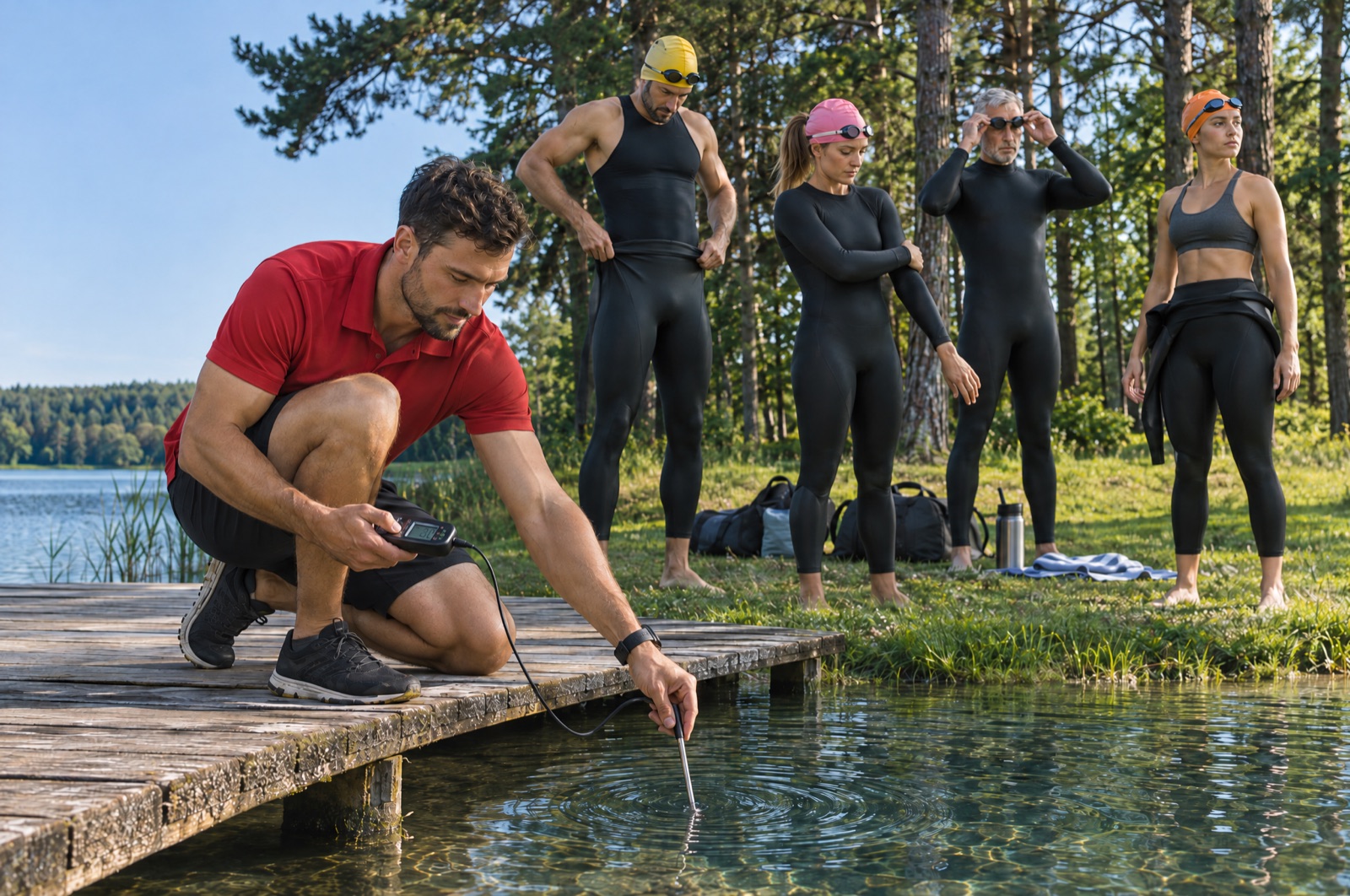
The number of meters in the table applies at a normal water temperature. The World Triathlon rules describe when the swim is shortened or dropped. This matters in both directions: a lake in northern Europe or Canada in early summer can be too cold, and a tropical sea or a reservoir in a heat wave can be too warm.
| Water temperature | Planned 750 m | Planned 1,500 m | Planned 1,900 m | Planned 3,800 m |
|---|---|---|---|---|
| 32.0°C (89.6°F) and above | canceled | canceled | canceled | canceled |
| 31.0–31.9°C | 750 m | 750 m | 750 m | 750 m |
| 15.0–30.9°C | 750 m | 1,500 m | 1,900 m | 3,800 m |
| 14.0–14.9°C | 750 m | 1,500 m | 1,900 m | 3,000 m |
| 13.0–13.9°C | 750 m | 1,500 m | 1,500 m | 1,500 m |
| 12.0–12.9°C | 750 m | 750 m | 750 m | 750 m |
| Below 12.0°C (53.6°F) | canceled | canceled | canceled | canceled |
The wetsuit rule depends on the distance too. For age groups up to 55–59 the wetsuit is forbidden from 22°C (71.6°F) on swims up to 1,500 m and from 24.6°C (76.3°F) on longer ones. From the 60–64 age group upward the limit is 24.6°C at every distance. It is mandatory for everyone at 15.9°C (60.6°F) and below. The maximum thickness is 5 mm. The same water at 23°C therefore means no wetsuit in a sprint and a wetsuit allowed on a 1.9 km swim. When the water is at or below 22°C and the air at or below 15°C, the rules also adjust the temperature used for the decision, so at the briefing you may hear a different value from the one on the thermometer.
The table and the wetsuit limits apply to races under World Triathlon rules. Other rule books differ:
- IRONMAN races typically allow wetsuits for age-group athletes up to 24.5°C (76.1°F). Above that, up to 28.8°C (83.8°F), you may usually still wear one but give up age-group awards and championship slots. Below 16°C (60.8°F) a wetsuit is mandatory. The athlete guide of each race confirms the values.
- USA Triathlon allows wetsuits up to 78°F (25.6°C). Between 78°F and 84°F (28.9°C) you may still wear one but you lose your place in the age-group ranking and awards. Above 84°F wetsuits are not allowed.
If the water is close to a limit, have a plan for swimming without a wetsuit. In warm-water races, Hawaii being the best-known example, a non-wetsuit swim is the normal case.
Draft-legal and non-drafting: the same distance, a different effort
Drafting means riding close behind another athlete to save energy. Whether it is allowed changes the race more than a few kilometers of course do.
| Format under World Triathlon rules | Elite, under-23 and junior | Age group |
|---|---|---|
| Sprint | draft-legal | both options exist |
| Standard (Olympic) | draft-legal for elite and under-23 | non-drafting |
| Middle and long | non-drafting | non-drafting |
In a non-drafting race the draft zone under World Triathlon rules is 12 m, measured from the front edge of the leading bike's front wheel, and you have 25 seconds to pass. IRONMAN keeps the same 12 m for age-group athletes. A drafting penalty is served in a penalty box on the course: 30 seconds in a sprint, 1 minute at the standard distance, 2 minutes at middle distance and 3 minutes at long distance.
In a draft-legal race you ride in a pack, on a road bike and not a time-trial bike, and the swim decides which pack you make. This is the format of the Olympic Games and of the top short-course series. Age-group athletes meet it less often, with one important exception: the age-group sprint world championships have been draft-legal since 2016, and some national qualifying races follow. The same 20 km in a group and alone are two different efforts, so check the format before you choose your bike and your pacing.
Why your 40 km may be 36 km
Triathlon distances are measured with a tolerance. The World Triathlon rules accept a 10% deviation on the bike with the approval of the technical delegate, and 5% at middle and long distance. An Olympic bike leg can therefore legally be anything from 36 km to 44 km. Brand races write their own tolerances into their rules and state that those rules take precedence over the federation's.
USA Triathlon goes a step further and classifies a race by bands, not by exact numbers: a bike of 30.1–50 km counts as intermediate whatever the brochure calls it. This is why comparing personal bests from different courses has limited meaning, and why a record on a "fast course" is worth checking against the map. The same applies to open-water swims, where wind and the placing of the buoys can change the real distance.
Relays, para triathlon and other formats
Not every start line leads to a solo swim, bike and run over a standard distance.
- Mixed relay. Teams of two women and two men. Under World Triathlon rules each leg is a 250–300 m swim, a 5–8 km bike and a 1.5–2 km run, and each athlete completes all three before tagging the next. It has been an Olympic event since Tokyo.
- Team relay at age-group races. At many middle and full-distance races, Challenge Roth among them, three people share one race: one swims, one rides and one runs. It is a good way to see a big event before you enter it alone.
- Para triathlon. Championship races, including the Paralympic Games, are held over the sprint distance: 750 m, 20 km and 5 km. Athletes are grouped by sport class. Wheelchair users (PTWC) use a handcycle on the bike and a racing chair on the run. Athletes with a visual impairment (PTVI) race with a guide and ride a tandem. The standing classes run from PTS2 to PTS5.
- Aquabike. Swim and bike only, usually held alongside a middle or long distance triathlon. It suits people who cannot run for a while.
- Duathlon and aquathlon. Run, bike, run, or swim and run. If the water is the barrier, a duathlon gives you the transitions and the pacing problem without the swim.
Challenge, T100, 5150 and other brand names
A brand changes the name, not always the distance. Challenge Family uses the names "100 distance", "long distance", "middle distance", "standard", "sprint" and "super sprint" in its calendar. Behind them are, for example:
- Challenge Roth, July 4, 2027: the classic full distance in Bavaria.
- Challenge Almere-Amsterdam, September 11, 2027: long distance, middle distance and super sprint.
- The Championship in Šamorín, May 2027: the 100 distance, plus shorter formats.
- 5150: the Olympic distance under the IRONMAN brand.
- T100: 2 km, 80 km and 18 km, with age-group races alongside the professional series.
The super sprint has no single value either. The French XS and the Scottish novice distance are 400 m, 10 km and 2.5 km, the Irish Try-a-Tri is 250 m, 6 km and 3 km, and you will also find 600 m, 15 km and 3 km, which is outside the World Triathlon range. With this format the only reliable information is the rules of the specific race.
Dates and programs are those announced by November 2026. Confirm them on the race page.
Ultra: distances longer than an Ironman
Ultra triathlon begins where the full distance ends. The federation of this discipline is the International Ultra Triathlon Association (IUTA). The formats are multiples of 226 km.
| Format | Swim | Bike | Run | Total |
|---|---|---|---|---|
| Double | 7.6 km | 360 km | 84.4 km | 452 km |
| Triple | 11.4 km | 540 km | 126.6 km | 678 km |
| Quintuple | 19 km | 900 km | 211 km | 1,130 km |
| Deca | 38 km | 1,800 km | 422 km | 2,260 km |
| Double Deca | 76 km | 3,600 km | 844 km | 4,520 km |
IUTA recognizes three forms of racing: continuous, one distance per day and split. A Deca can therefore mean one unbroken race or ten full distances in ten days. The rules reach up to 30 times the distance and the federation's website mentions 50 times.
Ultraman in Hawaii is a category of its own, raced over three days. Day one is a 10 km (6.2 mile) swim followed by a bike stage, day two about 276 km (171 miles) on the bike, and day three an 84 km (52.4 mile) run, a double marathon. The bike course closes 12 hours after the start of each stage.
How to choose a distance by the numbers
This page does not tell you how to train. It helps you work out which race is realistic. Answer three questions in order, then see where to go next.
1. Will you make the swim cut-off with a margin?
Convert your current pool pace into the distance. Times are in hours and minutes. Open water adds sighting, waves and the entry into the water, so treat the pool result as the lower limit.
| Your pace per 100 m | 400 m | 750 m | 1,500 m | 1,900 m | 3,800 m |
|---|---|---|---|---|---|
| 2:00 | 0:08 | 0:15 | 0:30 | 0:38 | 1:16 |
| 2:30 | 0:10 | 0:19 | 0:38 | 0:48 | 1:35 |
| 3:00 | 0:12 | 0:23 | 0:45 | 0:57 | 1:54 |
| 3:30 | 0:14 | 0:26 | 0:53 | 1:07 | 2:13 |
At 3:30/100 m you have about 3.5 minutes in hand in a 70.3 with a 1:10 cut-off, before you add wind, waves and going around the buoys. If a sprint gives you 30 minutes for the swim, the margin is under 4 minutes, and on the full distance it is 7 minutes. A shorter race changes little here, because swim cut-offs are roughly proportional. A swimmer at that pace needs to get faster in the water, not just pick a shorter distance.
2. Which leg is your problem?
| Situation | The more sensible choice | Why |
|---|---|---|
| Weak swim, good fitness | A sprint instead of an Olympic race, or a duathlon first | In the model above, about 17 minutes in the water instead of 35 |
| Strong swim that you want to use | Sprint or Olympic | The water is about 18% of the time instead of 12% |
| Slow run, risk of walking | Read the cut-offs of short city races | Fixed clock times can be tighter than the 8:32/km of a 70.3 |
| You do not ride for 3 hours yet | Give yourself more time before a 70.3 | The bike is half of the whole race, more than 3 hours in the model on this page |
| You have little time on race day | Sprint, possibly Olympic | In the model above a sprint takes about 1.5 hours and an Olympic race about 3 hours |
| Cold or very warm water worries you | Pick the race by its usual water temperature | The wetsuit rule changes at 22°C in short races and at 24.6°C in long ones |
In the model on this page a sprint takes about 1:35, an Olympic race 3:07, a 70.3 about 6:10 and a full distance about 12:20. The time roughly doubles with every step: from sprint to Olympic, from Olympic to half and from half to full. You can work out your own time at every distance in the triathlon time calculator.
3. Are you old enough?
| Distance | Minimum age, World Triathlon |
|---|---|
| Super sprint | 15 |
| Sprint | 16 |
| Olympic, middle and long | 18 |
Age is counted on December 31 of the race year. National federations and organizers can set their own limits for children and youth races. IRONMAN and IRONMAN 70.3 require you to be 18 on race day.
4. Where to go next
Have you picked a distance? A comparison of the training each one demands is in the overview of triathlon training plans, and there are separate pages for the sprint, the Olympic distance, the half and the full distance. If you are just starting, see the page for beginners. How registration for a branded race works is described in how to register for an Ironman. Once you have chosen a race, in the IMI app a real coach builds the plan for that distance and your date and then updates it every week.
Frequently asked questions
What are the distances in a triathlon?
The main ones are sprint (750 m, 20 km, 5 km), Olympic (1.5 km, 40 km, 10 km), half or 70.3 (1.9 km, 90 km, 21.1 km) and full distance (3.8 km, 180 km, 42.2 km). Around them you will find the super sprint, the 100 km T100 format and ultra races.
How long is a sprint triathlon?
A 750 m swim, a 20 km (12.4 mile) bike and a 5 km (3.1 mile) run, 25.75 km in total. That is the World Triathlon standard, but many local races call a slightly different course a sprint, so check the meters on the event page.
How long is an Ironman in miles and kilometers?
140.6 miles, or about 226 km: a 2.4 mile (3.8 km) swim, a 112 mile (180 km) bike and a 26.2 mile (42.2 km) marathon.
How long is a half Ironman?
70.3 miles, or 113 km: a 1.2 mile (1.9 km) swim, a 56 mile (90 km) bike and a 13.1 mile (21.1 km) run. The same distance is called 70.3, half, middle distance and Mitteldistanz.
What is the Olympic triathlon distance?
A 1,500 m swim, a 40 km bike and a 10 km run, 51.5 km in total. Federations call it the standard distance. A sprint is exactly half of it.
What is the shortest triathlon?
The super sprint. World Triathlon defines it as a range: 250–500 m of swimming, 6.5–13 km on the bike and 1.7–3.5 km of running. Local novice races can be shorter still, so check the event page.
What do 70.3 and 140.6 mean?
They are the total race length in miles. 2.4 + 112 + 26.2 is 140.6 and half of each leg adds up to 70.3. Both numbers are used as brand names by IRONMAN.
What is the cut-off time for an Ironman and a 70.3?
Typically 17 hours for the full distance, with 2:20 for the swim and 10:30 for the swim and bike together. A 70.3 typically allows 8:30, with 1:10 and 5:30. Some races are stricter, so check the athlete guide of your event.
How long does a triathlon take?
There are no official averages. At 2:20/100 m, 28 km/h and 6:00/km a sprint takes about 1:35, an Olympic race 3:07, a 70.3 about 6:10 and a full distance about 12:20. That is a constant-pace model: the real time depends on the course, the weather and how much your pace drops over the longer distances.
Which triathlon distance is best for a first race?
A super sprint or a sprint. Both let you practice open water and transitions in a race that lasts under two hours. Before you choose, check that you can make the swim cut-off with a margin.
What is the T100 distance?
A 100 km format: a 2 km swim, an 80 km bike and an 18 km run. It is the distance of the professional T100 series and of a growing number of age-group races.