Contents
- How to use the calculator
- Which numbers to enter
- The same paces at every distance
- Where you gain the most
- How to read the goal split
- Check the result against cut-off times
- How much time to enter for transitions
- Custom distance and unusual courses
- Metric, or miles and yards
- The most common mistakes when calculating a time
- What to remember
- Frequently asked questions
Triathlon time calculator
- Start0:00
- Swim:/100 m
- T1swim to bike:
- Bikekm/h
- T2bike to run:
- Run:/km
- Finish
Cut-offs depend on the race. Check the rules of your event.
Where you gain the most
Time arithmetic only. A harder bike leg can cost you more on the run.
How to use the calculator
Choose a distance: Sprint, Olympic, Half (70.3), Full or Custom. With a preset distance the meters and kilometers are locked. With Custom you can enter any course. Not sure which distance to pick? Start with the overview of triathlon distances.
Then set your swim pace, bike speed, run pace and the time in T1 and T2, with the slider or by typing the numbers. The result changes at once, and under each pace you see its equivalent in the other system of units. Already have a finish time in mind? Enter it in the field below the legs and click "Split it", and the calculator will split it into paces, keeping the proportions between the disciplines. An example with the default values for the Olympic distance: 2:15/100 m, 30 km/h (18.6 mph), 5:30/km (8:51/mile), T1 3:00 and T2 2:00.
| Leg | Time | Share | Race clock |
|---|---|---|---|
| Swim 1,500 m | 33:45 | 19.4% | 33:45 |
| T1 | 3:00 | 1.7% | 36:45 |
| Bike 40 km | 1:20:00 | 46.0% | 1:56:45 |
| T2 | 2:00 | 1.2% | 1:58:45 |
| Run 10 km | 55:00 | 31.7% | 2:53:45 |
The bar under the result shows the same proportions at a glance. The bike almost always takes about half the time, but the biggest gain is not always where you spend the most minutes.
Which numbers to enter
The calculator works out exactly what you type in. The biggest mistake is entering personal bests from three different months. Give the paces you can hold in a single race, after the legs that come before.
| Field | Best source | Correction |
|---|---|---|
| Swim | The pace from your last race, or from continuous swimming over the race distance | In open water add 5–10 s/100 m to your pool pace, because there are no turns and you swim in a group and not always in a straight line. In a wetsuit, take part of that loss back. |
| Bike | The average from a race or a long ride on a similar profile | Wind, climbs and a bike without aero bars change it more than fitness does |
| Run | The pace from a brick session or a previous triathlon | Do not enter a road-race personal best. See the table below. |
| Transitions | Your time from your last race | To begin with, 3:00 and 2:00, more for long distances |
The corrections are our reference point. How much a wetsuit gives depends on your build, your swimming level and the temperature. Measurements report an improvement from about 3% to almost 13%, which at 2:15/100 m means from 2:11 to 1:57/100 m. In a river or a tidal sea swim the current changes the time as well, so results from two years on the same course do not have to be comparable.
The run off the bike: what to enter
After the bike, running costs more energy. After 40 km of riding the cost rises by 1.6–11.6%, depending on the person. If you have no result from a triathlon, take your pace from a road race (you can work it out in the running pace calculator) and add the correction from the table:
| Distance | Take your pace from a | Add | Example |
|---|---|---|---|
| Sprint | 5K | 15–25 s/km (24–40 s/mile) | 5:00/km becomes 5:15–5:25/km |
| Olympic | 10K | 15–25 s/km (24–40 s/mile) | 5:10/km becomes 5:25–5:35/km |
| Half (70.3) | Half marathon | 30–50 s/km (48–80 s/mile) | 5:20/km becomes 5:50–6:10/km |
| Full distance | Marathon | 45–90 s/km (72–145 s/mile) | 5:40/km becomes 6:25–7:10/km |
This is a reference point for people who have done brick sessions. Without them, add more. The correction grows with distance: from a half to a full distance, run pace usually drops far more than bike speed.
The same paces at every distance
This is what one person's results look like at each preset distance. The table is pure arithmetic for 2:15/100 m, 30 km/h, 5:30/km and 5 minutes of transitions.
| Distance | Swim | Bike | Run | Finish |
|---|---|---|---|---|
| Sprint | 16:53 | 40:00 | 27:30 | 1:29:23 |
| Olympic | 33:45 | 1:20:00 | 55:00 | 2:53:45 |
| Half (70.3) | 42:45 | 3:00:00 | 1:56:03 | 5:43:48 |
| Full distance | 1:25:30 | 6:00:00 | 3:52:04 | 11:22:34 |
The last two rows are too optimistic, because nobody at that level of fitness holds the same pace over such a long distance. Transition times grow at long distances too. The table does show one practical thing. From sprint to Olympic, half and full, each step roughly doubles the length of the race, so pacing that works for 90 minutes has to be rethought for three hours.
Where you gain the most
The panel "Where you gain the most" under the calculator compares four changes: 5 s per 100 m in the water, 1 km/h on the bike, 10 s/km on the run and a minute less in each transition. For the same person it looks like this:
| Distance | Swim 5 s/100 m | Bike 1 km/h | Run 10 s/km | Transitions 2 min shorter |
|---|---|---|---|---|
| Sprint | 0:38 | 1:17 | 0:50 | 2:00 |
| Olympic | 1:15 | 2:35 | 1:40 | 2:00 |
| Half (70.3) | 1:35 | 5:48 | 3:31 | 2:00 |
| Full distance | 3:10 | 11:37 | 7:02 | 2:00 |
At short distances the cheapest minutes are in transition. Two minutes in a sprint is more than 1 km/h on the bike, and you can gain them with a few dry-land practice sessions. For the half and the full distance the bike wins, and transitions drop down the list.
You still have to count the cost. The table shows time arithmetic, not the price of the work.
| Change | How much work it usually costs | What to watch |
|---|---|---|
| Transitions 2 min shorter | A few short sessions, elastic laces | Speed does not excuse you from the rules: your things must stay at your own spot |
| Swim 5 s/100 m faster | At 2:15/100 m, often technique and regularity | Over 750 m it gives less than 40 seconds |
| Bike 1 km/h faster | Position, tires, aerodynamics or months of work on power | A harder bike leg can cost more on the run |
| Run 10 s/km faster | Better fueling and pacing, then brick sessions | Often it is enough not to ride the bike too hard |
How to read the goal split
The goal field shortens all three legs by the same percentage and leaves the transition times alone. From the default values for the Olympic distance, a goal of 2:45 gives about 2:08/100 m, 31.6 km/h and 5:13/km (1:57/100 yd, 19.7 mph and 8:24/mile), so each pace is a little over 5% better. The fields show rounded values, so after a manual change the result can move a few seconds away from the goal.
This is arithmetic, not a plan. Improvement is rarely spread evenly, because a weaker sport usually has more room than a strong one. Treat the result as a question: which of these three paces is furthest from your tests today? If the split tells you to run off the bike faster than you run a 10K on its own, look for the minutes somewhere else or move the goal to next season.
Check the result against cut-off times
For the Half and Full distances the calculator shows your margin against cut-offs typical of IRONMAN-branded races. A cut-off is the latest time by which you must finish a leg. Miss one and your race ends there, whatever your fitness.
| Race | Swim | Swim, T1 and bike | Finish |
|---|---|---|---|
| Typical IRONMAN 70.3 | 1:10 | 5:30 | 8:30 |
| Typical IRONMAN | 2:20 | 10:30 | 17:00 |
For any other race, compare the limit with the "race clock" value at each leg. It answers a question that can matter more than the finish time: will you make it before the cut-off. Take a half at 3:00/100 m, 25 km/h (15.5 mph), 7:00/km (11:16/mile) and transitions of 6:00 and 4:00. After the swim the clock shows 57:00, after T1 and the bike 4:39:00, and at the finish 7:10:42. That fits inside the typical 70.3 limits with room to spare.
Now a full distance at 3:00/100 m and 20 km/h (12.4 mph) with a 10-minute T1. The swim takes 1:54:00, well inside 2:20, but the clock after the bike reads 11:04:00, past the 10:30 limit. The bike cut-off counts from the start of your swim, so a slow swim and a slow T1 use up bike time.
Three caveats before you rely on these numbers:
- Cut-offs vary from race to race. The values in the table are a common pattern, not a rule. A race with an unusual swim or a hard bike course can allow more, a race with tight road closures less, and many courses add intermediate checkpoints on the bike and the run.
- The clock does not always start with you. In a rolling start your limits usually run from the moment you cross the timing mat, but road closures can end at a fixed time of day, so a late starter cannot assume every checkpoint moves with them.
- Other organizers set their own limits. World Triathlon gives age-group athletes a maximum of 1:40 in the water for 1.9 km and 2:20 for 3.8 km, and independent races can be tighter than the IRONMAN brand, on the swim and overall.
Check the limits in the current athlete guide of your race before you rely on any of these numbers. The full table is in the overview of distances, and the registration side is covered on the page about how to register for an Ironman.
How much time to enter for transitions
| Distance | T1, to start with | T2, to start with | Where the difference comes from |
|---|---|---|---|
| Sprint | 3:00 | 2:00 | An unhurried first race: 5:00 and 3:00 |
| Olympic | 3:00 | 2:00 | Shorter at a small event, longer in a big transition area |
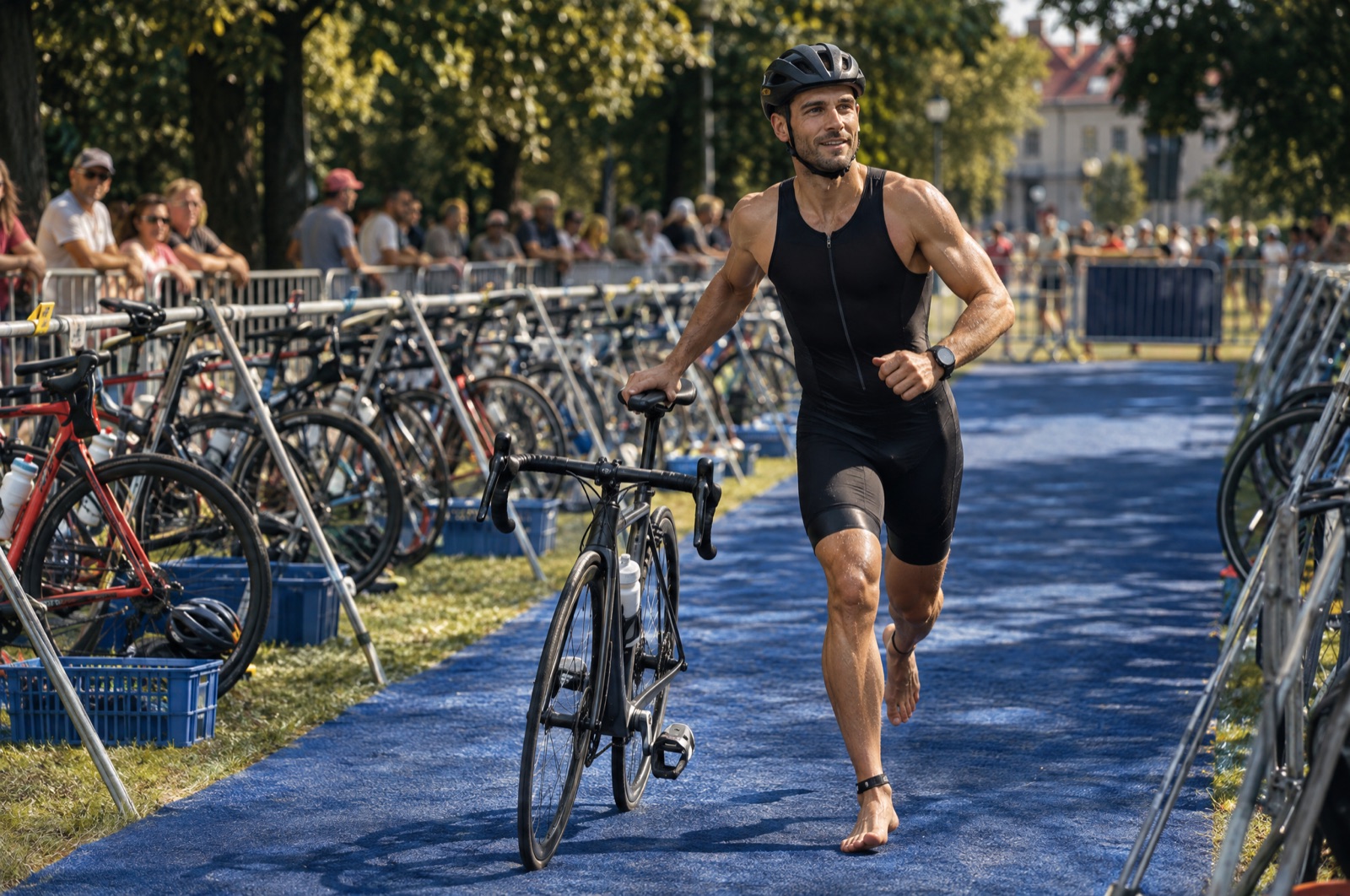
| Half (70.3) | 8:00 | 6:00 | Longer transition areas, gear bags and more to rack and put on |
| Full distance | 10:00 | 7:00 | Often a full change in a tent and an even longer run with the bike |
The time depends mainly on the length of the transition area, the wetsuit and how often you practice. At big events the run with the bike to the exit takes minutes in itself, and that time counts towards your result. In a sprint, transitions are about 6% of your time, at the full distance about 2%. The order of movements in T1 and T2 is described on the page for the beginner triathlon training plan.
Custom distance and unusual courses
The name of a distance does not always mean the same course. Choose Custom when the race information gives different numbers. An example from 2026 race listings: one sprint in a Canadian series has a 28 km bike leg instead of 20 km. At 2:15/100 m, 32 km/h, 5:10/km and 5 minutes of transitions the standard sprint comes to 1:25:13 and that race to 1:40:13. The 15-minute difference has nothing to do with fitness.
You can calculate other formats the same way: a T100 race of 2 km, 80 km and 18 km, a relay leg or a brick session. Compare times between editions only when the course is the same.
The same calculator also works on the distance pages with the settings ready, for example sprint, Olympic, half Ironman and Ironman.
Metric, or miles and yards
The unit switch changes meters to yards and kilometers to miles. The paces and distances you entered convert automatically. 2:15/100 m is 2:03/100 yd, 30 km/h is 18.6 mph, and 5:30/km is 8:51 per mile. The gains table then switches to 5 s/100 yd, 1 mph and 15 s/mile, so its numbers are not comparable with the metric version.
If you train in a 25-yard pool, remember that a pace per 100 yards is not a pace per 100 m: 1:50/100 yd is about 2:00/100 m. Race distances are set in meters almost everywhere, so enter the pace in the unit you measured it in and let the calculator convert.
The most common mistakes when calculating a time
- A pool best in the swim field. A pool with turns and open water are two different efforts.
- An average from a flat loop on a hilly course. Check the profile before you enter a speed.
- A run pace from a road-race best. By the correction table the result comes out too good by 1–2 minutes in a sprint, 10–18 minutes in a half and up to an hour at the full distance.
- Zero in the T1 and T2 fields. Two transitions in a sprint are minutes, not seconds.
- The same paces at every distance. A longer race needs slower values in every field.
- Ignoring the weather. A pace held on a cool morning will not hold in heat and humidity, least of all on the run.
- Treating the result as a promise. It is arithmetic based on your assumptions, not a forecast.
What to remember
The calculator does not know the course, the temperature or your fueling. Over the half and the full distance these are what most often decide whether the pace lasts to the end. The result is a reference point for a conversation about your goal. If you want someone to match these numbers to your tests and your week, at IMI a real human coach does that and updates the plan every week.
Frequently asked questions
Does the triathlon time calculator account for fatigue on the run?
No. It works out exactly what you enter, so in the run field give the pace you can hold after the bike.
How much time should I allow for transitions?
At short distances, 3 minutes for the first transition and 2 for the second. For the half and the full distance allow more: to start with, 14 minutes in total for a half (8 and 6) and 17 for a full distance (10 and 7).
Can I calculate in yards and miles?
Yes. The unit switch converts paces and distances to yards, miles and miles per hour.
What are the cut-off times for an Ironman and a 70.3?
Typically 2:20 for the swim, 10:30 from the start to the end of the bike and 17:00 overall in an IRONMAN, and 1:10, 5:30 and 8:30 in an IRONMAN 70.3. Individual races differ, so the athlete guide of your event has the final word.
How long does a sprint triathlon take?
At 2:15/100 m, 30 km/h (18.6 mph), 5:30/km (8:51/mile) and 5 minutes of transitions, a sprint takes about 1:29. At 2:30/100 m, 25 km/h (15.5 mph), 7:00/km (11:16/mile) and 8 minutes of transitions it is about 1:50. Enter your own paces above for your number.
What is a realistic Olympic triathlon time for a beginner?
About 3:10–3:30. At 2:30/100 m, 27 km/h (16.8 mph), 6:00/km (9:39/mile) and transitions of 4:00 and 2:30 the calculator shows 3:12:53, and with a first race and a slower swim about 3:30 is realistic too. Check that you fit inside the cut-offs of your race.
Can I enter the distance from my race information?
Yes. Choose Custom and give the meters and kilometers exactly as the organizer states them.
Why does the bike have the biggest share when the gain can be elsewhere?
Because the share only says where you spend your time, and the gain also depends on how easily you can improve a given leg. For a weak swimmer five seconds per 100 m can be easier to find than 1 km/h on the bike.