Contents
- Sprint triathlon distance: 750 m, 20 km, 5 km, unless the entry page says otherwise
- How long a sprint triathlon takes
- What decides the result: the swim weighs more than you think
- The whole race near threshold: what your body has to do
- How hard to swim the 750 m
- Wetsuit: the rules depend on who sanctions the race
- Transitions: the two minutes that are easiest to win back
- Drafting on the bike: usually banned, sometimes allowed
- Bike and run: how much is worth risking
- Equipment that matters over 20 km
- Sprint, super sprint or Olympic: which race is right for you
- What a sprint triathlon training plan has to cover
- Sprint races around the world and their cut-offs
- Mistakes typical of the sprint
- Frequently asked questions
Triathlon time calculator
- Start0:00
- Swim:/100 m
- T1swim to bike:
- Bikekm/h
- T2bike to run:
- Run:/km
- Finish
Cut-offs depend on the race. Check the rules of your event.
Where you gain the most
Time arithmetic only. A harder bike leg can cost you more on the run.
Sprint triathlon distance: 750 m, 20 km, 5 km, unless the entry page says otherwise
Before you enter, check the meters in the water. "Sprint" is a rulebook distance, but organizers also use the word for shorter swims, pool swims and longer bike legs. The finish times look similar. The preparation does not.
Under World Triathlon rules the sprint distance is a 750 m swim, a 20 km bike and a 5 km run (0.47, 12.4 and 3.1 miles). That is 25.75 km in total, exactly half of the Olympic distance. The minimum age is 16.
| What the entry page says | Swim | Bike | Run | What it really is |
|---|---|---|---|---|
| Sprint distance in World Triathlon rules | 750 m | 20 km | 5 km | The standard sprint |
| Sprint at Hamburg's mass-participation races, 2026 | 500 m | 20 km | 5 km | A sprint with a shorter swim |
| Sprint at the Chicago Triathlon | 750 m | 24 km | 5 km | A sprint with a longer bike |
| Pool-based sprint | Usually shorter than 750 m | Set by the organizer | Set by the organizer | A sprint with a pool swim and no wetsuit |
| Super sprint, typical | 400 m | 10 km | 2.5 km | Roughly half a sprint |
A difference of 250 m changes the preparation for someone who is still learning front crawl. If the water is what worries you, start with the page on a beginner triathlon training plan. Every format, from super sprint to full distance, is compared on the triathlon distances page.
How long a sprint triathlon takes
At a typical age-group pace, a sprint takes about 1:25. The reference point is 2:15/100 m in the water, 32 km/h (19.9 mph) on the bike, 5:10/km (8:19/mile) on the run and 5 minutes for both transitions.
| Segment | Time at this pace |
|---|---|
| Swim, 750 m | 16:52 |
| Bike, 20 km | 37:30 |
| Run, 5 km | 25:50 |
| Transitions (assumed) | 5:00 |
| Total | 1:25:12 |
This is a model, so it only shows the scale. Put your own paces and transition times into the calculator at the top of this page and you get your own target.
The same arithmetic gives the range. At 1:45/100 m, 36 km/h, 4:20/km (6:58/mile) and 3 minutes of transitions, an experienced athlete finishes in about 1:11. At 3:00/100 m, 25 km/h, 6:30/km (10:28/mile) and 8 minutes of transitions, a beginner takes about 1:51. There is no official statistic of age-group sprint times, so these are calculated reference points, not measured averages. To see where you stand, open last year's results of the same race, which the organizer publishes.
For scale: in a study of World Triathlon series races, with pack riding, the mean sprint times of three performance groups were 52.9–57.4 minutes for men and 58.2–63.2 minutes for women.
The name does not guarantee the length
Add 4 km to the bike, as in Chicago, and the same paces give 1:32:42. At the Frankfurt City Triathlon the sprint has a 28 km bike instead of 20, which at 32 km/h is a quarter of an hour more. Cut the swim to 500 m, as in Hamburg, and the model drops to 1:19:35. A time only means something together with the course, so compare yourself with your own previous race at the same event.
What decides the result: the swim weighs more than you think
Take the full sprint and the version with a 500 m swim. At the same paces they finish less than six minutes apart, but the time is distributed differently. The figures are plain arithmetic for 2:15/100 m, 32 km/h, 5:10/km and 5 minutes of transitions.
| Segment | Share of time, 750 m swim | Share of time, 500 m swim |
|---|---|---|
| Swim | 19.8% | 14.1% |
| Bike | 44.0% | 47.1% |
| Run | 30.3% | 32.5% |
| Transitions | 5.9% | 6.3% |
So the same improvement pays differently in the two formats.
| Improvement | Gain with a 750 m swim | Gain with a 500 m swim |
|---|---|---|
| 10 s/100 m in the water | 1:15 | 0:50 |
| 1 km/h on the bike (from 32 to 33 km/h) | 1:08 | 1:08 |
| 10 s/km on the run | 0:50 | 0:50 |
| Two minutes less in transition | 2:00 | 2:00 |
On a full sprint, 10 s/100 m is worth more than 1 km/h on the bike. With a 500 m swim it is the other way around. A weak swimmer loses so much over 750 m that 20 km on the bike is often not enough to get it back.
Look at the last row too. Two minutes in transition are worth as much as going from 32 to about 33.8 km/h over 20 km. That kind of speed takes months of work. Smoother transitions take a few practice sessions.
What the professionals show
An analysis of 113 World Triathlon races from 2017–2024 links the result mainly to the run, and on the sprint T1 and T2 also have a noticeable effect. Another study points to the bike as the best single predictor and to the bike and run together as the most important pair. The conclusions differ because the studies cover different fields and years.
Do not apply this to age-group racing. At elite level everyone swims well and pack riding evens out the field. You ride without shelter and can lose far more in the water.
The whole race near threshold: what your body has to do
There are few direct measurements of a sprint in race conditions. The best reference is a 2021 study of 17 well-trained men who raced the Olympic distance without drafting, that is, without riding close behind another athlete. Their average heart rate was 89.8% of maximum in the water, 91.1% on the bike and 90.7% on the run. Measured by heart rate, they spent about 92% of the swim and 79% of the bike above the anaerobic threshold.
A sprint is almost half as long, so the intensity is at least the same. That is an inference, not a measurement. In 5–10 km running races the average heart rate reaches 90–96% of maximum. In practice you work for more than an hour at a level where you cannot say a full sentence, with almost nowhere to rest.
- Threshold and aerobic capacity count for more than volume. If you can work for 90 minutes, basic endurance will not stop you. The result is set by the speed you can hold at threshold.
- Changes of discipline with no breather. After the swim you switch from arms to legs, and after the bike from pedaling to running, each time without dropping the intensity.
- Energy is hardly a limit. For efforts of up to about an hour, small amounts of carbohydrate or even a mouth rinse are enough, and slightly longer efforts do not need large doses either. In a sprint, breakfast and a bottle on the bike matter. A gel in T2 is usually unnecessary.
- Breathing and heart rate spike in the water. The start, the crowd and cold water push them up in the first minutes. This is a common cause of panic in first open-water races. Most races ask you to sign a health declaration or waiver, and a signature is not a check-up.
Shorter does not mean safer
An analysis of nearly 4.8 million race starts in the US from 2006–2016 found 1.74 deaths or cardiac arrests per 100,000 participants. The risk was similar across short, intermediate and long races: 1.61, 1.41 and 1.92 per 100,000. Over the registry's full record, from 1985 to 2016, 90 of 120 sudden deaths and cardiac arrests happened in the water. The risk rose with age and reached 18.6 per 100,000 in men over 60.
These events are still rare. The practical conclusion: swim in open water before race day and get a medical check-up, especially after 40. If you feel chest pain, palpitations or dizziness, stop and talk to a doctor.
How hard to swim the 750 m
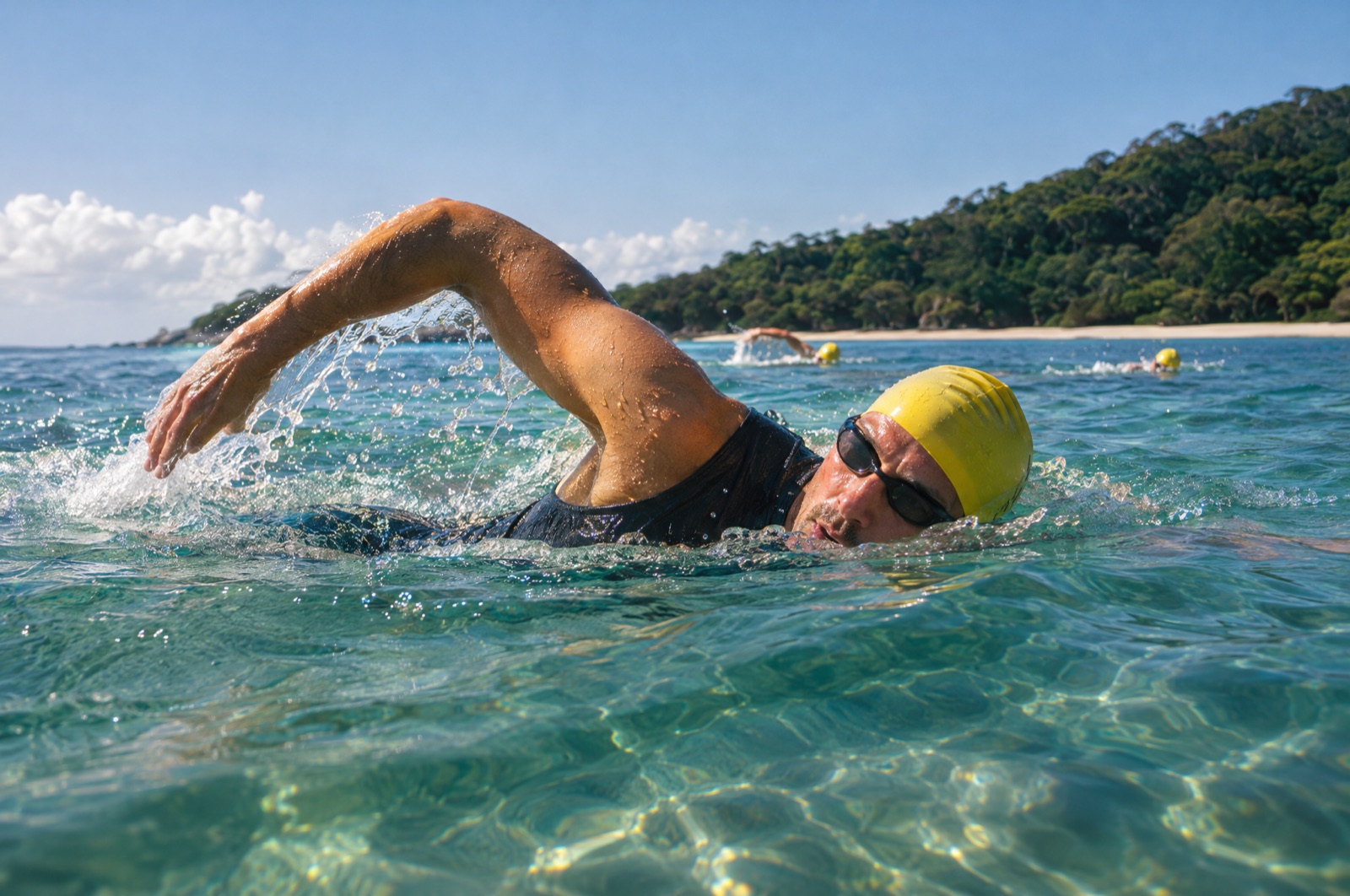
Swim hard, but not flat out. That is the conclusion of two small laboratory studies, which differ in the details because they tested different groups.
In a 2005 study, nine highly trained men completed simulated sprints after swimming at 80–85%, 90–95% and 98–102% of their time-trial speed. The bike was faster after the easier swims than after the all-out one, and the 80–85% version also gave a better overall time than the hardest one. Lactate after the hard swim was clearly higher.
Twenty years later a similar trial was run on 20 age-group athletes, 8 of them women, over exactly 750 m, 20 km and 5 km. In men, swim intensity did not change the finish time. In women, swimming below critical speed gave a worse result than swimming at or above it.
What that means for an age-group athlete:
- Do not swim at your absolute maximum. Neither study rewards it.
- Do not treat the 750 m as an easy warm-up either. If you are a weak swimmer, holding back costs minutes the bike will not return.
- Aim for the pace you can hold in training for 15 minutes without your technique falling apart. The strokes in the last 100 m should be as long as in the first.
- If swimming is your weakest discipline, start with technique and relaxation. They give more than extra power.
The water also offers an easy gain. Swimming on someone's feet is legal in every format. Directly behind the feet of the swimmer in front, 0–50 cm away, drag falls by 20–21%. To the side, with your hands 50–100 cm behind theirs, you gain 6–7%. Oxygen uptake falls by about 8–11% and heart rate by about 7%. Look for the feet of someone slightly faster and sight every few strokes, because the swimmer ahead may be off course.
Wetsuit: the rules depend on who sanctions the race
Under World Triathlon rules, for age groups up to 55–59 and swims of up to 1,500 m, wetsuits are forbidden from 22°C (71.6°F). From the 60–64 category the ban starts at 24.6°C (76.3°F). At 15.9°C (60.6°F) and below a wetsuit is mandatory for everyone. The suit cannot be thicker than 5 mm.
Most races in the United States follow USA Triathlon rules, which are more generous. A wetsuit is allowed up to 78°F (25.6°C). From 78.1 to 83.9°F you may still wear one, but you give up awards and rankings. From 84°F (28.9°C) it is banned. The cold end is practically the same: mandatory below about 16°C (60.8°F).
| Water temperature | World Triathlon rules, age groups to 55–59, sprint | USA Triathlon rules, most races |
|---|---|---|
| 15.9°C (60.6°F) and below | Mandatory | Mandatory |
| 16–21.9°C (60.8–71.4°F) | Your choice | Your choice |
| 22°C (71.6°F) to 78°F | Forbidden | Your choice |
| 78.1–83.9°F (25.6–28.8°C) | Forbidden | Allowed, but no awards or rankings |
| 28.9°C (84°F) and above | Forbidden | Forbidden |
The same lake can therefore be a wetsuit swim under one rulebook and a non-wetsuit swim under another. The Chicago Triathlon reports Lake Michigan averaging 65–74°F (18–23°C) in past years, which sits right on the World Triathlon line and comfortably inside the American one. In tropical and subtropical venues, and in late summer almost anywhere, expect to swim without a suit. In northern lakes and in the sea early in the season, expect it to be compulsory.
So bring the wetsuit to the race, but train without it as well. The official temperature is taken on race morning, and the referee usually announces the final decision about an hour before the start. Pool swims are swum without a wetsuit.
How much time does a wetsuit save? Measurements range from about 3% to almost 13%. The range is that wide because most trials were run in pools, in water warmer than on race day, and because leaner athletes and weaker swimmers gain more. In 14 female swimmers the gain was 4.96% over 400 m and 3.23% over 1,500 m. For someone who swims 17 minutes without a suit, 30–50 seconds is a sensible reference. Part of that gain is spent taking the suit off in T1, so practice it before race day.
The rules also shorten or cancel swims in cold water. A 750 m swim goes ahead in full as long as the water is at least 12°C (53.6°F), and below that it is canceled. In cool air the referee adjusts the reading: water at 16°C with air at 12°C counts as 14°C. That is why early-season races in cold climates are stressful even at the shortest distance.
Transitions: the two minutes that are easiest to win back
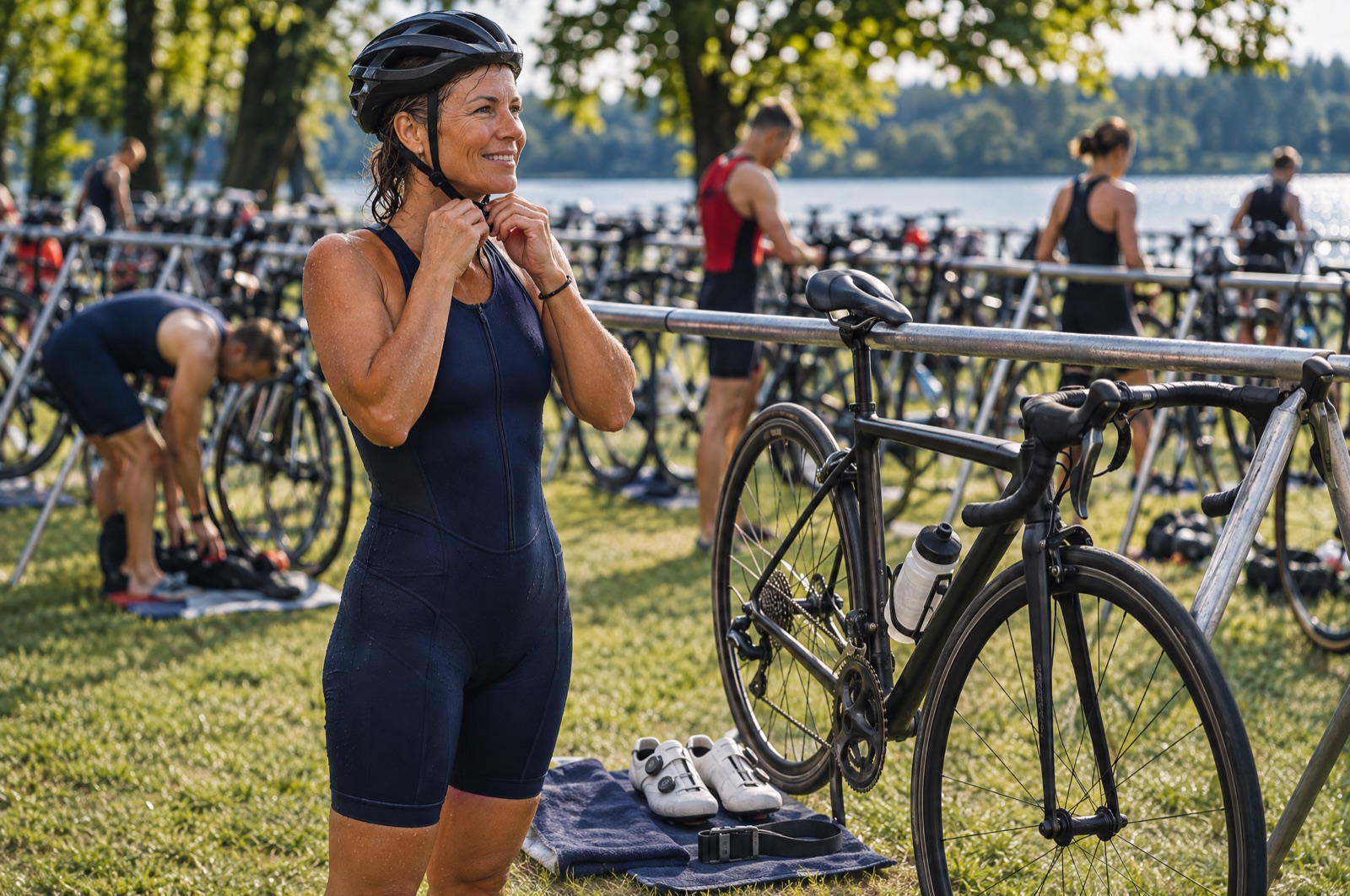
The assumed 5 minutes for both transitions is a reference point for an age-group athlete, not a rule. A lot depends on the layout: the length of the run from the water, the size of the transition area and where your rack is. Every extra 100 m of running at 6:00/km (9:39/mile) is 36 seconds, so walk the transition area before the start. For professionals, transitions took about 1.2% of total time at the Olympic distance. For an age-group athlete in a sprint it is closer to 6%.
What most often costs a penalty or your nerves:
- Your helmet must be fastened before you take the bike off the rack and unfastened only after you rack it again.
- You mount after the mount line and dismount before the dismount line. What counts is a full foot on the ground. Riding inside the transition area is not allowed.
- Inside transition you push the bike by hand.
- Marking your spot is forbidden. Officials can remove towels and markers without warning. Count the racks from the entrance and pick a fixed landmark.
- You may unzip the wetsuit on the way, but you take it off completely at your spot or in a designated area.
- On the run your race number must be visible on the front.
Socks are a choice. Running 5 km without them saves time in T2 if you have tested it in training. In your first race, choose comfort.
Drafting on the bike: usually banned, sometimes allowed
The sprint is the only popular distance where World Triathlon rules allow both formats for age groups: draft-legal, which means riding on a wheel, and draft-illegal. At the Olympic distance age-group athletes ride draft-illegal only. In practice most sprint races for age groups are draft-illegal. The main exception sits at the top: the age-group sprint world championship is raced draft-legal, and USA Triathlon, for example, holds both a non-draft and a draft-legal sprint at its national championships.
Draft-illegal races
The draft zone is 12 m long (39 feet), measured from the front wheel of the rider ahead. You have a maximum of 25 seconds to pass through it. The penalty in a sprint is 30 seconds in the penalty box, and a second offense means disqualification. Drafting penalties cannot be protested. Individual organizers can set their own versions, so read the athlete guide.
Turn that into speed. To cover a 12 m zone in 25 seconds you need to be at least 1.7 km/h (about 1 mph) faster. With a difference of 1 km/h you will not make it. Do not start a pass without a clear advantage.
The ban has a reason. Riding on a wheel at 32 km/h saves about 18% of oxygen. At 39.5 km/h (24.5 mph) on a triathlon course, oxygen uptake fell by 14%, heart rate by 7.5% and ventilation by almost 31%, and the run after such a ride was faster.
Draft-legal races
In draft-legal age-group races the equipment rules change. Only traditional drop handlebars are allowed. Clip-on bars are banned, wheels need at least 12 spokes and disc wheels are out, so check the rules before you pack the bike. In the water it also matters who you come out with, because a group rides faster than a single athlete.
Bike and run: how much is worth risking
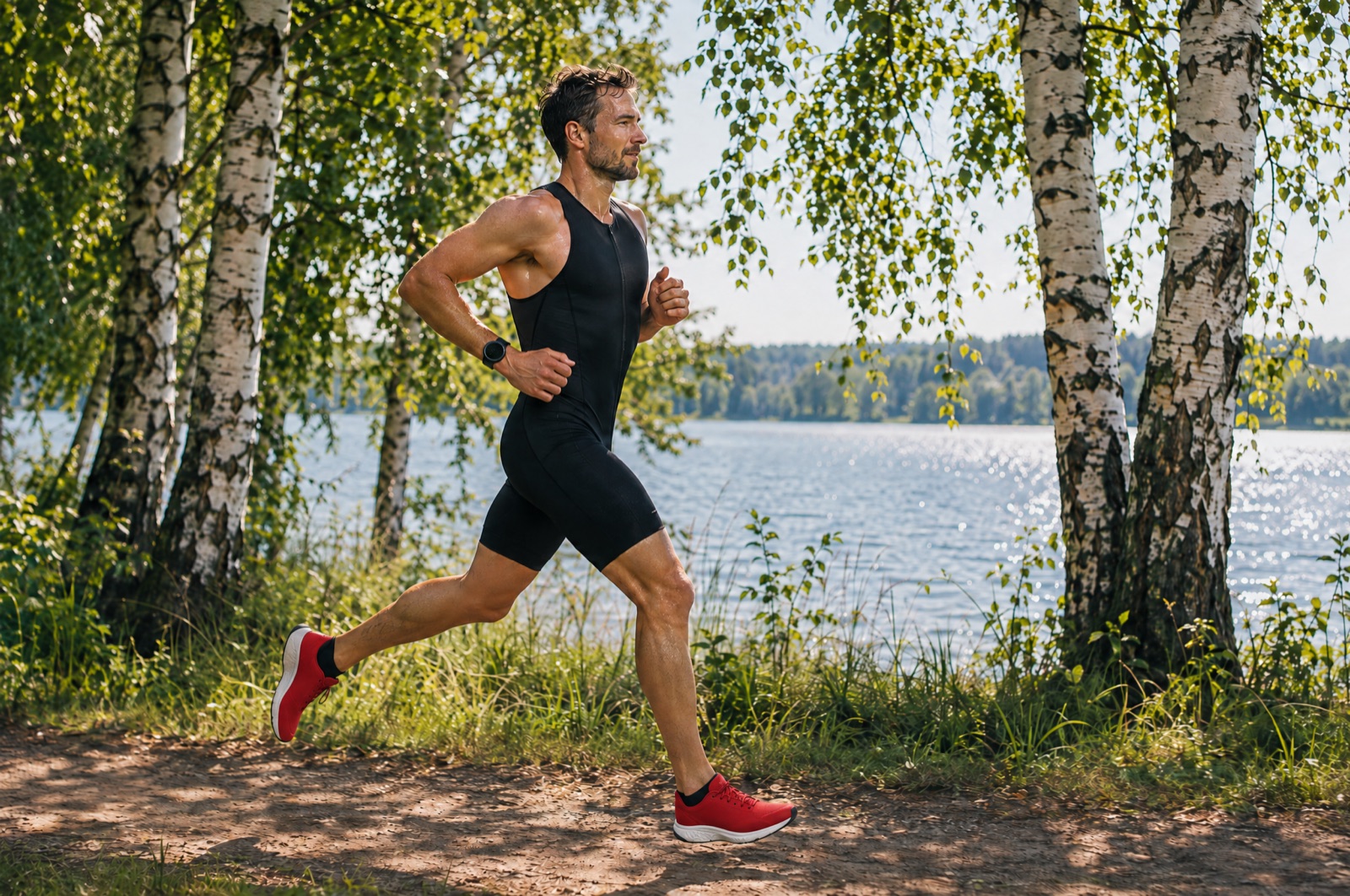
In a sprint you ride and run close to threshold, so it is easy to assume pacing does not matter here. It does, but the margin is small. Going from 32 to 33 km/h gains 1:08 over 20 km and takes about 10% more power on the flat. Every 10 s/km slower on the run costs 0:50. So the faster ride stops paying once the run slows by about 14 s/km. A run that is 30 s/km slower already costs 2:30, more than twice what the bike gave.
- Bike. Ride at an effort where you can speak in single words. If you know your FTP, the power you can hold for about an hour, use 90–95% of FTP as a starting point to test in training. The ride is shorter than an hour, but you still have to run after it.
- The last kilometer of the bike. Shift to an easier gear, raise your cadence and get ready to dismount before the line.
- Run. After a hard bike, 5 km usually comes out slower than fresh, so set your target from a bike-run session and not from your 5K personal best. The first kilometer is for finding rhythm, the last one for everything that is left.
Equipment that matters over 20 km
With about 37 minutes on the bike, equipment gives less than the adverts suggest. The order of purchases is simple:
- A well-fitting wetsuit, if you plan to race in cool water early or late in the season.
- A road bike in good working order and a certified helmet. Draft-illegal rules also allow time-trial bikes and clip-on bars, but they are not a condition of taking part.
- A bike position you can run off. You will feel an overly aggressive setup for 37 minutes in the first kilometer of the run.
- Elastic laces in your running shoes. The cheapest way to shorten T2.
- A tri suit worn from the water to the finish line. Changing clothes in transition is lost time in a sprint.
For a first race you do not need a disc wheel, a time-trial bike or a power meter bought just for race day. For a race that lasts about an hour and a half, that money is better spent on swim technique lessons.
Sprint, super sprint or Olympic: which race is right for you
The sprint sits between two other rulebook distances. The table uses the same paces as before, with 400 m, 10 km and 2.5 km as a typical super sprint.
| Feature | Super sprint | Sprint | Olympic |
|---|---|---|---|
| Distance | Typically 400 m, 10 km, 2.5 km | 750 m, 20 km, 5 km | 1,500 m, 40 km, 10 km |
| Time at 2:15/100 m, 32 km/h, 5:10/km and 5 min of transitions | 0:45:40 | 1:25:12 | 2:45:25 |
| Longest time in the water at 3:10/100 m | about 13 minutes | almost 24 minutes | 47:30 |
| Who it suits | A first race, a nervous swimmer | Anyone who can swim 750 m without stopping | A confident swimmer with a sprint behind them |
The Olympic distance is exactly twice as long, and at constant pace the time grows 1.94 times. In practice the pace drops, so do not simply double your sprint time when you plan the next step. How the preparation changes with each distance is laid out on the triathlon training plans page.
Time alone is not enough to decide. At 3:10/100 m the sprint swim takes almost 24 minutes, and the World Triathlon maximum for age groups over 301–750 m is 30 minutes. That is a narrow margin. If you are still learning front crawl, a super sprint or a sprint with a shorter swim is the safer first race. If you swim well and ride less well, the full 750 m works in your favor.
What a sprint triathlon training plan has to cover
Most people need 12–16 weeks and 5–8 hours of training a week. If you are starting from zero in one of the three sports, add time for the basics. The proportions follow from the numbers above: quality builds the result, and the swim gets more attention than at longer distances.
| Phase | Goal | What usually dominates |
|---|---|---|
| Foundation | Swim technique, continuity in three sports | Front crawl without stops, easy rides, regular short runs |
| Build | Raising threshold | Hard sessions on the bike and on the run, swimming at race pace |
| Race-specific | Work at race intensity | Running straight off the bike, open-water practice, transition drills |
| Taper | Freshness | Less volume, short efforts, usually about a week |
Open water is the part that depends on where you live. In temperate climates lakes and the sea warm up late, so for an early-season race you may see open water only in the last weeks of preparation. Plan those sessions in advance. In the southern hemisphere the calendar is reversed, with the main season running through the southern summer.
- Swim often, even briefly. Three shorter pool sessions usually give more than one long one.
- Before race day, swim 750 m without stopping in open water a few times, ideally in a group.
- In the last weeks, combine the bike with a run. A short run after a ride teaches your legs the first kilometer.
- Practice T1 and T2 on dry land. Ten minutes outside your home, a few times before the race, saves real seconds.
- Do not add long rides beyond what you need. A sprint is not won on kilometers.
Numbers work best when they are fitted to you. In the IMI app a real coach builds your plan after a survey and tests (the 12-minute Cooper test or a 5K run, FTP on the bike, a 200 m swim) and then updates it every week. Without a power meter the bike plan is built on heart rate. The app connects with Garmin and Apple Watch.
Sprint races around the world and their cut-offs
Sprint races exist at three levels. Which one you pick decides the rules you race under.
| Level | Example | What to expect |
|---|---|---|
| World championship | World Triathlon age-group sprint championship, Hamburg, September 2027 | Draft-legal, road bikes only, entry through your national federation |
| Big-city festival | Hamburg, Chicago | Large fields, long transition areas, distances that may differ from the rulebook |
| Local and club races | Lakes, pools and beaches everywhere | Small fields, easy logistics, limits set by the organizer |
Qualification for the world championship runs through national federations, each with its own criteria. USA Triathlon, for example, awards its places by age-group finishing position at its national championships. The governing bodies and race brands are explained on the triathlon organizations page.
The season follows the water. In Europe and North America most sprints fall between May and September. In Australia, New Zealand, South Africa and South America the season runs through the southern summer. In the tropics the water is warm enough that a wetsuit is rarely an option.
Cut-offs: check how the clock is counted
There is no single set of limits. World Triathlon rules cap the time in the water at 30 minutes for a 301–750 m swim, which is 4:00/100 m. Beyond that, each organizer sets its own limits, and they are counted in two ways.
Some races publish elapsed times. The Outlaw Nottingham Sprint in England, for example, allows 35 minutes for the swim and T1, 2:00 to the end of T2 and 2:45 to the finish, all measured from your wave start (as published in November 2026). Leave T1 right at the 35-minute mark and you still have 1:25 for the bike and T2. Over a 20 km ride with a 5-minute T2 that is only 15 km/h (9.3 mph), and the 45 minutes left for 5 km is a brisk walk at 9:00/km (14:29/mile). With limits like these the swim is the only real hurdle.
Other races publish clock times. At the Chicago Triathlon the sprint swim closes 45 minutes after the last sprint wave enters the water, and the bike and run courses close at fixed hours of the morning, so a late wave has less time than an early one. Find your wave start in the athlete guide and count back from the closing times.
Many federations also ask for a license: an annual membership or a day license bought with your entry. Independent organizers may not require one.
Mistakes typical of the sprint
- Training as if for a longer distance. Long, easy sessions with no work at threshold.
- Swimming the first 200 m like a 50 m race. The result is a heart-rate spike, lost technique and five minutes spent recovering.
- Treating the swim as a warm-up. It is almost 20% of your time.
- Not checking the distances. Entering a "sprint" without reading the course page, then meeting a 24 km bike or a draft-legal race with the wrong handlebars.
- An unrehearsed wetsuit. Taking it off for the first time in T1, with a high heart rate and cold fingers.
- Fueling as if for a half Ironman. Gels for 37 minutes on the bike bring more risk than benefit.
- Running the first 2 km too hard. Your legs mislead you after the bike. Take 3–4 minutes to find your rhythm, then push.
Frequently asked questions
How long is a sprint triathlon?
The sprint distance is 25.75 km (16 miles): a 750 m swim, a 20 km bike and a 5 km run. Some races that call themselves sprints have a shorter swim or a longer bike, so check the course page.
What is a good sprint triathlon time?
There is no official average. At 2:15/100 m, 32 km/h, 5:10/km and 5 minutes of transitions the model gives about 1:25, about 1:11 at an experienced athlete's paces and about 1:51 at a beginner's. Compare yourself with the results of the same race, because conditions and segment lengths differ.
How many weeks does it take to train for a sprint triathlon?
Usually 12–16 weeks on 5–8 hours a week. Someone who is still learning front crawl needs more time.
Do I need a wetsuit for a sprint triathlon?
It depends on the water temperature and the rulebook. At 15.9°C (60.6°F) and below a wetsuit is mandatory. Under World Triathlon rules it is forbidden from 22°C for age groups up to 55–59. Under USA Triathlon rules it is allowed up to 78°F (25.6°C). Be able to swim with and without one.
Is drafting allowed in a sprint triathlon?
Usually not. The rules allow both formats for age groups, but most races are draft-illegal, with a 12 m zone and a 30-second penalty. The age-group sprint world championship is draft-legal. Every race states its format in the rules.
Is a sprint triathlon good for beginners?
Yes, if you can swim 750 m without stopping or have time to learn before race day. If the water is your weakest side, a super sprint or a sprint with a shorter swim gives you less swimming for a similar experience.
Do I need to eat during a sprint triathlon?
Usually not. After a good meal before the start, water is enough, plus a sports drink on the bike if you have tested it.
Do I need a triathlon bike for a sprint?
No. For a first race a road bike in good order and a helmet are enough. In draft-legal races time-trial bikes and clip-on bars are banned. If you do not ride much yet, the beginner cycling training plan page covers the basics.
What is the cut-off time for a sprint triathlon?
It depends on the race. World Triathlon rules cap the swim at 30 minutes for 750 m, and organizers add their own limits for the bike and the finish, sometimes as clock times. One English sprint, for example, allows 2:45 from the wave start. Read the athlete guide before you enter.
What is the difference between a sprint and a super sprint triathlon?
A super sprint is roughly half a sprint: typically 400 m of swimming, 10 km on the bike and 2.5 km of running. At typical paces it takes about 45 minutes, against about 1:25 for a sprint.